×
Request Free Sample ×

Kindly complete the form below to receive a free sample of this Report

* Please use a valid business email

Leading companies partner with us for data-driven Insights

clients tt-cursor
Hero Background

Di-Nitrotoluene Market

ID: MRFR/CnM/32326-HCR
128 Pages
Chitranshi Jaiswal
February 2026

Di-Nitrotoluene Market Research Report By Application (Explosives, Aromatics, Dyes), By End Use Industry (Manufacturing, Chemical, Construction), By Form (Liquid, Solid), By Purity (Low Purity, High Purity) and By Regional (North America, Europe, South America, Asia Pacific, Middle East and Africa) - Forecast to 2035

Share:
Download PDF ×

We do not share your information with anyone. However, we may send you emails based on your report interest from time to time. You may contact us at any time to opt-out.

Di-Nitrotoluene Market Infographic
Purchase Options

Di-Nitrotoluene Market Summary

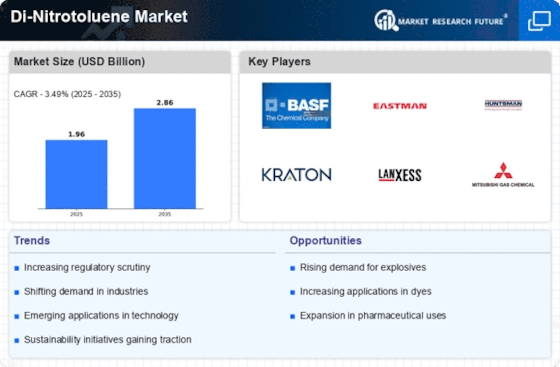
As per Market Research Future analysis, the Di-Nitrotoluene Market Size was estimated at 1.962 USD Billion in 2024. The Di-Nitrotoluene industry is projected to grow from USD 2.03 Billion in 2025 to USD 2.862 Billion by 2035, exhibiting a compound annual growth rate (CAGR) of 3.49% during the forecast period 2025 - 2035

Key Market Trends & Highlights

The Di-Nitrotoluene Market is poised for growth driven by sustainability and technological advancements.

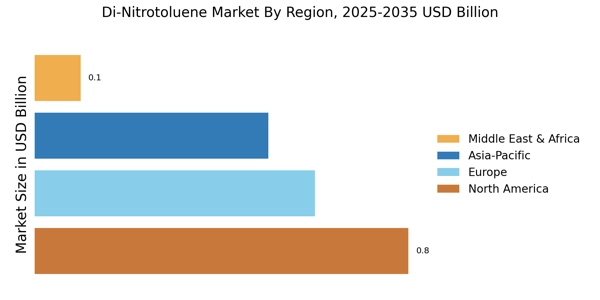
  • North America remains the largest market for Di-Nitrotoluene Market, primarily due to its extensive explosives manufacturing sector.
  • The Asia-Pacific region is emerging as the fastest-growing market, fueled by increasing demand in chemical manufacturing.
  • The explosives segment continues to dominate the market, while the dyes segment is experiencing rapid growth due to innovative applications.
  • Rising demand in explosives manufacturing and regulatory compliance are key drivers propelling market expansion.

Market Size & Forecast

2024 Market Size 1.962 (USD Billion)
2035 Market Size 2.862 (USD Billion)
CAGR (2025 - 2035) 3.49%

Major Players

BASF SE (DE), Eastman Chemical Company (US), Huntsman Corporation (US), Kraton Corporation (US), Lanxess AG (DE), Mitsubishi Gas Chemical Company, Inc. (JP), Nippon Steel Corporation (JP), SABIC (SA), Solvay S.A. (BE)

Our Impact
Enabled $4.3B Revenue Impact for Fortune 500 and Leading Multinationals
Partnering with 2000+ Global Organizations Each Year
30K+ Citations by Top-Tier Firms in the Industry

Di-Nitrotoluene Market Trends

The Di-Nitrotoluene Market is currently experiencing a phase of transformation, driven by various factors that influence its dynamics. The compound, primarily utilized in the production of dyes, explosives, and as a solvent, has seen a shift in demand patterns. This shift appears to be influenced by the growing emphasis on environmental regulations and safety standards, which may lead to a reevaluation of production methods and applications. Furthermore, the increasing focus on sustainable practices within the chemical industry suggests that manufacturers are likely to explore alternative materials and processes, potentially impacting the overall market landscape. In addition, the Di-Nitrotoluene Market is witnessing a rise in research and development activities aimed at enhancing product efficiency and safety. Innovations in chemical processes and formulations could lead to improved applications across various sectors, including pharmaceuticals and agriculture. As industries adapt to changing consumer preferences and regulatory frameworks, the market may experience fluctuations in demand. Overall, the Di-Nitrotoluene Market seems poised for a period of evolution, with potential opportunities for growth and adaptation in response to emerging trends and challenges.

Sustainability Initiatives

The Di-Nitrotoluene Market is increasingly influenced by sustainability initiatives. Manufacturers are exploring eco-friendly alternatives and production methods to align with global environmental standards. This trend may lead to a gradual shift in the types of products offered, as companies seek to minimize their ecological footprint.

Technological Advancements

Technological advancements are playing a crucial role in shaping the Di-Nitrotoluene Market. Innovations in production techniques and chemical formulations could enhance efficiency and safety. As a result, companies may invest in research and development to stay competitive and meet evolving industry demands.

Regulatory Changes

Regulatory changes are impacting the Di-Nitrotoluene Market significantly. Stricter safety and environmental regulations may compel manufacturers to adapt their processes and products. This trend suggests that compliance will be a key factor in determining market dynamics and competitive positioning.

Di-Nitrotoluene Market Drivers

Growth in Chemical Manufacturing

The Di-Nitrotoluene Market is poised for growth as the chemical manufacturing sector expands. Di-Nitrotoluene Market is utilized as a precursor in the production of various chemicals, including dyes and pharmaceuticals. The chemical industry has shown resilience and adaptability, with a projected growth rate of around 4.5% annually. This growth is likely to stimulate demand for Di-Nitrotoluene Market, as manufacturers seek reliable and efficient raw materials. Additionally, the increasing trend towards specialty chemicals may further enhance the relevance of Di-Nitrotoluene Market in diverse applications. As companies strive to innovate and improve product offerings, the Di-Nitrotoluene Market stands to gain from these developments.

Emerging Applications in Agriculture

The Di-Nitrotoluene Market is witnessing emerging applications in the agricultural sector, particularly in the formulation of herbicides and pesticides. As the global population continues to rise, the demand for effective agricultural solutions is increasing. Recent studies suggest that the agricultural chemicals market is expected to grow at a rate of approximately 6% per year. This growth may lead to a corresponding increase in the use of Di-Nitrotoluene Market as a key ingredient in agrochemicals. The potential for innovation in this area could further solidify the position of Di-Nitrotoluene Market within the agricultural sector, thereby expanding its market reach and applications.

Rising Demand in Explosives Manufacturing

The Di-Nitrotoluene Market is experiencing a notable increase in demand due to its critical role in the production of explosives. This compound serves as a key intermediate in the synthesis of various explosives, including TNT. As military and construction sectors expand, the need for reliable explosive materials grows. Recent data indicates that the explosives market is projected to grow at a compound annual growth rate of approximately 5.2% over the next few years. This trend suggests that the Di-Nitrotoluene Market will likely benefit from heightened production activities, thereby driving demand for this chemical compound. Furthermore, the increasing focus on safety and efficiency in explosive manufacturing may lead to innovations that further enhance the utility of Di-Nitrotoluene Market.

Regulatory Compliance and Safety Standards

The Di-Nitrotoluene Market is influenced by evolving regulatory compliance and safety standards. Governments and regulatory bodies are increasingly focusing on the environmental and health impacts of chemical substances. As a result, manufacturers are compelled to adhere to stringent regulations regarding the use and handling of Di-Nitrotoluene Market. This regulatory landscape may drive innovation in safer production methods and alternative formulations. While compliance may pose challenges, it also presents opportunities for companies to differentiate themselves through sustainable practices. The emphasis on safety and environmental responsibility is likely to shape the future of the Di-Nitrotoluene Market.

Technological Innovations in Production Processes

The Di-Nitrotoluene Market is benefiting from technological innovations that enhance production processes. Advances in chemical engineering and process optimization are enabling manufacturers to produce Di-Nitrotoluene Market more efficiently and sustainably. Recent technological developments suggest that production costs may decrease while maintaining product quality. This trend could lead to increased competitiveness within the market, as companies leverage new technologies to improve their operational efficiency. Furthermore, the integration of automation and digitalization in production facilities may streamline processes, thereby positively impacting the Di-Nitrotoluene Market. As these innovations continue to evolve, they may redefine the landscape of chemical manufacturing.


Market Segment Insights

By Application: Explosives (Largest) vs. Dyes (Fastest-Growing)

In the Di-Nitrotoluene Market, the application segment is characterized by three main values: Explosives, Aromatics, and Dyes. Among these, Explosives hold the largest market share, reflecting their critical role in military and industrial applications. Aromatics follow as a notable segment, primarily driven by their use in producing various chemicals and materials. Dyes, while currently a smaller segment, showcase significant potential due to the rise of the textile and consumer goods industries.

Explosives (Dominant) vs. Dyes (Emerging)

Explosives, as a dominant application of Di-Nitrotoluene Market, are utilized primarily due to their effectiveness in various blasting techniques and military applications. Their established position stems from consistent demand in construction, mining, and demolition sectors. Conversely, Dyes represent an emerging segment, driven by expanding end-use industries such as textiles, paints, and plastics. As sustainability concerns rise, there is also a growing focus on eco-friendly dye formulations, which could enable Dyes to capture a larger market share in the coming years. This dynamic illustrates a shifting landscape where traditional uses are complemented by innovative applications.

By End Use Industry: Manufacturing (Largest) vs. Chemical (Fastest-Growing)

In the Di-Nitrotoluene Market (DNT) market, the end-use industry has shown a significant distribution of market share among various segments, with manufacturing being the most substantial. Manufacturing applications utilize DNT primarily for producing colors, explosives, and solvents, making it a critical sector within the market. On the other hand, the chemical industry is on the rise, leveraging DNT in the synthesis of agricultural chemicals and intermediates, indicating a shift towards more diverse applications and innovations. Analyzing the growth trends, the manufacturing segment is expected to maintain its leadership due to existing infrastructures and long-standing demand. However, the chemical sector is rapidly expanding, driven by increased agricultural production and the need for advanced chemicals. Innovations in chemical processes and the rising environmental awareness are fueling this growth, making the chemical industry the fastest-growing end-use segment in the DNT market.

Manufacturing (Dominant) vs. Chemical (Emerging)

The manufacturing sector is recognized as the dominant player in the Di-Nitrotoluene Market, owing to its extensive applications in producing dyes, plastics, and explosives. This segment depends on DNT for its versatility and effectiveness as an industrial chemical. The growth is supported by robust infrastructure and a well-established supply chain, ensuring continuous demand. Conversely, the chemical sector emerges as an important player with innovative uses of DNT in creating pesticides and other crucial chemicals. As sustainability initiatives gain prominence, this segment focuses on developing eco-friendly products, making it essential for future market dynamics. The chemical industry's flexibility and adaptability to market needs allow it to carve out a growing niche within the broader market.

By Form: Liquid (Largest) vs. Solid (Fastest-Growing)

In the Di-Nitrotoluene Market, the segmentation by form reveals that liquid di-nitrotoluene holds the largest market share. It has established itself as the preferred choice for numerous applications due to its ease of handling and superior solubility characteristics. In contrast, solid di-nitrotoluene, while initially smaller in market presence, is gaining traction. It caters to niche segments within the industry, contributing to a balanced market dynamic.

Form: Liquid (Dominant) vs. Solid (Emerging)

Liquid di-nitrotoluene is recognized for its versatility and efficiency, serving as a critical component in explosives and industrial applications. Its dominant position is attributed to its excellent fluidity and performance in various processes. On the other hand, solid di-nitrotoluene is emerging as a preferred alternative in specific applications, thanks to its stable physical characteristics. While its adoption is growing, particularly in regions focusing on solid formulations, liquid di-nitrotoluene remains the industry standard. Emerging trends indicate a gradual shift towards solid forms, driven by advances in production technology and sustainability initiatives.

By Purity: High Purity (Largest) vs. Low Purity (Emerging)

The Di-Nitrotoluene Market is characterized by a distinct division between the low purity and high purity segments. High purity di-nitrotoluene holds the largest market share, driven by its extensive applications in the production of specialized chemicals, dyes, and polymers. Meanwhile, the low purity variant, while smaller in terms of market share, is employed in cost-sensitive applications, catering to sectors like industrial cleaning and manufacturing processes. As companies seek to optimize their production costs, the demand for low purity options is gradually increasing, albeit at a slower rate compared to high purity counterparts.

Purity Segment: High Purity (Dominant) vs. Low Purity (Emerging)

The high purity di-nitrotoluene segment dominates the market, primarily due to its superior quality and performance in high-end applications. This segment is favored by manufacturers in industries that require precise chemical properties and minimal impurities, leading to enhanced product performance. On the other hand, low purity di-nitrotoluene is emerging as a viable alternative for industries focused on cost efficiency. While it may not meet the stringent standards required in critical applications, its affordability makes it attractive for broader use in various industrial contexts. As regulatory frameworks evolve and the demand for eco-friendly solutions grows, both segments are likely to see changes in their market dynamics.

Get more detailed insights about Di-Nitrotoluene Market

Regional Insights

North America : Chemical Innovation Hub

North America is witnessing robust growth in the Di-Nitrotoluene Market (DNT) market, driven by increasing demand from the automotive and construction sectors. The region holds approximately 40% of the global market share, making it the largest market for DNT. Regulatory support for chemical manufacturing and innovation is further propelling this growth, with initiatives aimed at sustainable practices and safety standards. The United States is the leading country in this region, with major players like Eastman Chemical Company and Huntsman Corporation dominating the landscape. The competitive environment is characterized by significant investments in R&D and a focus on expanding production capacities. The presence of established companies ensures a steady supply chain and innovation in DNT applications, reinforcing North America's position in the global market.

Europe : Regulatory Compliance Focus

Europe is emerging as a significant player in the Di-Nitrotoluene Market, holding around 30% of the global share, making it the second-largest market. The growth is fueled by stringent regulations promoting sustainable chemical practices and a shift towards eco-friendly products. The European Union's REACH regulations are pivotal in shaping market dynamics, ensuring safety and environmental compliance in chemical manufacturing. Germany and France are the leading countries in this region, with key players like BASF SE and Lanxess AG leading the charge. The competitive landscape is marked by innovation and collaboration among companies to meet regulatory standards. Investments in green technologies and sustainable practices are becoming increasingly important, positioning Europe as a leader in responsible chemical production and usage.

Asia-Pacific : Emerging Market Potential

Asia-Pacific is rapidly becoming a crucial market for Di-Nitrotoluene Market, driven by industrialization and urbanization in countries like China and India. The region accounts for approximately 25% of the global market share, reflecting its growing demand for DNT in various applications, including explosives and dyes. Government initiatives to boost manufacturing and infrastructure development are significant growth drivers in this region. China is the largest market in Asia-Pacific, with a strong presence of local manufacturers and increasing foreign investments. Companies like Mitsubishi Gas Chemical and Nippon Steel Corporation are key players, contributing to the competitive landscape. The focus on expanding production capabilities and enhancing product quality is vital for meeting the rising demand, positioning Asia-Pacific as a significant player in The Di-Nitrotoluene Market.

Middle East and Africa : Resource-Rich Opportunities

The Middle East and Africa region is witnessing a gradual increase in the Di-Nitrotoluene Market, driven by the availability of raw materials and growing industrial sectors. This region holds about 5% of the global market share, with potential for growth as local industries expand. The focus on developing chemical manufacturing capabilities is supported by government initiatives aimed at diversifying economies and reducing reliance on oil exports. Countries like Saudi Arabia and South Africa are emerging as key players in this market, with investments in chemical production facilities. The competitive landscape is evolving, with both local and international companies seeking to establish a foothold. The presence of major chemical firms is expected to enhance market dynamics, fostering innovation and growth in the DNT sector.

Di-Nitrotoluene Market Regional Image

Key Players and Competitive Insights

The Di-Nitrotoluene Market is characterized by a competitive landscape that is increasingly shaped by innovation, sustainability, and strategic partnerships. Key players such as BASF SE (Germany), Eastman Chemical Company (US), and Huntsman Corporation (US) are actively pursuing strategies that emphasize technological advancement and regional expansion. BASF SE (Germany), for instance, focuses on enhancing its production capabilities through digital transformation initiatives, which aim to optimize operational efficiency and reduce environmental impact. Meanwhile, Eastman Chemical Company (US) is leveraging its strong R&D capabilities to develop sustainable alternatives, thereby positioning itself as a leader in eco-friendly chemical solutions. Huntsman Corporation (US) appears to be concentrating on strategic acquisitions to bolster its market presence, indicating a trend towards consolidation in the industry.The business tactics employed by these companies reflect a broader trend towards localizing manufacturing and optimizing supply chains to enhance responsiveness to market demands. The Di-Nitrotoluene Market is moderately fragmented, with a mix of established players and emerging companies vying for market share. The collective influence of these key players is significant, as they not only drive innovation but also set industry standards that smaller competitors must follow.

In August BASF SE (Germany) announced the launch of a new production facility aimed at increasing its Di-Nitrotoluene Market output while adhering to stringent environmental regulations. This strategic move is likely to enhance BASF's competitive edge by allowing for greater production capacity and reduced carbon emissions, aligning with global sustainability goals. Similarly, in July 2025, Eastman Chemical Company (US) unveiled a new line of bio-based Di-Nitrotoluene Market products, which could potentially capture a growing segment of environmentally conscious consumers and industries. This initiative not only reinforces Eastman's commitment to sustainability but also positions the company favorably against competitors who may not yet have adopted such practices.

In September Huntsman Corporation (US) completed the acquisition of a smaller chemical firm specializing in specialty chemicals, which includes Di-Nitrotoluene Market derivatives. This acquisition is expected to enhance Huntsman's product portfolio and market reach, allowing it to offer a more comprehensive range of solutions to its customers. The strategic importance of this move lies in Huntsman's ability to integrate new technologies and expertise, thereby strengthening its competitive position in the market.

As of October the Di-Nitrotoluene Market is witnessing trends that emphasize digitalization, sustainability, and the integration of artificial intelligence in production processes. Strategic alliances among key players are becoming increasingly common, as companies seek to pool resources and expertise to navigate the complexities of the market. The competitive differentiation is likely to evolve from traditional price-based competition towards a focus on innovation, technological advancements, and supply chain reliability. This shift suggests that companies that prioritize these aspects will be better positioned to thrive in an ever-evolving market landscape.

Key Companies in the Di-Nitrotoluene Market include

Industry Developments

In recent developments within the Di-Nitrotoluene Market, key players like BASF, Dow, and Huntsman Corporation have been actively engaging in strategic initiatives, likely aiming to enhance their market positions and product offerings. The market is witnessing increased demand across various sectors, particularly in the production of explosives and chemical intermediates, driven by growth in construction and defense industries. Companies such as Gujarat Aromatic and Eastman Chemical are experiencing valuation growth, impacting their competitive landscape and prompting others to innovate or consolidate.

Merger and acquisition activity remains a focal point, with several entities exploring potential collaborations to expand their market reach and operational efficiencies. A notable trend involves the strengthening of supply chains, particularly by companies such as Lanxess and SABIC, to mitigate fluctuations in raw material availability. The interplay of environmental regulations is also shaping market strategies, as firms like NITROCHEM and Karnavati Chemicals work towards sustainable practices. Overall, the combination of demand shifts, strategic partnerships, and a focus on sustainability is expected to continue influencing the Di-Nitrotoluene Market's trajectory.

Future Outlook

Di-Nitrotoluene Market Future Outlook

The Di-Nitrotoluene Market is projected to grow at a 3.49% CAGR from 2025 to 2035, driven by increasing demand in explosives and chemical manufacturing.

New opportunities lie in:

  • Expansion into emerging markets with tailored product offerings.
  • Development of eco-friendly DNT alternatives to meet regulatory demands.
  • Investment in advanced production technologies to enhance efficiency and reduce costs.

By 2035, the Di-Nitrotoluene Market is expected to solidify its position as a key player in the chemical industry.

Market Segmentation

Di-Nitrotoluene Market Form Outlook

  • Liquid
  • Solid

Di-Nitrotoluene Market Purity Outlook

  • Low Purity
  • High Purity

Di-Nitrotoluene Market Application Outlook

  • Explosives
  • Aromatics
  • Dyes

Di-Nitrotoluene Market End Use Industry Outlook

  • Manufacturing
  • Chemical
  • Construction

Report Scope

MARKET SIZE 20241.962(USD Billion)
MARKET SIZE 20252.03(USD Billion)
MARKET SIZE 20352.862(USD Billion)
COMPOUND ANNUAL GROWTH RATE (CAGR)3.49% (2025 - 2035)
REPORT COVERAGERevenue Forecast, Competitive Landscape, Growth Factors, and Trends
BASE YEAR2024
Market Forecast Period2025 - 2035
Historical Data2019 - 2024
Market Forecast UnitsUSD Billion
Key Companies ProfiledBASF SE (DE), Eastman Chemical Company (US), Huntsman Corporation (US), Kraton Corporation (US), Lanxess AG (DE), Mitsubishi Gas Chemical Company, Inc. (JP), Nippon Steel Corporation (JP), SABIC (SA), Solvay S.A. (BE)
Segments CoveredApplication, End Use Industry, Form, Purity, Regional
Key Market OpportunitiesGrowing demand for eco-friendly alternatives in the Di-Nitrotoluene Market presents significant opportunities for innovation.
Key Market DynamicsRising demand for Di-Nitrotoluene in explosives and dyes sectors drives competitive dynamics and regulatory scrutiny.
Countries CoveredNorth America, Europe, APAC, South America, MEA
Leave a Comment

FAQs

What is the projected market valuation of the Di-Nitrotoluene Market by 2035?

The Di-Nitrotoluene Market is projected to reach a valuation of 2.862 USD Billion by 2035.

What was the market valuation of the Di-Nitrotoluene Market in 2024?

In 2024, the Di-Nitrotoluene Market was valued at 1.962 USD Billion.

What is the expected CAGR for the Di-Nitrotoluene Market during the forecast period 2025 - 2035?

The expected CAGR for the Di-Nitrotoluene Market during the forecast period 2025 - 2035 is 3.49%.

Which companies are considered key players in the Di-Nitrotoluene Market?

Key players in the Di-Nitrotoluene Market include BASF SE, Eastman Chemical Company, Huntsman Corporation, and others.

What are the projected valuations for the Explosives segment of the Di-Nitrotoluene Market by 2035?

The Explosives segment is projected to grow from 0.8 USD Billion in 2024 to 1.2 USD Billion by 2035.

How does the valuation of the High Purity segment compare to the Low Purity segment in 2024?

In 2024, the High Purity segment was valued at 1.176 USD Billion, while the Low Purity segment was valued at 0.786 USD Billion.

What is the expected growth for the Liquid form of Di-Nitrotoluene by 2035?

The Liquid form of Di-Nitrotoluene is expected to grow from 1.2 USD Billion in 2024 to 1.7 USD Billion by 2035.

What are the projected valuations for the Dyes application segment by 2035?

The Dyes application segment is projected to increase from 0.562 USD Billion in 2024 to 0.762 USD Billion by 2035.

Which end-use industry is expected to see significant growth in the Di-Nitrotoluene Market?

The Manufacturing end-use industry is expected to grow from 0.8 USD Billion in 2024 to 1.2 USD Billion by 2035.

Download Free Sample

Kindly complete the form below to receive a free sample of this Report

Compare Licence

×
Features License Type
Single User Multiuser License Enterprise User
Price $4,950 $5,950 $7,250
Maximum User Access Limit 1 User Upto 10 Users Unrestricted Access Throughout the Organization
Free Customization
Direct Access to Analyst
Deliverable Format
Platform Access
Discount on Next Purchase 10% 15% 15%
Printable Versions