×
Request Free Sample ×

Kindly complete the form below to receive a free sample of this Report

* Please use a valid business email

Leading companies partner with us for data-driven Insights

clients tt-cursor
Hero Background
English
Chinese
French
Japanese
Korean
German
Spanish

Dercums Disease Market Trends

ID: MRFR/HC/4889-CR
115 Pages
Rahul Gotadki
August 2023

Dercum’s Disease Market Research Report Information by Treatment (Surgery, Medication {Diuretics, Non-Steroidal Anti-Inflammatory Drug, Corticosteroids, and Others}, Liposuction, Electrotherapy, Acupuncture, and Others) by End user (Hospital & Clinics, Ambulatory Surgical Centers, and Others), by Distribution Channel (Hospital Pharmacies, Retail Pharmacies, and Others) by Region (North America, Europe, Asia-Pacific, and Rest of the World) - Forecast till 2035

Share:
Download PDF ×

We do not share your information with anyone. However, we may send you emails based on your report interest from time to time. You may contact us at any time to opt-out.

Dercums Disease Market Infographic
×
Dercums Disease Market Infographic Full View
Purchase Options

Market Trends

Key Emerging Trends in the Dercums Disease Market

Dercum's Disease, also known as adiposis dolorosa, is a rare disorder characterized by the development of painful fatty deposits, typically in the subcutaneous tissue. Understanding market trends in this niche area is crucial for stakeholders, including pharmaceutical companies, researchers, healthcare providers, and patients.

Prevalence and Incidence : Despite being a rare disease, the prevalence of Dercum's Disease is steadily increasing globally. Improved awareness, advancements in diagnostic techniques, and changes in lifestyle factors contributing to obesity are influencing its incidence.

Diagnostic Advancements : The market is witnessing a surge in diagnostic advancements aimed at improving the accuracy and efficiency of Dercum's Disease diagnosis. This includes the development of imaging techniques such as MRI and CT scans, which aid in identifying fatty deposits and assessing disease progression.

Treatment Landscape : Currently, there are limited treatment options available for Dercum's Disease, primarily focused on managing symptoms such as pain and inflammation. Nonsteroidal anti-inflammatory drugs (NSAIDs), analgesics, and physical therapy are among the commonly prescribed treatments. However, there is a significant unmet need for more effective and targeted therapies.

Research and Development : Despite the challenges associated with the rarity of the disease, there is a growing interest among pharmaceutical companies and researchers in exploring potential therapeutic avenues for Dercum's Disease. This includes investigating the role of novel drug targets, such as adipose tissue metabolism and inflammation pathways, in the pathogenesis of the disease.

Clinical Trials : The number of clinical trials focused on Dercum's Disease is gradually increasing, reflecting the growing interest in developing targeted therapies. These trials aim to evaluate the safety and efficacy of investigational drugs, as well as to better understand the underlying mechanisms of the disease.

Patient Advocacy and Support : Patient advocacy groups and support networks play a crucial role in raising awareness about Dercum's Disease, advocating for research funding, and providing support to individuals living with the condition. Their efforts contribute to fostering a sense of community and empowering patients to actively participate in their healthcare journey.

Regulatory Landscape : Regulatory agencies, such as the FDA and EMA, are increasingly recognizing the need to address the unmet medical needs of patients with rare diseases like Dercum's Disease. Initiatives such as orphan drug designation and accelerated approval pathways aim to facilitate the development and approval of new treatments for these underserved patient populations.

Market Dynamics : Despite the challenges posed by the rarity of Dercum's Disease, there is a growing opportunity for stakeholders in the market. With increasing awareness, advancements in research and development, and supportive regulatory policies, the market is poised for growth in the coming years.

Future Outlook : Looking ahead, the Dercum's Disease market is expected to witness continued expansion driven by ongoing research efforts, advancements in diagnostic and therapeutic technologies, and increasing patient advocacy. Collaboration among stakeholders will be key to addressing the unmet needs of patients and improving outcomes in this rare disease space.

Author
Rahul Gotadki
Assistant Manager

He holds an experience of about 7+ years in Market Research and Business Consulting, working under the spectrum of Life Sciences and Healthcare domains. Rahul conceptualizes and implements a scalable business strategy and provides strategic leadership to the clients. His expertise lies in market estimation, competitive intelligence, pipeline analysis, customer assessment, etc. In addition to the above, his other responsibility includes strategic tracking of high growth markets & advising clients on the potential areas of focus they could direct their business initiatives

Leave a Comment

FAQs

What is the projected growth of the Dercum’s Disease market?

The Dercum’s Disease market is the expected increase in total market value of 27.34 USD billion over a defined forecast period 2025–2035. It is driven by factors such as demand trends, technological advances, regulatory changes, and geographic expansion.

What is the size of the Dercum’s Disease market?

Dercum’s Disease market size was valued at approximately 13.31 billion USD in 2024. This figure will reach 27.34 billion USD covering all regions (America, Europe, Asia, MEA and ROW), focusing its segments / services / distribution channels till 2035.

What is the CAGR of the Dercum’s Disease market?

Dercum’s Disease market is expected to grow at a CAGR of 6.76% between 2025 and 2035.

How much will the Dercum’s Disease market be worth by 2035?

Dercum’s Disease market is expected to be worth of 27.34 billion USD, reflecting growth driven by usage, technology and global demands by the end of 2035.

How will the Dercum’s Disease market perform over the next 10 years?

Over the next 10 years the Dercum’s Disease market is expected to shift from usd billion 13.31 to 27.34 billion USD, led by adoption of advanced tech, demographic trends, regulatory approvals, with potential headwinds from 2025 to 2035.

How big is the US dercum’s disease market?

The US is expected to hold an 82.56% share of the North America market for dercum’s disease market during the forecast period of 2025-2035.

Which region held the largest market share in the dercum’s disease market?

The North American region market held the largest market share in the dercum’s disease market.

Market Summary

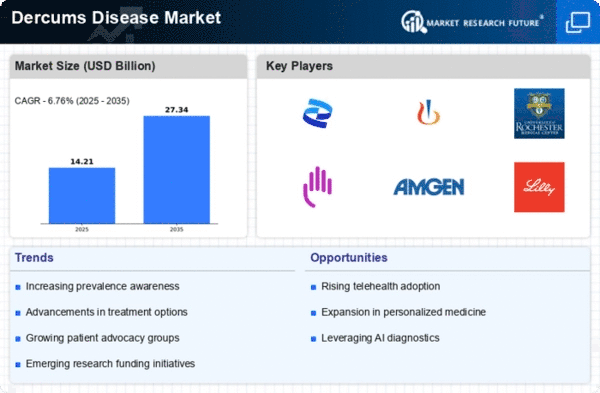
As per MRFR analysis, the Dercums Disease Market Size was estimated at 13.31 USD Billion in 2024. The Dercums Disease industry is projected to grow from 14.21 USD Billion in 2025 to 27.34 USD Billion by 2035, exhibiting a compound annual growth rate (CAGR) of 6.76 during the forecast period 2025 - 2035.

Key Market Trends & Highlights

The Dercums Disease Market is experiencing a dynamic evolution driven by increased research and advocacy efforts.

  • North America remains the largest market for Dercums Disease, reflecting a robust infrastructure for research and treatment.
  • The Asia-Pacific region is emerging as the fastest-growing market, driven by rising awareness and healthcare advancements.
  • Localized Dercums Disease represents the largest segment, while Generalized Dercums Disease is witnessing the fastest growth due to evolving treatment options.
  • Key market drivers include the rising prevalence of Dercums Disease and advancements in diagnostic techniques, fostering greater investment in research.

Market Size & Forecast

2024 Market Size 13.31 (USD Billion)
2035 Market Size 27.34 (USD Billion)
CAGR (2025 - 2035) 6.76%
Largest Regional Market Share in 2024 North America

Major Players

Pfizer (US), Novartis (CH), Roche (CH), Bristol-Myers Squibb (US), Amgen (US), Eli Lilly (US), Sanofi (FR), AstraZeneca (GB), Merck & Co. (US)

Market Trends

The Dercums Disease Market is currently characterized by a growing awareness of this rare condition, which is marked by painful lipomas and other associated symptoms. As healthcare professionals and researchers delve deeper into the complexities of Dercums disease, there appears to be an increasing focus on understanding its etiology and potential treatment options. This heightened interest may lead to advancements in diagnostic techniques and therapeutic interventions, potentially improving patient outcomes. Furthermore, the collaboration between academic institutions and pharmaceutical companies seems to be fostering innovation in the development of targeted therapies, which could address the unique challenges posed by this condition. In addition, the Dercums Disease Market is witnessing a gradual shift towards patient-centric approaches. Advocacy groups and patient organizations are playing a crucial role in raising awareness and providing support for individuals affected by this condition. This trend may encourage more individuals to seek medical advice and participate in clinical trials, thereby contributing to a more robust understanding of Dercums disease. As the market evolves, it is likely that stakeholders will prioritize research initiatives that focus on personalized medicine, ultimately enhancing the quality of life for those impacted by this rare disorder.

Increased Research Initiatives

There is a noticeable rise in research initiatives aimed at understanding Dercums disease. This trend suggests that both academic and clinical researchers are dedicating more resources to uncover the underlying mechanisms of the condition, which may lead to novel therapeutic strategies.

Patient Advocacy and Support

The role of patient advocacy groups is becoming increasingly prominent within the Dercums Disease Market. These organizations are instrumental in raising awareness, providing resources, and fostering community support, which may empower patients to engage more actively in their treatment journeys.

Emergence of Targeted Therapies

The development of targeted therapies appears to be gaining traction in the Dercums Disease Market. Pharmaceutical companies are exploring innovative treatment options that specifically address the unique symptoms and challenges associated with this condition, potentially transforming patient care.

Dercums Disease Market Market Drivers

Market Growth Projections

The Global Dercum’s Disease Market Industry is projected to experience substantial growth over the coming years. With an estimated market value of 13.3 USD Billion in 2024, the industry is expected to expand significantly, reaching 27.3 USD Billion by 2035. This growth trajectory reflects a compound annual growth rate of 6.76% from 2025 to 2035. Such projections indicate a robust market response to increasing prevalence, advancements in treatment options, and heightened awareness. The anticipated growth underscores the potential for innovation and investment in the Dercum's Disease sector, which may ultimately enhance patient outcomes and quality of life.

Rising Awareness and Advocacy

Awareness campaigns and advocacy efforts are playing a crucial role in shaping the Global Dercum’s Disease Market Industry. Organizations dedicated to educating the public and healthcare professionals about Dercum's Disease are emerging, which may lead to earlier diagnosis and improved treatment access. Increased visibility of the disease can foster a supportive community for patients and encourage funding for research initiatives. As advocacy groups continue to promote understanding and awareness, the market is likely to experience growth driven by a more informed patient population seeking effective management solutions.

Advancements in Treatment Options

Innovations in medical treatments for Dercum's Disease are emerging as a pivotal driver in the Global Dercum’s Disease Market Industry. New therapies, including pharmacological interventions and surgical options, are being developed to address the unique challenges posed by this condition. The introduction of targeted therapies and personalized medicine approaches may enhance patient outcomes and quality of life. As these advancements become more widely available, they are likely to stimulate market growth. The anticipated increase in market value to 27.3 USD Billion by 2035 underscores the potential impact of these treatment innovations on the overall landscape of Dercum's Disease management.

Increasing Prevalence of Dercum's Disease

The Global Dercum’s Disease Market Industry is witnessing a rise in the number of diagnosed cases, which is likely to drive market growth. As awareness of this rare condition increases, more patients are being identified and treated. In 2024, the market is projected to reach 13.3 USD Billion, reflecting the growing recognition of Dercum's Disease among healthcare professionals. This increase in prevalence may be attributed to better diagnostic techniques and heightened awareness among both patients and providers. Consequently, the demand for effective treatments and management strategies is expected to escalate, further propelling the market forward.

Regulatory Support and Policy Initiatives

The Global Dercum’s Disease Market Industry is influenced by supportive regulatory frameworks and policy initiatives aimed at rare diseases. Governments and health authorities are increasingly recognizing the need for policies that facilitate research, development, and access to treatments for rare conditions like Dercum's Disease. Initiatives such as orphan drug designations and funding for clinical trials may enhance the market environment. As regulatory bodies continue to streamline processes for bringing new therapies to market, the potential for growth in the Dercum's Disease sector appears promising, aligning with the broader trend of prioritizing rare disease management.

Growing Research and Development Activities

The Global Dercum’s Disease Market Industry is benefiting from an increase in research and development initiatives aimed at understanding the underlying mechanisms of the disease. Academic institutions and pharmaceutical companies are investing in studies to explore the etiology and potential therapeutic targets for Dercum's Disease. This focus on R&D is expected to yield new insights and treatment modalities, thereby enhancing the market landscape. The projected compound annual growth rate of 6.76% from 2025 to 2035 indicates a robust interest in advancing knowledge and treatment options for this rare condition, which may ultimately lead to improved patient care.

Market Segment Insights

By Disease Type: Localized Dercum's Disease (Largest) vs. Generalized Dercum's Disease (Fastest-Growing)

In the Dercum's Disease market, Localized Dercum's Disease accounts for the largest segment, reflecting a significant portion of the patient population. This form is often more recognizable and has established treatment protocols, leading to its prominence. On the other hand, Generalized Dercum's Disease is emerging rapidly, gaining attention due to increased awareness and diagnosis rates, thereby expanding its market share.

Localized Dercum's Disease (Dominant) vs. Generalized Dercum's Disease (Emerging)

Localized Dercum's Disease is characterized by distinct, localized lipomas that are often more manageable in terms of treatment and care. This dominance is supported by a clearer path for therapeutic options which resonates with both patients and healthcare providers. In contrast, Generalized Dercum's Disease, marked by widespread lipomas and a more complex symptomatology, is gaining ground as advancements in research foster better understanding and management. As diagnostic capabilities improve, this segment is positioning itself as a crucial area for future therapeutic development.

By Symptoms: Pain (Largest) vs. Fatigue (Fastest-Growing)

In the Dercums Disease Market, the symptoms segment showcases a distinct distribution of prevalence among its various components, notably pain, fatigue, obesity, and cognitive dysfunction. Among these, pain emerges as the largest segment, significantly impacting patient quality of life and driving the demand for treatment options. Fatigue, while less prevalent in absolute terms, is garnering attention as an increasingly recognized issue among patients, indicating a shift in focus within the market.

Pain: (Dominant) vs. Fatigue (Emerging)

Pain remains the dominant symptom in the Dercums Disease Market, characterized by its debilitating nature and profound effects on patient mobility and daily activities. This position stems from extensive patient reports and research linking pain intensity to Dercums Disease severity. Conversely, fatigue is emerging as a critical area for research and treatment, gaining momentum as clinicians recognize its substantial impact on patient well-being. This growing awareness is fostering a push for therapies targeting both foundational pain management strategies and the alleviation of fatigue, marking it as an important focus for future market developments.

By Treatment Type: Pharmacological Treatments (Largest) vs. Surgical Interventions (Fastest-Growing)

In the Dercums Disease Market, the segment of Treatment Type showcases varying levels of market share, with Pharmacological Treatments dominating this space. These treatments include a range of medications that target pain relief and symptom management for patients suffering from Dercums disease. Surgical Interventions, although smaller in market share compared to pharmacological options, are gaining traction as patients increasingly seek more drastic relief from severe symptoms. Physical Therapy and Lifestyle Modifications also play crucial roles, yet their market presence remains relatively limited, emphasizing the dominant role of pharmacological approaches.

Pharmacological Treatments (Dominant) vs. Surgical Interventions (Emerging)

Pharmacological Treatments have carved out a dominant position in the Dercums Disease Market due to their effectiveness in managing symptoms and improving the quality of life for patients. This category encompasses diverse medications that cater to pain relief and overall health improvement. On the other hand, Surgical Interventions are emerging as a significant alternative for patients whose symptoms are unmanageable through medication alone. Increased awareness and advocacy for surgical options have spurred their growth, offering hope for patients seeking more immediate and sustained relief. While Pharmacological Treatments continue to be the preferred choice, the rising interest in surgical options illustrates a shifting paradigm in Dercums disease management.

By Patient Demographics: Age Group (Largest) vs. Gender (Fastest-Growing)

In the Dercums Disease Market, age demographics reveal that middle-aged patients, specifically those aged 40 to 60, represent the largest share of the patient population. This group accounts for a significant majority due to the correlational increase in adipose tissue and various comorbidities associated with this age range. Conversely, the participation of different genders indicates that the condition is more prevalent in females, who make up a considerable portion of diagnosed cases. However, an increasing number of males are now being diagnosed, leading to a trend of expanding awareness and treatment options across genders.

Age Group (Dominant) vs. Gender (Emerging)

The age distribution of Dercums Disease patients clearly shows that individuals between 40 to 60 years are the dominant demographic, likely due to the natural weight gain and related conditions that surface during this life stage. These patients often present with advanced symptoms exacerbated by factors such as body mass index. On the other hand, the emerging prevalence of the disease in males highlights the evolving understanding of Dercums Disease, as healthcare providers are increasingly recognizing the condition's impact across genders. The rising diagnosis rates among younger demographics also suggest a shifting landscape in patient profiles, necessitating tailored treatment strategies to address distinct needs.

Get more detailed insights about Dercum’s Disease Market Research Report—Global Forecast till 2035

Regional Insights

North America : Market Leader in Dercums Disease

North America is poised to maintain its leadership in the Dercums Disease market, holding a significant market share of 6.66 in 2024. The region benefits from advanced healthcare infrastructure, increasing awareness of Dercums Disease, and a growing patient population. Regulatory support and innovative treatment options are driving demand, with a focus on personalized medicine and patient-centric approaches. The competitive landscape in North America is robust, featuring key players such as Pfizer, Bristol-Myers Squibb, and Amgen. These companies are investing heavily in research and development to enhance treatment efficacy. The U.S. remains the largest market, supported by favorable reimbursement policies and a strong pipeline of therapies. The presence of leading pharmaceutical firms ensures continuous innovation and growth in this sector.

Europe : Emerging Market with Growth Potential

Europe is witnessing a growing interest in the Dercums Disease market, with a market size of 3.99. Factors such as increasing healthcare expenditure, rising awareness, and supportive regulatory frameworks are driving growth. The European Medicines Agency (EMA) is actively working to streamline the approval process for new treatments, which is expected to enhance market dynamics and patient access to therapies. Leading countries in Europe include Germany, France, and the UK, where significant investments in healthcare infrastructure are being made. Key players like Novartis and Roche are expanding their presence, focusing on innovative therapies. The competitive landscape is evolving, with collaborations and partnerships becoming common to enhance treatment options and improve patient outcomes. The region is set to become a vital player in The Dercums Disease.

Asia-Pacific : Emerging Powerhouse in Healthcare

The Asia-Pacific region is emerging as a significant player in the Dercums Disease market, with a market size of 2.66. Factors such as increasing healthcare investments, a growing population, and rising awareness of rare diseases are driving market growth. Governments are implementing policies to improve healthcare access and support research initiatives, which are crucial for the development of effective treatments. Countries like Japan, China, and Australia are leading the charge in this region, with a focus on enhancing healthcare infrastructure. The competitive landscape includes key players like Eli Lilly and Sanofi, who are actively pursuing market opportunities. Collaborations with local firms are becoming common to navigate regulatory challenges and improve patient access to therapies, positioning Asia-Pacific as a vital market for Dercums Disease treatments.

Middle East and Africa : Untapped Market Potential

The Middle East and Africa (MEA) region currently represents an untapped market for Dercums Disease, with a market size of 0.0. Despite the challenges posed by limited healthcare infrastructure and awareness, there is a growing recognition of the need for improved healthcare services. Governments are beginning to prioritize rare diseases, which could catalyze future growth in this sector. Countries like South Africa and the UAE are starting to invest in healthcare improvements, but the competitive landscape remains sparse. Key players are yet to establish a strong presence, presenting opportunities for new entrants. As awareness increases and healthcare policies evolve, the MEA region could become a focal point for Dercums Disease treatment development in the coming years.

Key Players and Competitive Insights

The Dercums Disease Market is characterized by a complex interplay of competitive dynamics, driven by a growing understanding of the disease and the need for effective treatment options. Key players such as Pfizer (US), Novartis (CH), and Roche (CH) are at the forefront, each adopting distinct strategies to enhance their market presence. Pfizer (US) has focused on innovation through the development of targeted therapies, while Novartis (CH) emphasizes strategic partnerships to bolster its research capabilities. Roche (CH) is leveraging its extensive experience in oncology to explore potential therapeutic avenues for Dercums Disease, thereby shaping a competitive environment that is increasingly collaborative yet fiercely competitive.In terms of business tactics, companies are localizing manufacturing and optimizing supply chains to enhance efficiency and responsiveness to market demands. The market structure appears moderately fragmented, with several players vying for dominance. However, the collective influence of major companies like Amgen (US) and Eli Lilly (US) is significant, as they contribute to a competitive landscape that is both dynamic and evolving.

In November Amgen (US) announced a strategic collaboration with a leading biotechnology firm to develop a novel treatment for Dercums Disease. This partnership is expected to accelerate the research and development process, potentially leading to groundbreaking therapies that could redefine treatment protocols. The strategic importance of this collaboration lies in its potential to combine resources and expertise, thereby enhancing Amgen's competitive edge in the market.

In October Eli Lilly (US) launched a new clinical trial aimed at evaluating the efficacy of its latest drug candidate for Dercums Disease. This initiative underscores the company's commitment to innovation and its proactive approach to addressing unmet medical needs. The trial's outcomes could significantly influence Eli Lilly's market positioning, particularly if the results demonstrate substantial therapeutic benefits.

In September Novartis (CH) expanded its research facilities in Switzerland, focusing on rare diseases, including Dercums Disease. This expansion is indicative of Novartis's long-term strategy to invest in niche markets, which may yield high returns as the demand for specialized treatments continues to grow. The strategic importance of this move lies in its potential to enhance Novartis's research capabilities and foster innovation in the treatment landscape.

As of December current competitive trends are increasingly defined by digitalization, sustainability, and the integration of artificial intelligence in drug development. Strategic alliances are becoming more prevalent, as companies recognize the value of collaboration in navigating the complexities of the market. Looking ahead, competitive differentiation is likely to evolve, shifting from price-based competition to a focus on innovation, technological advancements, and supply chain reliability. This transition may redefine how companies approach market entry and product development, ultimately benefiting patients with Dercums Disease.

Key Companies in the Dercums Disease Market include

Industry Developments

September 2020: Raziel Therapeutics Ltd (Israel) entered into an agreement with Fosun Pharma (China) for RZL 012. In accordance with the contract, Raziel Therapeutics is eligible to receive tiered royalty payments on future net sales, additional potential sales milestone payments of up to USD 47 million, and potential payments of USD 27 million between now and the Territory's marketing approval of RZL 012.

Future Outlook

Dercums Disease Market Future Outlook

The Dercums Disease Market is projected to grow at a 6.76% CAGR from 2025 to 2035, driven by increasing awareness, advancements in treatment options, and rising healthcare expenditure.

New opportunities lie in:

  • Development of targeted therapies for symptom management
  • Expansion of telehealth services for patient monitoring
  • Investment in patient education programs to enhance treatment adherence

By 2035, the Dercums Disease Market is expected to achieve substantial growth and innovation.

Market Segmentation

Dercums Disease Market Symptoms Outlook

  • Pain
  • Fatigue
  • Obesity
  • Cognitive Dysfunction

Dercums Disease Market Disease Type Outlook

  • Localized Dercum's Disease
  • Generalized Dercum's Disease
  • Dercum's Disease with Lipomas

Dercums Disease Market Treatment Type Outlook

  • Pharmacological Treatments
  • Surgical Interventions
  • Physical Therapy
  • Lifestyle Modifications

Dercums Disease Market Patient Demographics Outlook

  • Age Group
  • Gender
  • Body Mass Index
  • Comorbid Conditions

Report Scope

MARKET SIZE 202413.31(USD Billion)
MARKET SIZE 202514.21(USD Billion)
MARKET SIZE 203527.34(USD Billion)
COMPOUND ANNUAL GROWTH RATE (CAGR)6.76% (2025 - 2035)
REPORT COVERAGERevenue Forecast, Competitive Landscape, Growth Factors, and Trends
BASE YEAR2024
Market Forecast Period2025 - 2035
Historical Data2019 - 2024
Market Forecast UnitsUSD Billion
Key Companies ProfiledPfizer (US), Novartis (CH), Roche (CH), Bristol-Myers Squibb (US), Amgen (US), Eli Lilly (US), Sanofi (FR), AstraZeneca (GB), Merck & Co. (US)
Segments CoveredDisease Type, Symptoms, Treatment Type, Patient Demographics
Key Market OpportunitiesAdvancements in personalized therapies and diagnostics create opportunities in the Dercums Disease Market.
Key Market DynamicsRising demand for targeted therapies drives innovation and competition in the Dercums Disease treatment landscape.
Countries CoveredNorth America, Europe, APAC, South America, MEA

FAQs

What is the projected growth of the Dercum’s Disease market?

The Dercum’s Disease market is the expected increase in total market value of 27.34 USD billion over a defined forecast period 2025–2035. It is driven by factors such as demand trends, technological advances, regulatory changes, and geographic expansion.

What is the size of the Dercum’s Disease market?

Dercum’s Disease market size was valued at approximately 13.31 billion USD in 2024. This figure will reach 27.34 billion USD covering all regions (America, Europe, Asia, MEA and ROW), focusing its segments / services / distribution channels till 2035.

What is the CAGR of the Dercum’s Disease market?

Dercum’s Disease market is expected to grow at a CAGR of 6.76% between 2025 and 2035.

How much will the Dercum’s Disease market be worth by 2035?

Dercum’s Disease market is expected to be worth of 27.34 billion USD, reflecting growth driven by usage, technology and global demands by the end of 2035.

How will the Dercum’s Disease market perform over the next 10 years?

Over the next 10 years the Dercum’s Disease market is expected to shift from usd billion 13.31 to 27.34 billion USD, led by adoption of advanced tech, demographic trends, regulatory approvals, with potential headwinds from 2025 to 2035.

How big is the US dercum’s disease market?

The US is expected to hold an 82.56% share of the North America market for dercum’s disease market during the forecast period of 2025-2035.

Which region held the largest market share in the dercum’s disease market?

The North American region market held the largest market share in the dercum’s disease market.

  1. SECTION I: EXECUTIVE SUMMARY AND KEY HIGHLIGHTS
    1. | 1.1 EXECUTIVE SUMMARY
    2. | 1.1.1 Market Overview
    3. | 1.1.2 Key Findings
    4. | 1.1.3 Market Segmentation
    5. | 1.1.4 Competitive Landscape
    6. | 1.1.5 Challenges and Opportunities
    7. | 1.1.6 Future Outlook
  2. SECTION II: SCOPING, METHODOLOGY AND MARKET STRUCTURE
    1. | 2.1 MARKET INTRODUCTION
    2. | 2.1.1 Definition
    3. | 2.1.2 Scope of the study
    4. |-- 2.1.2.1 Research Objective
    5. |-- 2.1.2.2 Assumption
    6. |-- 2.1.2.3 Limitations
    7. | 2.2 RESEARCH METHODOLOGY
    8. | 2.2.1 Overview
    9. | 2.2.2 Data Mining
    10. | 2.2.3 Secondary Research
    11. | 2.2.4 Primary Research
    12. |-- 2.2.4.1 Primary Interviews and Information Gathering Process
    13. |-- 2.2.4.2 Breakdown of Primary Respondents
    14. | 2.2.5 Forecasting Model
    15. | 2.2.6 Market Size Estimation
    16. |-- 2.2.6.1 Bottom-Up Approach
    17. |-- 2.2.6.2 Top-Down Approach
    18. | 2.2.7 Data Triangulation
    19. | 2.2.8 Validation
  3. SECTION III: QUALITATIVE ANALYSIS
    1. | 3.1 MARKET DYNAMICS
    2. | 3.1.1 Overview
    3. | 3.1.2 Drivers
    4. | 3.1.3 Restraints
    5. | 3.1.4 Opportunities
    6. | 3.2 MARKET FACTOR ANALYSIS
    7. | 3.2.1 Value chain Analysis
    8. | 3.2.2 Porter's Five Forces Analysis
    9. |-- 3.2.2.1 Bargaining Power of Suppliers
    10. |-- 3.2.2.2 Bargaining Power of Buyers
    11. |-- 3.2.2.3 Threat of New Entrants
    12. |-- 3.2.2.4 Threat of Substitutes
    13. |-- 3.2.2.5 Intensity of Rivalry
    14. | 3.2.3 COVID-19 Impact Analysis
    15. |-- 3.2.3.1 Market Impact Analysis
    16. |-- 3.2.3.2 Regional Impact
    17. |-- 3.2.3.3 Opportunity and Threat Analysis
  4. SECTION IV: QUANTITATIVE ANALYSIS
    1. | 4.1 Healthcare, BY Disease Type (USD Billion)
    2. | 4.1.1 Localized Dercum's Disease
    3. | 4.1.2 Generalized Dercum's Disease
    4. | 4.1.3 Dercum's Disease with Lipomas
    5. | 4.2 Healthcare, BY Symptoms (USD Billion)
    6. | 4.2.1 Pain
    7. | 4.2.2 Fatigue
    8. | 4.2.3 Obesity
    9. | 4.2.4 Cognitive Dysfunction
    10. | 4.3 Healthcare, BY Treatment Type (USD Billion)
    11. | 4.3.1 Pharmacological Treatments
    12. | 4.3.2 Surgical Interventions
    13. | 4.3.3 Physical Therapy
    14. | 4.3.4 Lifestyle Modifications
    15. | 4.4 Healthcare, BY Patient Demographics (USD Billion)
    16. | 4.4.1 Age Group
    17. | 4.4.2 Gender
    18. | 4.4.3 Body Mass Index
    19. | 4.4.4 Comorbid Conditions
    20. | 4.5 Healthcare, BY Region (USD Billion)
    21. | 4.5.1 North America
    22. |-- 4.5.1.1 US
    23. |-- 4.5.1.2 Canada
    24. | 4.5.2 Europe
    25. |-- 4.5.2.1 Germany
    26. |-- 4.5.2.2 UK
    27. |-- 4.5.2.3 France
    28. |-- 4.5.2.4 Russia
    29. |-- 4.5.2.5 Italy
    30. |-- 4.5.2.6 Spain
    31. |-- 4.5.2.7 Rest of Europe
    32. | 4.5.3 APAC
    33. |-- 4.5.3.1 China
    34. |-- 4.5.3.2 India
    35. |-- 4.5.3.3 Japan
    36. |-- 4.5.3.4 South Korea
    37. |-- 4.5.3.5 Malaysia
    38. |-- 4.5.3.6 Thailand
    39. |-- 4.5.3.7 Indonesia
    40. |-- 4.5.3.8 Rest of APAC
    41. | 4.5.4 South America
    42. |-- 4.5.4.1 Brazil
    43. |-- 4.5.4.2 Mexico
    44. |-- 4.5.4.3 Argentina
    45. |-- 4.5.4.4 Rest of South America
    46. | 4.5.5 MEA
    47. |-- 4.5.5.1 GCC Countries
    48. |-- 4.5.5.2 South Africa
    49. |-- 4.5.5.3 Rest of MEA
  5. SECTION V: COMPETITIVE ANALYSIS
    1. | 5.1 Competitive Landscape
    2. | 5.1.1 Overview
    3. | 5.1.2 Competitive Analysis
    4. | 5.1.3 Market share Analysis
    5. | 5.1.4 Major Growth Strategy in the Healthcare
    6. | 5.1.5 Competitive Benchmarking
    7. | 5.1.6 Leading Players in Terms of Number of Developments in the Healthcare
    8. | 5.1.7 Key developments and growth strategies
    9. |-- 5.1.7.1 New Product Launch/Service Deployment
    10. |-- 5.1.7.2 Merger & Acquisitions
    11. |-- 5.1.7.3 Joint Ventures
    12. | 5.1.8 Major Players Financial Matrix
    13. |-- 5.1.8.1 Sales and Operating Income
    14. |-- 5.1.8.2 Major Players R&D Expenditure. 2023
    15. | 5.2 Company Profiles
    16. | 5.2.1 Pfizer (US)
    17. |-- 5.2.1.1 Financial Overview
    18. |-- 5.2.1.2 Products Offered
    19. |-- 5.2.1.3 Key Developments
    20. |-- 5.2.1.4 SWOT Analysis
    21. |-- 5.2.1.5 Key Strategies
    22. | 5.2.2 Novartis (CH)
    23. |-- 5.2.2.1 Financial Overview
    24. |-- 5.2.2.2 Products Offered
    25. |-- 5.2.2.3 Key Developments
    26. |-- 5.2.2.4 SWOT Analysis
    27. |-- 5.2.2.5 Key Strategies
    28. | 5.2.3 Roche (CH)
    29. |-- 5.2.3.1 Financial Overview
    30. |-- 5.2.3.2 Products Offered
    31. |-- 5.2.3.3 Key Developments
    32. |-- 5.2.3.4 SWOT Analysis
    33. |-- 5.2.3.5 Key Strategies
    34. | 5.2.4 Bristol-Myers Squibb (US)
    35. |-- 5.2.4.1 Financial Overview
    36. |-- 5.2.4.2 Products Offered
    37. |-- 5.2.4.3 Key Developments
    38. |-- 5.2.4.4 SWOT Analysis
    39. |-- 5.2.4.5 Key Strategies
    40. | 5.2.5 Amgen (US)
    41. |-- 5.2.5.1 Financial Overview
    42. |-- 5.2.5.2 Products Offered
    43. |-- 5.2.5.3 Key Developments
    44. |-- 5.2.5.4 SWOT Analysis
    45. |-- 5.2.5.5 Key Strategies
    46. | 5.2.6 Eli Lilly (US)
    47. |-- 5.2.6.1 Financial Overview
    48. |-- 5.2.6.2 Products Offered
    49. |-- 5.2.6.3 Key Developments
    50. |-- 5.2.6.4 SWOT Analysis
    51. |-- 5.2.6.5 Key Strategies
    52. | 5.2.7 Sanofi (FR)
    53. |-- 5.2.7.1 Financial Overview
    54. |-- 5.2.7.2 Products Offered
    55. |-- 5.2.7.3 Key Developments
    56. |-- 5.2.7.4 SWOT Analysis
    57. |-- 5.2.7.5 Key Strategies
    58. | 5.2.8 AstraZeneca (GB)
    59. |-- 5.2.8.1 Financial Overview
    60. |-- 5.2.8.2 Products Offered
    61. |-- 5.2.8.3 Key Developments
    62. |-- 5.2.8.4 SWOT Analysis
    63. |-- 5.2.8.5 Key Strategies
    64. | 5.2.9 Merck & Co. (US)
    65. |-- 5.2.9.1 Financial Overview
    66. |-- 5.2.9.2 Products Offered
    67. |-- 5.2.9.3 Key Developments
    68. |-- 5.2.9.4 SWOT Analysis
    69. |-- 5.2.9.5 Key Strategies
    70. | 5.3 Appendix
    71. | 5.3.1 References
    72. | 5.3.2 Related Reports

Healthcare Market Segmentation

Healthcare By Disease Type (USD Billion, 2025-2035)

  • Localized Dercum's Disease
  • Generalized Dercum's Disease
  • Dercum's Disease with Lipomas

Healthcare By Symptoms (USD Billion, 2025-2035)

  • Pain
  • Fatigue
  • Obesity
  • Cognitive Dysfunction

Healthcare By Treatment Type (USD Billion, 2025-2035)

  • Pharmacological Treatments
  • Surgical Interventions
  • Physical Therapy
  • Lifestyle Modifications

Healthcare By Patient Demographics (USD Billion, 2025-2035)

  • Age Group
  • Gender
  • Body Mass Index
  • Comorbid Conditions
Infographic

Free Sample Request

Kindly complete the form below to receive a free sample of this Report

Get Free Sample

Customer Strories

Compare Licence

×
Features License Type
Single User Multiuser License Enterprise User
Price $4,950 $5,950 $7,250
Maximum User Access Limit 1 User Upto 10 Users Unrestricted Access Throughout the Organization
Free Customization
Direct Access to Analyst
Deliverable Format
Platform Access
Discount on Next Purchase 10% 15% 15%
Printable Versions