×
Request Free Sample ×

Kindly complete the form below to receive a free sample of this Report

* Please use a valid business email

Leading companies partner with us for data-driven Insights

clients tt-cursor
Hero Background

Counterfeit Money Detection Market

ID: MRFR/ICT/26352-HCR
100 Pages
Aarti Dhapte
February 2026

Counterfeit Money Detection Market Size, Share and Research Report: By Technology (Ultraviolet Light Detection, Infrared Detection, Magnetic Ink Detection, Hologram Detection, Security Thread Detection), By Application (Banking and Finance, Retail and Commercial, Law Enforcement, Transportation and Logistics, Government and Public Sector), By Currency Type (Paper Currency, Coins, Digital Currency), By Counterfeit Type (High-Quality Counterfeits, Medium-Quality Counterfeits, Low-Quality Counterfeits) and By Region (North America, Europe, South America, Asia Pacific, Middle East and Africa)- Industry Forecast to 2035

Share:
Download PDF ×

We do not share your information with anyone. However, we may send you emails based on your report interest from time to time. You may contact us at any time to opt-out.

Counterfeit Money Detection Market Infographic
Purchase Options

Counterfeit Money Detection Market Summary

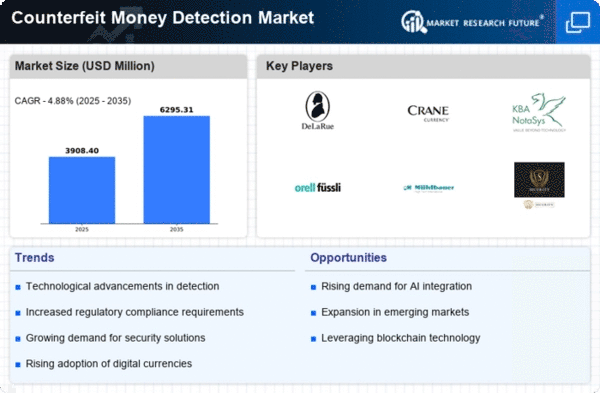
As per MRFR analysis, the Counterfeit Money Detection Market Size was estimated at 3726.54 USD Million in 2024. The Counterfeit Money Detection industry is projected to grow from 3908.47 USD Million in 2025 to 6295.31 USD Million by 2035, exhibiting a compound annual growth rate (CAGR) of 4.88 during the forecast period 2025 - 2035.

Key Market Trends & Highlights

The Counterfeit Money Detection Market is experiencing robust growth driven by technological advancements and increasing regulatory compliance.

  • North America remains the largest market for counterfeit money detection, driven by stringent regulatory frameworks.
  • Asia-Pacific is the fastest-growing region, fueled by rising e-commerce transactions and consumer awareness.
  • The banking sector continues to dominate the market, while the retail segment is witnessing the fastest growth due to increased counterfeit threats.
  • Technological innovations and regulatory compliance requirements are key drivers, as businesses seek to enhance security measures against counterfeit currency.

Market Size & Forecast

2024 Market Size 3726.54 (USD Million)
2035 Market Size 6295.31 (USD Million)
CAGR (2025 - 2035) 4.88%

Major Players

Giesecke+Devrient (DE), De La Rue (GB), Crane Currency (US), KBA-NotaSys (CH), Orell Füssli (CH), Mühlbauer (DE), SECURIT (BE), NBS (US), Cimpress (IE)

Our Impact
Enabled $4.3B Revenue Impact for Fortune 500 and Leading Multinationals
Partnering with 2000+ Global Organizations Each Year
30K+ Citations by Top-Tier Firms in the Industry

Counterfeit Money Detection Market Trends

The Counterfeit Money Detection Market is currently experiencing a notable evolution, driven by the increasing sophistication of counterfeiting techniques and the growing demand for secure transactions across various sectors. Financial institutions, retail businesses, and government agencies are investing in advanced detection technologies to safeguard their operations and maintain consumer trust. This market appears to be characterized by a diverse range of products, including handheld devices, desktop machines, and integrated software solutions, each designed to enhance the accuracy and efficiency of counterfeit detection. As the global economy continues to expand, the need for reliable detection methods becomes more pressing, suggesting a robust growth trajectory for this sector. In addition to technological advancements, regulatory frameworks are evolving to address the challenges posed by counterfeit currency. Governments worldwide are implementing stricter measures to combat counterfeiting, which may further stimulate demand for detection solutions. The Counterfeit Money Detection Market seems poised for continued innovation, with emerging technologies such as artificial intelligence and machine learning likely to play a pivotal role in enhancing detection capabilities. As stakeholders seek to adapt to the changing landscape, the market is expected to witness a surge in new entrants and product offerings, ultimately benefiting end-users through improved security and efficiency.

Technological Advancements

The Counterfeit Money Detection Market is witnessing rapid technological advancements, with innovations such as artificial intelligence and machine learning enhancing detection accuracy. These technologies enable systems to learn from patterns and improve their ability to identify counterfeit notes, thereby increasing reliability in various environments.

Regulatory Influence

Regulatory bodies are increasingly focusing on combating counterfeiting, leading to stricter compliance requirements for businesses. This trend is likely to drive demand for advanced detection solutions, as organizations strive to meet regulatory standards and protect their financial integrity.

Integration of Multi-Functional Devices

There is a growing trend towards the integration of multi-functional devices in the Counterfeit Money Detection Market. These devices not only detect counterfeit currency but also offer additional features such as currency counting and sorting, providing added value to users and streamlining operations.

Counterfeit Money Detection Market Drivers

Regulatory Compliance and Standards

The Global Counterfeit Money Detection Market Industry is significantly influenced by stringent regulatory compliance and standards imposed by governments and financial authorities. These regulations mandate the implementation of effective counterfeit detection systems to protect consumers and maintain the integrity of financial transactions. For example, the introduction of new currency designs with enhanced security features necessitates the adoption of advanced detection technologies. As regulatory bodies continue to enforce these standards, organizations are compelled to invest in sophisticated detection solutions. This trend is expected to contribute to a compound annual growth rate of 4.79% from 2025 to 2035, reflecting the market's responsiveness to compliance requirements.

Increasing Counterfeit Currency Incidents

The Global Counterfeit Money Detection Market Industry is driven by the rising incidents of counterfeit currency worldwide. Reports indicate that counterfeit currency has become a pressing issue, with billions of dollars in fake notes circulating in various economies. This alarming trend compels financial institutions, retailers, and governments to enhance their counterfeit detection measures. The urgency to combat this issue is reflected in the market's projected growth, reaching 6.52 USD Billion by 2035. As organizations recognize the potential financial repercussions of counterfeit money, investments in detection technologies are likely to increase, thereby propelling market expansion.

Technological Advancements in Detection Methods

The Global Counterfeit Money Detection Market Industry is experiencing a surge in technological innovations, particularly in the realm of detection methods. Advanced technologies such as ultraviolet light, magnetic ink detection, and digital watermarking are being integrated into currency verification systems. For instance, the adoption of AI-driven solutions enhances the accuracy of counterfeit detection, thereby reducing the risk of financial losses. As these technologies evolve, they are expected to play a pivotal role in the market, which is projected to reach 3.9 USD Billion in 2024. This growth underscores the necessity for businesses to invest in state-of-the-art detection systems to safeguard against counterfeit threats.

Expansion of E-Commerce and Digital Transactions

The Global Counterfeit Money Detection Market Industry is being shaped by the rapid expansion of e-commerce and digital transactions. As online shopping continues to gain traction, the risk of counterfeit currency infiltrating digital payment systems becomes a concern for businesses and consumers alike. This shift necessitates the development of robust detection mechanisms to ensure secure transactions. Companies are increasingly investing in technologies that can verify the authenticity of currency in both physical and digital environments. The market's growth trajectory, projected to reach 3.9 USD Billion in 2024, reflects the urgent need for effective counterfeit detection solutions in an evolving financial landscape.

Growing Awareness Among Consumers and Businesses

The Global Counterfeit Money Detection Market Industry is witnessing a rise in awareness among consumers and businesses regarding the risks associated with counterfeit currency. Educational campaigns and training programs are being implemented to inform stakeholders about the importance of counterfeit detection. This heightened awareness is leading to increased demand for reliable detection solutions, as businesses strive to protect their revenues and reputations. As consumers become more vigilant, the market is likely to see a shift towards more advanced detection technologies. This trend aligns with the projected market growth, indicating a proactive approach to combating counterfeit threats.


Market Segment Insights

By Application: Banking (Largest) vs. Retail (Fastest-Growing)

In the Counterfeit Money Detection Market, the application segment predominantly features Banking, which accounts for the largest market share. This segment's leading position is influenced by the high demand from financial institutions to combat counterfeit threats. Following closely is the Retail sector, which is experiencing robust growth due to increasing cash transactions and the necessity for retail businesses to ensure the authenticity of banknotes at the point of sale. The Government and Transportation segments are also significant but contribute less compared to Banking and Retail. The growth trends in the Counterfeit Money Detection Market are driven by advancements in technology, especially in the Banking and Retail segments. As financial organizations and retailers upgrade their detection systems to enhance security, investments in counterfeit detection technologies are expected to increase. Government initiatives to improve security standards and the rise in cash transactions in the Transportation sector further contribute to the growing demand for reliable counterfeit detection solutions. Overall, the market is poised for expansion as more sectors recognize the importance of safeguarding against counterfeit risks.

Banking: Dominant vs. Retail: Emerging

The Banking segment stands as the dominant force in the Counterfeit Money Detection Market, benefitting from extensive regulatory frameworks and the critical need for financial security. Banks utilize sophisticated detection mechanisms, integrating advanced technologies to ensure the authenticity of currency. Conversely, the Retail sector is emerging rapidly due to the increasing volume of cash transactions and a heightened focus on loss prevention. Retail chains are investing in user-friendly counterfeit detection tools to enhance customer trust and reduce losses. This shift reflects a growing awareness of the importance of securing cash flow against fraudulent activities. As such, while Banking leads, Retail is swiftly evolving to adapt to market demands and mitigate counterfeit risks.

By Technology: Optical Recognition (Largest) vs. Ultraviolet Detection (Fastest-Growing)

The Counterfeit Money Detection Market showcases a competitive landscape with various technologies, each playing a pivotal role in ensuring authenticity. Among these, Optical Recognition emerges as the largest segment, leveraging advanced imaging techniques to identify counterfeit currency. In contrast, Ultraviolet Detection is the fastest-growing segment, gaining traction due to its efficiency and integration in smart devices, appealing to both businesses and consumers for enhanced security. As the demand for counterfeit detection devices increases globally, the market is witnessing robust growth fueled by advancements in technology and rising counterfeiting incidents. Optical Recognition benefits from its widespread application in banking and retail, while Ultraviolet Detection is rapidly being adopted in handheld devices. This trend reflects a shifting preference towards more convenient and reliable counterfeit detection methods during transactions.

Technology: Optical Recognition (Dominant) vs. Ultraviolet Detection (Emerging)

Optical Recognition stands as the dominant technology in the Counterfeit Money Detection Market, characterized by its ability to assess and analyze complex features on banknotes. This segment's technology is widely trusted in banks and retail environments due to its accuracy in detecting counterfeits. In contrast, Ultraviolet Detection is emerging as a pivotal player, driven by growing demands for portable and cost-effective detection solutions. This technology detects specific inks and markings on banknotes, thus offering rapid verification with minimal training required. As counterfeit tactics evolve, both technologies are likely to complement each other, enhancing the overall efficacy of currency validation.

By End Use: Financial Institutions (Largest) vs. Law Enforcement (Fastest-Growing)

In the Counterfeit Money Detection Market, the distribution of market share among various end-use segments reveals a significant dominance of financial institutions. This segment represents the largest portion of the market as these institutions require advanced counterfeit detection technologies to protect their assets and maintain consumer trust. Following closely are commercial applications, which also hold a substantial share, driven by the need for retailers to ensure the authenticity of currency during transactions. Industrial and residential sectors, while important, occupy smaller proportions of the market share. The growth trends indicate that the law enforcement sector is emerging as the fastest-growing segment owing to increasing collaborations with governments and a rising focus on reducing counterfeit currency-related crimes. Additionally, the surge in digital currencies necessitates further investments in detection technologies within all segments, including industrial and residential, as even these areas become more susceptible to counterfeiting. Key drivers include technological advancements and heightened regulations surrounding currency legitimacy.

Financial Institutions (Dominant) vs. Law Enforcement (Emerging)

The financial institutions segment is characterized by a robust demand for high-precision counterfeit detection technologies, as these institutions face a constant threat from counterfeiters. They invest heavily in sophisticated systems that can quickly verify currency authenticity and prevent financial losses. In contrast, the law enforcement segment, while currently emerging, is experiencing rapid growth driven by an increasing number of counterfeit-related cases and a need for law enforcement agencies to adopt advanced technology to combat these crimes effectively. This segment is gaining traction with innovative detection solutions that enable swift identification and handling of counterfeit incidents, thus enhancing public safety and trust in financial systems. As both segments evolve, collaboration between technology providers and end-users will shape the future landscape of counterfeit detection.

By Product Type: Handheld Detectors (Largest) vs. Mobile Applications (Fastest-Growing)

The Counterfeit Money Detection Market is characterized by a diverse range of product types, with handheld detectors holding the largest share. They are favored for their ease of use, portability, and reliability, making them the preferred choice for retailers and small businesses. Desktop detectors also play a significant role, catering primarily to banking institutions and businesses requiring high-volume currency verification. Mobile applications are gaining traction due to the growing penetration of smartphones, offering intuitive and convenient counterfeit detection on-the-go.

Handheld Detectors (Dominant) vs. Integrated Systems (Emerging)

Handheld detectors dominate the market due to their practicality and effectiveness in various environments, especially for small businesses and cash-intensive venues. These devices are designed for immediate assessments, enhancing user confidence in cash transactions. Conversely, integrated systems, though emerging, offer sophisticated solutions that combine multiple validation methods into a single unit. These systems are increasingly being adopted by larger enterprises as they streamline cash management processes and provide comprehensive fraud prevention. The transition towards integrated systems is driven by the need for advanced security and the integration of AI technologies, positioning them favorably in the evolving market.

Get more detailed insights about Counterfeit Money Detection Market

Regional Insights

North America : Market Leader in Detection

North America is poised to maintain its leadership in the Counterfeit Money Detection Market, holding a significant market share of $1865.0M as of 2024. The region's growth is driven by stringent regulations and increasing demand for advanced detection technologies. The rise in counterfeit activities has prompted financial institutions and governments to invest heavily in innovative solutions, ensuring compliance with regulatory standards. The United States and Canada are the primary contributors to this market, with key players like Crane Currency and Giesecke+Devrient leading the charge. The competitive landscape is characterized by continuous technological advancements and partnerships among manufacturers. As the market evolves, the focus on integrating AI and machine learning into detection systems is expected to further enhance the region's market position.

Europe : Emerging Regulatory Frameworks

Europe is witnessing a robust growth trajectory in the Counterfeit Money Detection Market, valued at $1050.0M. The region's growth is fueled by the implementation of stringent regulations aimed at combating counterfeiting, alongside increasing public awareness. Countries are investing in advanced detection technologies to safeguard their economies, reflecting a proactive approach to financial security. Leading countries such as Germany, the UK, and France are at the forefront, with key players like De La Rue and KBA-NotaSys driving innovation. The competitive landscape is marked by collaborations between governments and private sectors to enhance detection capabilities. As regulations evolve, the market is expected to adapt, ensuring that detection technologies remain effective against emerging threats.

Asia-Pacific : Rapid Growth in Demand

The Asia-Pacific region is rapidly emerging in the Counterfeit Money Detection Market, currently valued at $650.0M. The growth is driven by increasing economic activities and a rising number of counterfeit incidents, prompting governments and businesses to invest in advanced detection technologies. Regulatory bodies are also enhancing their frameworks to address these challenges, fostering a conducive environment for market expansion. Countries like China, India, and Japan are leading the charge, with a growing presence of key players such as Mühlbauer and SECURIT. The competitive landscape is evolving, with local manufacturers increasingly entering the market to meet the rising demand. As the region continues to develop economically, the focus on counterfeit detection will become paramount to protect financial systems and consumer trust.

Middle East and Africa : Growing Awareness and Investment

The Middle East and Africa region is gradually recognizing the importance of the Counterfeit Money Detection Market, valued at $161.54M. The growth is driven by increasing awareness of counterfeit threats and the need for enhanced financial security measures. Governments are beginning to invest in detection technologies, reflecting a shift towards safeguarding their economies from financial crimes. Countries like South Africa and the UAE are leading the way, with a growing interest from key players such as NBS and Cimpress. The competitive landscape is characterized by a mix of local and international players, all vying to establish a foothold in this emerging market. As awareness grows, the demand for effective detection solutions is expected to rise, paving the way for future investments and innovations.

Key Players and Competitive Insights

The Counterfeit Money Detection Market is characterized by a dynamic competitive landscape, driven by the increasing sophistication of counterfeiting techniques and the growing demand for secure currency solutions. Key players such as Giesecke+Devrient (DE), De La Rue (GB), and Crane Currency (US) are at the forefront, each adopting distinct strategies to enhance their market positioning. Giesecke+Devrient (DE) focuses on innovation through advanced security features in banknotes, while De La Rue (GB) emphasizes partnerships with governments to develop tailored solutions. Crane Currency (US) leverages its expertise in polymer substrates to create durable and secure currency, indicating a trend towards specialized offerings that cater to specific market needs.The market structure appears moderately fragmented, with several players vying for market share. Key business tactics include localizing manufacturing to reduce costs and optimize supply chains, which enhances responsiveness to regional demands. The collective influence of these major companies shapes a competitive environment where innovation and strategic partnerships are paramount, allowing them to adapt to evolving threats and customer expectations.

In November Giesecke+Devrient (DE) announced a collaboration with a leading technology firm to integrate AI-driven counterfeit detection systems into their existing product lines. This strategic move is likely to enhance their product offerings, positioning them as a leader in the integration of cutting-edge technology within the currency sector. The partnership underscores the importance of technological advancement in maintaining a competitive edge in the market.

In October De La Rue (GB) launched a new line of banknotes featuring enhanced security features, including holographic elements and advanced color-shifting inks. This initiative not only aims to combat counterfeiting but also reflects a broader trend towards incorporating innovative design elements that appeal to both consumers and governments. The launch is indicative of De La Rue's commitment to staying ahead of counterfeiting trends through continuous product development.

In September Crane Currency (US) expanded its production capabilities by investing in a new facility dedicated to the production of polymer substrates. This investment is significant as it allows Crane to meet the increasing demand for secure currency solutions while also enhancing production efficiency. The move is expected to solidify Crane's position in the market, particularly as governments seek more durable and secure currency options.

As of December the Counterfeit Money Detection Market is witnessing trends such as digitalization, sustainability, and AI integration, which are reshaping competitive dynamics. Strategic alliances are becoming increasingly important, as companies recognize the need to collaborate to enhance their technological capabilities and market reach. Looking ahead, competitive differentiation is likely to evolve from traditional price-based competition to a focus on innovation, technology, and supply chain reliability, suggesting a shift towards more sophisticated and integrated solutions in the fight against counterfeiting.

Key Companies in the Counterfeit Money Detection Market include

Industry Developments

The counterfeit money detection market is projected to reach a value of USD 5.2 billion by 2032, exhibiting a CAGR of 4.88% during the forecast period (2024-2032). The market growth is attributed to the increasing prevalence of counterfeiting activities, advancements in counterfeiting techniques, and the rising demand for secure and reliable counterfeit detection solutions. Government initiatives and regulations aimed at combating counterfeiting are also driving market growth.

Key market players are investing in research and development to enhance the accuracy and efficiency of counterfeit detection technologies. Recent developments include the integration of artificial intelligence (AI) and machine learning (ML) algorithms into counterfeit detection systems, enabling real-time and more precise identification of counterfeit currency.

Future Outlook

Counterfeit Money Detection Market Future Outlook

The Counterfeit Money Detection Market is projected to grow at a 4.88% CAGR from 2025 to 2035, driven by technological advancements and increasing counterfeiting activities.

New opportunities lie in:

  • Integration of AI-driven detection systems in retail environments.
  • Development of portable detection devices for field use.
  • Expansion of blockchain technology for secure currency verification.

By 2035, the market is expected to be robust, driven by innovation and heightened security demands.

Market Segmentation

Counterfeit Money Detection Market End Use Outlook

  • Commercial
  • Industrial
  • Residential
  • Financial Institutions
  • Law Enforcement

Counterfeit Money Detection Market Technology Outlook

  • Optical Recognition
  • Ultraviolet Detection
  • Magnetic Detection
  • Infrared Detection
  • Microprinting

Counterfeit Money Detection Market Application Outlook

  • Banking
  • Retail
  • Government
  • Transportation
  • Security

Counterfeit Money Detection Market Product Type Outlook

  • Handheld Detectors
  • Desktop Detectors
  • Mobile Applications
  • Integrated Systems
  • Counterfeit Detection Software

Report Scope

MARKET SIZE 20243726.54(USD Million)
MARKET SIZE 20253908.47(USD Million)
MARKET SIZE 20356295.31(USD Million)
COMPOUND ANNUAL GROWTH RATE (CAGR)4.88% (2025 - 2035)
REPORT COVERAGERevenue Forecast, Competitive Landscape, Growth Factors, and Trends
BASE YEAR2024
Market Forecast Period2025 - 2035
Historical Data2019 - 2024
Market Forecast UnitsUSD Million
Key Companies ProfiledGiesecke+Devrient (DE), De La Rue (GB), Crane Currency (US), KBA-NotaSys (CH), Orell Füssli (CH), Mühlbauer (DE), SECURIT (BE), NBS (US), Cimpress (IE)
Segments CoveredApplication, Technology, End Use, Product Type
Key Market OpportunitiesIntegration of advanced artificial intelligence in counterfeit detection systems enhances accuracy and efficiency.
Key Market DynamicsRising technological advancements drive innovation in counterfeit money detection solutions, enhancing security and efficiency.
Countries CoveredNorth America, Europe, APAC, South America, MEA
Leave a Comment

FAQs

What was the expected market size of the Counterfeit Money Detection Market in 2023?

The counterfeit money detection market reached a valuation of 3.55 billion USD in 2023.

What is the projected CAGR of the Counterfeit Money Detection Market from 2025 to 2034?

The counterfeit money detection market is projected to grow at a CAGR of 4.88% from 2025 to 2034.

What is the expected market size of the Counterfeit Money Detection Market in 2034?

The counterfeit money detection market is expected to reach a valuation of 6.22 billion USD by 2034.

Which region held the largest market share in the Counterfeit Money Detection Market in 2023?

North America held the largest market share in the counterfeit money detection market in 2023.

What are some of the key applications of counterfeit money detection technology?

Key applications of counterfeit money detection technology include retail, banking, law enforcement, and border control.

Who are some of the key competitors in the Counterfeit Money Detection Market?

Key competitors include G&D, Holographic Imaging, SICPA, Crane Currency, and Landqart.

What are the major factors driving the growth of the Counterfeit Money Detection Market?

Major factors driving growth include increasing counterfeiting activities, technological advancements, and growing demand for security measures.

What are some of the challenges faced by the Counterfeit Money Detection Market?

Challenges faced by the market include the availability of sophisticated counterfeiting techniques and the need for continuous innovation to stay ahead of counterfeiters.

What are the expected trends in the Counterfeit Money Detection Market?

Expected trends in the market include the adoption of artificial intelligence, the use of mobile devices for counterfeit detection, and the development of new security features.

What is the regulatory landscape of the Counterfeit Money Detection Market?

The regulatory landscape varies by region, with different countries having their own regulations and standards for counterfeit detection technology.

Download Free Sample

Kindly complete the form below to receive a free sample of this Report

Compare Licence

×
Features License Type
Single User Multiuser License Enterprise User
Price $4,950 $5,950 $7,250
Maximum User Access Limit 1 User Upto 10 Users Unrestricted Access Throughout the Organization
Free Customization
Direct Access to Analyst
Deliverable Format
Platform Access
Discount on Next Purchase 10% 15% 15%
Printable Versions