×
Request Free Sample ×

Kindly complete the form below to receive a free sample of this Report

* Please use a valid business email

Leading companies partner with us for data-driven Insights

clients tt-cursor
Hero Background
English
Chinese
French
Japanese
Korean
German
Spanish

Compound Semiconductor Market Share

ID: MRFR/SEM/8651-HCR
200 Pages
Aarti Dhapte
October 2025

Compound Semiconductor Market Size, Share and Research Report: By Application (Telecommunications, Consumer Electronics, Lighting, Automotive, Renewable Energy), By Material Type (Gallium Nitride, Gallium Arsenide, Indium Phosphide, Silicon Carbide, Zinc Oxide), By Device Type (RF Device, Power Device, LED, Photonic Device), By End Use (Industrial, Commercial, Residential) and By Regional (North America, Europe, South America, Asia Pacific, Middle East and Africa) - Industry Forecast Till 2035

Share:
Download PDF ×

We do not share your information with anyone. However, we may send you emails based on your report interest from time to time. You may contact us at any time to opt-out.

Compound Semiconductor Market Infographic
Purchase Options

Market Share

Compound Semiconductor Market Share Analysis

In the ever-evolving landscape of the Compound Semiconductor Market, companies employ a range of strategies to secure and enhance their market share. An important approach is centered around product differentiation in which companies focus on providing a unique and improved products by technology, materials or performance. With many uses of compound semiconductors in areas such as electronics, telecommunications and optoelectronics companies respond to market needs innovatively by directing their research at those niches. However, pricing strategies play a vital role in the market share positioning of Compound Semiconductor Market. In other cases, some of the companies follow a cost leadership strategy that sees them focus on efficiency and economies in scale so that they offer low-cost products as compared to competitors. In this way, the company attracts price-conscious market segments and covers a wide range of customers.

On another note, others choose high-end pricing due to positioning their compound semiconductor products as cutting edge solutions with superior feature. This approach targets customers ready to spend on the latest technology ensuring higher profit margins. The third element of the market share positioning in Compound Semiconductor Market is efficient segmentation. Companies focus on targeting certain industries, applications or geographic regions and design the products that suit their specific needs. This focused approach enables businesses to better meet the varied needs of customers, and as a result they have an improved market presence and competitiveness. The Compound Semiconductor Market is heavily dependent on strategic partnerships and collaborations.

Businesses usually collaborate with research institutions, equipment suppliers or end-users to enhance innovation through mutual sharing of resources and market reach. The collaborative approach enables the development of new applications and solutions setting companies at a leading edge in emerging technologies and markets. Geographical growth is a strategic necessity for companies striving to strengthen their market share in the Compound Semiconductor Market. This could include entering new territories, setting up local manufacturing facilities or aligning with distributors in select markets. This knowledge also allows companies to adjust their approaches depending on the situation in particular regions, which makes for a greater reception and permeation. Customer-centric strategies play a pivotal role in the Compound Semiconductor Market. Creating favorable customer relationships through effective support, customization offers, and continuous engagement leads to the development of brand loyalty.

To conclude therefore market positioning in the Compound Semiconductor Market is a complex strategic approach which includes product differentiation pricing strategies, segmentation of markets alliances geographic expansion and customer orientation. Successful companies in this dynamic market navigate the complexities by staying innovative, understanding diverse customer needs, and adapting to the evolving technological and market trends.


Author
Aarti Dhapte
Team Lead - Research

She holds an experience of about 6+ years in Market Research and Business Consulting, working under the spectrum of Information Communication Technology, Telecommunications and Semiconductor domains. Aarti conceptualizes and implements a scalable business strategy and provides strategic leadership to the clients. Her expertise lies in market estimation, competitive intelligence, pipeline analysis, customer assessment, etc.

Leave a Comment

FAQs

What is the projected market size of the Compound Semiconductor Market in 2024?

The Compound Semiconductor Market is expected to be valued at 12.71 USD Billion in 2024.

What is the expected market CAGR from 2025 to 2035?

The Compound Semiconductor Market is projected to have a CAGR of 8.12% from 2025 to 2035.

Which region holds the largest market share in the Compound Semiconductor Market in 2024?

North America holds the largest market share in the Compound Semiconductor Market, valued at 4.5 USD Billion in 2024.

What will the value of the Compound Semiconductor Market be by 2035?

The Compound Semiconductor Market is expected to be valued at 30.0 USD Billion by 2035.

What is the market size for Telecommunications in the Compound Semiconductor Market in 2024?

The market size for Telecommunications in the Compound Semiconductor Market is valued at 3.25 USD Billion in 2024.

Who are the key players in the Compound Semiconductor Market?

Key players in the Compound Semiconductor Market include Skyworks Solutions, Broadcom, Cree, Microchip Technology, and NXP Semiconductors.

What is the market size for Consumer Electronics in 2035?

The market size for Consumer Electronics in the Compound Semiconductor Market is projected to be 9.5 USD Billion in 2035.

How is the market for Renewable Energy expected to grow by 2035?

The Renewable Energy segment of the Compound Semiconductor Market is expected to grow to 2.7 USD Billion by 2035.

What is the market size for Europe in 2024?

The Compound Semiconductor Market size for Europe is valued at 3.2 USD Billion in 2024.

What is the projected market size for Automotive in 2035?

The Automotive segment of the Compound Semiconductor Market is anticipated to reach 5.8 USD Billion by 2035.

Market Summary

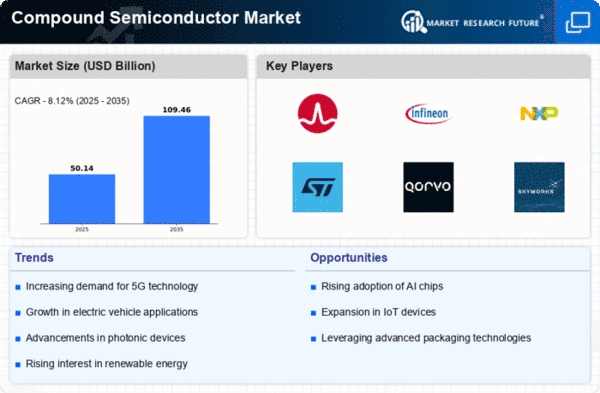
As per MRFR analysis, the Compound Semiconductor Market Size was estimated at 46.37 USD Billion in 2024. The Compound Semiconductor industry is projected to grow from 50.14 USD Billion in 2025 to 109.46 USD Billion by 2035, exhibiting a compound annual growth rate (CAGR) of 8.12 during the forecast period 2025 - 2035.

Key Market Trends & Highlights

The Compound Semiconductor Market is poised for substantial growth driven by technological advancements and increasing demand across various sectors.

  • North America remains the largest market for compound semiconductors, driven by robust demand in telecommunications and automotive sectors. The Asia-Pacific region is currently the fastest-growing market, fueled by rapid advancements in consumer electronics and renewable energy technologies. Telecommunications continues to dominate the market, while the consumer electronics segment is experiencing the fastest growth due to rising consumer demand. Key market drivers include the increasing adoption of 5G technology and the expansion of Internet of Things (IoT) devices, which are significantly influencing market dynamics.

Market Size & Forecast

2024 Market Size 46.37 (USD Billion)
2035 Market Size 109.46 (USD Billion)
CAGR (2025 - 2035) 8.12%
Largest Regional Market Share in 2024 North America

Major Players

Broadcom (US), Infineon Technologies (DE), NXP Semiconductors (NL), STMicroelectronics (CH), Qorvo (US), Skyworks Solutions (US), Cree (US), GaN Systems (CA), II-VI Incorporated (US)

Market Trends

The Compound Semiconductor Market is currently experiencing a transformative phase, driven by advancements in technology and increasing demand across various sectors. This market encompasses a diverse range of materials, including gallium nitride and silicon carbide, which are pivotal in enhancing the performance of electronic devices. The proliferation of electric vehicles, renewable energy systems, and high-frequency communication technologies appears to be propelling the growth of this sector. As industries seek to improve efficiency and reduce energy consumption, the relevance of compound semiconductors becomes increasingly pronounced. Moreover, the Compound Semiconductor Market is characterized by a dynamic landscape where innovation plays a crucial role. Companies are investing in research and development to create more efficient and sustainable solutions. The integration of compound semiconductors in consumer electronics, telecommunications, and industrial applications suggests a broadening scope of influence. As the market evolves, it seems likely that collaboration among stakeholders will intensify, fostering an environment conducive to further advancements and applications. This collaborative approach may lead to enhanced product offerings and a more robust supply chain, ultimately benefiting end-users and manufacturers alike.

Rising Demand for Electric Vehicles

The shift towards electric vehicles is significantly influencing the Compound Semiconductor Market. As automakers increasingly adopt advanced technologies to enhance vehicle performance and efficiency, the need for high-performance semiconductors becomes evident. These materials are essential for power management and energy conversion, which are critical in electric vehicle applications.

Growth in Renewable Energy Solutions

The transition to renewable energy sources is driving the Compound Semiconductor Market forward. Technologies such as solar inverters and wind turbine systems require efficient power electronics, which rely on compound semiconductors. This trend indicates a growing reliance on these materials to facilitate the shift towards sustainable energy.

Advancements in Telecommunications

The telecommunications sector is undergoing rapid evolution, particularly with the rollout of next-generation networks. The demand for high-frequency and high-efficiency components is increasing, leading to a greater emphasis on compound semiconductors. These materials are crucial for enabling faster data transmission and improved connectivity.

Compound Semiconductor Market Market Drivers

Market Trends and Projections

The Global Compound Semiconductor Market Industry is characterized by dynamic trends and projections that reflect its growth trajectory. The market is anticipated to reach 12.7 USD Billion in 2024, with a robust CAGR of 8.12% expected from 2025 to 2035. This growth is driven by various factors, including the increasing demand for electric vehicles, the expansion of 5G infrastructure, and advancements in renewable energy applications. As these trends continue to evolve, the Global Compound Semiconductor Market Industry is likely to witness substantial investment and innovation, positioning it as a critical player in the global technology landscape.

Expansion of 5G Infrastructure

The Global Compound Semiconductor Market Industry is significantly influenced by the expansion of 5G infrastructure. As telecommunications companies roll out 5G networks, there is an increasing demand for high-frequency components that can support faster data transmission and improved connectivity. Compound semiconductors, such as gallium nitride and gallium arsenide, are essential for the development of 5G base stations and devices. This trend is expected to propel the market to approximately 30 USD Billion by 2035, as the need for enhanced communication capabilities continues to rise. The Global Compound Semiconductor Market Industry stands to gain from the technological advancements associated with 5G deployment.

Rising Demand for Electric Vehicles

The Global Compound Semiconductor Market Industry experiences a notable surge in demand driven by the increasing adoption of electric vehicles. As governments worldwide implement stringent emissions regulations, the automotive sector is shifting towards electric mobility. This transition necessitates advanced semiconductor technologies, particularly in power electronics and battery management systems. The market is projected to reach 12.7 USD Billion in 2024, reflecting the growing need for efficient energy conversion and management solutions. Consequently, the Global Compound Semiconductor Market Industry is poised to benefit from this trend, as manufacturers invest in innovative materials and designs to enhance vehicle performance and sustainability.

Advancements in Consumer Electronics

The Global Compound Semiconductor Market Industry is propelled by advancements in consumer electronics, particularly in high-performance devices. As consumers demand faster, more efficient gadgets, manufacturers are increasingly turning to compound semiconductors for their superior performance characteristics. These materials enable the development of compact, high-efficiency components for smartphones, tablets, and wearables. The growing trend towards miniaturization and enhanced functionality in consumer electronics is expected to contribute to the market's expansion. With the industry projected to reach 12.7 USD Billion in 2024, the Global Compound Semiconductor Market Industry is well-positioned to capitalize on these technological advancements.

Growth in Renewable Energy Applications

The Global Compound Semiconductor Market Industry is witnessing growth due to the rising adoption of renewable energy technologies. As countries strive to meet sustainability goals, there is an increasing focus on solar and wind energy systems, which require efficient power conversion solutions. Compound semiconductors play a crucial role in inverters and power management systems, enhancing the efficiency of energy conversion processes. The market is projected to grow at a CAGR of 8.12% from 2025 to 2035, driven by the demand for clean energy solutions. This trend indicates a robust future for the Global Compound Semiconductor Market Industry as it aligns with global energy transition initiatives.

Emerging Applications in Aerospace and Defense

The Global Compound Semiconductor Market Industry is experiencing growth due to emerging applications in the aerospace and defense sectors. These industries require high-performance, reliable components for radar systems, satellite communications, and electronic warfare systems. Compound semiconductors, known for their ability to operate at high frequencies and temperatures, are increasingly utilized in these applications. As defense budgets expand and the demand for advanced technologies rises, the market is likely to see significant investment in compound semiconductor solutions. This trend underscores the potential for the Global Compound Semiconductor Market Industry to thrive in specialized sectors that prioritize performance and reliability.

Market Segment Insights

By Application: Telecommunications (Largest) vs. Consumer Electronics (Fastest-Growing)

The Compound Semiconductor Market demonstrates a diverse application landscape, with <a href="https://www.marketresearchfuture.com/reports/telecommunications-insurance-market-24091">telecommunications </a>holding the largest share. With the rising demand for high-speed connectivity and advanced communication systems, telecommunications applications are leading the market. Following closely are consumer electronics, driven by a surge in smart device production and innovations in audio and visual technologies, catering to growing consumer appetites for advanced features and functionalities.

Telecommunications (Dominant) vs. Consumer Electronics (Emerging)

Telecommunications stands as the dominant force within the Compound Semiconductor Market, leveraging advancements in 5G technologies and the ever-growing demand for faster and more reliable communication. On the other hand, consumer electronics are emerging rapidly, spurred by technological innovations that focus on enhanced user experiences. This segment is witnessing growth in areas like smartphones and wearables, where compound semiconductors are utilized for improved performance. Both segments show a strong interdependence, as advancements in telecommunications further fuel innovation in consumer electronics.

By Material Type: Gallium Nitride (Largest) vs. Silicon Carbide (Fastest-Growing)

In the Compound Semiconductor Market, Gallium Nitride holds the largest share due to its widespread application in high-frequency and high-power devices. Silicon Carbide is rapidly gaining traction as the fastest-growing material, particularly in electric vehicle and renewable energy applications, driven by its superior thermal conductivity and efficiency. Other materials such as Gallium Arsenide, Indium Phosphide, and Zinc Oxide, while present, capture smaller portions of the market, each serving niche applications in optoelectronics and telecommunications.

Gallium Nitride (Dominant) vs. Silicon Carbide (Emerging)

Gallium Nitride is regarded as the dominant material in the compound semiconductor industry because of its exceptional properties, which lend themselves well to high-performance applications such as LED technology and power amplifiers. It offers advantages in terms of efficiency and size, making it a preferred choice for a wide range of electronic devices. In contrast, Silicon Carbide is emerging rapidly, positioned as a key enabler in the growth of power electronics, particularly in sectors like electric vehicles and solar power generation. The increasing demand for energy-efficient solutions is propelling Silicon Carbide to a significant market position, leveraging its high temperature and voltage ratings.

By Device Type: Power Devices (Largest) vs. Optoelectronic Devices (Fastest-Growing)

In the Compound Semiconductor Market, the distribution of market share among device types reveals that Power Devices maintain the largest position, reflecting a strong demand primarily driven by advancements in electric vehicles and renewable energy applications. Following closely, Optoelectronic Devices are not far behind, capturing significant market interest due to their essential applications in telecommunications and consumer electronics. Other segments like RF Devices, Sensors, and LEDs are pivotal, but they hold lesser shares compared to these dominant categories.

Power Devices (Dominant) vs. Optoelectronic Devices (Emerging)

Power Devices are characterized by their efficiency in handling high voltages and currents, making them critical in power conversion and control applications. They are a fundamental component in electric vehicles, renewable energy systems, and smart grid technologies, positioning them as a dominant force in the market. On the other hand, Optoelectronic Devices are emerging due to their versatility in light emission and detection, crucial for applications such as fiber optics, LED technology, and sensors. This segment is experiencing rapid growth, fueled by increasing demand for advanced communication technologies and energy-efficient lighting solutions.

By End Use: Telecommunication Equipment (Largest) vs. Electric Vehicles (Fastest-Growing)

The Compound Semiconductor Market exhibits a diverse array of end use applications, with telecommunication equipment leading the charge. This segment capitalizes on the increasing demand for high-speed connectivity and the evolving landscape of 5G technology, positioning it as the largest segment within the market. Following closely, electric vehicles are emerging as a significant contender, driven by the global shift towards sustainable transportation and government incentives promoting electric mobility. This competitive landscape underscores the importance of robust, high-performance semiconductor solutions across various sectors. In recent years, the growth trends in the Compound Semiconductor Market reflect a strong inclination towards innovation in electric vehicles, which is currently the fastest-growing segment. Factors such as advancements in battery technologies and the relentless pursuit for energy efficiency are propelling this segment forward. In addition, the integration of compound semiconductors in renewable energy systems and military and defense applications is further amplifying growth, leading to a well-rounded market landscape that promises continuous evolution and adaptation to new technological demands.

Telecommunication Equipment (Dominant) vs. Electric Vehicles (Emerging)

Telecommunication equipment remains the dominant force within the Compound Semiconductor Market due to its crucial role in the deployment of advanced communication technologies like 5G. This segment thrives on innovations enabling higher frequency operations and improved data transmission, thereby fulfilling the ever-growing demand for faster and more reliable communication systems. In contrast, electric vehicles represent an emerging segment characterized by rapid innovation and technological advancements. The use of compound semiconductors in electric vehicles enhances power efficiency, thermal management, and overall performance, making them integral to the automotive industry's transformation. Both segments illustrate the duality in the market, with established players in telecommunications coexisting alongside rapidly evolving technologies in electric vehicles.

Get more detailed insights about Compound Semiconductor Market Research Report - Forecast till 2035

Regional Insights

North America : Market Leader in Innovation

North America continues to lead the compound semiconductor market, holding a significant share of 23.5% in 2024. The region's growth is driven by increasing demand for advanced electronic devices, automotive applications, and 5G technology. Regulatory support for semiconductor manufacturing and R&D initiatives further catalyze market expansion. The U.S. government has been actively promoting domestic production to reduce reliance on foreign supply chains, enhancing the region's competitive edge. The competitive landscape in North America is robust, featuring key players such as Broadcom, Cree, and Qorvo. The presence of major technology hubs in the U.S. and Canada fosters innovation and collaboration among industry leaders. Companies are investing heavily in R&D to develop next-generation semiconductor technologies, ensuring they remain at the forefront of the market. This dynamic environment positions North America as a critical player in the global compound semiconductor landscape.

Europe : Emerging Market with Potential

Europe is witnessing a growing interest in the compound semiconductor market, with a market size of €10.5 billion projected for 2025. The region's growth is fueled by increasing investments in renewable energy, automotive electrification, and telecommunications. Regulatory frameworks aimed at enhancing semiconductor production capabilities are also pivotal in driving market growth. The European Union's initiatives to bolster local manufacturing are expected to significantly impact the sector's development. Leading countries in Europe include Germany, the Netherlands, and Switzerland, where companies like Infineon Technologies and STMicroelectronics are prominent. The competitive landscape is characterized by a mix of established firms and innovative startups, fostering a vibrant ecosystem. As Europe aims to reduce its dependency on external suppliers, the compound semiconductor market is poised for substantial growth, supported by strategic partnerships and collaborations across the region.

Asia-Pacific : Rapid Growth and Adoption

The Asia-Pacific region is experiencing rapid growth in the compound semiconductor market, with a projected size of $10.0 billion by 2025. This growth is driven by the increasing demand for consumer electronics, automotive applications, and advancements in telecommunications. Countries in this region are investing heavily in semiconductor manufacturing capabilities, supported by favorable government policies and incentives aimed at boosting local production and innovation. Key players in the Asia-Pacific market include NXP Semiconductors and GaN Systems, with significant contributions from countries like China, Japan, and South Korea. The competitive landscape is marked by a strong focus on R&D and technological advancements, enabling companies to develop cutting-edge solutions. As the region continues to expand its semiconductor capabilities, it is set to play a crucial role in the global market dynamics of compound semiconductors.

Middle East and Africa : Emerging Market Opportunities

The Middle East and Africa (MEA) region is gradually emerging in the compound semiconductor market, with a market size of $2.37 billion anticipated by 2025. The growth is primarily driven by increasing investments in technology infrastructure and a rising demand for electronic devices. Governments in the region are recognizing the importance of developing a local semiconductor industry, leading to various initiatives aimed at fostering innovation and attracting foreign investment. Countries like South Africa and the UAE are taking the lead in establishing semiconductor manufacturing capabilities. The competitive landscape is still developing, with a mix of local and international players entering the market. As the region continues to invest in technology and infrastructure, the compound semiconductor market is expected to grow, presenting significant opportunities for both established companies and new entrants.

Key Players and Competitive Insights

The Compound Semiconductor Market is currently characterized by a dynamic competitive landscape, driven by advancements in technology and increasing demand for high-performance electronic devices. Key players such as Broadcom (US), Infineon Technologies (DE), and Cree (US) are strategically positioning themselves through innovation and partnerships. Broadcom (US) focuses on enhancing its product portfolio in wireless communication, while Infineon Technologies (DE) emphasizes its commitment to automotive applications, particularly in electric vehicles. Cree (US), on the other hand, is advancing its efforts in the LED and power semiconductor sectors, indicating a collective shift towards more energy-efficient solutions that shape the competitive environment.
In terms of business tactics, companies are increasingly localizing manufacturing to mitigate supply chain disruptions and optimize operational efficiency. The market appears moderately fragmented, with a mix of established players and emerging companies vying for market share. This competitive structure allows for diverse strategies, where key players leverage their strengths to influence market dynamics collectively.
In November 2025, Infineon Technologies (DE) announced a strategic partnership with a leading automotive manufacturer to develop next-generation power modules for electric vehicles. This collaboration is poised to enhance Infineon’s position in the automotive sector, aligning with the growing trend towards electrification and sustainability. The partnership not only reinforces Infineon’s commitment to innovation but also positions it favorably in a rapidly evolving market.
In October 2025, Cree (US) unveiled its latest GaN-based power devices aimed at improving energy efficiency in industrial applications. This launch reflects Cree’s ongoing investment in research and development, showcasing its dedication to providing cutting-edge solutions. The introduction of these devices is likely to strengthen Cree’s market presence and cater to the increasing demand for high-performance power electronics.
In September 2025, Broadcom (US) expanded its manufacturing capabilities by investing in a new facility dedicated to the production of advanced semiconductor components. This strategic move is indicative of Broadcom’s focus on scaling operations to meet the rising demand for wireless communication technologies. The expansion not only enhances production capacity but also signifies Broadcom’s commitment to maintaining a competitive edge in the market.
As of December 2025, current trends in the Compound Semiconductor Market are heavily influenced by digitalization, sustainability, and the integration of AI technologies. Strategic alliances among key players are shaping the landscape, fostering innovation and collaboration. The competitive differentiation is likely to evolve, moving away from price-based competition towards a focus on technological advancements and supply chain reliability. This shift underscores the importance of innovation as a key driver for success in the market.

Key Companies in the Compound Semiconductor Market include

Industry Developments

The Compound Semiconductor Market is experiencing significant developments, particularly with companies such as Skyworks Solutions, Broadcom, Cree, Microchip Technology, and NXP Semiconductors. Recently, in September 2023, Marvell Technology announced its acquisition of a key technology firm, enhancing its capabilities in the compound semiconductor space. Moreover, Texas Instruments and Analog Devices are actively investing in Research and Development to meet the increasing demand for high-performance electronic devices, which is driving market growth. The adoption of compound semiconductors is being fueled by trends in 5G technology and electric vehicles, with GaN Systems and ON Semiconductor focusing on expanding their product lines.

In 2022, STMicroelectronics also made strides in the market by entering a joint venture with another semiconductor company to bolster its manufacturing capabilities. The market valuation of these companies has been positively impacted, reflecting robust demand and ongoing innovation. As of October 2023, the Compound Semiconductor Market is projected to grow, driven by advancements in technology and increasing applications across various industries.

Future Outlook

Compound Semiconductor Market Future Outlook

The Compound Semiconductor Market is projected to grow at an 8.12% CAGR from 2025 to 2035, driven by advancements in 5G technology, electric vehicles, and renewable energy applications.

New opportunities lie in:

  • Development of advanced GaN-based power devices for electric vehicles.
  • Expansion into photonic integrated circuits for telecommunications.
  • Investment in R&amp;D for next-generation semiconductor materials.

By 2035, the Compound Semiconductor Market is expected to achieve substantial growth and innovation.

Market Segmentation

Compound Semiconductor Market End Use Outlook

  • Telecommunication Equipment
  • Consumer Electronics
  • Electric Vehicles
  • Renewable Energy Systems
  • Military and Defense

Compound Semiconductor Market Application Outlook

  • Telecommunications
  • Consumer Electronics
  • Automotive
  • Industrial
  • Aerospace

Compound Semiconductor Market Device Type Outlook

  • Power Devices
  • Optoelectronic Devices
  • RF Devices
  • Sensors
  • LEDs

Compound Semiconductor Market Material Type Outlook

  • Gallium Nitride
  • Silicon Carbide
  • Gallium Arsenide
  • Indium Phosphide
  • Zinc Oxide

Report Scope

MARKET SIZE 2024 46.37(USD Billion)
MARKET SIZE 2025 50.14(USD Billion)
MARKET SIZE 2035 109.46(USD Billion)
COMPOUND ANNUAL GROWTH RATE (CAGR) 8.12% (2025 - 2035)
REPORT COVERAGE Revenue Forecast, Competitive Landscape, Growth Factors, and Trends
BASE YEAR 2024
Market Forecast Period 2025 - 2035
Historical Data 2019 - 2024
Market Forecast Units USD Billion
Key Companies Profiled Broadcom (US), Infineon Technologies (DE), NXP Semiconductors (NL), STMicroelectronics (CH), Qorvo (US), Skyworks Solutions (US), Cree (US), GaN Systems (CA), II-VI Incorporated (US)
Segments Covered Application, Material Type, Device Type, End Use
Key Market Opportunities Advancements in electric vehicles drive demand for high-performance components in the Compound Semiconductor Market.
Key Market Dynamics Rising demand for energy-efficient devices drives innovation and competition in the Compound Semiconductor Market.
Countries Covered North America, Europe, APAC, South America, MEA

FAQs

What is the projected market size of the Compound Semiconductor Market in 2024?

The Compound Semiconductor Market is expected to be valued at 12.71 USD Billion in 2024.

What is the expected market CAGR from 2025 to 2035?

The Compound Semiconductor Market is projected to have a CAGR of 8.12% from 2025 to 2035.

Which region holds the largest market share in the Compound Semiconductor Market in 2024?

North America holds the largest market share in the Compound Semiconductor Market, valued at 4.5 USD Billion in 2024.

What will the value of the Compound Semiconductor Market be by 2035?

The Compound Semiconductor Market is expected to be valued at 30.0 USD Billion by 2035.

What is the market size for Telecommunications in the Compound Semiconductor Market in 2024?

The market size for Telecommunications in the Compound Semiconductor Market is valued at 3.25 USD Billion in 2024.

Who are the key players in the Compound Semiconductor Market?

Key players in the Compound Semiconductor Market include Skyworks Solutions, Broadcom, Cree, Microchip Technology, and NXP Semiconductors.

What is the market size for Consumer Electronics in 2035?

The market size for Consumer Electronics in the Compound Semiconductor Market is projected to be 9.5 USD Billion in 2035.

How is the market for Renewable Energy expected to grow by 2035?

The Renewable Energy segment of the Compound Semiconductor Market is expected to grow to 2.7 USD Billion by 2035.

What is the market size for Europe in 2024?

The Compound Semiconductor Market size for Europe is valued at 3.2 USD Billion in 2024.

What is the projected market size for Automotive in 2035?

The Automotive segment of the Compound Semiconductor Market is anticipated to reach 5.8 USD Billion by 2035.

  1. SECTION I: EXECUTIVE SUMMARY AND KEY HIGHLIGHTS
    1. | 1.1 EXECUTIVE SUMMARY
    2. | 1.1.1 Market Overview
    3. | 1.1.2 Key Findings
    4. | 1.1.3 Market Segmentation
    5. | 1.1.4 Competitive Landscape
    6. | 1.1.5 Challenges and Opportunities
    7. | 1.1.6 Future Outlook
  2. SECTION II: SCOPING, METHODOLOGY AND MARKET STRUCTURE
    1. | 2.1 MARKET INTRODUCTION
    2. | 2.1.1 Definition
    3. | 2.1.2 Scope of the study
    4. |-- 2.1.2.1 Research Objective
    5. |-- 2.1.2.2 Assumption
    6. |-- 2.1.2.3 Limitations
    7. | 2.2 RESEARCH METHODOLOGY
    8. | 2.2.1 Overview
    9. | 2.2.2 Data Mining
    10. | 2.2.3 Secondary Research
    11. | 2.2.4 Primary Research
    12. |-- 2.2.4.1 Primary Interviews and Information Gathering Process
    13. |-- 2.2.4.2 Breakdown of Primary Respondents
    14. | 2.2.5 Forecasting Model
    15. | 2.2.6 Market Size Estimation
    16. |-- 2.2.6.1 Bottom-Up Approach
    17. |-- 2.2.6.2 Top-Down Approach
    18. | 2.2.7 Data Triangulation
    19. | 2.2.8 Validation
  3. SECTION III: QUALITATIVE ANALYSIS
    1. | 3.1 MARKET DYNAMICS
    2. | 3.1.1 Overview
    3. | 3.1.2 Drivers
    4. | 3.1.3 Restraints
    5. | 3.1.4 Opportunities
    6. | 3.2 MARKET FACTOR ANALYSIS
    7. | 3.2.1 Value chain Analysis
    8. | 3.2.2 Porter's Five Forces Analysis
    9. |-- 3.2.2.1 Bargaining Power of Suppliers
    10. |-- 3.2.2.2 Bargaining Power of Buyers
    11. |-- 3.2.2.3 Threat of New Entrants
    12. |-- 3.2.2.4 Threat of Substitutes
    13. |-- 3.2.2.5 Intensity of Rivalry
    14. | 3.2.3 COVID-19 Impact Analysis
    15. |-- 3.2.3.1 Market Impact Analysis
    16. |-- 3.2.3.2 Regional Impact
    17. |-- 3.2.3.3 Opportunity and Threat Analysis
  4. SECTION IV: QUANTITATIVE ANALYSIS
    1. | 4.1 Semiconductor & Electronics, BY Application (USD Billion)
    2. | 4.1.1 Telecommunications
    3. | 4.1.2 Consumer Electronics
    4. | 4.1.3 Automotive
    5. | 4.1.4 Industrial
    6. | 4.1.5 Aerospace
    7. | 4.2 Semiconductor & Electronics, BY Material Type (USD Billion)
    8. | 4.2.1 Gallium Nitride
    9. | 4.2.2 Silicon Carbide
    10. | 4.2.3 Gallium Arsenide
    11. | 4.2.4 Indium Phosphide
    12. | 4.2.5 Zinc Oxide
    13. | 4.3 Semiconductor & Electronics, BY Device Type (USD Billion)
    14. | 4.3.1 Power Devices
    15. | 4.3.2 Optoelectronic Devices
    16. | 4.3.3 RF Devices
    17. | 4.3.4 Sensors
    18. | 4.3.5 LEDs
    19. | 4.4 Semiconductor & Electronics, BY End Use (USD Billion)
    20. | 4.4.1 Telecommunication Equipment
    21. | 4.4.2 Consumer Electronics
    22. | 4.4.3 Electric Vehicles
    23. | 4.4.4 Renewable Energy Systems
    24. | 4.4.5 Military and Defense
    25. | 4.5 Semiconductor & Electronics, BY Region (USD Billion)
    26. | 4.5.1 North America
    27. |-- 4.5.1.1 US
    28. |-- 4.5.1.2 Canada
    29. | 4.5.2 Europe
    30. |-- 4.5.2.1 Germany
    31. |-- 4.5.2.2 UK
    32. |-- 4.5.2.3 France
    33. |-- 4.5.2.4 Russia
    34. |-- 4.5.2.5 Italy
    35. |-- 4.5.2.6 Spain
    36. |-- 4.5.2.7 Rest of Europe
    37. | 4.5.3 APAC
    38. |-- 4.5.3.1 China
    39. |-- 4.5.3.2 India
    40. |-- 4.5.3.3 Japan
    41. |-- 4.5.3.4 South Korea
    42. |-- 4.5.3.5 Malaysia
    43. |-- 4.5.3.6 Thailand
    44. |-- 4.5.3.7 Indonesia
    45. |-- 4.5.3.8 Rest of APAC
    46. | 4.5.4 South America
    47. |-- 4.5.4.1 Brazil
    48. |-- 4.5.4.2 Mexico
    49. |-- 4.5.4.3 Argentina
    50. |-- 4.5.4.4 Rest of South America
    51. | 4.5.5 MEA
    52. |-- 4.5.5.1 GCC Countries
    53. |-- 4.5.5.2 South Africa
    54. |-- 4.5.5.3 Rest of MEA
  5. SECTION V: COMPETITIVE ANALYSIS
    1. | 5.1 Competitive Landscape
    2. | 5.1.1 Overview
    3. | 5.1.2 Competitive Analysis
    4. | 5.1.3 Market share Analysis
    5. | 5.1.4 Major Growth Strategy in the Semiconductor & Electronics
    6. | 5.1.5 Competitive Benchmarking
    7. | 5.1.6 Leading Players in Terms of Number of Developments in the Semiconductor & Electronics
    8. | 5.1.7 Key developments and growth strategies
    9. |-- 5.1.7.1 New Product Launch/Service Deployment
    10. |-- 5.1.7.2 Merger & Acquisitions
    11. |-- 5.1.7.3 Joint Ventures
    12. | 5.1.8 Major Players Financial Matrix
    13. |-- 5.1.8.1 Sales and Operating Income
    14. |-- 5.1.8.2 Major Players R&D Expenditure. 2023
    15. | 5.2 Company Profiles
    16. | 5.2.1 Broadcom (US)
    17. |-- 5.2.1.1 Financial Overview
    18. |-- 5.2.1.2 Products Offered
    19. |-- 5.2.1.3 Key Developments
    20. |-- 5.2.1.4 SWOT Analysis
    21. |-- 5.2.1.5 Key Strategies
    22. | 5.2.2 Infineon Technologies (DE)
    23. |-- 5.2.2.1 Financial Overview
    24. |-- 5.2.2.2 Products Offered
    25. |-- 5.2.2.3 Key Developments
    26. |-- 5.2.2.4 SWOT Analysis
    27. |-- 5.2.2.5 Key Strategies
    28. | 5.2.3 NXP Semiconductors (NL)
    29. |-- 5.2.3.1 Financial Overview
    30. |-- 5.2.3.2 Products Offered
    31. |-- 5.2.3.3 Key Developments
    32. |-- 5.2.3.4 SWOT Analysis
    33. |-- 5.2.3.5 Key Strategies
    34. | 5.2.4 STMicroelectronics (CH)
    35. |-- 5.2.4.1 Financial Overview
    36. |-- 5.2.4.2 Products Offered
    37. |-- 5.2.4.3 Key Developments
    38. |-- 5.2.4.4 SWOT Analysis
    39. |-- 5.2.4.5 Key Strategies
    40. | 5.2.5 Qorvo (US)
    41. |-- 5.2.5.1 Financial Overview
    42. |-- 5.2.5.2 Products Offered
    43. |-- 5.2.5.3 Key Developments
    44. |-- 5.2.5.4 SWOT Analysis
    45. |-- 5.2.5.5 Key Strategies
    46. | 5.2.6 Skyworks Solutions (US)
    47. |-- 5.2.6.1 Financial Overview
    48. |-- 5.2.6.2 Products Offered
    49. |-- 5.2.6.3 Key Developments
    50. |-- 5.2.6.4 SWOT Analysis
    51. |-- 5.2.6.5 Key Strategies
    52. | 5.2.7 Cree (US)
    53. |-- 5.2.7.1 Financial Overview
    54. |-- 5.2.7.2 Products Offered
    55. |-- 5.2.7.3 Key Developments
    56. |-- 5.2.7.4 SWOT Analysis
    57. |-- 5.2.7.5 Key Strategies
    58. | 5.2.8 GaN Systems (CA)
    59. |-- 5.2.8.1 Financial Overview
    60. |-- 5.2.8.2 Products Offered
    61. |-- 5.2.8.3 Key Developments
    62. |-- 5.2.8.4 SWOT Analysis
    63. |-- 5.2.8.5 Key Strategies
    64. | 5.2.9 II-VI Incorporated (US)
    65. |-- 5.2.9.1 Financial Overview
    66. |-- 5.2.9.2 Products Offered
    67. |-- 5.2.9.3 Key Developments
    68. |-- 5.2.9.4 SWOT Analysis
    69. |-- 5.2.9.5 Key Strategies
    70. | 5.3 Appendix
    71. | 5.3.1 References
    72. | 5.3.2 Related Reports

Semiconductor & Electronics Market Segmentation

Semiconductor & Electronics By Application (USD Billion, 2025-2035)

  • Telecommunications
  • Consumer Electronics
  • Automotive
  • Industrial
  • Aerospace

Semiconductor & Electronics By Material Type (USD Billion, 2025-2035)

  • Gallium Nitride
  • Silicon Carbide
  • Gallium Arsenide
  • Indium Phosphide
  • Zinc Oxide

Semiconductor & Electronics By Device Type (USD Billion, 2025-2035)

  • Power Devices
  • Optoelectronic Devices
  • RF Devices
  • Sensors
  • LEDs

Semiconductor & Electronics By End Use (USD Billion, 2025-2035)

  • Telecommunication Equipment
  • Consumer Electronics
  • Electric Vehicles
  • Renewable Energy Systems
  • Military and Defense
Infographic

Free Sample Request

Kindly complete the form below to receive a free sample of this Report

Get Free Sample

Customer Strories

Compare Licence

×
Features License Type
Single User Multiuser License Enterprise User
Price $4,950 $5,950 $7,250
Maximum User Access Limit 1 User Upto 10 Users Unrestricted Access Throughout the Organization
Free Customization
Direct Access to Analyst
Deliverable Format
Platform Access
Discount on Next Purchase 10% 15% 15%
Printable Versions