×
Request Free Sample ×

Kindly complete the form below to receive a free sample of this Report

* Please use a valid business email

Leading companies partner with us for data-driven Insights

clients tt-cursor
Hero Background
English
Chinese
French
Japanese
Korean
German
Spanish

Chloroprene Rubber Market Trends

ID: MRFR/CnM/3502-CR
111 Pages
Chitranshi Jaiswal
February 2021

Global Chloroprene Rubber Market Research Report Information by Grade (Linear, Crystallizing Resistance, Sulfur Modified, Others), Application (Coatings & Adhesives, Wires & Cables, Hoses & Tubes, Others), End-Use Industry (Automotive, Construction, Furniture, Electronics, Textile, Others) and Region (Asia-Pacific, Europe, Latin America, North America and the Middle East & Africa) - Forecast till 2035

Share:
Download PDF ×

We do not share your information with anyone. However, we may send you emails based on your report interest from time to time. You may contact us at any time to opt-out.

Chloroprene Rubber Market Infographic
×
Chloroprene Rubber Market Infographic Full View
Purchase Options

Market Trends

Key Emerging Trends in the Chloroprene Rubber Market

Market trends in the Chloroprene Rubber (CR) market reflect dynamic shifts influenced by several factors:

Growing Demand in Automotive Sector: One prominent trend in the CR market is the increasing demand from the automotive industry. CR is utilized in automotive applications such as hoses, belts, seals, and gaskets due to its resistance to oil, heat, and weathering. As the automotive sector continues to expand globally, driven by factors like population growth, urbanization, and rising disposable incomes, the demand for CR in this industry is expected to rise steadily.

Rise in Construction Activities: Another significant trend is the growing demand for CR in the construction sector. CR is used in construction applications such as roofing membranes, sealants, and adhesives due to its excellent weather resistance and durability. With increasing construction activities worldwide, particularly in emerging economies, the demand for CR in the construction sector is projected to witness substantial growth.

Expanding Footprint in Electrical and Electronics: The electrical and electronics industry is emerging as a key consumer of CR. CR is utilized in cable sheathing, insulation, and gaskets in electrical equipment due to its flame retardancy and electrical insulation properties. As the demand for consumer electronics, appliances, and electrical infrastructure continues to rise, driven by technological advancements and increasing urbanization, the demand for CR in this sector is expected to grow significantly.

Shift towards Eco-friendly Materials: There is a noticeable trend towards the adoption of eco-friendly materials in various industries, including the rubber industry. CR manufacturers are increasingly focusing on developing bio-based and sustainable CR grades to meet the growing demand for environmentally friendly products. This trend is driven by increasing environmental awareness, regulatory initiatives, and consumer preferences for sustainable products.

Technological Advancements and Product Innovation: Technological advancements and product innovations are driving market trends in the CR industry. Manufacturers are investing in research and development to enhance the performance characteristics of CR, such as improving mechanical properties, enhancing processability, and reducing production costs. These advancements enable manufacturers to offer high-performance CR grades tailored to specific application requirements, driving market growth.

Demand for High-performance Elastomers: There is a growing demand for high-performance elastomers like CR in specialized applications that require superior mechanical properties, chemical resistance, and durability. CR's unique combination of properties makes it suitable for demanding applications in industries such as automotive, aerospace, marine, and industrial manufacturing. As industries continue to prioritize performance and reliability, the demand for CR is expected to grow in these niche markets.

Shift towards Green Building Materials: The construction industry is witnessing a shift towards green building materials to meet sustainability goals and achieve energy efficiency. CR, with its recyclability, durability, and energy-saving properties, is gaining traction as a green building material. As governments implement stricter building codes and environmental regulations, the demand for CR in green construction projects is expected to increase.

Emerging Applications in Medical and Healthcare: The medical and healthcare sector is emerging as a new application area for CR. CR is being used in medical devices, surgical gloves, seals, and gaskets due to its biocompatibility and resistance to chemicals and sterilization methods. With the increasing demand for medical devices and healthcare products, driven by factors such as aging populations and healthcare infrastructure development, the demand for CR in this sector is projected to grow.

Globalization and Market Expansion: CR manufacturers are increasingly expanding their global footprint to tap into emerging markets with high growth potential. Market expansion strategies such as mergers, acquisitions, partnerships, and joint ventures enable companies to access new markets, strengthen their distribution networks, and enhance their market presence. This trend is driven by the need to diversify revenue streams, mitigate risks, and capitalize on growth opportunities in emerging economies.

Supply Chain Optimization and Resilience: In light of global supply chain disruptions, CR manufacturers are focusing on optimizing their supply chains and enhancing resilience to mitigate risks and ensure continuity of supply. Strategies such as inventory management, supplier diversification, and localization of production facilities help manufacturers adapt to changing market dynamics and minimize the impact of supply chain disruptions on their operations.
Author
Chitranshi Jaiswal
Research Analyst Level I

In her 3 years of experience in the market research field, she has handled critical cross-domain projects. She has an in-depth knowledge of market estimation & analysis, problem-solving, primary as well as secondary research, and team management.She holds an engineering degree and is an MBA professional from a well-known university, capable of evaluating the market and competitive conditions. An exceptional strategist with excellent communication skills and a passion for delivering cutting-edge & practical insights for the market. Proficient in multi-tasking, and can successfully deal with competing demands, while maintaining complete confidentiality. Generated business through active client and project development, networking, and high-quality responses. Her knowledge and skills have helped in making solid business decisions, securing funding from investors, and avoiding business failures.

Leave a Comment

FAQs

How is chloroprene rubber produced?

Chloroprene rubber is produced by polymerizing 2-chloro 1-3 butadiene in the presence of a catalyst, emulsifying agents, modifiers, and protective agents.

What are the advantages of chloroprene rubber over conventional rubber?

Major advantages of chloroprene rubber include a higher resistance to chemicals, oils, ozone, and heat.

What is the volume of the global chloroprene rubber market?

The chloroprene rubber market stood at 1.62 billion by 2035.

What is the major driver for the chloroprene rubber market?

The major driver for the global chloroprene rubber market is the growth of the automotive industry.

What are the major restraints acting on the chloroprene rubber market?

The major restraints acting on the global chloroprene rubber market include the widespread adoption of alternative rubber products such as natural rubber, styrene butadiene rubber, and isoprene.

Market Summary

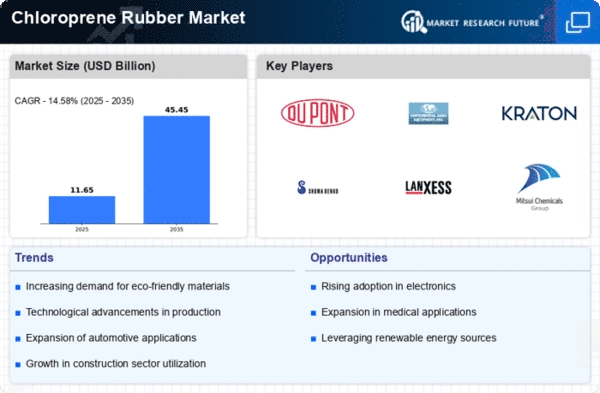
As per MRFR analysis, the Chloroprene Rubber Market Size was estimated at 10.17 USD Billion in 2024. The Chloroprene Rubber industry is projected to grow from 11.65 USD Billion in 2025 to 45.45 USD Billion by 2035, exhibiting a compound annual growth rate (CAGR) of 14.58 during the forecast period 2025 - 2035.

Key Market Trends & Highlights

The Chloroprene Rubber Market is poised for growth driven by sustainability and technological advancements.

  • North America remains the largest market for chloroprene rubber, driven by robust demand in the automotive and construction sectors.
  • Asia-Pacific is recognized as the fastest-growing region, with increasing investments in automotive applications and medical uses.
  • The adhesives segment continues to dominate the market, while the automotive parts segment is experiencing rapid growth due to technological innovations.
  • Key market drivers include rising demand in the construction sector and an increased focus on environmental regulations.

Market Size & Forecast

2024 Market Size 10.17 (USD Billion)
2035 Market Size 45.45 (USD Billion)
CAGR (2025 - 2035) 14.58%
Largest Regional Market Share in 2024 North America

Major Players

DuPont (US), Continental AG (DE), Kraton Corporation (US), Showa Denko K.K. (JP), Lanxess AG (DE), Mitsui Chemicals, Inc. (JP), Tosoh Corporation (JP), Kumho Petrochemical Co., Ltd. (KR), Nippon Zeon Corporation (JP)

Market Trends

The Chloroprene Rubber Market is currently experiencing a dynamic phase characterized by evolving consumer preferences and technological advancements. The demand for chloroprene rubber, known for its excellent weather resistance and durability, is on the rise across various industries, including automotive, construction, and consumer goods. This growth is likely driven by the material's versatility, which allows it to be utilized in a wide range of applications, from adhesives to protective clothing. Furthermore, the increasing emphasis on sustainability may influence manufacturers to explore eco-friendly alternatives, potentially reshaping the market landscape. In addition, the Chloroprene Rubber Market appears to be influenced by global economic trends and regulatory frameworks. As industries strive for innovation, the integration of advanced manufacturing processes and materials is becoming more prevalent. This shift may lead to enhanced product performance and efficiency, thereby attracting a broader customer base. Moreover, the ongoing research and development efforts in polymer science suggest that the market could witness the introduction of novel formulations, which may further expand its applications and appeal. Overall, the Chloroprene Rubber Market is poised for growth, with various factors contributing to its evolving dynamics.

Sustainability Initiatives

The Chloroprene Rubber Market is increasingly focusing on sustainability initiatives. Manufacturers are exploring eco-friendly production methods and materials to meet the growing demand for environmentally responsible products. This trend may lead to the development of bio-based chloroprene rubber alternatives, which could appeal to environmentally conscious consumers.

Technological Advancements

Technological advancements are playing a crucial role in shaping the Chloroprene Rubber Market. Innovations in manufacturing processes are enhancing product quality and performance. These advancements may enable the production of chloroprene rubber with improved properties, such as greater heat resistance and flexibility, thereby expanding its applications.

Growing Automotive Sector

The automotive sector is a significant driver of growth in the Chloroprene Rubber Market. As the demand for durable and high-performance materials increases, chloroprene rubber is being utilized in various automotive components. This trend suggests a potential for increased market penetration as automotive manufacturers seek reliable materials for their products.

Chloroprene Rubber Market Market Drivers

Market Growth Projections

The Global Chloroprene Rubber Market Industry is projected to experience substantial growth, with estimates indicating a market value of 0.72 USD Billion in 2024 and a remarkable increase to 1.97 USD Billion by 2035. This growth trajectory suggests a compound annual growth rate (CAGR) of 9.57% from 2025 to 2035, reflecting the expanding applications and increasing demand across various sectors. The anticipated growth is driven by factors such as rising automotive production, expanding construction activities, and technological advancements in manufacturing processes. These projections underscore the potential for chloroprene rubber to play a pivotal role in multiple industries in the coming years.

Growth in Construction Activities

The Global Chloroprene Rubber Market Industry benefits from the expanding construction sector, where chloroprene rubber is utilized for its adhesive properties and resistance to environmental factors. As urbanization accelerates globally, the demand for construction materials that offer longevity and reliability increases. Chloroprene rubber is particularly favored for roofing and flooring applications, where its resilience to weathering is crucial. This growth in construction activities is anticipated to contribute significantly to the market, with forecasts indicating a rise to 1.97 USD Billion by 2035. The ongoing infrastructure projects across various regions further underscore the potential of the Global Chloroprene Rubber Market Industry.

Increasing Environmental Regulations

The Global Chloroprene Rubber Market Industry is influenced by increasing environmental regulations that promote the use of sustainable materials. As governments worldwide implement stricter guidelines on emissions and waste management, manufacturers are compelled to adopt eco-friendly practices. Chloroprene rubber, known for its low environmental impact compared to other synthetic rubbers, stands to benefit from this trend. The shift towards sustainability is likely to enhance the market's appeal, as industries seek compliant materials that do not compromise performance. This regulatory landscape may drive innovation and adaptation within the Global Chloroprene Rubber Market Industry, fostering a more sustainable future.

Rising Demand from Automotive Sector

The Global Chloroprene Rubber Market Industry experiences a notable surge in demand from the automotive sector, primarily due to its excellent properties such as heat resistance and durability. As automotive manufacturers increasingly prioritize high-performance materials, chloroprene rubber finds applications in seals, gaskets, and hoses. This trend is expected to drive the market's growth, with projections indicating a market value of 0.72 USD Billion in 2024. The automotive industry's shift towards lightweight and efficient materials further enhances the relevance of chloroprene rubber, suggesting a robust trajectory for the Global Chloroprene Rubber Market Industry in the coming years.

Diverse Applications Across Industries

The versatility of chloroprene rubber across various industries significantly contributes to the growth of the Global Chloroprene Rubber Market Industry. Its applications span automotive, construction, electronics, and healthcare, among others. This diversity allows for a broad customer base and mitigates risks associated with market fluctuations in any single sector. As industries continue to evolve and seek specialized materials, chloroprene rubber's unique properties, such as chemical resistance and flexibility, make it a preferred choice. This broad applicability is expected to sustain market growth, with projections indicating a steady increase in demand over the next decade.

Technological Advancements in Manufacturing

Technological advancements in the manufacturing processes of chloroprene rubber are poised to enhance production efficiency and product quality. Innovations in polymerization techniques and compounding methods enable manufacturers to produce chloroprene rubber with superior characteristics, catering to diverse applications. These advancements not only improve the performance of the material but also reduce production costs, making it more accessible to various industries. As a result, the Global Chloroprene Rubber Market Industry is likely to witness accelerated growth, with a projected CAGR of 9.57% from 2025 to 2035. This technological evolution is expected to create new opportunities for market players.

Market Segment Insights

By Application: Adhesives (Largest) vs. Automotive Parts (Fastest-Growing)

The chloroprene rubber market displays a diverse application segment, with adhesives emerging as the largest player. This category dominates due to its extensive use in various industries, including construction, automotive, and consumer goods. Following closely are coatings and sealants, which also contribute significantly to the overall market share, driven by their utility in protective and aesthetic applications. Automotive parts are gaining traction, marking their importance as a key application area.

Adhesives: Dominant vs. Automotive Parts: Emerging

Adhesives are the cornerstone of the chloroprene rubber market, valued for their strong bonding characteristics, flexibility, and resistance to environmental factors. This segment supports crucial applications in construction, electronics, and automotive industries, making it a mainstay in product development. On the other hand, automotive parts are recognized as an emerging area fueled by technological advances in vehicle manufacturing and increasing automotive production worldwide. The lightweight properties of chloroprene rubber make it ideal for components such as gaskets and seals, reflecting the segment's growing market presence as manufacturers seek high-performance materials.

By End Use: Automotive (Largest) vs. Medical (Fastest-Growing)

In the Chloroprene Rubber Market, the end-use segment is displaying varied interests, with the automotive sector holding the largest market share. This dominance is attributed to the automotive industry's extensive need for durable and flexible materials that can withstand varying environmental conditions. The construction sector follows closely, utilizing chloroprene rubber for seals and adhesives, while the consumer goods and industrial segments contribute modestly to the market share. The medical sector, though smaller, is rapidly emerging thanks to advancements in healthcare technologies and increased demand for medical devices.

Automotive: Dominant vs. Medical: Emerging

The automotive segment is recognized as a dominant force in the Chloroprene Rubber Market due to its significant consumption of the material for components like gaskets, seals, and hoses, which require high resilience and performance. Conversely, the medical segment is gaining traction as an emerging player, primarily driven by the increased use of chloroprene rubber in manufacturing healthcare products like gloves and tubing. The rising focus on hygienic and safe medical applications is propelling the growth of this segment, indicating a strong potential for innovation and expansion in the years to come.

By Type: Solid Chloroprene Rubber (Largest) vs. Liquid Chloroprene Rubber (Fastest-Growing)

In the Chloroprene Rubber Market, Solid Chloroprene Rubber holds a significant market share, being the largest segment due to its diverse applications in various industries, including automotive, construction, and consumer goods. This type is widely preferred for its durability and excellent weather resistance. On the other hand, Liquid Chloroprene Rubber is rapidly gaining traction, driven by its increasing use in adhesive formulations and sealants, making it a key player in the burgeoning construction and automotive sectors.

Solid Chloroprene Rubber (Dominant) vs. Liquid Chloroprene Rubber (Emerging)

Solid Chloroprene Rubber stands as the dominant segment in the Chloroprene Rubber Market, known for its robust physical properties and versatility across various applications. It is typically used in the manufacture of gaskets, hoses, and coatings due to its excellent resistance to oil, ozone, and extreme temperatures. In contrast, Liquid Chloroprene Rubber, though emerging, is steadily capturing market share, primarily utilized in adhesives and sealants. Its ability to offer superior bonding strength and flexibility makes it increasingly favored in the construction and automotive industries, heralding a shift in market dynamics.

By Formulation: Compounded Rubber (Largest) vs. Uncompounded Rubber (Fastest-Growing)

In the Chloroprene Rubber Market, the formulation segment showcases a diverse landscape characterized by Compounded Rubber, Uncompounded Rubber, and Blends. Compounded Rubber accounts for the largest share, largely due to its widespread application in various industries like automotive, construction, and textiles. Uncompounded Rubber, while smaller in share, is rapidly gaining traction, driven by its unique properties that cater to specific manufacturing needs, signifying a dynamic shift in market preferences. As the market evolves, the demand for sustainable and performance-enhanced materials fuels growth in the formulation segment, especially for Uncompounded Rubber, which is witnessing increased adoption in specialized applications. Innovation in blends further emphasizes the importance of flexibility and enhanced performance characteristics in chloroprene rubber products, fostering competitive advantages in a market striving for efficiency and adaptability.

Compounded Rubber (Dominant) vs. Blends (Emerging)

Compounded Rubber represents the dominant formulation in the Chloroprene Rubber Market, recognized for its superior mechanical properties and versatility. This formulation is extensively utilized across industries for applications requiring high tensile strength and elastic recovery. Its extensive use in manufacturing processes makes it a staple for various end products, ensuring its leading market position. On the other hand, Blends are emerging as a significant trend, integrating chloroprene rubber with other polymers to enhance functionality and performance features. These blends provide improved resilience, temperature resistance, and adaptability, catering to specific demands in niche markets. Although currently smaller in share compared to Compounded Rubber, the expanding application range of Blends indicates a growing market segment that could redefine future product formulations.

By Processing Method: Molding (Largest) vs. Extrusion (Fastest-Growing)

The Chloroprene Rubber Market showcases a diverse range of processing methods, with molding holding the largest share. Molding is favored for its ability to create complex shapes and components, making it essential for various applications. Extrusion, while currently holding a smaller share, is witnessing a rapid growth trend due to its efficiency in producing long, continuous shapes, which is beneficial for many industrial uses. As the demand for specialized rubber products increases, both methods are vying for a more significant market presence.

Molding (Dominant) vs. Extrusion (Emerging)

Molding has established itself as the dominant processing method in the Chloroprene Rubber Market, primarily due to its versatility and ability to produce intricate designs that meet specific application requirements. This method allows manufacturers to utilize unique molds that ensure precision and performance. On the other hand, extrusion is becoming an emerging processing method, characterized by its capability to produce continuous profiles, which is increasingly in demand. This process benefits from efficiency and cost-effectiveness, particularly in mass production scenarios, enabling manufacturers to cater to various sectors like automotive and construction. As advancements in extrusion technology occur, its market position strengthens, potentially leading to a shift in market dynamics.

Get more detailed insights about Chloroprene Rubber Market Research Report - Global Forecast till 2035

Regional Insights

North America : Market Leader in Chloroprene

North America is poised to maintain its leadership in the Chloroprene Rubber market, holding a significant market share of 4.5 in 2024. The region's growth is driven by robust demand from automotive, construction, and consumer goods sectors, alongside stringent regulations promoting sustainable materials. The increasing focus on eco-friendly products is further catalyzing market expansion, supported by government initiatives aimed at reducing carbon footprints. The competitive landscape in North America is characterized by the presence of major players such as DuPont and Kraton Corporation, which are investing heavily in R&D to innovate and enhance product offerings. The U.S. remains the leading country, with a strong manufacturing base and advanced technological capabilities. This region's strategic focus on sustainability and innovation positions it favorably for continued growth in the Chloroprene Rubber market.

Europe : Emerging Market Dynamics

Europe is witnessing a dynamic shift in the Chloroprene Rubber market, with a market size of 3.0 in 2024. The region's growth is fueled by increasing demand in automotive and industrial applications, alongside regulatory frameworks that encourage the use of high-performance materials. The European Union's commitment to sustainability and circular economy principles is driving innovation and adoption of eco-friendly alternatives, enhancing market prospects. Leading countries such as Germany and France are at the forefront, with key players like Continental AG and Lanxess AG actively participating in market development. The competitive landscape is marked by strategic collaborations and investments in sustainable technologies. As the region adapts to changing consumer preferences, the Chloroprene Rubber market is expected to thrive, supported by a strong regulatory environment that fosters innovation and growth.

Asia-Pacific : Rapid Growth Potential

Asia-Pacific is emerging as a significant player in the Chloroprene Rubber market, with a market size of 2.5 in 2024. The region's growth is driven by rapid industrialization, urbanization, and increasing demand from the automotive and electronics sectors. Countries like China and Japan are leading this growth, supported by favorable government policies and investments in infrastructure development, which are catalyzing market expansion. The competitive landscape is characterized by the presence of key players such as Mitsui Chemicals and Showa Denko K.K., who are focusing on enhancing production capabilities and expanding their market reach. As the region continues to evolve, the demand for high-quality Chloroprene Rubber is expected to rise, driven by technological advancements and a growing emphasis on sustainability in manufacturing processes.

Middle East and Africa : Emerging Market Opportunities

The Middle East and Africa region is at the nascent stage of developing its Chloroprene Rubber market, with a market size of 0.17 in 2024. The growth potential is significant, driven by increasing industrial activities and infrastructure projects across the region. Governments are investing in various sectors, including construction and automotive, which are expected to boost demand for Chloroprene Rubber in the coming years. Countries like South Africa and the UAE are emerging as key players in this market, with local manufacturers beginning to establish a foothold. The competitive landscape is still developing, but there is a growing interest from international players looking to tap into this market. As the region continues to invest in industrial growth, the Chloroprene Rubber market is likely to see substantial opportunities for expansion and innovation.

Key Players and Competitive Insights

The Chloroprene Rubber Market is currently characterized by a dynamic competitive landscape, driven by increasing demand across various applications such as automotive, construction, and consumer goods. Key players are actively engaging in strategies that emphasize innovation, sustainability, and regional expansion. For instance, DuPont (US) has been focusing on enhancing its product portfolio through research and development, aiming to introduce more environmentally friendly alternatives. Similarly, Continental AG (DE) is leveraging its technological expertise to develop advanced materials that cater to the evolving needs of the automotive sector, thereby positioning itself as a leader in high-performance applications. These strategic initiatives collectively contribute to a competitive environment that is increasingly oriented towards differentiation through quality and innovation.In terms of business tactics, companies are localizing manufacturing to reduce lead times and optimize supply chains, which is particularly crucial in a market that is moderately fragmented. This approach not only enhances operational efficiency but also allows for better responsiveness to regional market demands. The competitive structure is shaped by the collective influence of major players, which, while diverse, tends to favor those who can effectively balance cost management with innovation.

In November Kraton Corporation (US) announced a strategic partnership with a leading automotive manufacturer to develop a new line of chloroprene rubber products tailored for electric vehicles. This collaboration is significant as it aligns with the growing trend towards electrification in the automotive industry, positioning Kraton to capture a share of this emerging market segment. The partnership underscores the importance of aligning product development with industry trends, thereby enhancing Kraton's competitive edge.

In October Showa Denko K.K. (JP) unveiled a new production facility in Southeast Asia, aimed at increasing its output capacity for chloroprene rubber. This expansion is indicative of Showa Denko's commitment to meeting rising demand in the Asia-Pacific region, which is expected to witness substantial growth in the coming years. By enhancing its manufacturing capabilities, the company is likely to improve its market position and respond more effectively to customer needs.

In September Lanxess AG (DE) launched a sustainability initiative focused on reducing the carbon footprint of its chloroprene rubber production processes. This initiative reflects a broader industry trend towards sustainability, as companies increasingly recognize the importance of environmental responsibility. By prioritizing sustainable practices, Lanxess is not only addressing regulatory pressures but also appealing to a growing segment of environmentally conscious consumers.

As of December the competitive trends in the Chloroprene Rubber Market are increasingly defined by digitalization, sustainability, and the integration of advanced technologies such as AI. Strategic alliances are becoming more prevalent, as companies seek to leverage complementary strengths to enhance their market offerings. Looking ahead, competitive differentiation is likely to evolve from traditional price-based competition towards a focus on innovation, technological advancements, and supply chain reliability. This shift suggests that companies that can effectively harness these trends will be better positioned to thrive in an increasingly complex market.

Key Companies in the Chloroprene Rubber Market include

Industry Developments

Future Outlook

Chloroprene Rubber Market Future Outlook

The Chloroprene Rubber Market is projected to grow at a 14.58% CAGR from 2024 to 2035, driven by increasing demand in automotive and construction sectors.

New opportunities lie in:

  • Expansion into bio-based chloroprene rubber production
  • Development of high-performance adhesives for industrial applications
  • Investment in advanced recycling technologies for sustainable practices

By 2035, the market is expected to achieve robust growth, solidifying its position in various industries.

Market Segmentation

Chloroprene Rubber Market Type Outlook

  • Solid Chloroprene Rubber
  • Liquid Chloroprene Rubber
  • Latex Chloroprene Rubber

Chloroprene Rubber Market End Use Outlook

  • Automotive
  • Construction
  • Consumer Goods
  • Industrial
  • Medical

Chloroprene Rubber Market Application Outlook

  • Adhesives
  • Coatings
  • Sealants
  • Automotive Parts
  • Textiles

Chloroprene Rubber Market Formulation Outlook

  • Compounded Rubber
  • Uncompounded Rubber
  • Blends

Chloroprene Rubber Market Processing Method Outlook

  • Molding
  • Extrusion
  • Calendering

Report Scope

MARKET SIZE 202410.17(USD Billion)
MARKET SIZE 202511.65(USD Billion)
MARKET SIZE 203545.45(USD Billion)
COMPOUND ANNUAL GROWTH RATE (CAGR)14.58% (2025 - 2035)
REPORT COVERAGERevenue Forecast, Competitive Landscape, Growth Factors, and Trends
BASE YEAR2024
Market Forecast Period2025 - 2035
Historical Data2019 - 2024
Market Forecast UnitsUSD Billion
Key Companies ProfiledDuPont (US), Continental AG (DE), Kraton Corporation (US), Showa Denko K.K. (JP), Lanxess AG (DE), Mitsui Chemicals, Inc. (JP), Tosoh Corporation (JP), Kumho Petrochemical Co., Ltd. (KR), Nippon Zeon Corporation (JP)
Segments CoveredApplication, End Use, Type, Formulation, Processing Method
Key Market OpportunitiesGrowing demand for eco-friendly alternatives in the Chloroprene Rubber Market presents significant opportunities.
Key Market DynamicsRising demand for eco-friendly materials drives innovation and competition in the Chloroprene Rubber market.
Countries CoveredNorth America, Europe, APAC, South America, MEA

FAQs

How is chloroprene rubber produced?

Chloroprene rubber is produced by polymerizing 2-chloro 1-3 butadiene in the presence of a catalyst, emulsifying agents, modifiers, and protective agents.

What are the advantages of chloroprene rubber over conventional rubber?

Major advantages of chloroprene rubber include a higher resistance to chemicals, oils, ozone, and heat.

What is the volume of the global chloroprene rubber market?

The chloroprene rubber market stood at 1.62 billion by 2035.

What is the major driver for the chloroprene rubber market?

The major driver for the global chloroprene rubber market is the growth of the automotive industry.

What are the major restraints acting on the chloroprene rubber market?

The major restraints acting on the global chloroprene rubber market include the widespread adoption of alternative rubber products such as natural rubber, styrene butadiene rubber, and isoprene.

  1. SECTION I: EXECUTIVE SUMMARY AND KEY HIGHLIGHTS
    1. | 1.1 EXECUTIVE SUMMARY
  2. SECTION II: SCOPING, METHODOLOGY AND MARKET STRUCTURE
    1. | 2.1 MARKET INTRODUCTION
    2. | 2.2 RESEARCH METHODOLOGY
  3. SECTION III: QUALITATIVE ANALYSIS
    1. | 3.1 MARKET DYNAMICS
    2. | 3.2 MARKET FACTOR ANALYSIS
  4. SECTION IV: QUANTITATIVE ANALYSIS
    1. | 4.1 Chemicals and Materials, BY Application (USD Billion)
    2. | 4.2 Chemicals and Materials, BY End Use (USD Billion)
    3. | 4.3 Chemicals and Materials, BY Type (USD Billion)
    4. | 4.4 Chemicals and Materials, BY Formulation (USD Billion)
    5. | 4.5 Chemicals and Materials, BY Processing Method (USD Billion)
    6. | 4.6 Chemicals and Materials, BY Region (USD Billion)
  5. SECTION V: COMPETITIVE ANALYSIS
    1. | 5.1 Competitive Landscape
    2. | 5.2 Company Profiles
    3. | 5.3 Appendix

Chloroprene Rubber Market Segmentation

Market Segmentation Overview

  • Detailed segmentation data will be available in the full report
  • Comprehensive analysis by multiple parameters
  • Regional and country-level breakdowns
  • Market size forecasts by segment
Infographic

Free Sample Request

Kindly complete the form below to receive a free sample of this Report

Get Free Sample

Customer Strories

Compare Licence

×
Features License Type
Single User Multiuser License Enterprise User
Price $4,950 $5,950 $7,250
Maximum User Access Limit 1 User Upto 10 Users Unrestricted Access Throughout the Organization
Free Customization
Direct Access to Analyst
Deliverable Format
Platform Access
Discount on Next Purchase 10% 15% 15%
Printable Versions