×
Request Free Sample ×

Kindly complete the form below to receive a free sample of this Report

* Please use a valid business email

Leading companies partner with us for data-driven Insights

clients tt-cursor
Hero Background

China Virtual Sensors Market

ID: MRFR/ICT/60358-HCR
200 Pages
Aarti Dhapte
February 2026

China Virtual Sensors Market Size, Share and Research Report: By Component (Solution, Services), By Deployment Mode (Cloud, On-Premise) and By End User (Electronics, Automotive & Transportation, Manufacturing & Utilities, Healthcare, Oil & Gas, Aerospace & Defense, Others)-Forecast to 2035

Share:
Download PDF ×

We do not share your information with anyone. However, we may send you emails based on your report interest from time to time. You may contact us at any time to opt-out.

China Virtual Sensors Market Infographic
Purchase Options

China Virtual Sensors Market Summary

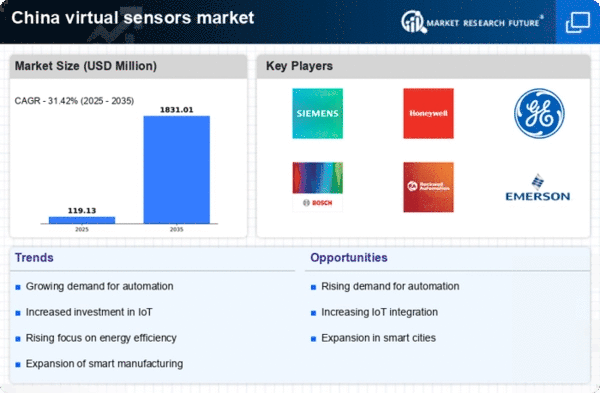
As per Market Research Future analysis, the China Virtual Sensors Market size was estimated at 90.65 USD Million in 2024. The Virtual Sensors market industry is projected to grow from 119.13 USD Million in 2025 to 1831.01 USD Million by 2035, exhibiting a compound annual growth rate (CAGR) of 31.4% during the forecast period 2025 - 2035

Key Market Trends & Highlights

The China virtual sensors market is poised for substantial growth driven by technological advancements and increasing demand for smart solutions.

  • Technological advancements are enhancing the capabilities of virtual sensors, leading to broader applications across various industries.
  • The manufacturing segment emerges as the largest, while the smart city segment is recognized as the fastest-growing in the market.
  • Regulatory support is fostering innovation and adoption of virtual sensors, particularly in urban development and industrial applications.
  • Rising demand for smart manufacturing and the expansion of the IoT ecosystem are key drivers propelling market growth.

Market Size & Forecast

2024 Market Size 90.65 (USD Million)
2035 Market Size 1831.01 (USD Million)
CAGR (2025 - 2035) 31.42%

Major Players

Siemens (DE), Honeywell (US), General Electric (US), Bosch (DE), Rockwell Automation (US), Emerson Electric (US), Schneider Electric (FR), ABB (CH), Texas Instruments (US)

Our Impact
Enabled $4.3B Revenue Impact for Fortune 500 and Leading Multinationals
Partnering with 2000+ Global Organizations Each Year
30K+ Citations by Top-Tier Firms in the Industry

China Virtual Sensors Market Trends

The China Virtual Sensors Market is experiencing notable growth, driven by advancements in technology and increasing demand for efficient data collection methods. In recent years, the integration of artificial intelligence and machine learning into sensor technology has enhanced the capabilities of virtual sensors, allowing for more accurate and real-time data analysis. This evolution is particularly relevant in sectors such as manufacturing, healthcare, and environmental monitoring, where the need for precise measurements and timely insights is paramount. Furthermore, the push towards smart cities and the Internet of Things (IoT) is propelling the adoption of virtual sensors, as they play a crucial role in optimizing resource management and improving overall operational efficiency. In addition, the regulatory environment in China is becoming increasingly supportive of innovative technologies, which bodes well for the virtual sensors market. Government initiatives aimed at promoting digital transformation and smart infrastructure are likely to create a conducive atmosphere for market expansion. As industries continue to embrace automation and data-driven decision-making, the reliance on virtual sensors is expected to grow. This trend indicates a shift towards more sustainable practices, as virtual sensors can contribute to energy efficiency and reduced waste, aligning with broader environmental goals. Overall, the future of the virtual sensors market appears promising, with significant opportunities for growth and innovation on the horizon.

Technological Advancements

The virtual sensors market is witnessing rapid technological advancements, particularly in the integration of AI and machine learning. These innovations enhance data accuracy and enable real-time analytics, making virtual sensors indispensable in various applications.

Regulatory Support

The regulatory landscape in China is increasingly favorable towards the adoption of innovative technologies. Government initiatives aimed at digital transformation are likely to bolster the virtual sensors market, encouraging industries to adopt these solutions.

Sustainability Focus

There is a growing emphasis on sustainability within the virtual sensors market. As industries seek to optimize resource management and reduce environmental impact, virtual sensors are becoming essential tools for achieving these objectives.

China Virtual Sensors Market Drivers

Emergence of Smart Cities

The emergence of smart cities in China is a significant driver for the virtual sensors market. As urbanization accelerates, cities are increasingly adopting smart technologies to enhance infrastructure, improve public services, and promote sustainability. Virtual sensors play a crucial role in smart city initiatives by providing real-time data on traffic, air quality, and energy consumption. This data is essential for effective urban planning and management. As of November 2025, it is estimated that over 100 cities in China are implementing smart city projects, creating a substantial demand for virtual sensors. The investment in smart city infrastructure is projected to exceed $300 billion in the coming years, further fueling the growth of the virtual sensors market. This trend indicates a promising future for virtual sensors as they become integral components of urban development strategies.

Expansion of IoT Ecosystem

The expansion of the Internet of Things (IoT) ecosystem in China is a critical driver for the virtual sensors market. With the proliferation of connected devices and the increasing interconnectivity of systems, the demand for virtual sensors is expected to rise. These sensors play a vital role in collecting and transmitting data from various IoT devices, facilitating seamless communication and integration. As of November 2025, it is estimated that the number of IoT devices in China has surpassed 1 billion, creating a vast landscape for virtual sensors to thrive. This growth in the IoT ecosystem not only enhances operational efficiency but also enables innovative applications across sectors such as healthcare, transportation, and smart cities. Therefore, the virtual sensors market is likely to see substantial growth as businesses and governments invest in IoT infrastructure.

Increased Investment in R&D

In China, the virtual sensors market is benefiting from increased investment in research and development (R&D) across various industries. Companies are recognizing the potential of virtual sensors to enhance product quality and operational efficiency, leading to a surge in funding for innovative sensor technologies. The Chinese government has also been supportive of R&D initiatives, allocating substantial resources to promote technological advancements. As a result, the market for virtual sensors is projected to grow significantly, with estimates suggesting a potential increase of 30% in R&D spending over the next few years. This investment is likely to foster the development of more sophisticated virtual sensors, further driving their adoption in sectors such as manufacturing, automotive, and energy. The emphasis on R&D is expected to position the virtual sensors market as a key player in China's technological landscape.

Growing Focus on Data Analytics

The virtual sensors market in China is increasingly influenced by the growing focus on data analytics across various sectors. Organizations are recognizing the importance of data-driven insights for decision-making and operational improvements. Virtual sensors facilitate the collection of vast amounts of data, which can be analyzed to derive actionable insights. As businesses strive to enhance their competitive edge, the demand for advanced data analytics solutions is expected to rise. In 2025, the data analytics market in China is projected to reach approximately $20 billion, indicating a robust growth trajectory. This trend is likely to drive the adoption of virtual sensors, as companies seek to harness the power of data analytics to optimize processes and improve customer experiences. Consequently, the virtual sensors market is positioned to benefit from this increasing emphasis on data-driven strategies.

Rising Demand for Smart Manufacturing

The virtual sensors market in China is experiencing a notable surge due to the increasing demand for smart manufacturing solutions. As industries strive for enhanced efficiency and productivity, the integration of virtual sensors into manufacturing processes appears to be a key strategy. These sensors facilitate real-time monitoring and data analysis, enabling manufacturers to optimize operations and reduce downtime. According to recent estimates, the smart manufacturing sector in China is projected to grow at a CAGR of approximately 25% over the next five years. This growth is likely to drive the adoption of virtual sensors, as companies seek to leverage advanced technologies to remain competitive in a rapidly evolving market. Consequently, the virtual sensors market is poised to benefit significantly from this trend, as manufacturers increasingly recognize the value of data-driven decision-making.


Market Segment Insights

By Type: Solutions (Largest) vs. Services (Fastest-Growing)

In the China virtual sensors market, Solutions holds the largest market share, reflecting its established presence and wide adoption across various industries. This segment benefits from a robust infrastructure that integrates advanced technology into operational processes, thereby enhancing efficiency and reliability. On the other hand, the Services segment is identified as the fastest-growing aspect of the market. This growth is driven by increasing demand for cloud-based integration and analytics services, which allow businesses to leverage real-time data. The rise of IoT applications also elevates the need for efficient service solutions, leading to substantial investment in this area.

Solutions (Dominant) vs. Services (Emerging)

The Solutions segment in the China virtual sensors market represents a dominant force, characterized by its comprehensive offerings that integrate hardware and software for seamless operation. Solutions are preferred for their reliability and proven effectiveness across sectors such as manufacturing and smart cities. In contrast, the Services segment is emerging rapidly, reflecting the shift towards service-based models which offer flexibility and scalability. Companies are increasingly investing in services that include remote monitoring, maintenance, and data analysis, which are critical for optimizing performance and fostering innovation. This dynamic creates a vibrant competitive landscape, where service providers are continuously enhancing their offerings to meet the evolving needs of clients.

By Deployment Mode: Cloud (Largest) vs. On-Premise (Fastest-Growing)

In the China virtual sensors market, the deployment mode segment is primarily dominated by cloud solutions, which capture a significant market share due to their scalability, flexibility, and lower upfront costs. Organizations are increasingly opting for cloud-based virtual sensors as they provide real-time data access, enhanced collaboration, and reduced maintenance challenges. On the other hand, on-premise solutions, though currently smaller in share, are witnessing a surge in adoption among enterprises requiring robust data security and compliance with local regulations. The growth trends in this segment are being driven by the rapid digital transformation across industries as businesses seek advanced data analytics and IoT integration. Cloud deployment is seeing a rise as compatibility with multiple devices and remote accessibility becomes a necessity in the modern enterprise landscape. Conversely, on-premise deployments are gaining traction as organizations aim to retain full control over their data processing and storage, responding to increasing privacy concerns and regulatory compliance requirements.

Deployment Mode: Cloud (Dominant) vs. On-Premise (Emerging)

Cloud deployment in the China virtual sensors market is recognized for its flexibility and cost-effectiveness, making it the dominant choice for many businesses looking to leverage virtual sensor technology. It allows for seamless integration with various platforms, providing users with real-time data insights that enhance operational efficiency. Additionally, the cloud's scalability enables organizations to expand their sensor networks easily. On the other hand, on-premise solutions are considered emerging, appealing to companies that prioritize stringent data security measures and prefer to manage their infrastructure. This segment is growing rapidly as firms in regulated industries recognize the need for robust data protection and compliance, thus opting for on-premise deployments to maintain closer oversight of their data.

By End User: Electronics (Largest) vs. Healthcare (Fastest-Growing)

The distribution of the China virtual sensors market across various end-user segments shows that the Electronics sector holds the largest share, driven by the rapid advancement of smart devices and IoT applications. Following closely, the Automotive & Transportation segment is also significant due to the increasing adoption of automated systems and electric vehicles. Other sectors like Healthcare and Manufacturing & Utilities continue to contribute to a growing market landscape, supported by technological integration. In terms of growth trends, the Healthcare segment is identified as the fastest-growing area within the China virtual sensors market, propelled by the rising demand for remote monitoring and patient management systems. The Automotive & Transportation sector is also expanding, fueled by innovations in autonomous driving and efficiency enhancements. Such trends highlight the ongoing digital transformation across various industries, significantly impacting sensor technology adoption and development.

Electronics: Dominant vs. Healthcare: Emerging

The Electronics segment stands out as the dominant force in the China virtual sensors market, leveraging advancements in technology to enhance device capabilities and functionality. This segment benefits from a wide array of applications, including smart homes and connected devices, which are increasingly incorporating virtual sensors for enhanced automation and user experience. Meanwhile, the Healthcare segment is emerging rapidly, focusing on patient-centric solutions through remote health monitoring systems. This growth is supported by significant investments in telemedicine and wearable technology, indicating a transition towards more integrated and real-time health management solutions. Both segments illustrate distinct characteristics, with Electronics thriving on broad applications and cascading technology, while Healthcare emphasizes innovative patient solutions.

Get more detailed insights about China Virtual Sensors Market

Key Players and Competitive Insights

The virtual sensors market in China is characterized by a dynamic competitive landscape, driven by rapid technological advancements and increasing demand for automation across various sectors. Key players such as Siemens (DE), Honeywell (US), and General Electric (US) are actively shaping the market through strategic initiatives focused on innovation and digital transformation. Siemens (DE) emphasizes its commitment to Industry 4.0, leveraging its expertise in automation and digitalization to enhance operational efficiency. Meanwhile, Honeywell (US) is concentrating on expanding its IoT capabilities, integrating advanced analytics to optimize sensor performance. General Electric (US) is also investing in smart sensor technologies, aiming to improve predictive maintenance and operational reliability, thereby collectively intensifying competition in the market.The business tactics employed by these companies reflect a trend towards localizing manufacturing and optimizing supply chains to enhance responsiveness to market demands. The competitive structure of the market appears moderately fragmented, with several players vying for market share. However, the influence of major companies is substantial, as they set benchmarks for innovation and operational excellence, thereby shaping the overall market dynamics.

In October Siemens (DE) announced a strategic partnership with a leading Chinese technology firm to develop next-generation virtual sensors tailored for smart manufacturing applications. This collaboration is expected to enhance Siemens' market presence in China, allowing for localized solutions that cater to specific industry needs. The strategic importance of this partnership lies in its potential to accelerate product development cycles and improve customer engagement through tailored offerings.

In September Honeywell (US) launched a new line of virtual sensors designed for environmental monitoring, targeting the growing demand for sustainability solutions in industrial operations. This initiative not only reinforces Honeywell's commitment to environmental stewardship but also positions the company as a leader in providing innovative solutions that address regulatory compliance and sustainability goals. The launch is likely to enhance Honeywell's competitive edge in a market increasingly focused on eco-friendly technologies.

In August General Electric (US) unveiled a comprehensive upgrade to its existing virtual sensor platform, incorporating advanced AI algorithms to enhance data analytics capabilities. This upgrade is significant as it allows for real-time monitoring and predictive insights, thereby improving operational efficiency for clients across various sectors. The integration of AI into their offerings suggests a strategic pivot towards more intelligent and autonomous systems, which could redefine competitive standards in the market.

As of November current trends in the virtual sensors market are heavily influenced by digitalization, sustainability, and the integration of AI technologies. Strategic alliances among key players are increasingly shaping the competitive landscape, fostering innovation and enhancing product offerings. Looking ahead, it is anticipated that competitive differentiation will evolve, with a shift from traditional price-based competition towards a focus on technological innovation, reliability in supply chains, and the ability to deliver customized solutions that meet the specific needs of diverse industries.

Key Companies in the China Virtual Sensors Market include

Industry Developments

The China Virtual Sensors Market has experienced significant developments recently, reflecting rapid technological advancements and increased demand across various sectors. Companies such as Honeywell, ZTE, and Huawei are actively participating in the evolution of this market by leveraging their expertise in Internet of Things (IoT) solutions and smart sensors. In particular, the growth of smart city initiatives in China has underscored the necessity for sophisticated virtual sensor technologies.

Additionally, in June 2023, STMicroelectronics reported a surge in market valuation due to its innovative virtual sensor solutions, impacting overall market dynamics positively. Acquisitions continue to shape the sector, with NXP Semiconductors acquiring a subsidiary of Renesas Electronics in July 2023, thereby expanding their footprint in the virtual sensor landscape. This strategic move is anticipated to enhance their capabilities in developing cutting-edge virtual sensor technologies. Such developments highlight the competitive nature of the China Virtual Sensors Market as it adapts to market needs and technological evolution.

Future Outlook

China Virtual Sensors Market Future Outlook

The virtual sensors market in China is projected to grow at a remarkable 31.42% CAGR from 2025 to 2035, driven by advancements in IoT, AI integration, and demand for real-time data analytics.

New opportunities lie in:

  • Development of AI-driven predictive maintenance solutions for industrial applications.
  • Integration of virtual sensors in smart city infrastructure for enhanced urban management.
  • Creation of customized virtual sensor solutions for agriculture to optimize resource usage.

By 2035, the virtual sensors market is expected to achieve substantial growth, positioning itself as a leader in technological innovation.

Market Segmentation

China Virtual Sensors Market Type Outlook

  • Solutions
  • Services

China Virtual Sensors Market End User Outlook

  • Electronics
  • Automotive & Transportation
  • Manufacturing & Utilities
  • Healthcare
  • Oil & Gas
  • Aerospace & Defense
  • Others

China Virtual Sensors Market Deployment Mode Outlook

  • Cloud
  • On-Premise

Report Scope

MARKET SIZE 2024 90.65(USD Million)
MARKET SIZE 2025 119.13(USD Million)
MARKET SIZE 2035 1831.01(USD Million)
COMPOUND ANNUAL GROWTH RATE (CAGR) 31.42% (2025 - 2035)
REPORT COVERAGE Revenue Forecast, Competitive Landscape, Growth Factors, and Trends
BASE YEAR 2024
Market Forecast Period 2025 - 2035
Historical Data 2019 - 2024
Market Forecast Units USD Million
Key Companies Profiled Siemens (DE), Honeywell (US), General Electric (US), Bosch (DE), Rockwell Automation (US), Emerson Electric (US), Schneider Electric (FR), ABB (CH), Texas Instruments (US)
Segments Covered Type, Deployment Mode, End User
Key Market Opportunities Integration of artificial intelligence in virtual sensors enhances data accuracy and operational efficiency.
Key Market Dynamics Rising demand for smart manufacturing drives innovation in virtual sensors, enhancing operational efficiency across industries.
Countries Covered China
Leave a Comment

FAQs

What is the expected market size of the China Virtual Sensors Market in 2024?

The market is expected to be valued at 95.0 million USD in 2024.

What will be the projected market size of the China Virtual Sensors Market by 2035?

By 2035, the market is anticipated to reach a value of 2040.0 million USD.

What is the compound annual growth rate (CAGR) for the China Virtual Sensors Market from 2025 to 2035?

The expected CAGR for the market during this period is 32.155%.

How is the market size for virtual sensors services expected to change by 2035?

The market size for services is projected to grow from 57.0 million USD in 2024 to 1200.0 million USD by 2035.

What are the key players in the China Virtual Sensors Market?

Major players in the market include Honeywell, ZTE, Huawei, and Siemens among others.

What is the projected market size for solutions within the China Virtual Sensors Market by 2035?

The market size for solutions is expected to increase from 38.0 million USD in 2024 to 840.0 million USD in 2035.

What are the emerging trends in the China Virtual Sensors Market?

Emerging trends include increasing demand for smart technologies and the integration of virtual sensors in various applications.

How does the China Virtual Sensors Market's growth rate compare across different regions?

The growth rate in China is notably high, driven by technological advancements and increased industrial automation.

What challenges are currently facing the China Virtual Sensors Market?

Challenges include competition from traditional sensor technology and the need for regulatory compliance.

What opportunities exist for companies looking to enter the China Virtual Sensors Market?

Opportunities lie in the expanding applications of virtual sensors in industries such as manufacturing, healthcare, and smart buildings.

Download Free Sample

Kindly complete the form below to receive a free sample of this Report

Compare Licence

×
Features License Type
Single User Multiuser License Enterprise User
Price $4,950 $5,950 $7,250
Maximum User Access Limit 1 User Upto 10 Users Unrestricted Access Throughout the Organization
Free Customization
Direct Access to Analyst
Deliverable Format
Platform Access
Discount on Next Purchase 10% 15% 15%
Printable Versions