×
Request Free Sample ×

Kindly complete the form below to receive a free sample of this Report

* Please use a valid business email

Leading companies partner with us for data-driven Insights

clients tt-cursor
Hero Background

China Teleradiology Market

ID: MRFR/HC/49969-HCR
200 Pages
Rahul Gotadki
February 2026

China Teleradiology Market Research Report By Application (Bone Imaging, Cardiac Imaging, Neuroimaging, Oncology Imaging, Chest Imaging), By Modality (X-Ray, CT Scan, MRI, Ultrasound, Nuclear Medicine), By End Use (Hospitals, Diagnostic Imaging Centers, Research Organizations, Home Healthcare, Emergency Care) and By Configuration (Cloud-Based, Web-Based, Standalone) - Growth & Industry Forecast 2025 To 2035

Share:
Download PDF ×

We do not share your information with anyone. However, we may send you emails based on your report interest from time to time. You may contact us at any time to opt-out.

China Teleradiology Market Infographic
Purchase Options

China Teleradiology Market Summary

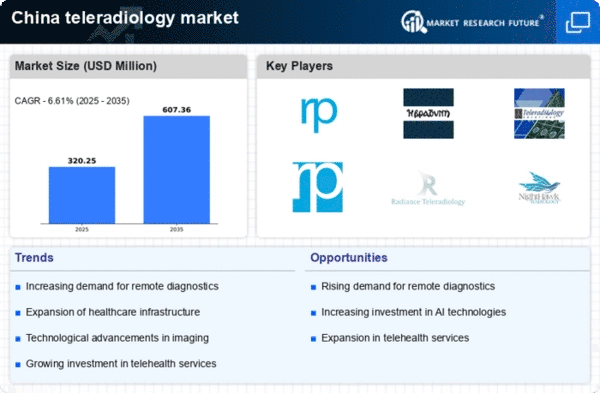
As per Market Research Future analysis, the China teleradiology market Size was estimated at 300.39 USD Million in 2024. The China teleradiology market is projected to grow from 320.25 USD Million in 2025 to 607.36 USD Million by 2035, exhibiting a compound annual growth rate (CAGR) of 6.6% during the forecast period 2025 - 2035

Key Market Trends & Highlights

The China teleradiology market is poised for substantial growth driven by technological advancements and increasing demand for remote healthcare services.

  • Technological advancements are enhancing the efficiency and accuracy of teleradiology services.
  • The regulatory support from the government is fostering a conducive environment for market expansion.
  • The largest segment in the market is the diagnostic imaging segment, while the fastest-growing segment is teleconsultation services.
  • Key market drivers include increasing healthcare accessibility and the integration of artificial intelligence in radiology.

Market Size & Forecast

2024 Market Size 300.39 (USD Million)
2035 Market Size 607.36 (USD Million)
CAGR (2025 - 2035) 6.61%

Major Players

Radiology Partners (US), vRad (US), Teleradiology Solutions (IN), Mednax (US), TeleRadiology (US), Nighthawk Radiology (US), Global Diagnostics (AU), Onrad (US)

Our Impact
Enabled $4.3B Revenue Impact for Fortune 500 and Leading Multinationals
Partnering with 2000+ Global Organizations Each Year
30K+ Citations by Top-Tier Firms in the Industry

China Teleradiology Market Trends

The teleradiology market is currently experiencing notable growth, driven by advancements in technology and increasing demand for remote diagnostic services. The integration of artificial intelligence and machine learning into imaging processes appears to enhance the accuracy and efficiency of radiological assessments. Furthermore, the rising prevalence of chronic diseases necessitates timely and effective imaging solutions, which teleradiology can provide. As healthcare systems evolve, the need for accessible and rapid diagnostic services is becoming more pronounced, suggesting a robust future for this sector. In addition, regulatory frameworks are adapting to support the expansion of teleradiology services. Policies aimed at improving healthcare access and quality are likely to facilitate the adoption of remote imaging solutions. This shift may lead to increased collaboration between healthcare providers and technology firms, fostering innovation in service delivery. Overall, the teleradiology market is poised for significant transformation, with a focus on enhancing patient outcomes and operational efficiencies across healthcare settings.

Technological Advancements

The teleradiology market is witnessing rapid technological advancements that enhance diagnostic capabilities. Innovations such as cloud computing and mobile applications are streamlining the process of image transmission and interpretation. These developments not only improve the speed of service delivery but also facilitate remote consultations, thereby expanding access to specialized care.

Regulatory Support

Regulatory bodies are increasingly recognizing the importance of teleradiology in improving healthcare access. New policies are being implemented to support the integration of remote imaging services into standard healthcare practices. This regulatory support is likely to encourage healthcare providers to adopt teleradiology solutions, thereby expanding the market.

Growing Demand for Remote Services

There is a rising demand for remote diagnostic services within the teleradiology market. Factors such as an aging population and the prevalence of chronic diseases are driving this trend. Patients and healthcare providers alike are seeking efficient and timely imaging solutions, which teleradiology can effectively deliver.

China Teleradiology Market Drivers

Government Initiatives and Funding

Government initiatives aimed at enhancing healthcare infrastructure are playing a crucial role in the teleradiology market in China. Increased funding for telehealth services and digital health technologies is facilitating the adoption of teleradiology solutions across various healthcare settings. The Chinese government has recognized the importance of telemedicine in improving healthcare delivery, leading to policies that support the integration of teleradiology into the national healthcare framework. This support is expected to bolster market growth, with investments projected to reach $1 billion by 2027. Such initiatives are likely to create a favorable environment for the expansion of teleradiology services.

Increasing Healthcare Accessibility

The teleradiology market in China is experiencing growth due to the increasing demand for accessible healthcare services. With a vast population and a significant rural demographic, the need for remote diagnostic services is paramount. Teleradiology enables healthcare providers to deliver timely radiological services to patients in remote areas, thereby improving patient outcomes. The market is projected to expand as more healthcare facilities adopt teleradiology solutions, with estimates suggesting a growth rate of approximately 15% annually. This trend indicates a shift towards more inclusive healthcare delivery models, which is essential for addressing the disparities in healthcare access across different regions of China.

Rising Incidence of Chronic Diseases

The teleradiology market in China is significantly influenced by the rising incidence of chronic diseases, such as cardiovascular conditions and cancer. As these diseases require regular monitoring and imaging, the demand for teleradiology services is expected to surge. Reports indicate that chronic diseases account for over 80% of healthcare expenditures in China, necessitating efficient diagnostic solutions. Teleradiology provides a viable option for continuous monitoring and timely intervention, thereby supporting the healthcare system in managing these conditions effectively. This trend is likely to drive market growth as healthcare providers seek innovative solutions to meet the increasing demand.

Integration of Artificial Intelligence

The integration of artificial intelligence (AI) technologies into the teleradiology market is transforming diagnostic processes in China. AI algorithms enhance image analysis, leading to quicker and more accurate interpretations of radiological data. This technological advancement not only improves diagnostic accuracy but also increases the efficiency of radiologists, allowing them to handle larger volumes of cases. As AI continues to evolve, its application in teleradiology is expected to grow, potentially increasing market revenues by up to 20% over the next few years. The synergy between AI and teleradiology is likely to redefine standards of care in the industry.

Growing Awareness of Preventive Healthcare

There is a notable shift towards preventive healthcare in China, which is positively impacting the teleradiology market. As the population becomes more health-conscious, there is an increasing emphasis on early detection and diagnosis of diseases. Teleradiology facilitates this preventive approach by providing timely access to imaging services, enabling healthcare providers to identify potential health issues before they escalate. This growing awareness is likely to drive demand for teleradiology services, with market analysts predicting a growth rate of around 12% in the coming years. The focus on preventive healthcare aligns with broader public health goals, further supporting the expansion of the teleradiology market.


Market Segment Insights

By Application: Neuroimaging (Largest) vs. Oncology Imaging (Fastest-Growing)

In the China teleradiology market, Neuroimaging holds a prominent share, dominating the application landscape alongside Bone Imaging and Chest Imaging. Cardiac Imaging also remains relevant but takes a smaller foothold in comparison. Oncology Imaging, while currently less dominant, is gaining traction due to increasing awareness and advancements in technology that enhance diagnostic capabilities. Growth trends show that Oncology Imaging is evolving rapidly, driven by rising cancer incidences and improvements in imaging technologies. The demand for non-invasive diagnostic procedures is propelling its expansion, making it the fastest-growing segment. Neuroimaging, on the other hand, benefits from continuous investments in research and development, ensuring its firm position in the market.

Neuroimaging (Dominant) vs. Oncology Imaging (Emerging)

Neuroimaging serves as the dominant application within the China teleradiology market, leveraging advanced technology for enhanced diagnostics in neurological disorders. Its established position benefits from a robust infrastructure and increasing acceptance among healthcare professionals. In contrast, Oncology Imaging is emerging rapidly, focusing on improved cancer detection and treatment planning. This segment is characterized by a surge in innovative imaging techniques and a growing network of specialized services catering to oncology. Notably, the shift towards personalized medicine is propelling demand for Oncology Imaging, where early detection plays a crucial role, contrasting the well-entrenched presence of Neuroimaging.

By Modality: CT Scan (Largest) vs. MRI (Fastest-Growing)

In the China teleradiology market, the market share is largely dominated by CT Scan, which is noted for its efficiency and accuracy in diagnosing various medical conditions. The modality accounts for a significant portion of the overall market share, driven by its widespread adoption in hospitals and healthcare facilities across the region. Following closely, MRI has shown a notable rise in its market presence, gaining traction due to its advanced imaging capabilities that are expanding into new clinical applications. Growth trends in this segment indicate a rising demand for high-resolution imaging techniques such as MRI and Ultrasound, facilitated by technological advancements and an increasing emphasis on preventive healthcare. Factors such as the aging population and growing prevalence of chronic diseases are further propelling the adoption of these modalities. The integration of AI and machine learning in imaging processes is expected to enhance diagnostic accuracy, thus boosting growth in the China teleradiology market.

CT Scan (Dominant) vs. Ultrasound (Emerging)

CT Scan is firmly established as the dominant modality within the China teleradiology market, favored for its rapid imaging capabilities and comprehensive diagnostic information. It is particularly utilized in emergency settings and complex cases, providing detailed cross-sectional images that are crucial for accurate diagnosis. In contrast, Ultrasound, while emerging, is gaining popularity due to its non-invasive nature and real-time imaging advantage. Its applicability in various fields such as obstetrics and cardiology positions it as a valuable tool in routine examinations. The evolving technology in Ultrasound, such as 3D and Doppler imaging, is expanding its utility, making it a compelling option for healthcare providers aiming to enhance patient care.

By End Use: Hospitals (Largest) vs. Emergency Care (Fastest-Growing)

In the China teleradiology market, hospitals represent the largest segment, accounting for a significant share of operations due to their crucial role in patient diagnostics and treatment. Following hospitals, diagnostic imaging centers and research organizations also contribute importantly, but their market shares are relatively smaller compared to the hospital segment. Home healthcare and emergency care segments are smaller but rapidly evolving, catering to specific healthcare needs and convenience for patients. Growth trends show that while hospitals continue to dominate, the emerging demand for teleradiology services in emergency care is noteworthy, as it addresses urgent and critical diagnostic needs. Advances in technology, such as improved imaging techniques and artificial intelligence integration, are driving growth across all segments. The shift toward decentralized healthcare solutions and rising patient expectations for timely diagnoses are further propelling the expansion of both hospitals and the fastest-growing emergency care services.

Hospitals (Dominant) vs. Emergency Care (Emerging)

Hospitals are the dominant players in the China teleradiology market due to their capacity for large-scale diagnostics and treatment functions. They utilize advanced technologies for efficient imaging and patient care, ensuring high accuracy and speed in diagnostic processes. Conversely, emergency care is identified as an emerging sector within the market, driven by the growing need for rapid response and efficient diagnostic services for acute conditions. This segment leverages telemedicine technologies to provide timely imaging services, enhancing patient outcomes in crises. Both segments are essential, with hospitals focusing on comprehensive care while emergency services rapidly adapt to the need for immediacy and efficiency in healthcare delivery.

By Configuration: Cloud-Based (Largest) vs. Web-Based (Fastest-Growing)

In the China teleradiology market, the configuration segment has seen significant differentiation among its values. Cloud-based solutions currently hold the largest share, appealing to healthcare institutions for their flexibility and scalability. Web-based systems follow closely, becoming increasingly popular due to their accessibility and user-friendly interfaces. Standalone systems, while present, have a limited market share in contrast to their cloud and web counterparts, primarily due to evolving technology preferences among users. Growth trends in this segment are driven by the increasing adoption of digital solutions and the push for improved healthcare delivery. Cloud-based systems are favored for their robust data management capabilities, while web-based formats are embraced for their ease of use in remote conditions. Emerging technologies such as AI and telecommunication advancements are expected to foster further growth, particularly in web-based systems, which cater to the rising demand for remote diagnostics and virtual consultations.

Cloud-Based (Dominant) vs. Web-Based (Emerging)

Cloud-based teleradiology solutions dominate the China teleradiology market, providing vast advantages in data management, storage solutions, and operational efficiency. Their ability to integrate with existing systems allows for seamless workflow and heightened collaboration among healthcare professionals. In contrast, web-based teleradiology systems are emerging as vital alternatives, characterized by their accessibility and lower upfront costs. These systems facilitate remote access to radiology services, crucial for areas with limited specialist availability. As telemedicine gains traction, both segment values are poised for growth, with cloud-based solutions retaining dominance while web-based options rapidly expand in relevance, particularly in rural and underserved regions.

Get more detailed insights about China Teleradiology Market

Key Players and Competitive Insights

The teleradiology market in China is characterized by a dynamic competitive landscape, driven by technological advancements and an increasing demand for remote diagnostic services. Key players such as Radiology Partners (US), Teleradiology Solutions (IN), and Nighthawk Radiology (US) are actively shaping the market through strategic initiatives. Radiology Partners (US) focuses on expanding its service offerings and enhancing its technological capabilities, which positions it as a leader in the sector. Meanwhile, Teleradiology Solutions (IN) emphasizes partnerships with local healthcare providers to enhance its market penetration, while Nighthawk Radiology (US) is leveraging its expertise in AI-driven diagnostics to improve efficiency and accuracy in radiological assessments.The business tactics employed by these companies reflect a trend towards localization and optimization of supply chains. The market appears moderately fragmented, with several players vying for market share. However, the collective influence of these key players is significant, as they drive innovation and set benchmarks for service quality and operational efficiency. This competitive structure suggests that while there is room for new entrants, established companies maintain a stronghold through their advanced technologies and strategic partnerships.

In October Radiology Partners (US) announced a collaboration with a leading AI technology firm to enhance its diagnostic capabilities. This strategic move is likely to bolster its competitive edge by integrating cutting-edge AI tools into its workflow, thereby improving diagnostic accuracy and turnaround times. Such advancements may not only attract more healthcare facilities but also enhance patient outcomes, reinforcing the company's market position.

In September Teleradiology Solutions (IN) expanded its operations into several provinces in China, establishing partnerships with local hospitals. This expansion is indicative of a strategic focus on regional growth, allowing the company to tap into the burgeoning demand for teleradiology services in underserved areas. By localizing its services, Teleradiology Solutions (IN) is likely to enhance its service delivery and responsiveness to local healthcare needs, which could lead to increased market share.

In August Nighthawk Radiology (US) launched a new telehealth platform aimed at streamlining the radiology reporting process. This initiative reflects a broader trend towards digital transformation within the industry, as companies seek to enhance operational efficiencies and improve user experiences. The introduction of such platforms may facilitate better communication between radiologists and healthcare providers, ultimately leading to improved patient care.

As of November the teleradiology market is witnessing trends such as digitalization, AI integration, and a growing emphasis on sustainability. Strategic alliances among key players are increasingly shaping the competitive landscape, fostering innovation and collaboration. The shift from price-based competition to a focus on technological advancements and supply chain reliability is evident, suggesting that future competitive differentiation will hinge on the ability to innovate and adapt to evolving market demands.

Key Companies in the China Teleradiology Market include

Industry Developments

In recent developments within the China Teleradiology Market, significant activity has been observed from companies such as Philips Healthcare, Siemens Healthineers, and United Imaging Healthcare, particularly in the sector of AI-assisted imaging technologies in response to increasing demand for remote diagnostic services. In October 2023, Zhongguancun Teleradiology announced a collaboration with CureMetrix to enhance AI-based diagnostic tools. Notably, in June 2023, Ping An Technology partnered with Neusoft Medical Systems to improve telehealth services, reinforcing the market's emphasis on integrated health solutions. 

The market's growth is underpinned by increasing healthcare access in rural areas, supported by Chinese government initiatives to expand telemedicine infrastructure. The overall valuation of the China Teleradiology Market has seen an upsurge due to these advancements, with estimates suggesting a notable increase in market size driven by rising healthcare investments and technological innovation. Furthermore, the consolidation trend is notable with Fujifilm Holdings exploring strategic partnerships to enhance its presence in this competitive landscape, illustrating the dynamic shifts occurring in the industry.

Future Outlook

China Teleradiology Market Future Outlook

The Teleradiology Market in China is projected to grow at a 6.61% CAGR from 2025 to 2035, driven by technological advancements, increasing healthcare demands, and enhanced diagnostic capabilities.

New opportunities lie in:

  • Development of AI-driven diagnostic tools for faster image analysis.
  • Expansion of telehealth services to rural and underserved areas.
  • Partnerships with local hospitals for integrated teleradiology solutions.

By 2035, the teleradiology market is expected to achieve substantial growth and innovation.

Market Segmentation

China Teleradiology Market End Use Outlook

  • Hospitals
  • Diagnostic Imaging Centers
  • Research Organizations
  • Home Healthcare
  • Emergency Care

China Teleradiology Market Modality Outlook

  • X-Ray
  • CT Scan
  • MRI
  • Ultrasound
  • Nuclear Medicine

China Teleradiology Market Application Outlook

  • Bone Imaging
  • Cardiac Imaging
  • Neuroimaging
  • Oncology Imaging
  • Chest Imaging

China Teleradiology Market Configuration Outlook

  • Cloud-Based
  • Web-Based
  • Standalone

Report Scope

MARKET SIZE 2024 300.39(USD Million)
MARKET SIZE 2025 320.25(USD Million)
MARKET SIZE 2035 607.36(USD Million)
COMPOUND ANNUAL GROWTH RATE (CAGR) 6.61% (2025 - 2035)
REPORT COVERAGE Revenue Forecast, Competitive Landscape, Growth Factors, and Trends
BASE YEAR 2024
Market Forecast Period 2025 - 2035
Historical Data 2019 - 2024
Market Forecast Units USD Million
Key Companies Profiled Radiology Partners (US), vRad (US), Teleradiology Solutions (IN), Mednax (US), TeleRadiology (US), Nighthawk Radiology (US), Global Diagnostics (AU), Onrad (US)
Segments Covered Application, Modality, End Use, Configuration
Key Market Opportunities Integration of artificial intelligence enhances diagnostic accuracy in the teleradiology market.

Key Market Dynamics Rapid technological advancements and regulatory changes are reshaping the teleradiology market dynamics in China.
Countries Covered China
Leave a Comment

FAQs

What is the projected market size of the China Teleradiology Market in 2024?

The China Teleradiology Market is projected to be valued at 300.0 million USD in 2024.

How much is the China Teleradiology Market expected to grow by 2035?

By 2035, the China Teleradiology Market is expected to reach a value of 600.0 million USD.

What is the expected CAGR for the China Teleradiology Market from 2025 to 2035?

The expected CAGR for the China Teleradiology Market from 2025 to 2035 is 6.504%.

Which application segment is expected to dominate the China Teleradiology Market in 2024?

Bone Imaging is expected to dominate the Teleradiology Market with a value of 80.0 million USD in 2024.

What will be the market size for Cardiac Imaging in the China Teleradiology Market by 2035?

The market size for Cardiac Imaging in the China Teleradiology Market is projected to be 120.0 million USD by 2035.

What key players are dominating the China Teleradiology Market?

Key players in the China Teleradiology Market include Siemens Healthineers, Philips Healthcare, and GE Healthcare among others.

What is the projected market size for Oncology Imaging in 2024?

Oncology Imaging is projected to be valued at 70.0 million USD in the China Teleradiology Market in 2024.

How much is the Neuroimaging segment expected to grow by 2035?

The Neuroimaging segment is expected to grow to 100.0 million USD in the China Teleradiology Market by 2035.

What challenges could impact the growth of the China Teleradiology Market?

Challenges impacting the market growth may include regulatory hurdles and integration of technology in hospitals.

What is the market outlook for Chest Imaging in the China Teleradiology Market by 2035?

The Chest Imaging segment is projected to reach a market size of 80.0 million USD by 2035.

Download Free Sample

Kindly complete the form below to receive a free sample of this Report

Compare Licence

×
Features License Type
Single User Multiuser License Enterprise User
Price $4,950 $5,950 $7,250
Maximum User Access Limit 1 User Upto 10 Users Unrestricted Access Throughout the Organization
Free Customization
Direct Access to Analyst
Deliverable Format
Platform Access
Discount on Next Purchase 10% 15% 15%
Printable Versions