×
Request Free Sample ×

Kindly complete the form below to receive a free sample of this Report

* Please use a valid business email

Leading companies partner with us for data-driven Insights

clients tt-cursor
Hero Background

China Single Photon Emission Computed Tomography Market

ID: MRFR/HC/48648-HCR
200 Pages
Rahul Gotadki
February 2026

China Single Photon Emission Computed Tomography Market Research Report: Size, Share, Trend Analysis By Types (Hybrid SPECT Systems, Standalone SPECT System), By Applications (Oncology, Cardiology, Neurology) and By End Users (Hospitals, Diagnostic Imaging Centers) - Growth Outlook & Industry Forecast 2025 To 2035

Share:
Download PDF ×

We do not share your information with anyone. However, we may send you emails based on your report interest from time to time. You may contact us at any time to opt-out.

China Single Photon Emission Computed Tomography Market Infographic
Purchase Options

China Single Photon Emission Computed Tomography Market Summary

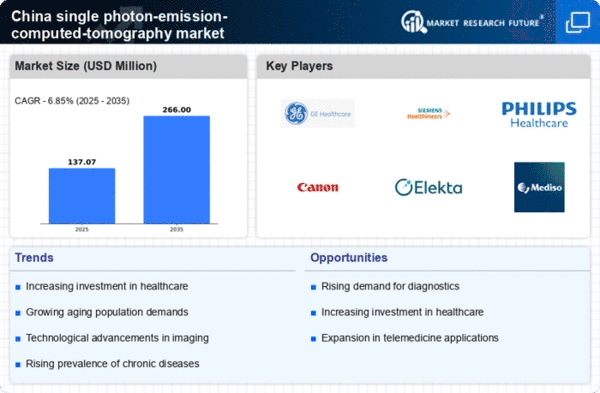
As per Market Research Future analysis, the China Single Photon Emission Computed Tomography Market size was estimated at 128.28 USD Million in 2024. The Single Photon-emission-computed-tomography market is projected to grow from 137.07 USD Million in 2025 to 266.0 USD Million by 2035, exhibiting a compound annual growth rate (CAGR) of 6.8% during the forecast period 2025 - 2035

Key Market Trends & Highlights

The China single photon-emission-computed-tomography market is poised for substantial growth driven by technological advancements and increasing healthcare demands.

  • Technological advancements in imaging techniques are enhancing the accuracy and efficiency of single photon-emission-computed-tomography systems.
  • The largest segment in the market is expected to be oncology, while the fastest-growing segment is anticipated to be cardiology.
  • Regulatory support is fostering innovation and adoption of advanced imaging technologies across healthcare facilities.
  • Key market drivers include increasing healthcare expenditure and a rising aging population, which are likely to boost demand for diagnostic imaging services.

Market Size & Forecast

2024 Market Size 128.28 (USD Million)
2035 Market Size 266.0 (USD Million)
CAGR (2025 - 2035) 6.85%

Major Players

GE Healthcare (US), Siemens Healthineers (DE), Philips Healthcare (NL), Canon Medical Systems (JP), Elekta (SE), Mediso Medical Imaging Systems (HU), Spectrum Dynamics Medical (US), Nuclear Imaging Systems (US)

Our Impact
Enabled $4.3B Revenue Impact for Fortune 500 and Leading Multinationals
Partnering with 2000+ Global Organizations Each Year
30K+ Citations by Top-Tier Firms in the Industry

China Single Photon Emission Computed Tomography Market Trends

The single photon-emission-computed-tomography market is experiencing notable advancements, driven by increasing demand for precise diagnostic imaging techniques. This technology, which allows for the visualization of metabolic processes in the body, is becoming increasingly vital in the fields of oncology, cardiology, and neurology. The integration of advanced imaging technologies and artificial intelligence is enhancing the capabilities of single photon-emission-computed-tomography systems, leading to improved accuracy and efficiency in patient diagnosis. Furthermore, the growing prevalence of chronic diseases in the population is likely to propel the adoption of this imaging modality, as healthcare providers seek effective tools for early detection and treatment planning. In addition, the regulatory environment in China appears to be evolving, with government initiatives aimed at promoting advanced medical technologies. This supportive framework may facilitate the China Single Photon Emission Computed Tomography Market, thereby fostering competition and driving down costs. As healthcare infrastructure continues to improve, particularly in urban areas, access to advanced imaging services is expected to expand. Overall, the single photon-emission-computed-tomography market is poised for growth, reflecting broader trends in healthcare towards precision medicine and enhanced diagnostic capabilities.

Technological Advancements

The single photon-emission-computed-tomography market is witnessing rapid technological innovations. Enhanced imaging systems are being developed, incorporating advanced detectors and software algorithms. These improvements are likely to increase the resolution and speed of imaging, thereby facilitating better diagnostic outcomes.

Regulatory Support

The regulatory landscape is becoming increasingly favorable for the single photon-emission-computed-tomography market. Government initiatives aimed at promoting advanced medical technologies may lead to streamlined approval processes for new devices, encouraging innovation and market entry.

Rising Demand for Early Diagnosis

There is a growing emphasis on early diagnosis in the healthcare sector, particularly for chronic diseases. This trend is expected to drive the demand for single photon-emission-computed-tomography systems, as they provide critical insights into metabolic functions, aiding in timely treatment decisions.

China Single Photon Emission Computed Tomography Market Drivers

Aging Population

China's aging population is a significant factor influencing the single photon-emission-computed-tomography market. With an increasing number of elderly individuals, the prevalence of chronic diseases such as cardiovascular disorders and cancer is also on the rise. According to recent statistics, by 2025, it is projected that over 300 million people in China will be aged 60 and above. This demographic shift necessitates advanced diagnostic imaging technologies to facilitate early detection and treatment of diseases. Consequently, healthcare providers are likely to invest more in single photon-emission-computed-tomography systems to cater to the diagnostic needs of this growing population segment, thereby driving market expansion.

Increasing Healthcare Expenditure

The rising healthcare expenditure in China is a pivotal driver for the single photon-emission-computed-tomography market. As the government allocates more funds towards healthcare, the demand for advanced diagnostic tools, including single photon-emission-computed-tomography systems, is likely to increase. In 2023, healthcare spending in China reached approximately $1.2 trillion, reflecting a growth rate of around 10% annually. This trend suggests that hospitals and diagnostic centers are more inclined to invest in cutting-edge technologies to enhance patient care. Furthermore, the emphasis on improving healthcare infrastructure and expanding access to medical services may lead to a higher adoption rate of single photon-emission-computed-tomography systems, thereby propelling market growth in the coming years.

Rising Awareness of Diagnostic Imaging

There is a growing awareness among healthcare professionals and patients regarding the benefits of diagnostic imaging, which serves as a catalyst for the single photon-emission-computed-tomography market. Educational campaigns and training programs are being conducted to inform stakeholders about the advantages of early diagnosis and the role of advanced imaging techniques. This heightened awareness is likely to drive demand for single photon-emission-computed-tomography systems, as healthcare providers seek to offer comprehensive diagnostic services. Furthermore, as patients become more informed about their health options, they may advocate for advanced imaging solutions, further propelling market growth.

Technological Integration in Healthcare

The integration of advanced technologies in healthcare is transforming the landscape of medical diagnostics in China, thereby impacting the single photon-emission-computed-tomography market. Innovations such as artificial intelligence and machine learning are being incorporated into imaging systems to enhance diagnostic accuracy and efficiency. Hospitals are increasingly adopting these technologies to streamline operations and improve patient outcomes. For instance, the use of AI algorithms in analyzing single photon-emission-computed-tomography images can significantly reduce interpretation time and increase diagnostic confidence. This trend indicates a potential for market growth as healthcare facilities seek to leverage technology to provide superior diagnostic services.

Government Initiatives for Healthcare Improvement

The Chinese government has implemented various initiatives aimed at improving healthcare services, which positively affects the single photon-emission-computed-tomography market. Policies promoting the adoption of advanced medical technologies are being prioritized to enhance diagnostic capabilities across the nation. For example, the Healthy China 2030 initiative emphasizes the importance of early disease detection and prevention, which aligns with the capabilities of single photon-emission-computed-tomography systems. As a result, hospitals and clinics are likely to receive support for acquiring these technologies, leading to increased market penetration and growth opportunities in the sector.


Market Segment Insights

By Type: Hybrid SPECT Systems (Largest) vs. Standalone SPECT System (Fastest-Growing)

In the China single photon-emission-computed-tomography market, Hybrid SPECT Systems hold the largest market share, dominating the landscape due to their advanced capabilities and integration with other imaging technologies. This segment benefits from a growing demand driven by improved diagnostic accuracy and the ability to perform multiple imaging modalities efficiently, making it a favored choice among healthcare facilities. On the other hand, Standalone SPECT Systems are emerging as the fastest-growing segment in the market. This growth is propelled by innovations that enhance system performance and lower operational costs, making these systems increasingly accessible to smaller healthcare providers. The rising prevalence of chronic diseases and increased funding for medical imaging technologies further stimulates this segment's expansion.

Hybrid SPECT Systems (Dominant) vs. Standalone SPECT System (Emerging)

Hybrid SPECT Systems are recognized for their superior performance and versatility in diagnostic imaging, enabling clinicians to obtain comprehensive patient data rapidly. These systems integrate SPECT with CT technologies, which significantly enhances anatomical localization, aiding in better treatment planning and patient management. The wide adoption of this technology in major hospitals is a testament to its dominance. Conversely, Standalone SPECT Systems are carving out their niche by providing targeted imaging solutions at lower costs, making them particularly appealing to smaller medical institutions. These systems are often favored for routine imaging applications due to their user-friendly designs and cost-effectiveness, driving their emergence in the competitive landscape.

By Application: Oncology (Largest) vs. Cardiology (Fastest-Growing)

In the China single photon-emission-computed-tomography market, the distribution of market share among the application segments reveals Oncology as the most significant area, commanding a substantial presence. Cardiology and Neurology also contribute notably, yet their shares are relatively smaller, especially in comparison to the dominant Oncology segment. The demand for improved diagnostic solutions in these fields drives their respective market positions, depicting a comprehensive landscape of therapeutic priorities. Growth trends indicate that Cardiology is experiencing rapid expansion, outpacing other segments as advancements in imaging technology enhance diagnostic capabilities. Driven by an aging population and increasing prevalence of cardiovascular diseases, the Cardiology segment's demand is expected to soar. Meanwhile, Oncology remains strong due to ongoing investments in targeted therapies and innovative imaging techniques, making it a critical focus within the healthcare infrastructure.

Oncology (Dominant) vs. Cardiology (Emerging)

Oncology stands as the dominant application segment in the China single photon-emission-computed-tomography market, primarily driven by the escalating need for precise cancer diagnosis and treatment monitoring. This segment benefits from continuous technological advancements and increased awareness regarding early cancer detection. In contrast, Cardiology is viewed as an emerging segment, rapidly gaining traction due to rising incidences of cardiac diseases and innovations in cardiac imaging. While Oncology enjoys a more established position, Cardiology's growth potential is bolstered by advancements in interventional procedures and a focus on patient-centric solutions. The dual dynamics of these segments illustrate a strong future for diagnostic technologies in both cancer and heart-related disorders.

By End-User: Hospitals (Largest) vs. Diagnostic Imaging Centers (Fastest-Growing)

In the China single photon-emission-computed-tomography market, hospitals constitute the largest segment, commanding a significant share due to their established infrastructure and comprehensive healthcare services. These facilities benefit from high patient volumes and ongoing investments in advanced imaging technologies, making them pivotal players in the market. Meanwhile, diagnostic imaging centers are rapidly gaining traction, driven by the increasing demand for specialized medical services and outpatient care solutions that enhance patient access and convenience. Growth trends in this segment are positively influenced by technological advancements in imaging modalities, improving diagnostic accuracy and efficiency. The rising prevalence of chronic diseases and the aging population are propelling the demand for medical imaging services. Furthermore, government initiatives aimed at improving healthcare infrastructure and funding are expected to further support the expansion of both hospitals and diagnostic imaging centers in the market.

Hospitals (Dominant) vs. Diagnostic Imaging Centers (Emerging)

Hospitals are recognized as the dominant force in the China single photon-emission-computed-tomography market due to their capacity to provide comprehensive diagnostic services and cater to a high volume of patients. They have the advantage of established operations, skilled medical staff, and integrated healthcare services that enhance patient throughput. In contrast, diagnostic imaging centers represent an emerging segment characterized by specialized services and a focus on outpatient care. These centers are increasingly adopting advanced imaging technologies to provide innovative solutions that meet the growing demand for efficient and accessible diagnostic services. Their agility in operations and service offerings makes them well-positioned to leverage opportunities in the evolving healthcare landscape.

Get more detailed insights about China Single Photon Emission Computed Tomography Market

Key Players and Competitive Insights

The competitive dynamics within the single photon-emission-computed-tomography market are characterized by a blend of innovation, strategic partnerships, and regional expansion. Key players such as GE Healthcare (US), Siemens Healthineers (DE), and Philips Healthcare (NL) are at the forefront, each adopting distinct strategies to enhance their market presence. GE Healthcare (US) emphasizes technological advancements in imaging systems, focusing on integrating AI to improve diagnostic accuracy. Siemens Healthineers (DE) appears to prioritize partnerships with local healthcare providers to expand its footprint in China, while Philips Healthcare (NL) is investing in digital transformation initiatives to streamline operations and enhance customer engagement. Collectively, these strategies contribute to a competitive environment that is increasingly driven by technological innovation and localized service delivery.
In terms of business tactics, companies are localizing manufacturing and optimizing supply chains to better serve the Chinese market. The competitive structure of this market is moderately fragmented, with several players vying for market share. However, the influence of major companies is substantial, as they leverage their technological expertise and established networks to shape market trends. This fragmentation allows for niche players to emerge, yet the dominance of key players ensures that competition remains robust and innovation-driven.
In October 2025, Siemens Healthineers (DE) announced a strategic partnership with a leading Chinese hospital network to co-develop advanced imaging solutions tailored for local healthcare needs. This collaboration is significant as it not only enhances Siemens' market penetration but also aligns with the growing demand for customized healthcare solutions in China. By leveraging local insights, Siemens Healthineers is likely to improve its product offerings and strengthen its competitive position.
In September 2025, GE Healthcare (US) launched a new line of advanced SPECT imaging systems designed specifically for the Chinese market, incorporating feedback from local healthcare professionals. This move underscores GE's commitment to innovation and responsiveness to market demands. The introduction of these systems is expected to enhance diagnostic capabilities and solidify GE's reputation as a leader in imaging technology within the region.
In August 2025, Philips Healthcare (NL) expanded its digital health platform to include advanced analytics for SPECT imaging, aiming to improve patient outcomes through data-driven insights. This strategic enhancement reflects Philips' focus on integrating digital solutions into traditional imaging practices, potentially setting a new standard for operational efficiency and patient care in the market.
As of November 2025, the competitive landscape is increasingly defined by trends such as digitalization, sustainability, and AI integration. Strategic alliances are becoming pivotal, as companies recognize the value of collaboration in driving innovation and enhancing service delivery. Looking ahead, competitive differentiation is likely to evolve from traditional price-based competition to a focus on technological advancement, reliability in supply chains, and the ability to deliver tailored solutions. This shift indicates a promising future for companies that can effectively navigate the complexities of the market while prioritizing innovation and customer-centric strategies.

Key Companies in the China Single Photon Emission Computed Tomography Market include

Industry Developments

In recent developments within the China Single Photon Emission Computed Tomography Market, there has been a notable increase in technological advancements and collaborations among leading healthcare companies. Major players such as GE Healthcare and Siemens have launched enhanced SPECT systems that promise improved resolution and diagnostic capabilities, reflecting the industry's commitment to superior patient care in China. In October 2023, Philips announced an expansion of its SPECT/CT facility in Shanghai to cater to the growing demand for hybrid imaging solutions.

Additionally, in a move to broaden their market footprint, Canon Medical Systems is reportedly strengthening its partnerships in China, focusing on integrated imaging solutions. 

Over the past few years, the market has seen significant growth, predominantly driven by rising healthcare expenditure and an aging population, culminating in the market valuation surpassing USD 500 million in 2022. Furthermore, there have been no significant mergers or acquisitions to date in the China Single Photon Emission Computed Tomography Market sector involving companies like Mediso, AioMed, and Toshiba that meet the criteria established in recent months. This ongoing evolution underscores China's increasing adoption of advanced imaging technologies, prioritizing innovation and enhanced healthcare outcomes.


Future Outlook

China Single Photon Emission Computed Tomography Market Future Outlook

The single photon-emission-computed-tomography market in China is projected to grow at a 6.85% CAGR from 2025 to 2035, driven by technological advancements and increasing healthcare investments.

New opportunities lie in:

  • Development of AI-driven imaging software for enhanced diagnostic accuracy.
  • Expansion of mobile SPECT units for remote healthcare services.
  • Partnerships with pharmaceutical companies for integrated diagnostic solutions.

By 2035, the market is expected to achieve substantial growth, reflecting advancements and increased adoption.

Market Segmentation

China Single Photon Emission Computed Tomography Market Type Outlook

  • Hybrid SPECT Systems
  • Standalone SPECT System

China Single Photon Emission Computed Tomography Market End-User Outlook

  • Hospitals
  • Diagnostic Imaging Centers

China Single Photon Emission Computed Tomography Market Application Outlook

  • Oncology
  • Cardiology
  • Neurology

Report Scope

MARKET SIZE 2024 128.28(USD Million)
MARKET SIZE 2025 137.07(USD Million)
MARKET SIZE 2035 266.0(USD Million)
COMPOUND ANNUAL GROWTH RATE (CAGR) 6.85% (2025 - 2035)
REPORT COVERAGE Revenue Forecast, Competitive Landscape, Growth Factors, and Trends
BASE YEAR 2024
Market Forecast Period 2025 - 2035
Historical Data 2019 - 2024
Market Forecast Units USD Million
Key Companies Profiled GE Healthcare (US), Siemens Healthineers (DE), Philips Healthcare (NL), Canon Medical Systems (JP), Elekta (SE), Mediso Medical Imaging Systems (HU), Spectrum Dynamics Medical (US), Nuclear Imaging Systems (US)
Segments Covered Type, Application, End-User
Key Market Opportunities Advancements in imaging technology enhance diagnostic capabilities in the single photon-emission-computed-tomography market.
Key Market Dynamics Technological advancements and regulatory changes drive growth in the single photon-emission-computed-tomography market.
Countries Covered China
Leave a Comment

FAQs

What is the expected market size of the China Single Photon Emission Computed Tomography Market in 2024?

The market is expected to be valued at 128.25 million USD in 2024.

What will be the projected market value of the China Single Photon Emission Computed Tomography Market by 2035?

By 2035, the market is anticipated to reach a valuation of 312.0 million USD.

What is the expected compound annual growth rate (CAGR) for the China Single Photon Emission Computed Tomography Market from 2025 to 2035?

The market is expected to grow at a CAGR of 8.418% during the forecast period from 2025 to 2035.

Which segment is projected to dominate the China Single Photon Emission Computed Tomography Market?

The Hybrid SPECT Systems segment is projected to have a significant share, valued at 150.0 million USD by 2035.

What is the market size expected for Standalone SPECT Systems in 2035?

The Standalone SPECT System segment is expected to reach a value of 162.0 million USD by 2035.

Who are the key players in the China Single Photon Emission Computed Tomography Market?

Major players include PHILIPS, GE HEALTHCARE, SIEMENS, and CANON MEDICAL SYSTEMS among others.

What key trends are driving the growth of the China Single Photon Emission Computed Tomography Market?

Increasing demand for advanced imaging technologies and higher accuracy in diagnosis are key trends driving market growth.

What challenges is the China Single Photon Emission Computed Tomography Market facing?

Challenges include high operational costs and the need for skilled professionals to operate the equipment.

Are there specific applications driving the growth of the market?

Yes, applications in cardiac imaging and cancer diagnosis are significantly boosting the demand for Single Photon Emission Computed Tomography.

How is the current global scenario impacting the China Single Photon Emission Computed Tomography Market?

The global scenario is driving innovation in imaging technologies, creating both opportunities and competition in the market.

Download Free Sample

Kindly complete the form below to receive a free sample of this Report

Compare Licence

×
Features License Type
Single User Multiuser License Enterprise User
Price $4,950 $5,950 $7,250
Maximum User Access Limit 1 User Upto 10 Users Unrestricted Access Throughout the Organization
Free Customization
Direct Access to Analyst
Deliverable Format
Platform Access
Discount on Next Purchase 10% 15% 15%
Printable Versions