×
Request Free Sample ×

Kindly complete the form below to receive a free sample of this Report

* Please use a valid business email

Leading companies partner with us for data-driven Insights

clients tt-cursor
Hero Background

China Rockwool Market

ID: MRFR/CnM/47008-HCR
200 Pages
Chitranshi Jaiswal
February 2026

China Rockwool Market Research Report By Type (Roving, Chopped Strands, Fabric, Mesh or Grids) and By End User (Construction, Automotive, Aerospace & Defense, Power Generation, Sports & Related Accessories)- Forecast to 2035

Share:
Download PDF ×

We do not share your information with anyone. However, we may send you emails based on your report interest from time to time. You may contact us at any time to opt-out.

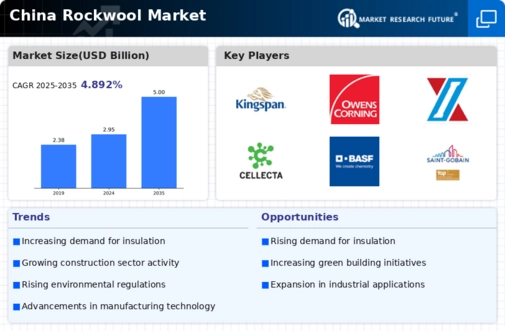
China Rockwool Market Infographic
Purchase Options

China Rockwool Market Summary

As per analysis, the China rockwool market is projected to grow from USD 2.35 Billion in 2025 to USD 4.05 Billion by 2035, exhibiting a compound annual growth rate (CAGR) of 5.65% during the forecast period (2025 - 2035).

Key Market Trends & Highlights

The China rockwool market is poised for growth driven by sustainability and industrial applications.

  • The thermal insulation segment remains the largest contributor to the market, reflecting a strong demand for energy efficiency.
  • The fire protection segment is currently the fastest-growing area, indicating heightened awareness of fire safety standards.
  • Sustainable construction practices are increasingly influencing market dynamics, aligning with government support for green building initiatives.
  • Rising demand for energy efficiency and government regulations are key drivers propelling the growth of the rockwool market.

Market Size & Forecast

2024 Market Size 2.22 (USD Billion)
2035 Market Size 4.05 (USD Billion)
CAGR (2025 - 2035) 5.65%

Major Players

Rockwool International A/S (DK), Saint-Gobain (FR), Knauf Insulation (DE), Owens Corning (US), Paroc Group (FI), Johns Manville (US), BASF SE (DE), Sika AG (CH)

Our Impact
Enabled $4.3B Revenue Impact for Fortune 500 and Leading Multinationals
Partnering with 2000+ Global Organizations Each Year
30K+ Citations by Top-Tier Firms in the Industry

China Rockwool Market Trends

The china rockwool market is currently experiencing a notable transformation, driven by increasing demand for energy-efficient insulation materials. This shift is largely influenced by the growing emphasis on sustainable construction practices and the need for improved thermal performance in buildings. As urbanization continues to accelerate in China, the construction sector is expanding, leading to a heightened interest in materials that offer both environmental benefits and cost-effectiveness. Furthermore, government initiatives aimed at promoting green building standards are likely to bolster the adoption of rockwool products, which are recognized for their fire resistance and sound insulation properties. In addition to the construction sector, the China rockwool market is also witnessing a rise in applications within the industrial sector. Industries are increasingly utilizing rockwool for insulation in various processes, which may enhance energy efficiency and reduce operational costs. The versatility of rockwool, combined with its favorable characteristics, positions it as a preferred choice among manufacturers. As the market evolves, stakeholders are expected to focus on innovation and product development to meet the diverse needs of consumers, potentially leading to a more competitive landscape in the coming years.

Sustainable Construction Practices

The china rockwool market is increasingly influenced by the shift towards sustainable construction practices. As environmental concerns gain prominence, builders are seeking materials that not only meet performance standards but also contribute to energy efficiency and reduced carbon footprints. Rockwool, with its excellent insulation properties, aligns well with these objectives, making it a favored choice in modern construction.

Industrial Applications Growth

There is a noticeable trend towards the adoption of rockwool in various industrial applications. Industries are recognizing the benefits of using rockwool for insulation in processes, which may lead to enhanced energy efficiency and lower operational costs. This trend indicates a diversification of the market beyond traditional construction uses, potentially expanding the customer base.

Government Support for Green Building

Government initiatives aimed at promoting green building standards are likely to play a crucial role in the china rockwool market. Policies encouraging the use of environmentally friendly materials may drive demand for rockwool products, as they are recognized for their fire resistance and sound insulation capabilities. This support could foster a more favorable environment for market growth.

China Rockwool Market Drivers

Growth in Industrial Applications

the China rockwool market is experiencing substantial growth due to its increasing applications in various industrial sectors. Industries such as manufacturing, petrochemicals, and power generation are utilizing rockwool for its fire-resistant and insulating properties. In 2025, the industrial segment represented around 40% of the total rockwool consumption in China. This trend is expected to persist as industries prioritize safety and efficiency, leading to a higher adoption of rockwool products. Furthermore, the expansion of industrial facilities in China is likely to create additional demand for rockwool insulation solutions.

Increased Awareness of Fire Safety

Fire safety has become a paramount concern in the construction industry, particularly in urban areas of China. the China rockwool market is poised to benefit from this heightened awareness, as rockwool is renowned for its fire-resistant properties. In 2025, the demand for fire-resistant materials surged, with rockwool accounting for a significant portion of this market segment. The government has also been proactive in promoting fire safety regulations, which are likely to drive the adoption of rockwool in both residential and commercial buildings. This trend indicates a growing recognition of the importance of fire safety in construction.

Rising Demand for Energy Efficiency

The increasing emphasis on energy efficiency in construction is a pivotal driver for the China rockwool market. As energy costs rise, builders and developers are seeking materials that enhance insulation and reduce energy consumption. Rockwool, known for its excellent thermal properties, is becoming a preferred choice. In 2025, the market for energy-efficient building materials in China was valued at approximately USD 15 billion, with rockwool accounting for a notable share. This trend is likely to continue as the government promotes energy-saving initiatives, further propelling the demand for rockwool in both residential and commercial sectors.

Government Regulations and Standards

The regulatory landscape in China is evolving, with the government implementing stricter building codes and standards aimed at enhancing safety and sustainability. These regulations are driving the adoption of high-performance insulation materials, including rockwool. the China rockwool market benefits from these policies, as they encourage the use of non-combustible materials in construction. In 2025, approximately 60% of new buildings in urban areas were required to meet these enhanced standards, which is likely to boost rockwool demand significantly. Compliance with these regulations is becoming essential for construction companies, further solidifying rockwool's position in the market.

Sustainability and Environmental Concerns

Sustainability is increasingly influencing construction practices in China, with a growing focus on environmentally friendly materials. the China rockwool market is benefiting from this trend, as rockwool is made from natural and recycled materials, making it a sustainable choice. In 2025, the market for sustainable building materials in China was estimated to reach USD 20 billion, with rockwool playing a crucial role. The government is also promoting green building certifications, which encourage the use of sustainable materials. This shift towards sustainability is likely to enhance the market position of rockwool in the coming years.


Market Segment Insights

By Application: Thermal Insulation (Largest) vs. Fire Protection (Fastest-Growing)

The application segment in the China rockwool market shows considerable diversification, with thermal insulation leading the way as the largest share contributor. This segment is favored across various industries, especially in construction and manufacturing, due to its superior thermal resistance. Meanwhile, fire protection is emerging as a significant focus area, reflecting heightened safety regulations and increased awareness among consumers and industries alike regarding fire risks. Consequently, while thermal insulation holds the majority, fire protection is gaining momentum, driven by regulatory compliance and safety concerns. The growth trends in the rockwool application segment are closely linked to government policies and urban development initiatives that promote energy efficiency and safety. As China continues to urbanize, the demand for energy-efficient thermal insulation is projected to maintain its strength, while fire protection technologies rapidly evolve, supported by innovations and new product developments tailored to meet stringent safety standards. Overall, the focus on sustainability and safety in construction projects will bolster the growth of these application areas, with thermal insulation maintaining dominance against a backdrop of rising fire protection demands.

Thermal Insulation (Dominant) vs. Acoustic Insulation (Emerging)

Thermal insulation stands as the dominant application in the China rockwool market, primarily due to its extensive use in thermal performance improvement in buildings and industrial processes. This segment benefits from the increasing emphasis on energy conservation and building codes that favor high insulation standards. On the other hand, acoustic insulation is emerging as a critical area, gaining traction in residential, commercial, and industrial applications, especially in urban areas where noise pollution is prevalent. The market for acoustic insulation is propelled by consumer demand for quieter environments, leading to innovative product formulations and applications. Together, these segments highlight the dual focus on energy efficiency and comfort in modern construction, with both thermal insulation's established presence and acoustic insulation's rising prominence carving a complementary role in the overall market.

By End Use: Construction (Largest) vs. Industrial (Fastest-Growing)

In the China rockwool market, the end use segments demonstrate a diverse distribution of market share. The construction sector is identified as the largest segment due to the growing demand for energy-efficient buildings and green construction practices. This trend is paralleled by the increasing use of rockwool as a key insulation material, contributing significantly to its dominance in the market. On the other hand, the industrial sector is witnessing rapid growth, driven by increased industrialization and the rising need for fire safety and insulation solutions in manufacturing and processing plants.

Construction: Dominant vs. Industrial: Emerging

In the China rockwool market, the construction segment serves as the dominant force, primarily fueled by national policy initiatives promoting energy efficiency and sustainability in new building projects. Rockwool's thermal insulation properties are crucial for meeting stringent building codes and enhancing energy performance ratings. Conversely, the industrial segment is emerging swiftly, due to the heightened focus on workplace safety and the demand for high-performance insulation solutions in manufacturing environments. Sectors such as petrochemicals and heavy manufacturing are increasingly adopting rockwool products, driven by technological advancements and regulatory requirements aimed at improving safety standards.

By Product Type: Blanket Rockwool (Largest) vs. Pipe Rockwool (Fastest-Growing)

In the China rockwool market, Blanket Rockwool holds the largest market share, primarily due to its extensive application in thermal insulation and acoustic control across various industries. It is favored for its superior performance in energy efficiency, driving substantial demand from the construction and industrial sectors. Conversely, Pipe Rockwool is rapidly gaining traction, attributed to stringent regulations on energy conservation and growing awareness of fire safety across infrastructural projects.

Blanket Rockwool (Dominant) vs. Pipe Rockwool (Emerging)

Blanket Rockwool represents the dominant segment in the China rockwool market, widely used for insulation purposes in both residential and commercial buildings. Its flexibility and ease of installation make it a preferred choice among builders and contractors. On the other hand, Pipe Rockwool is emerging as a critical segment, finding applications in various plumbing and HVAC systems. Its unique properties, such as high thermal resistance and fire safety features, position it favorably amid increasing regulatory demands for energy efficiency and safety, allowing it to capture a significant share of the market.

By Density: Medium Density (Largest) vs. High Density (Fastest-Growing)

In the China rockwool market, the density segment showcases a diverse distribution with medium density rockwool dominating the landscape. Its popularity stems from its versatile application in insulation and soundproofing within both residential and commercial sectors. Low density rockwool, while still relevant, has a more niche market presence, primarily serving specific applications such as lightweight insulation in less demanding environments. High density rockwool is gaining traction, particularly in industrial applications where superior thermal resistance is essential, marking it as an emerging player in the segment. The growth trends within this segment are driven by increasing awareness of energy efficiency and sustainability in construction materials. As green building standards rise, there is a corresponding demand for high-performance insulation solutions. Medium density rockwool, with its balanced properties, continues to capture the majority market share. In contrast, high density rockwool is witnessing rapid growth, attributed to its effectiveness in industrial settings and the rising focus on sound insulation and fire resistance features. This trend indicates a shift in consumer preference towards more specialized products that offer enhanced performance.

Medium Density (Dominant) vs. High Density (Emerging)

Medium density rockwool is recognized as the dominant player in the China rockwool market due to its optimal balance of thermal insulation and soundproofing capabilities. It is widely used in a variety of applications ranging from residential buildings to office spaces, making it a popular choice among architects and builders. The versatility of medium density rockwool allows it to serve as both an effective thermal insulator and an acoustic barrier, catering to a broad spectrum of construction needs. Conversely, high density rockwool is emerging as a significant contender, largely driven by its exceptional properties in noise reduction and fire resistance. Its application in industrial sectors is rapidly increasing as businesses prioritize safety and efficiency. The heightened demand for high density products is reflective of evolving construction trends that emphasize not only performance but also compliance with stringent building regulations.

By Form: Rolls (Largest) vs. Boards (Fastest-Growing)

In the China rockwool market, the segmentation by form reveals that Rolls hold the largest market share, owing to their versatility and ease of application in various construction and insulation projects. They are preferred in both industrial and residential sectors for their application in thermal and acoustic insulation. Boards follow closely, rapidly gaining traction due to their structural benefits and performance efficiency, making them a preferred choice among builders and architects seeking energy-efficient solutions. The rice of Loose Fill forms a smaller portion of the market, primarily used for specific applications such as filling gaps and providing additional insulation where other forms may not fit well.

Rolls (Dominant) vs. Boards (Emerging)

In the China rockwool market, Rolls are recognized as the dominant form due to their practical advantages, including flexibility in usage and cost-effectiveness. Their design allows for easy transportation and application, making them suitable for a wide range of projects. In contrast, Boards are emerging as a significant contender in insulation markets, appealing to an audience prioritizing energy efficiency and regulatory compliance. Boards are thicker and provide robust insulation against both temperature and sound, positioning them favorably in commercial building projects. Loose Fill forms, while necessary, tend to cater to niche applications and do not compete directly with the dominant segment.

Get more detailed insights about China Rockwool Market

Key Players and Competitive Insights

The competitive dynamics within the rockwool market in China are characterized by a blend of innovation, strategic partnerships, and regional expansion. Key players such as Rockwool International A/S (DK), Saint-Gobain (FR), and Knauf Insulation (DE) are actively shaping the landscape. Rockwool International A/S (DK) focuses on sustainability and energy efficiency, positioning itself as a leader in eco-friendly insulation solutions. Meanwhile, Saint-Gobain (FR) emphasizes digital transformation and innovation in product development, enhancing its competitive edge. Knauf Insulation (DE) is pursuing aggressive regional expansion, particularly in the northern provinces of China, to capitalize on the growing demand for insulation materials. Collectively, these strategies indicate a competitive environment that is increasingly driven by technological advancements and sustainability initiatives.

In terms of business tactics, companies are localizing manufacturing to reduce costs and optimize supply chains. The market structure appears moderately fragmented, with several key players exerting influence while also facing competition from smaller, regional manufacturers. This fragmentation allows for a diverse range of products and innovations, although the presence of major players like Owens Corning (US) and BASF SE (DE) adds a layer of complexity to the competitive landscape.

In December 2025, Owens Corning (US) announced the opening of a new manufacturing facility in Jiangsu province, aimed at increasing production capacity for rockwool insulation. This strategic move is likely to enhance their market share in the region, responding to the rising demand for energy-efficient building materials. The facility is expected to utilize advanced manufacturing technologies, aligning with the company's commitment to sustainability and innovation.

In November 2025, BASF SE (DE) launched a new line of rockwool products that incorporate recycled materials, reflecting a growing trend towards sustainability in the construction sector. This initiative not only positions BASF as a leader in eco-friendly solutions but also caters to the increasing consumer preference for sustainable building materials. The introduction of these products may significantly impact market dynamics by setting new standards for environmental responsibility.

In October 2025, Knauf Insulation (DE) entered into a strategic partnership with a local construction firm to develop customized insulation solutions for high-rise buildings in urban areas. This collaboration is indicative of a broader trend where companies are leveraging local expertise to enhance product offerings and meet specific market needs. Such partnerships may facilitate quicker responses to market demands and foster innovation in product development.

As of January 2026, the rockwool market is witnessing trends that emphasize digitalization, sustainability, and the integration of AI technologies. Strategic alliances are becoming increasingly pivotal, enabling companies to pool resources and expertise to drive innovation. The competitive differentiation is likely to evolve from traditional price-based competition towards a focus on technological advancements, supply chain reliability, and sustainable practices. This shift suggests that companies that prioritize innovation and sustainability will be better positioned to thrive in the future.

Key Companies in the China Rockwool Market include

Industry Developments

The China Rockwool Market has recently seen significant developments, driven by an increase in demand for fire-resistant insulation materials amid the country's expanding construction industry. Companies like Sika AG and Rockwool International are focusing on enhancing their production capabilities to meet this surge. In September 2023, Kingspan Group announced plans to invest in new manufacturing facilities in China to boost their rockwool insulation production.

Xinxing Ductile Iron Pipes has also expanded its product line to include rockwool, aligning with the trend toward sustainable construction solutions.Moreover, mergers and acquisitions are shaping the landscape, with Saint-Gobain acquiring a local competitor in Beijing in August 2023, which has helped strengthen its market position significantly. Meanwhile, Owens Corning has reported a solid increase in market valuation following its strategic investments in innovative technologies, impacting the overall competitive environment.Over the past few years, the adoption of rockwool insulation has increased due to China's stringent energy efficiency regulations, emphasizing sustainable development in construction.

With government support for green building initiatives, companies such as Knauf Insulation and Paroc Group are also poised for growth, reflecting a robust outlook for this sector in China.

Future Outlook

China Rockwool Market Future Outlook

The China rockwool market is projected to grow at a 5.65% CAGR from 2025 to 2035, driven by increasing construction activities, energy efficiency regulations, and demand for fire-resistant materials.

New opportunities lie in:

  • Expansion into eco-friendly rockwool production methods
  • Development of customized insulation solutions for industrial applications
  • Strategic partnerships with construction firms for integrated supply solutions

By 2035, the market is expected to solidify its position as a leader in insulation solutions.

Market Segmentation

China Rockwool Market Form Outlook

  • Rolls
  • Boards
  • Loose Fill

China Rockwool Market Density Outlook

  • Low Density
  • Medium Density
  • High Density

China Rockwool Market End Use Outlook

  • Construction
  • Industrial
  • Marine
  • Transportation

China Rockwool Market Application Outlook

  • Thermal Insulation
  • Acoustic Insulation
  • Fire Protection
  • Soundproofing

China Rockwool Market Product Type Outlook

  • Blanket Rockwool
  • Board Rockwool
  • Pipe Rockwool
  • Spray Rockwool

Report Scope

MARKET SIZE 20242.22(USD Billion)
MARKET SIZE 20252.35(USD Billion)
MARKET SIZE 20354.05(USD Billion)
COMPOUND ANNUAL GROWTH RATE (CAGR)5.65% (2024 - 2035)
REPORT COVERAGERevenue Forecast, Competitive Landscape, Growth Factors, and Trends
BASE YEAR2024
Market Forecast Period2025 - 2035
Historical Data2019 - 2024
Market Forecast UnitsUSD Billion
Key Companies ProfiledRockwool International A/S (DK), Saint-Gobain (FR), Knauf Insulation (DE), Owens Corning (US), Paroc Group (FI), Johns Manville (US), BASF SE (DE), Sika AG (CH)
Segments CoveredApplication, End Use, Product Type, Density, Form
Key Market OpportunitiesGrowing demand for energy-efficient insulation solutions in the china rockwool market presents significant opportunities.
Key Market DynamicsRising demand for energy-efficient insulation drives innovation and competition in China's rockwool market.
Countries CoveredChina
Leave a Comment

FAQs

What is the current valuation of the China rockwool market?

As of 2024, the China rockwool market was valued at 2.22 USD Billion.

What is the projected market size for the China rockwool market by 2035?

The market is projected to reach 4.05 USD Billion by 2035.

What is the expected CAGR for the China rockwool market during the forecast period?

The expected CAGR for the China rockwool market from 2025 to 2035 is 5.65%.

Which companies are the key players in the China rockwool market?

Key players include Rockwool International A/S, Saint-Gobain, Knauf Insulation, and Owens Corning.

What are the main applications of rockwool in the China market?

The main applications include thermal insulation, acoustic insulation, fire protection, and soundproofing.

How does the construction sector impact the China rockwool market?

The construction sector is a significant end-use segment, with a valuation expected to grow from 0.89 to 1.6 USD Billion by 2035.

What product types dominate the China rockwool market?

Dominant product types include blanket rockwool, board rockwool, pipe rockwool, and spray rockwool.

What density categories are present in the China rockwool market?

The market features low density, medium density, and high density rockwool, with medium density projected to grow significantly.

What forms of rockwool are available in the China market?

Available forms include rolls, boards, and loose fill, with boards expected to see substantial growth.

How does the industrial sector contribute to the China rockwool market?

The industrial sector is projected to grow from 0.67 to 1.2 USD Billion by 2035, indicating its importance in the market.

Download Free Sample

Kindly complete the form below to receive a free sample of this Report

Compare Licence

×
Features License Type
Single User Multiuser License Enterprise User
Price $4,950 $5,950 $7,250
Maximum User Access Limit 1 User Upto 10 Users Unrestricted Access Throughout the Organization
Free Customization
Direct Access to Analyst
Deliverable Format
Platform Access
Discount on Next Purchase 10% 15% 15%
Printable Versions