×
Request Free Sample ×

Kindly complete the form below to receive a free sample of this Report

* Please use a valid business email

Leading companies partner with us for data-driven Insights

clients tt-cursor
Hero Background

China Real Time Payment Market

ID: MRFR/BS/60258-HCR
200 Pages
Aarti Dhapte
February 2026

China Real-Time Payment Market Size, Share and Research Report By Technology (Blockchain, Artificial Intelligence, Mobile Payment Solutions, Card Payment Systems), By Application (Retail Payments, Business Payments, Peer-to-Peer Payments, Government Payments), By End Use (Consumer, Businesses, Financial Institutions) and By Payment Mode (Remote, In-Store, Online)-Forecast to 2035

Share:
Download PDF ×

We do not share your information with anyone. However, we may send you emails based on your report interest from time to time. You may contact us at any time to opt-out.

China Real Time Payment Market Infographic
Purchase Options

China Real Time Payment Market Summary

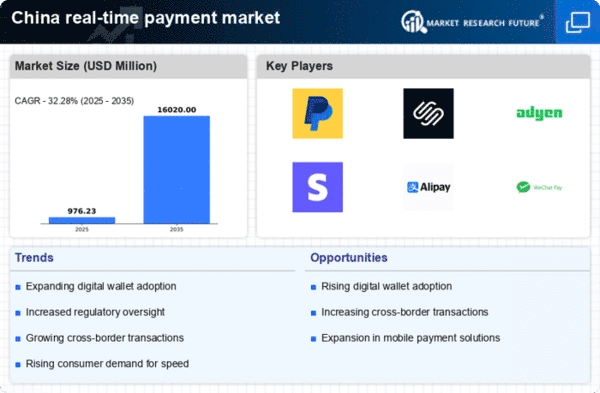
As per Market Research Future analysis, the size was estimated at 738.0 USD Million in 2024. The Real Time-payment market is projected to grow from 976.23 USD Million in 2025 to 16020.0 USD Million by 2035, exhibiting a compound annual growth rate (CAGR) of 32.2% during the forecast period 2025 - 2035

Key Market Trends & Highlights

The China The China real-time payment market experiences robust growth driven by technological advancements and consumer demand..

  • The largest segment in the China real time-payment market is mobile payments, which continues to see increased adoption among consumers.
  • Integration of advanced security features is becoming a priority for payment providers to enhance user trust and safety.
  • Collaboration between financial institutions and tech firms is fostering innovation and expanding service offerings in the market.
  • Key drivers such as the growing e-commerce sector and rising consumer demand for instant transactions are propelling market expansion.

Market Size & Forecast

2024 Market Size 738.0 (USD Million)
2035 Market Size 16020.0 (USD Million)
CAGR (2025 - 2035) 32.28%

Major Players

PayPal (US), Square (US), Adyen (NL), Stripe (US), Alipay (CN), WeChat Pay (CN), Zelle (US), Revolut (GB), TransferWise (GB)

Our Impact
Enabled $4.3B Revenue Impact for Fortune 500 and Leading Multinationals
Partnering with 2000+ Global Organizations Each Year
30K+ Citations by Top-Tier Firms in the Industry

China Real Time Payment Market Trends

The The real-time payment market experiences notable growth., driven by advancements in technology and increasing consumer demand for instant transactions. In recent years, the adoption of mobile payment solutions has surged, as users seek convenience and efficiency in their financial dealings. This shift is further supported by government initiatives aimed at promoting digital payment systems, which are seen as essential for enhancing economic activity and financial inclusion. As a result, various stakeholders, including banks and fintech companies, are actively investing in innovative solutions to capture a larger share of this evolving market. Moreover, the competitive landscape is intensifying, with numerous players vying for dominance. Traditional financial institutions are adapting to the changing environment by integrating real time-payment capabilities into their existing services. Meanwhile, new entrants are leveraging cutting-edge technologies to offer unique features that appeal to tech-savvy consumers. This dynamic interplay between established entities and emerging startups is likely to shape the future of the real time-payment market, fostering an ecosystem that prioritizes speed, security, and user experience. As the market continues to mature, it appears poised for further expansion, driven by ongoing technological advancements and shifting consumer preferences.

Increased Adoption of Mobile Payments

The trend towards mobile payments is gaining momentum, as consumers increasingly prefer the convenience of making transactions via smartphones. This shift is facilitated by the proliferation of mobile wallets and payment apps, which offer seamless user experiences. Financial institutions are responding by enhancing their mobile offerings, ensuring that they remain competitive in this rapidly evolving landscape.

Integration of Advanced Security Features

As the real time-payment market expands, the emphasis on security becomes paramount. Stakeholders are investing in advanced security measures, such as biometric authentication and encryption technologies, to protect user data and build trust. This focus on security is essential for encouraging wider adoption and mitigating concerns related to fraud and data breaches.

Collaboration Between Financial Institutions and Tech Firms

There is a growing trend of collaboration between traditional banks and technology companies, aimed at enhancing the capabilities of real time-payment systems. These partnerships enable financial institutions to leverage innovative technologies, while tech firms gain access to established customer bases. This synergy is likely to drive the development of more efficient and user-friendly payment solutions.

China Real Time Payment Market Drivers

Growing E-commerce Sector

The rapid expansion of the e-commerce sector in China is a pivotal driver for the real time-payment market. As online shopping continues to gain traction, consumers increasingly demand seamless and instantaneous payment solutions. In 2025, e-commerce sales in China are projected to reach approximately $2 trillion, indicating a robust growth trajectory. This surge necessitates efficient payment systems that can handle high transaction volumes in real time. Retailers are thus incentivized to adopt real time-payment solutions to enhance customer experience and reduce cart abandonment rates. The integration of these payment systems not only facilitates faster transactions but also fosters consumer trust, as buyers feel more secure with immediate payment confirmations. Consequently, the growing e-commerce sector significantly propels the demand for real time-payment services, shaping the landscape of the market in China.

Government Initiatives and Regulations

Government initiatives play a crucial role in shaping the In the China real-time payment market, Mobile Payment Solutions hold the largest market share.. The Chinese government has been actively promoting digital payment solutions as part of its broader strategy to enhance financial inclusion and streamline economic transactions. Recent regulations have encouraged the adoption of real time-payment systems, ensuring that they comply with security and operational standards. For instance, the People's Bank of China has implemented policies aimed at fostering innovation in payment technologies, which has led to increased investment in the sector. Furthermore, the government's push for a cashless society aligns with the growing consumer preference for digital transactions. As a result, these initiatives not only stimulate market growth but also create a conducive environment for the development of advanced payment technologies, thereby driving the real time-payment market forward.

Increased Competition Among Payment Providers

The competitive landscape among payment providers is intensifying, serving as a key driver for the In the China real-time payment market, the distribution of payment modes illustrates a diverse preference among consumers.. With numerous players entering the market, including traditional banks and fintech startups, there is a growing emphasis on offering innovative and efficient payment solutions. This competition is likely to lead to enhanced service offerings, as providers strive to differentiate themselves through features such as lower transaction fees, faster processing times, and improved user experiences. In 2025, it is projected that the number of active payment service providers in China will exceed 500, further fueling competition. As a result, consumers stand to benefit from a wider array of choices and better services, which in turn drives the adoption of real time-payment systems. This dynamic environment fosters innovation and encourages continuous improvement within the market.

Technological Advancements in Payment Systems

Technological advancements are significantly influencing the In the China real-time payment market, the application segment is primarily dominated by retail payments.. Innovations such as blockchain technology, artificial intelligence, and machine learning are enhancing the efficiency and security of payment systems. In 2025, it is estimated that over 70% of transactions in the real time-payment market will leverage advanced technologies to improve processing speeds and reduce fraud. These advancements enable financial institutions to offer more reliable and user-friendly payment solutions, which are essential in meeting the evolving demands of consumers. Moreover, the integration of biometric authentication methods is likely to further bolster security, thereby increasing consumer confidence in digital transactions. As technology continues to evolve, it appears that the real time-payment market will experience sustained growth, driven by the need for faster, safer, and more efficient payment solutions.

Rising Consumer Demand for Instant Transactions

The increasing consumer demand for instant transactions is a significant driver of the In the China real-time payment market, the distribution of market share among end users reflects distinct preferences.. As consumers become accustomed to the immediacy of digital services, their expectations for payment processes have evolved. In 2025, surveys indicate that approximately 85% of consumers prefer payment methods that offer real time processing, reflecting a shift in consumer behavior. This demand is particularly pronounced among younger demographics, who prioritize convenience and speed in their financial transactions. Consequently, businesses are compelled to adopt real time-payment solutions to remain competitive and meet customer expectations. The ability to provide instant payment confirmations not only enhances customer satisfaction but also encourages repeat business, thereby driving growth in the real time-payment market. This trend underscores the necessity for businesses to innovate and adapt to the changing landscape of consumer preferences.


Market Segment Insights

By Technology: Mobile Payment Solutions (Largest) vs. Blockchain (Fastest-Growing)

In the China real time-payment market, Mobile Payment Solutions hold the largest market share, driven by widespread adoption among consumers and businesses alike. Blockchain technology, while currently a smaller share compared to mobile payments, is gaining traction with an increasing focus on decentralization and enhanced security features. The growth trends for these segments indicate that Mobile Payment Solutions will continue to dominate as convenience and efficiency remain key drivers. Conversely, Blockchain is recognized as the fastest-growing segment, propelled by innovations that improve transactional integrity and foster trust among users. As regulatory frameworks evolve, both segments are expected to thrive, albeit at different paces.

Mobile Payment Solutions: Dominant vs. Blockchain: Emerging

Mobile Payment Solutions in the China real time-payment market are characterized by their high adoption rates, with users favoring applications that offer seamless and secure transactions on their devices. With major players investing heavily in this technology, enhanced user experiences and loyalty programs drive further growth. On the other hand, Blockchain is emerging as a disruptive force, providing decentralized solutions that address issues like fraud and transaction speed. As companies explore smart contracts and tokenization, Blockchain's potential to integrate with existing payment systems positions it as a vital area for future development. Together, these technologies illustrate a diverse landscape where innovation continues to drive the market forward.

By Application: Retail Payments (Largest) vs. Peer-to-Peer Payments (Fastest-Growing)

In the China real time-payment market, the application segment is primarily dominated by retail payments, which hold a significant market share due to the widespread adoption of digital payment solutions in everyday transactions. Business payments also contribute notably, leveraging electronic invoicing and mobile platforms to streamline financial operations. Peer-to-peer payments are gaining traction, particularly among younger demographics, while government payments, although smaller in volume, are increasingly integrating digital solutions to enhance efficiency and transparency. Growth in the application segment is driven by the rise of e-commerce, which fuels the demand for retail and peer-to-peer payment solutions. Recent trends highlight the shift towards cashless transactions, bolstered by the rapid expansion of mobile wallet services. Additionally, regulatory support for digital payments, along with consumer preferences for fast and secure payment methods, is further accelerating growth in business and government payments. As more consumers and businesses embrace digital solutions, the market landscape continues to evolve.

Retail Payments: Dominant vs. Peer-to-Peer Payments: Emerging

Retail payments represent the dominant force in the application segment, characterized by their transactional frequency and extensive integration across various sectors, such as online shopping and in-store purchases. This segment benefits from robust technological infrastructure and a strong consumer preference for seamless transactions. Conversely, peer-to-peer payments are emerging swiftly, appealing particularly to tech-savvy individuals who favor quick and convenient ways to transfer money among friends and family. The user-friendly nature of these platforms and the increasing peer influence contribute to their rapid adoption. As both segments grow, their unique characteristics highlight the diverse needs and preferences of consumers in the China real time-payment market.

By End Use: Consumers (Largest) vs. Businesses (Fastest-Growing)

In the China real time-payment market, the distribution of market share among end users reflects distinct preferences. Consumers constitute the largest segment, driven by the increasing adoption of mobile payment technologies and a surge in online shopping behaviors. Their familiarization with digital wallets and quick payment solutions underpins this dominance, making them a fundamental component of the market landscape. On the other hand, businesses, particularly small and medium enterprises, represent the fastest-growing segment. The shift towards digitalization and the need for efficient payment solutions compel businesses to integrate real time payments. This transition is further supported by technological advancements and the rising demand for seamless transaction experiences, positioning businesses as pivotal players in the evolving market.

Consumers (Dominant) vs. Businesses (Emerging)

Consumers play a dominant role in the China real time-payment market, characterized by their high engagement and preference for mobile payment systems due to convenience and enhanced user experience. This segment is driven by younger demographics who favor online shopping and rapid payment solutions. In contrast, businesses are emerging as significant contributors as they adopt real time-payment systems to streamline operations and improve cash flow. The increasing emphasis on customer-centric services and integrated payment solutions pushes businesses towards embracing this technology, thereby positioning them as an essential segment poised for substantial growth in the marketplace.

By Payment Mode: In-Store (Largest) vs. Online (Fastest-Growing)

In the China real time-payment market, the distribution of payment modes illustrates a diverse preference among consumers. In-Store payments represent the largest segment, driven by the significant volume of physical transactions occurring in retail environments. Meanwhile, Remote payments are witnessing notable engagement, but Online payments are becoming increasingly integral to the market as digital and mobile technologies empower consumers to shop and pay from anywhere with ease. Growth trends indicate that Online payments are the fastest-growing segment as the proliferation of e-commerce continues to change consumer behaviors. Factors such as improved internet connectivity, smartphone penetration, and innovative payment solutions enhance convenience and security, prompting consumers to embrace Online payment methods. In contrast, while In-Store payments remain dominant, there is a gradual shift towards integrating digital capabilities into physical retail spaces, indicating the potential for hybrid payment solutions.

In-Store (Dominant) vs. Online (Emerging)

In-Store payments in the China real time-payment market continue to dominate due to their prevalence in daily transactions and consumer habits. This segment benefits from a robust ecosystem of retailers that embrace technology to streamline payment processes. As digital solutions are increasingly integrated into physical shopping experiences, providers who facilitate seamless In-Store transactions are well-positioned to capitalize on existing consumer behaviors. Conversely, Online payments are emerging rapidly, appealing to consumers seeking flexibility and accessibility. The ease of making purchases from home or on-the-go, combined with mobile wallet innovations, makes this segment attractive for a tech-savvy population. As these trends evolve, both segments will likely influence each other's growth trajectories, paving the way for a more interconnected payment landscape.

Get more detailed insights about China Real Time Payment Market

Key Players and Competitive Insights

The real time-payment market in China is characterized by intense competition and rapid innovation, driven by the increasing demand for instantaneous transactions and digital financial solutions. Major players such as Alipay (CN) and WeChat Pay (CN) dominate the landscape, leveraging their extensive user bases and integrated ecosystems to enhance customer experience. Alipay (CN) focuses on expanding its services beyond payments, integrating features like credit scoring and investment options, while WeChat Pay (CN) emphasizes seamless integration within the WeChat ecosystem, facilitating social commerce and peer-to-peer transactions. These strategies not only solidify their market positions but also create a competitive environment that encourages continuous improvement and innovation among all players.The market structure appears moderately fragmented, with a mix of established giants and emerging fintech companies. Key tactics employed by these companies include localizing services to cater to regional preferences and optimizing supply chains to enhance transaction efficiency. This competitive structure allows for a diverse range of offerings, fostering an environment where innovation is paramount, and customer-centric solutions are prioritized.


In October Alipay (CN) announced a partnership with several local banks to enhance its payment processing capabilities, aiming to reduce transaction times and improve security measures. This strategic move is likely to bolster Alipay's competitive edge by ensuring faster and more secure transactions, which are critical in retaining customer trust and satisfaction in a rapidly evolving market.


In September WeChat Pay (CN) launched a new feature that allows users to make payments using facial recognition technology. This initiative not only enhances user convenience but also positions WeChat Pay as a leader in adopting cutting-edge technology in the payment space. The integration of biometric authentication could potentially reduce fraud and increase user engagement, thereby strengthening its market presence.


In November PayPal (US) expanded its operations in China by introducing a localized version of its app, tailored to meet the specific needs of Chinese consumers. This strategic localization effort indicates PayPal's commitment to capturing a share of the growing real time-payment market in China, where understanding local consumer behavior is crucial for success. By adapting its services to align with local preferences, PayPal may enhance its competitive positioning against entrenched players like Alipay and WeChat Pay.


As of November the competitive trends in the real time-payment market are increasingly defined by digitalization, sustainability, and the integration of artificial intelligence (AI). Strategic alliances among companies are shaping the landscape, enabling them to pool resources and expertise to innovate more effectively. The shift from price-based competition to a focus on technological advancement and supply chain reliability is evident, suggesting that future differentiation will hinge on the ability to deliver innovative solutions that enhance user experience and operational efficiency.

Key Companies in the China Real Time Payment Market include

Industry Developments

Recent developments in the China Real-Time Payment Market indicate significant growth and continuous innovation. Companies like Ant Group and Tencent, through Alipay and WeChat Pay, respectively, are leading the charge in mobile payments, which saw a surge during the COVID-19 pandemic, boosting digital transactions significantly. In October 2022, Xiaomi Pay gained traction by integrating with various e-commerce platforms, expanding its user base.

Moreover, in March 2023, Lianlian Pay secured a partnership with China Merchants Bank to enhance itspayment solutions. Mergers and acquisitions are shaping the landscape, with UnionPay acquiring stakes in smaller fintech firms to broaden its service offerings reported in September 2022. The Bank of China is also focusing on launching innovative financial services that cater to real-time payment needs.

The market valuation of real-time payment solutions is currently estimated to grow substantially, driven by increasing smartphone penetration and consumer demand for seamless payment experiences. This trend is further fueled by the government's supportive regulations to enhance digital transaction infrastructures across the nation. As of mid-2023, new initiatives are expected to improve security and efficiency, fostering further market expansion.

Future Outlook

China Real Time Payment Market Future Outlook

The real time-payment market in China is projected to grow at a 32.28% CAGR from 2025 to 2035, driven by technological advancements and increasing consumer demand.

New opportunities lie in:

  • Integration of AI-driven fraud detection systems Expansion of mobile payment platforms for SMEs Development of cross-border real time payment solutions

By 2035, the market is expected to achieve substantial growth and innovation.

Market Segmentation

China Real Time Payment Market End Use Outlook

  • Consumers
  • Businesses
  • Financial Institutions

China Real Time Payment Market Technology Outlook

  • Blockchain
  • Artificial Intelligence
  • Mobile Payment Solutions
  • Card Payment Systems

China Real Time Payment Market Application Outlook

  • Retail Payments
  • Business Payments
  • Peer-to-Peer Payments
  • Government Payments

China Real Time Payment Market Payment Mode Outlook

  • Remote
  • In-Store
  • Online

Report Scope

MARKET SIZE 2024 738.0(USD Million)
MARKET SIZE 2025 976.23(USD Million)
MARKET SIZE 2035 16020.0(USD Million)
COMPOUND ANNUAL GROWTH RATE (CAGR) 32.28% (2025 - 2035)
REPORT COVERAGE Revenue Forecast, Competitive Landscape, Growth Factors, and Trends
BASE YEAR 2024
Market Forecast Period 2025 - 2035
Historical Data 2019 - 2024
Market Forecast Units USD Million
Key Companies Profiled PayPal (US), Square (US), Adyen (NL), Stripe (US), Alipay (CN), WeChat Pay (CN), Zelle (US), Revolut (GB), TransferWise (GB)
Segments Covered Technology, Application, End Use, Payment Mode
Key Market Opportunities Integration of blockchain technology enhances security and efficiency in the real time-payment market.
Key Market Dynamics Rapid technological advancements and regulatory shifts drive growth in the real time-payment market.
Countries Covered China
Leave a Comment

FAQs

What is the estimated market size of the China Real-Time Payment Market for 2024?

The estimated market size of the China Real-Time Payment Market for 2024 is expected to be valued at 1.39 billion USD.

What is the projected market value of the China Real-Time Payment Market by 2035?

By 2035, the China Real-Time Payment Market is projected to reach a value of 3.37 billion USD.

What is the expected CAGR for the China Real-Time Payment Market from 2025 to 2035?

The expected compound annual growth rate (CAGR) for the China Real-Time Payment Market from 2025 to 2035 is 8.353%.

What are the key players in the China Real-Time Payment Market?

Key players in the China Real-Time Payment Market include Xiaomi Pay, Ant Group, Tencent, Alipay, and WeChat Pay among others.

How is the China Real-Time Payment Market segmented by technology?

The China Real-Time Payment Market is segmented by technology into Blockchain, Artificial Intelligence, Mobile Payment Solutions, and Card Payment Systems.

What is the market value for Blockchain technology in the China Real-Time Payment Market for 2024?

The market value for Blockchain technology in the China Real-Time Payment Market for 2024 is estimated at 0.3 billion USD.

What is the anticipated market size for Mobile Payment Solutions by 2035?

The anticipated market size for Mobile Payment Solutions in the China Real-Time Payment Market by 2035 is projected to reach 1.25 billion USD.

Which segment of the China Real-Time Payment Market is expected to grow the fastest from 2025 to 2035?

The segment of Mobile Payment Solutions is expected to grow the fastest within the China Real-Time Payment Market during the forecast period from 2025 to 2035.

What is the market size for Artificial Intelligence technology in the China Real-Time Payment Market for 2024?

Artificial Intelligence technology in the China Real-Time Payment Market is expected to have a market size of 0.25 billion USD for 2024.

What challenges does the China Real-Time Payment Market currently face?

The China Real-Time Payment Market faces challenges such as regulatory compliance, competition among key players, and technological advancements in payments.

Download Free Sample

Kindly complete the form below to receive a free sample of this Report

Compare Licence

×
Features License Type
Single User Multiuser License Enterprise User
Price $4,950 $5,950 $7,250
Maximum User Access Limit 1 User Upto 10 Users Unrestricted Access Throughout the Organization
Free Customization
Direct Access to Analyst
Deliverable Format
Platform Access
Discount on Next Purchase 10% 15% 15%
Printable Versions