×
Request Free Sample ×

Kindly complete the form below to receive a free sample of this Report

* Please use a valid business email

Leading companies partner with us for data-driven Insights

clients tt-cursor
Hero Background

China Plant Asset Management Market

ID: MRFR/ICT/59509-HCR
200 Pages
Aarti Dhapte
February 2026

China Plant Asset Management Market Size, Share and Research Report: By Deployment Type (On-Premise, Cloud-Based, Hybrid), By Solution Type (Software, Services), By Application (Manufacturing, Oil and Gas, Utilities, Mining, Transportation) and By Asset Type (Physical Assets, Digital Assets, Production Assets) - Industry Forecast to 2035

Share:
Download PDF ×

We do not share your information with anyone. However, we may send you emails based on your report interest from time to time. You may contact us at any time to opt-out.

China Plant Asset Management Market Infographic
Purchase Options

China Plant Asset Management Market Summary

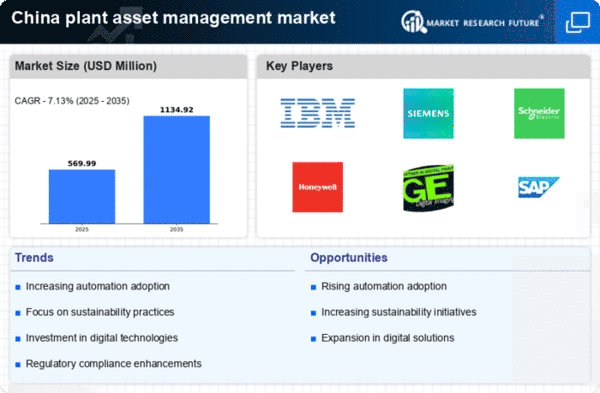
As per Market Research Future analysis, the China Plant Asset Management Market size was estimated at 532.05 USD Million in 2024. The Plant Asset-management market is projected to grow from 569.99 USD Million in 2025 to 1134.92 USD Million by 2035, exhibiting a compound annual growth rate (CAGR) of 7.1% during the forecast period 2025 - 2035

Key Market Trends & Highlights

The China plant asset-management market is experiencing robust growth driven by technological advancements and sustainability initiatives.

  • Technological integration is reshaping the plant asset-management landscape, enhancing operational efficiency and data utilization.
  • The sustainability focus is becoming increasingly prominent, with companies prioritizing eco-friendly practices and resource optimization.
  • Regulatory compliance is driving investments in plant asset-management solutions, particularly in the manufacturing and energy sectors.
  • Rising industrial automation and a growing demand for compliance and risk management are key drivers propelling market expansion.

Market Size & Forecast

2024 Market Size 532.05 (USD Million)
2035 Market Size 1134.92 (USD Million)
CAGR (2025 - 2035) 7.13%

Major Players

IBM (US), Siemens (DE), Schneider Electric (FR), Honeywell (US), GE Digital (US), SAP (DE), Oracle (US), Emerson (US), Rockwell Automation (US)

Our Impact
Enabled $4.3B Revenue Impact for Fortune 500 and Leading Multinationals
Partnering with 2000+ Global Organizations Each Year
30K+ Citations by Top-Tier Firms in the Industry

China Plant Asset Management Market Trends

The China Plant Asset Management Market is currently experiencing a transformative phase, driven by advancements in technology and a growing emphasis on operational efficiency. In recent years, organizations have increasingly recognized the importance of effectively managing their assets to enhance productivity and reduce costs. This shift is evident in the adoption of sophisticated software solutions that facilitate real-time monitoring and predictive maintenance. As a result, companies are likely to achieve improved asset utilization and extended equipment lifespan, which are crucial for maintaining competitiveness in a rapidly evolving landscape. Moreover, the regulatory environment in China appears to be evolving, with authorities promoting sustainable practices and encouraging investments in smart technologies. This regulatory push may lead to a more integrated approach to asset management, where data analytics and IoT technologies play a pivotal role. The emphasis on sustainability could also drive the development of innovative solutions that align with environmental goals. Consequently, the plant asset-management market is poised for growth, as organizations seek to leverage these trends to optimize their operations and meet regulatory requirements.

Technological Integration

The integration of advanced technologies such as IoT and AI is reshaping the plant asset-management market. These innovations enable real-time data collection and analysis, allowing organizations to make informed decisions regarding asset performance and maintenance.

Sustainability Focus

There is a growing emphasis on sustainability within the plant asset-management market. Companies are increasingly adopting practices that not only enhance efficiency but also align with environmental regulations and corporate social responsibility initiatives.

Regulatory Compliance

The regulatory landscape is evolving, with authorities in China implementing stricter guidelines for asset management. This trend necessitates that organizations adapt their strategies to ensure compliance, thereby driving demand for sophisticated management solutions.

China Plant Asset Management Market Drivers

Rising Industrial Automation

The increasing trend of industrial automation in China is a pivotal driver for the plant asset-management market. As industries strive for enhanced efficiency and productivity, the adoption of automated systems is becoming more prevalent. This shift is evidenced by a reported growth of 15% in automation investments across various sectors. Consequently, companies are seeking advanced asset-management solutions to optimize their automated processes. The integration of smart technologies, such as IoT and AI, into asset management systems is expected to streamline operations and reduce downtime. This trend not only enhances operational efficiency but also aligns with the broader goals of digital transformation within the manufacturing sector. As a result, the plant asset-management market is likely to experience significant growth, driven by the demand for sophisticated management tools that can support automated environments.

Focus on Operational Efficiency

The relentless pursuit of operational efficiency within Chinese industries is a significant driver for the plant asset-management market. Companies are increasingly recognizing the importance of optimizing asset utilization to reduce costs and enhance productivity. Reports indicate that organizations that implement effective asset-management strategies can achieve up to 20% reductions in operational costs. This realization is prompting businesses to invest in advanced asset-management solutions that provide real-time data analytics and predictive maintenance capabilities. By leveraging these technologies, companies can make informed decisions that lead to improved asset performance and reduced downtime. As the competitive landscape intensifies, the plant asset-management market is likely to expand, driven by the need for solutions that facilitate operational excellence and cost-effectiveness.

Emphasis on Data-Driven Decision Making

The growing emphasis on data-driven decision making in China is reshaping the landscape of the plant asset-management market. Organizations are increasingly leveraging data analytics to inform their asset management strategies, leading to more informed and strategic decisions. The ability to analyze vast amounts of data allows companies to identify trends, predict failures, and optimize maintenance schedules. This shift towards data-centric approaches is supported by advancements in technology, such as cloud computing and big data analytics. As a result, the demand for sophisticated asset-management solutions that can harness data effectively is on the rise. The plant asset-management market is expected to thrive as businesses seek tools that enable them to capitalize on data insights, ultimately enhancing their operational capabilities and asset performance.

Investment in Infrastructure Development

China's ongoing investment in infrastructure development serves as a crucial driver for the plant asset-management market. The government has allocated substantial funds, estimated at over $1 trillion, towards infrastructure projects, including transportation, energy, and utilities. This influx of capital is expected to stimulate demand for effective asset management solutions that can oversee and maintain these large-scale projects. As infrastructure assets become more complex, the need for robust management systems that can track performance, ensure compliance, and optimize maintenance schedules becomes increasingly important. The plant asset-management market is poised to benefit from this trend, as companies seek to implement systems that can handle the intricacies of modern infrastructure while maximizing asset longevity and operational efficiency.

Growing Demand for Compliance and Risk Management

The increasing complexity of regulatory requirements in China is driving the demand for compliance and risk management solutions within the plant asset-management market. Companies are facing heightened scrutiny regarding their operational practices, necessitating robust asset management systems that ensure compliance with local regulations. The potential financial penalties for non-compliance can be substantial, prompting organizations to prioritize risk management strategies. As a result, there is a growing need for asset-management solutions that incorporate compliance tracking and risk assessment features. This trend is likely to propel the plant asset-management market forward, as businesses seek to mitigate risks and ensure adherence to regulatory standards while maintaining operational efficiency.


Market Segment Insights

By Deployment Type: Cloud-Based (Largest) vs. Hybrid (Fastest-Growing)

The distribution of market share among the deployment types in the segment reveals that cloud-based solutions are dominating the China plant asset-management market, driven by their scalability and ease of deployment. In contrast, on-premise solutions, while still relevant, are experiencing a decline as companies increasingly adopt cloud technologies. Hybrid solutions are emerging as a significant player, appealing to organizations seeking to balance traditional and cloud approaches. Growth trends in the deployment type segment are heavily influenced by the rapid digital transformation initiatives across industries in China. Factors such as enhanced connectivity, the proliferation of IoT devices, and a shifting focus toward operational efficiency are propelling hybrid solutions to the forefront. Companies are seeking flexibility in their deployment strategies, leading to a surge in demand for hybrid models that combine the strengths of both on-premise and cloud-based systems.

Cloud-Based (Dominant) vs. On-Premise (Emerging)

Cloud-based deployment continues to assert itself as the dominant option in the China plant asset-management market, favored for its low upfront costs and reduced maintenance requirements. Organizations appreciate the ability to access real-time data and analytics from anywhere, promoting agility and decision-making. On-premise solutions, although designated as emerging, still retain a loyal customer base particularly among industries with stringent data security requirements. These systems provide a familiar infrastructure for existing operations, but face challenges in scalability and integration with modern tools. The combined strengths of both deployment types offer organizations tailored approaches that can meet diverse operational demands.

By Solution Type: Software (Largest) vs. Services (Fastest-Growing)

In the China plant asset-management market, the distribution of market share between software and services reveals a competitive landscape. Software solutions dominate the segment, contributing significantly to the sector's revenue generation. Services, while currently smaller in market share, are gaining traction as more organizations seek optimized operational efficiency and specialized support in managing their assets. Growth trends indicate that the services segment is the fastest-growing area, driven by an increasing demand for tailored maintenance solutions and expert consultancy. Companies are transitioning towards integrated asset management services that not only enhance performance but also reduce downtime and maintenance costs. As digital transformation accelerates, the synergy between software tools and service offerings will further augment growth in this vital segment.

Software (Dominant) vs. Services (Emerging)

Software solutions in the China plant asset-management market serve as the backbone for efficient asset oversight, providing tools that streamline processes and enhance data visibility. These solutions are fundamental in automating maintenance scheduling, performance tracking, and compliance management, thereby delivering significant operational advantages. In contrast, the services segment is emerging as a critical complement, offering expertise in implementation, customization, and ongoing support. As companies seek to maximize their investments in software technologies, the value of integrated service offerings becomes clearer, positioning this segment as a vital area for innovation and growth.

By Application: Manufacturing (Largest) vs. Oil and Gas (Fastest-Growing)

The application segment of the China plant asset-management market is characterized by diverse sector engagements, with Manufacturing capturing the largest market share. This segment benefits from the rapid industrial growth and modernization efforts across various regions, driving substantial investments in asset management technologies. Following closely, the Oil and Gas sector exhibits significant growth patterns as enhanced asset management practices become imperative in optimizing operations and minimizing downtime. Emerging trends indicate that Utilities and Transportation are also gaining traction due to increasing regulatory frameworks and the need for efficient resource management. The Mining industry, although smaller in share, plays a crucial role in adopting advanced asset management solutions to improve productivity and safety standards. Overall, the application segment is poised for continued evolution driven by technological advancements and shifting market demands.

Manufacturing: Dominant vs. Oil and Gas: Emerging

Manufacturing stands as the dominant application in the China plant asset-management market, propelled by robust industrial output and an emphasis on optimizing production processes. This segment is characterized by extensive use of automation, IoT, and predictive maintenance solutions, allowing manufacturers to improve efficiency and reduce operational costs. On the other hand, Oil and Gas represents an emerging application led by its need for advanced monitoring and management systems to enhance safety, reduce risks, and optimize resource allocation. Both segments exhibit distinct characteristics: Manufacturing focuses on production efficiency while Oil and Gas targets risk mitigation and operational resilience, indicating that each plays a strategic role in shaping the overall market landscape.

By Asset Type: Physical Assets (Largest) vs. Digital Assets (Fastest-Growing)

In the China plant asset-management market, Physical Assets dominate the landscape, holding a significant market share due to their essential nature in operational functionality. Digital Assets, while smaller in share, are rapidly gaining traction as industries embrace technology, leading to an increase in investment in this area. The strong presence of Physical Assets reflects their foundational role in production processes, while the upward trend for Digital Assets signifies a shift toward modernization. The growth trend for Digital Assets is propelled by the increasing adoption of IoT and AI technologies, driving efficiency and data-driven decision-making. Companies are transitioning towards more agile and digital-first approaches, creating a burgeoning market for Digital Assets. Conversely, Physical Assets maintain stability, driven by ongoing production needs and maintenance demands. This dynamic illustrates a market that is evolving with new technologies while still valuing traditional operational methods.

Physical Assets: Dominant vs. Digital Assets: Emerging

Physical Assets are characterized by their tangible nature and are crucial for seamless operations in the manufacturing sector. These assets include machinery, equipment, and infrastructure vital for production activities. Their market position remains robust due to the ongoing necessity for physical asset management and maintenance, ensuring operational reliability. On the other hand, Digital Assets represent an emerging segment focused on software and digital tools that enhance asset visibility and efficiency. As data analytics and smart technologies become integral to management strategies, the role of Digital Assets is swiftly evolving, signaling a transformative phase in how companies perceive and leverage their asset portfolios.

Get more detailed insights about China Plant Asset Management Market

Key Players and Competitive Insights

The plant asset-management market in China is characterized by a dynamic competitive landscape, driven by rapid technological advancements and increasing demand for operational efficiency. Major players such as IBM (US), Siemens (DE), and Schneider Electric (FR) are at the forefront, each adopting distinct strategies to enhance their market presence. IBM (US) focuses on leveraging artificial intelligence and data analytics to optimize asset performance, while Siemens (DE) emphasizes digital twin technology to improve predictive maintenance capabilities. Schneider Electric (FR) is actively pursuing sustainability initiatives, integrating energy management solutions into their asset-management offerings, thereby appealing to environmentally conscious enterprises. Collectively, these strategies foster a competitive environment that prioritizes innovation and operational excellence.Key business tactics within this market include localizing manufacturing and optimizing supply chains to enhance responsiveness to regional demands. The competitive structure appears moderately fragmented, with several key players exerting influence over various segments. This fragmentation allows for niche players to emerge, yet the collective strength of major companies shapes market dynamics significantly, as they invest in advanced technologies and strategic partnerships to maintain their competitive edge.

In October Siemens (DE) announced a partnership with a leading Chinese technology firm to develop a new platform for real-time asset monitoring. This collaboration is poised to enhance Siemens' capabilities in predictive maintenance, allowing clients to minimize downtime and optimize resource allocation. The strategic importance of this partnership lies in its potential to solidify Siemens' position in the Chinese market, where demand for advanced asset-management solutions is surging.

In September Schneider Electric (FR) launched a new suite of software tools aimed at improving energy efficiency in industrial operations. This initiative aligns with global sustainability trends and positions Schneider Electric as a leader in integrating energy management with asset management. The launch is significant as it not only addresses regulatory pressures but also meets the growing expectations of clients seeking sustainable solutions.

In August IBM (US) unveiled an enhanced version of its asset-management software, incorporating advanced AI capabilities for predictive analytics. This upgrade is crucial as it enables organizations to make data-driven decisions, thereby improving asset utilization and reducing operational costs. The introduction of these features reflects IBM's commitment to innovation and its understanding of the evolving needs of the market.

As of November current trends in the plant asset-management market are heavily influenced by digitalization, sustainability, and the integration of AI technologies. Strategic alliances are increasingly shaping the competitive landscape, allowing companies to pool resources and expertise to deliver comprehensive solutions. Looking ahead, competitive differentiation is likely to evolve from traditional price-based competition to a focus on innovation, technological advancements, and supply chain reliability. This shift underscores the importance of adaptability and forward-thinking strategies in maintaining a competitive advantage.

Key Companies in the China Plant Asset Management Market include

Industry Developments

The China Plant Asset Management Market has witnessed significant activity in recent months, with companies focusing on enhancing operational efficiency through advanced digital solutions. Schneider Electric has been enhancing its EcoStruxure platform, aiming to optimize plant management and boost energy efficiency. Similarly, Honeywell has expanded its digital offerings to improve asset reliability and performance in industrial environments. In the realm of mergers and acquisitions, General Electric announced a strategic collaboration in April 2023 with China Petroleum and Chemical Corporation to jointly develop innovative energy solutions, which highlights the increasing focus on sustainable practices.

Siemens has been aggressively pursuing market share in China, leveraging its digital twin technology to optimize maintenance processes. 

Additionally, Mitsubishi Electric launched new automation solutions in winter 2023 to support smart manufacturing initiatives within the Chinese market. The overall market for plant asset management is projected to grow substantially as industries increasingly adopt IoT and AI technologies, creating opportunities for companies like Rockwell Automation and ABB to expand their footprint in China. Recent policies from the Chinese government have also encouraged industrial upgrades, further boosting the demand for advanced asset management solutions across various sectors.

Future Outlook

China Plant Asset Management Market Future Outlook

The Plant Asset Management Market in China is projected to grow at a 7.13% CAGR from 2025 to 2035, driven by technological advancements and increasing operational efficiency demands.

New opportunities lie in:

  • Integration of IoT for real-time asset monitoring
  • Development of predictive maintenance software solutions
  • Expansion of cloud-based asset management platforms

By 2035, the market is expected to achieve substantial growth, driven by innovation and efficiency improvements.

Market Segmentation

China Plant Asset Management Market Asset Type Outlook

  • Physical Assets
  • Digital Assets
  • Production Assets

China Plant Asset Management Market Application Outlook

  • Manufacturing
  • Oil and Gas
  • Utilities
  • Mining
  • Transportation

China Plant Asset Management Market Solution Type Outlook

  • Software
  • Services

China Plant Asset Management Market Deployment Type Outlook

  • On-Premise
  • Cloud-Based
  • Hybrid

Report Scope

MARKET SIZE 2024 532.05(USD Million)
MARKET SIZE 2025 569.99(USD Million)
MARKET SIZE 2035 1134.92(USD Million)
COMPOUND ANNUAL GROWTH RATE (CAGR) 7.13% (2025 - 2035)
REPORT COVERAGE Revenue Forecast, Competitive Landscape, Growth Factors, and Trends
BASE YEAR 2024
Market Forecast Period 2025 - 2035
Historical Data 2019 - 2024
Market Forecast Units USD Million
Key Companies Profiled IBM (US), Siemens (DE), Schneider Electric (FR), Honeywell (US), GE Digital (US), SAP (DE), Oracle (US), Emerson (US), Rockwell Automation (US)
Segments Covered Deployment Type, Solution Type, Application, Asset Type
Key Market Opportunities Integration of advanced analytics and IoT for enhanced operational efficiency in the plant asset-management market.
Key Market Dynamics Growing emphasis on digital transformation and predictive maintenance in the plant asset-management market.
Countries Covered China
Leave a Comment

FAQs

What is the expected market size of the China Plant Asset Management Market in 2024?

The expected market size of the China Plant Asset Management Market in 2024 is valued at 590.7 million USD.

What is the projected market size of the China Plant Asset Management Market by 2035?

The projected market size of the China Plant Asset Management Market by 2035 is estimated to reach 1214.7 million USD.

What is the anticipated compound annual growth rate (CAGR) for the China Plant Asset Management Market from 2025 to 2035?

The anticipated CAGR for the China Plant Asset Management Market from 2025 to 2035 is 6.774 percent.

What are the leading deployment types in the China Plant Asset Management Market?

The leading deployment types in the China Plant Asset Management Market include On-Premise, Cloud-Based, and Hybrid solutions.

How much is the On-Premise segment of the market valued at in 2024?

The On-Premise segment of the market is valued at 208.3 million USD in 2024.

What is the expected market value of the Cloud-Based segment in 2035?

The expected market value of the Cloud-Based segment in 2035 is 505.5 million USD.

Which companies are recognized as key players in the China Plant Asset Management Market?

Key players in the China Plant Asset Management Market include Schneider Electric, Honeywell, General Electric, and Siemens among others.

What is the projected market value of the Hybrid segment in 2024?

The projected market value of the Hybrid segment in 2024 is 132.3 million USD.

What growth opportunities are present in the China Plant Asset Management Market?

Growth opportunities in the China Plant Asset Management Market include advancements in technology and increased automation in various industries.

What impact do current global trends have on the China Plant Asset Management Market?

Current global trends have led to increased investment in asset management technologies, driving growth in the China Plant Asset Management Market.

Download Free Sample

Kindly complete the form below to receive a free sample of this Report

Compare Licence

×
Features License Type
Single User Multiuser License Enterprise User
Price $4,950 $5,950 $7,250
Maximum User Access Limit 1 User Upto 10 Users Unrestricted Access Throughout the Organization
Free Customization
Direct Access to Analyst
Deliverable Format
Platform Access
Discount on Next Purchase 10% 15% 15%
Printable Versions