×
Request Free Sample ×

Kindly complete the form below to receive a free sample of this Report

* Please use a valid business email

Leading companies partner with us for data-driven Insights

clients tt-cursor
Hero Background

China Montelukast Intermediate Market

ID: MRFR/HC/51295-HCR
200 Pages
Garvit Vyas
February 2026

China Montelukast Intermediate Market Research Report By Application (Asthma, Allergic Rhinitis, Bronchospasm, Urticaria) - Growth & Industry Forecast 2025 To 2035

Share:
Download PDF ×

We do not share your information with anyone. However, we may send you emails based on your report interest from time to time. You may contact us at any time to opt-out.

China Montelukast Intermediate Market Infographic
Purchase Options

China Montelukast Intermediate Market Summary

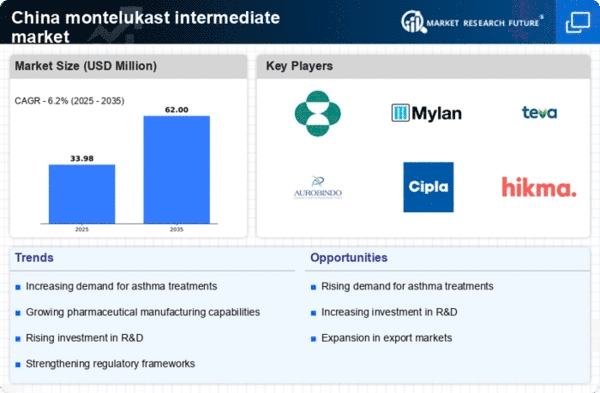
As per Market Research Future analysis, the China Montelukast Intermediate Market size was estimated at 32.0 USD Million in 2024. The Montelukast Intermediate market is projected to grow from 33.98 USD Million in 2025 to 62.0 USD Million by 2035, exhibiting a compound annual growth rate (CAGR) of 6% during the forecast period 2025 - 2035

Key Market Trends & Highlights

The China montelukast intermediate market is experiencing robust growth driven by rising demand for respiratory treatments and advancements in production technologies.

  • The market is characterized by a rising demand for respiratory treatments, particularly in urban areas.
  • Technological advancements in production processes are enhancing efficiency and reducing costs.
  • The evolving regulatory environment is fostering innovation and compliance in pharmaceutical manufacturing.
  • Key market drivers include the increasing prevalence of allergic conditions and government initiatives for healthcare improvement.

Market Size & Forecast

2024 Market Size 32.0 (USD Million)
2035 Market Size 62.0 (USD Million)
CAGR (2025 - 2035) 6.2%

Major Players

Merck & Co. (US), Mylan N.V. (US), Teva Pharmaceutical Industries Ltd. (IL), Aurobindo Pharma (IN), Cipla Ltd. (IN), Hikma Pharmaceuticals PLC (GB), Sandoz International GmbH (CH), Zydus Cadila (IN)

Our Impact
Enabled $4.3B Revenue Impact for Fortune 500 and Leading Multinationals
Partnering with 2000+ Global Organizations Each Year
30K+ Citations by Top-Tier Firms in the Industry

China Montelukast Intermediate Market Trends

The China Montelukast Intermediate Market is currently experiencing notable developments, driven by various factors including regulatory changes and increasing demand for asthma and allergy medications. The market appears to be influenced by the growing prevalence of respiratory conditions, which has led to a heightened focus on effective treatment options. Furthermore, advancements in manufacturing processes and technology may enhance production efficiency, potentially reducing costs and improving accessibility for consumers. As a result, stakeholders in the montelukast intermediate market are likely to explore innovative strategies to meet the evolving needs of healthcare providers and patients alike. In addition, the regulatory landscape surrounding the montelukast intermediate market is evolving, with authorities emphasizing quality control and safety standards. This shift may compel manufacturers to invest in compliance measures, thereby impacting operational costs. Moreover, the increasing collaboration between pharmaceutical companies and research institutions could foster the development of new formulations and delivery methods, further expanding the market's potential. Overall, the montelukast intermediate market seems poised for growth, driven by a combination of demand, innovation, and regulatory support.

Rising Demand for Respiratory Treatments

The montelukast intermediate market is witnessing an increase in demand for effective treatments for respiratory conditions. This trend is likely fueled by a growing awareness of asthma and allergies among the population, prompting healthcare providers to seek reliable solutions. As a result, manufacturers may focus on enhancing their product offerings to cater to this rising need.

Technological Advancements in Production

Innovations in manufacturing technology are playing a crucial role in the montelukast intermediate market. Enhanced production techniques may lead to improved efficiency and reduced costs, allowing companies to offer competitive pricing. This trend suggests that stakeholders are likely to invest in modernizing their facilities to keep pace with industry demands.

Evolving Regulatory Environment

The regulatory framework governing the montelukast intermediate market is undergoing significant changes. Authorities are placing greater emphasis on quality assurance and safety protocols, which may compel manufacturers to adapt their practices. This evolving landscape indicates that compliance will be a key focus for companies aiming to maintain their market position.

China Montelukast Intermediate Market Drivers

Growing Awareness of Preventive Healthcare

There is a notable shift towards preventive healthcare in China, which is impacting the montelukast intermediate market. As awareness of the importance of managing respiratory conditions early increases, more patients are seeking preventive treatments. This trend is reflected in the rising sales of montelukast, which is often prescribed as a preventive measure. The montelukast intermediate market is thus likely to experience growth as healthcare providers emphasize the importance of early intervention, leading to increased demand for intermediates used in the production of this medication.

Increasing Prevalence of Allergic Conditions

The montelukast intermediate market in China is experiencing growth due to the rising prevalence of allergic conditions such as asthma and allergic rhinitis. Reports indicate that approximately 30% of the population suffers from some form of allergy, leading to a heightened demand for effective treatments. This trend is likely to drive the production and consumption of montelukast intermediates, as healthcare providers increasingly prescribe this medication to manage symptoms. The montelukast intermediate market is thus positioned to benefit from this growing patient population, as pharmaceutical companies expand their production capabilities to meet the rising demand.

Government Initiatives for Healthcare Improvement

In China, government initiatives aimed at improving healthcare access and quality are positively influencing the montelukast intermediate market. The government has implemented policies to enhance the availability of essential medications, including those for respiratory conditions. This has resulted in increased funding for research and development in the pharmaceutical sector, particularly for montelukast intermediates. As a result, the montelukast intermediate market is likely to see a surge in investment, fostering innovation and potentially lowering production costs, which could enhance market competitiveness.

Expansion of Pharmaceutical Manufacturing Capabilities

The montelukast intermediate market is benefiting from the expansion of pharmaceutical manufacturing capabilities in China. With advancements in production technologies and increased investment in manufacturing facilities, companies are better equipped to produce montelukast intermediates at scale. This expansion is crucial as it allows for greater efficiency and cost-effectiveness in production processes. Consequently, the montelukast intermediate market is poised for growth, as manufacturers can meet the rising demand for montelukast while maintaining competitive pricing.

Rising Export Opportunities for Pharmaceutical Products

China's montelukast intermediate market is also influenced by rising export opportunities for pharmaceutical products. As the country strengthens its position in the global pharmaceutical supply chain, there is an increasing demand for montelukast intermediates from international markets. This trend is supported by favorable trade agreements and a growing reputation for quality in Chinese pharmaceuticals. The montelukast intermediate market is likely to capitalize on these opportunities, potentially leading to increased production and revenue as companies seek to expand their market reach.


Market Segment Insights

By Application: Asthma Treatment (Largest) vs. Chronic Obstructive Pulmonary Disease (Fastest-Growing)

In the China montelukast intermediate market, the application segment is prominently characterized by asthma treatment, which holds a significant share of the market. This segment caters to a large patient population, driving a steady demand for medication. In addition to asthma, allergic rhinitis treatment also contributes notably, though it does not surpass the demand seen in asthma care. Chronic obstructive pulmonary disease, while currently less prevalent, is gaining attention as a growing segment due to increasing air pollution and smoking rates that lead to respiratory issues. The growth trends in the application segment depict a dynamic landscape, with asthma treatment remaining the dominant player. However, the chronic obstructive pulmonary disease segment is emerging rapidly, driven by heightened awareness and diagnosis rates in urban populations. The rise in allergens and respiratory diseases further propels the market, suggesting that over the next several years, a significant shift may occur, resulting in an expanded share for the faster-growing segments like chronic obstructive pulmonary disease.

Asthma Treatment (Dominant) vs. Chronic Obstructive Pulmonary Disease (Emerging)

Asthma treatment is established as the dominant force in the application segment, characterized by strong market penetration and a loyal consumer base. The therapies available are well-accepted and continuously evolving to incorporate the latest advancements. On the other hand, chronic obstructive pulmonary disease is recognized as an emerging segment, gaining traction as awareness about the condition increases among healthcare providers and patients alike. The rapid urbanization and resultant environmental factors are contributing to a greater incidence of COPD, enhancing the demand for effective treatments. As more healthcare initiatives focus on respiratory illnesses, both segments are expected to co-exist, with asthma treatment remaining predominant while chronic obstructive pulmonary disease gradually captures a larger market share.

By Formulation Type: Tablets (Largest) vs. Oral Solution (Fastest-Growing)

In the China montelukast intermediate market, the formulation type segment is characterized by a distribution where tablets hold the largest market share, benefiting from their widespread acceptance and convenience for patients. Granules and oral solutions represent vital options but to a lesser extent, reflecting specific patient needs and preferences. The demand dynamics among these formulations reveal that tablets dominate due to their ease of dose management, while oral solutions have seen increased attention due to their suitability for younger patients. Growth trends in this segment are driven by several factors including rising healthcare awareness and changes in patient demographics. Tablets are expected to continue leading the market; however, oral solutions are on an upward trajectory as healthcare providers seek alternatives for patients with difficulty swallowing. Granules maintain a steady position but are primarily used in niche applications. Innovations in formulation technologies are also driving the segment's evolution, focusing on enhanced bioavailability and patient compliance.

Tablets (Dominant) vs. Granules (Emerging)

Tablets stand as the dominant formulation in the China montelukast intermediate market, largely due to their convenience and established presence among prescription medications. They offer precise dosing and cater to a wide demographic, including both adults and older children. In contrast, granules have emerged as a noteworthy alternative formulation, appealing particularly to specific patient groups such as pediatric patients who may struggle with swallowing pills. While tablets remain crucial for general market use, granules are increasingly recognized for their adaptability, allowing for customization in dosing and flavoring to improve adherence among younger populations. As patient-centric approaches gain traction, granules are likely to carve out a more defined space within the market.

By Route of Administration: Oral (Largest) vs. Inhalation (Fastest-Growing)

In the China montelukast intermediate market, the Oral route of administration holds the largest share, predominantly due to its convenience and patient compliance. This method is favored by a significant portion of the population, benefiting from established usage patterns and the simplicity of administration. In contrast, Inhalation is emerging quickly, capturing attention for its efficiency and targeted delivery, appealing to specific patient needs, particularly among those suffering from respiratory issues. The growth trends in this segment highlight an increasing shift towards Inhalation, driven by technological advancements and a growing emphasis on personalized medicine. As patients and healthcare providers prioritize treatments that maximize efficacy while minimizing systemic exposure, the Inhalation method has gained traction, reflecting its potential to become a dominant player in the future. The robust healthcare infrastructure in China further supports this evolution, allowing for the swift adoption of innovative delivery systems.

Oral (Dominant) vs. Inhalation (Emerging)

The Oral route of administration is characterized by its widespread acceptance and reliability, catering to a large demographic within the China montelukast intermediate market. This method benefits from easy storage and administration, reinforcing its position as the dominant choice for patients seeking convenience. Conversely, the Inhalation route is rapidly establishing itself as an emerging option, particularly for patients with acute respiratory conditions. It promises enhanced therapeutic effects through localized delivery and reduced systemic side effects. While still growing, this method's appeal lies in its innovative approaches to drug delivery, underscoring a shift towards more effective treatment options that meet diverse patient needs.

By Distribution Channel: Pharmacies (Largest) vs. Online Pharmacies (Fastest-Growing)

In the China montelukast intermediate market, Pharmacies account for the largest share, serving as the primary distribution channel for consumers seeking montelukast. This channel dominates the market structure due to its extensive network and accessibility to patients, allowing for high volumes of dispensed medication. Meanwhile, Online Pharmacies have emerged as a competitive alternative, increasingly capturing a significant portion of the market as consumers lean towards the convenience of digital purchasing options. Growth trends indicate a shift towards Online Pharmacies, driven by technological advancements and changing consumer preferences. The rise of e-commerce has facilitated easier access to medicines and a broader range of available products, appealing especially to younger demographics. Pharmacies continue to thrive, but Online Pharmacies are fast becoming a favored channel due to the pandemic's lasting impact on shopping behavior, enhancing their market appeal.

Pharmacies (Dominant) vs. Online Pharmacies (Emerging)

Pharmacies have established themselves as the dominant distribution channel in the montelukast intermediate market by maintaining direct relationships with consumers and healthcare providers. They offer personalized services, contribute to patient adherence, and leverage their physical presence to enhance brand loyalty. Conversely, Online Pharmacies represent an emerging force, driven by the demand for convenience and the growing acceptance of online shopping for healthcare products. They are characterized by their ability to provide competitive pricing, home delivery, and a wide array of options, appealing to a tech-savvy population. As both segments continue to develop, their interplay will shape the future dynamics of the market.

Get more detailed insights about China Montelukast Intermediate Market

Key Players and Competitive Insights

The montelukast intermediate market exhibits a dynamic competitive landscape characterized by a blend of established players and emerging competitors. Key growth drivers include increasing demand for asthma and allergy medications, alongside a rising focus on cost-effective generic alternatives. Major companies such as Merck & Co. (US), Mylan N.V. (US), and Teva Pharmaceutical Industries Ltd. (IL) are strategically positioned to leverage their extensive research capabilities and established distribution networks. Merck & Co. (US) emphasizes innovation in drug formulation, while Mylan N.V. (US) focuses on expanding its generic portfolio to capture market share. Teva Pharmaceutical Industries Ltd. (IL) is enhancing its operational efficiency through digital transformation initiatives, collectively shaping a competitive environment that prioritizes both innovation and accessibility.In terms of business tactics, companies are increasingly localizing manufacturing to reduce costs and enhance supply chain resilience. The market structure appears moderately fragmented, with several players vying for dominance. This fragmentation allows for competitive pricing strategies, yet the influence of key players remains substantial, as they set industry standards and drive technological advancements.

In October Merck & Co. (US) announced a strategic partnership with a leading Chinese biotech firm to co-develop a new montelukast formulation aimed at improving patient compliance. This collaboration is likely to enhance Merck's market presence in China, tapping into local expertise and accelerating product development cycles. The strategic importance of this partnership lies in its potential to address specific regional needs while reinforcing Merck's commitment to innovation.

In September Mylan N.V. (US) launched a new generic version of montelukast in China, significantly reducing the price point by approximately 15%. This move is indicative of Mylan's strategy to penetrate the market further by offering cost-effective solutions, thereby appealing to a broader patient demographic. The launch not only strengthens Mylan's competitive position but also reflects a growing trend towards affordability in the pharmaceutical sector.

In August Teva Pharmaceutical Industries Ltd. (IL) expanded its manufacturing capabilities in China by investing $50 million in a new facility dedicated to the production of montelukast intermediates. This investment underscores Teva's commitment to enhancing supply chain reliability and meeting the increasing demand for its products in the region. The strategic importance of this expansion is multifaceted, as it not only boosts production capacity but also aligns with global sustainability goals by incorporating eco-friendly manufacturing practices.

As of November current competitive trends are increasingly defined by digitalization, sustainability, and the integration of AI technologies. Strategic alliances are becoming pivotal in shaping the landscape, as companies seek to enhance their capabilities and market reach. The shift from price-based competition to a focus on innovation, technology, and supply chain reliability is evident, suggesting that future differentiation will hinge on the ability to deliver high-quality, innovative solutions that meet evolving consumer needs.

Key Companies in the China Montelukast Intermediate Market include

Industry Developments

In recent months, the China Montelukast Intermediate Market has observed several significant developments and current affairs. Notably, companies like Huahai Pharmaceutical and Zhejiang Jianfeng have been expanding their production capacities in response to increased domestic and international demand for Montelukast.

In June 2023, Hubei Dongying announced an enhancement in their manufacturing processes to improve yield. In contrast, Jiangsu Hengrui is reportedly focusing on Research and Development to introduce a new generation of Montelukast products. There has also been an uptick in market valuation, driven by heightened competition among players such as Wuxi AppTec and Shijiazhuang Yiling, aimed at capturing a larger share of the growing asthma management segment.

No substantial mergers or acquisitions have been reported among the listed companies in the last few months. However, major happenings include the government's recent push for stringent quality regulations, which may reshape market dynamics. Over the past two to three years, the industry's consolidation trends have indicated a shift towards innovation and quality improvement.

This is especially true among leading firms like Hangzhou Jinchang and Nanjing Jianfeng, positioning them well for future growth potential in both domestic and international markets.

Future Outlook

China Montelukast Intermediate Market Future Outlook

The Montelukast Intermediate Market is projected to grow at a 6.2% CAGR from 2025 to 2035, driven by increasing demand for asthma treatments and regulatory support.

New opportunities lie in:

  • Expansion of production facilities to enhance supply chain efficiency.
  • Development of novel formulations to cater to diverse patient needs.
  • Strategic partnerships with local pharmaceutical companies for market penetration.

By 2035, the montelukast intermediate market is expected to achieve robust growth and increased market share.

Market Segmentation

China Montelukast Intermediate Market Application Outlook

  • Asthma Treatment
  • Allergic Rhinitis Treatment
  • Chronic Obstructive Pulmonary Disease

China Montelukast Intermediate Market Formulation Type Outlook

  • Tablets
  • Granules
  • Oral Solution

China Montelukast Intermediate Market Distribution Channel Outlook

  • Pharmacies
  • Online Pharmacies
  • Hospitals

China Montelukast Intermediate Market Route of Administration Outlook

  • Oral
  • Inhalation

Report Scope

MARKET SIZE 2024 32.0(USD Million)
MARKET SIZE 2025 33.98(USD Million)
MARKET SIZE 2035 62.0(USD Million)
COMPOUND ANNUAL GROWTH RATE (CAGR) 6.2% (2025 - 2035)
REPORT COVERAGE Revenue Forecast, Competitive Landscape, Growth Factors, and Trends
BASE YEAR 2024
Market Forecast Period 2025 - 2035
Historical Data 2019 - 2024
Market Forecast Units USD Million
Key Companies Profiled Merck & Co. (US), Mylan N.V. (US), Teva Pharmaceutical Industries Ltd. (IL), Aurobindo Pharma (IN), Cipla Ltd. (IN), Hikma Pharmaceuticals PLC (GB), Sandoz International GmbH (CH), Zydus Cadila (IN)
Segments Covered Application, Formulation Type, Route of Administration, Distribution Channel
Key Market Opportunities Emerging demand for montelukast intermediates driven by regulatory shifts and increased asthma prevalence.
Key Market Dynamics Rising demand for montelukast intermediates driven by regulatory shifts and increased production capacity in local markets.
Countries Covered China
Leave a Comment

FAQs

What is the expected market size of the China Montelukast Intermediate Market in 2024?

The China Montelukast Intermediate Market is expected to be valued at 1.5 million USD in 2024.

What will be the estimated market size in 2035?

By the year 2035, the market is projected to reach a value of 2.5 million USD.

What is the projected CAGR for the China Montelukast Intermediate Market from 2025 to 2035?

The expected CAGR for the market from 2025 to 2035 is 4.753 percent.

Which application accounts for the largest market share in 2024?

In 2024, the application for Asthma is expected to account for the largest market share, valued at 0.6 million USD.

What is the expected market size for the Allergic Rhinitis application in 2035?

The market size for the Allergic Rhinitis application is anticipated to reach 0.7 million USD by 2035.

Who are the key players in the China Montelukast Intermediate Market?

Major players in the market include Huahai Pharmaceutical, Zhejiang Jianfeng, Tianjin Zhongxin, and Wuxi AppTec among others.

What is the projected value for the Bronchospasm application in 2024?

The Bronchospasm application is projected to be valued at 0.3 million USD in the year 2024.

What challenges does the China Montelukast Intermediate Market face?

Challenges may include regulatory hurdles and competition from alternative treatments in the market.

What is the expected market size for Urticaria by 2035?

The Urticaria application is expected to be valued at 0.3 million USD in 2035.

Are there any emerging trends in the China Montelukast Intermediate Market?

Emerging trends include the increasing demand for more effective therapeutic options and advancements in drug formulation technologies.

Download Free Sample

Kindly complete the form below to receive a free sample of this Report

Compare Licence

×
Features License Type
Single User Multiuser License Enterprise User
Price $4,950 $5,950 $7,250
Maximum User Access Limit 1 User Upto 10 Users Unrestricted Access Throughout the Organization
Free Customization
Direct Access to Analyst
Deliverable Format
Platform Access
Discount on Next Purchase 10% 15% 15%
Printable Versions