×
Request Free Sample ×

Kindly complete the form below to receive a free sample of this Report

* Please use a valid business email

Leading companies partner with us for data-driven Insights

clients tt-cursor
Hero Background

China Military Laser Rangefinder Market

ID: MRFR/AD/52408-HCR
200 Pages
Garvit Vyas
February 2026

China Military Laser Rangefinder Market Size, Share, Industry Trend & Analysis Research Report By Product Type (Man-Portable, Vehicle-Mounted), By Application (Weapon Guidance, Detection) andBy Range (Up to 15 KM, Over 15 KM)- Forecast to 2035 China Military Laser Rangefinder Market Size, Share, Industry Trend & Analysis Overview: As per MRFR analysis, the China Military Laser Rangefinder Size was estimated at 93

Share:
Download PDF ×

We do not share your information with anyone. However, we may send you emails based on your report interest from time to time. You may contact us at any time to opt-out.

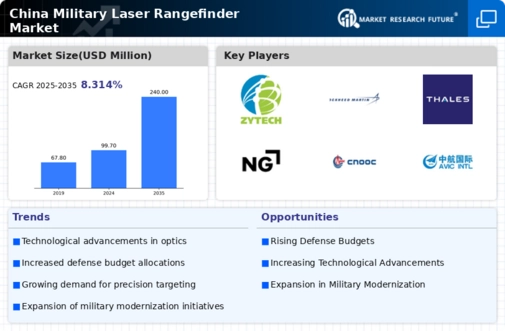
China Military Laser Rangefinder Market Infographic
Purchase Options

China Military Laser Rangefinder Market Summary

As per analysis, the China military laser rangefinder market is projected to grow from USD 1.27 Million in 2025 to USD 2.92 Million by 2035, exhibiting a compound annual growth rate (CAGR) of 8.81% during the forecast period (2025 - 2035).

Key Market Trends & Highlights

The China military laser rangefinder market is poised for growth driven by technological advancements and increased defense spending.

  • Technological advancements are enhancing the accuracy and efficiency of military laser rangefinders, particularly in ground forces.
  • The ground forces segment remains the largest, while the surveillance segment is experiencing the fastest growth due to rising demand for precision targeting.
  • Increased defense spending is fueling investments in domestic production capabilities, ensuring self-reliance in military technologies.
  • Strategic military modernization initiatives and growing demand for precision targeting are key drivers propelling market expansion.

Market Size & Forecast

2024 Market Size 1.16 (USD Million)
2035 Market Size 2.92 (USD Million)
CAGR (2025 - 2035) 8.81%

Major Players

China Electronics Technology Group Corporation (CN), North Industries Group Corporation (CN), Aerospace Science and Technology Corporation (CN), China South Industries Group Corporation (CN), Hunan Aerospace Industry Group (CN), Zhejiang University (CN), China National Precision Machinery Import and Export Corporation (CN), Beijing Institute of Technology (CN)

Our Impact
Enabled $4.3B Revenue Impact for Fortune 500 and Leading Multinationals
Partnering with 2000+ Global Organizations Each Year
30K+ Citations by Top-Tier Firms in the Industry

China Military Laser Rangefinder Market Trends

The China military laser rangefinder market is currently experiencing a notable evolution, driven by advancements in technology and increasing defense expenditures. The Chinese government has prioritized modernization of its military capabilities, which includes the integration of sophisticated optical systems such as laser rangefinders. These devices are essential for enhancing targeting accuracy and operational efficiency in various military applications. As a result, the demand for high-performance laser rangefinders is on the rise, reflecting a broader trend towards the adoption of cutting-edge technologies in the armed forces. Moreover, the competitive landscape of the china military laser rangefinder market is characterized by a mix of domestic manufacturers and collaborations with international firms. This dynamic fosters innovation and the development of new products tailored to meet the specific needs of the Chinese military. The emphasis on research and development is likely to yield advanced solutions that improve the effectiveness of military operations. As the market continues to evolve, it appears poised for further growth, driven by the ongoing commitment to enhancing national defense capabilities and the integration of advanced technologies.

Technological Advancements

The china military laser rangefinder market is witnessing rapid technological advancements, particularly in miniaturization and precision. Innovations in optics and electronics are leading to the development of more compact and efficient devices, which are crucial for modern military operations. These advancements not only enhance the performance of rangefinders but also contribute to the overall effectiveness of military strategies.

Increased Defense Spending

The commitment of the Chinese government to bolster its defense budget is significantly impacting the china military laser rangefinder market. This increase in funding allows for the procurement of advanced equipment, including laser rangefinders, which are essential for improving combat readiness and operational capabilities. As defense spending rises, the demand for high-quality rangefinding solutions is expected to grow.

Focus on Domestic Production

There is a marked emphasis on domestic production within the china military laser rangefinder market. The Chinese government encourages local manufacturers to develop and produce advanced military technologies, reducing reliance on foreign suppliers. This focus on self-sufficiency not only strengthens the national defense industry but also fosters innovation and competitiveness among local firms.

China Military Laser Rangefinder Market Drivers

Increased Defense Spending

In recent years, the Chinese government has significantly increased its defense budget, which has a direct impact on the China military laser rangefinder market. The focus on modernizing the military and enhancing its capabilities has led to a surge in demand for advanced military equipment, including laser rangefinders. According to government reports, defense spending is expected to reach approximately USD 300 billion by 2026, with a substantial portion allocated to research and development of cutting-edge technologies. This increase in funding is likely to facilitate the procurement of high-performance laser rangefinders, thereby driving market growth and fostering competition among domestic manufacturers.

Technological Advancements

The China military laser rangefinder market is experiencing rapid technological advancements, which are enhancing the capabilities and performance of these devices. Innovations in laser technology, such as the development of solid-state lasers and improved optics, are leading to more accurate and reliable rangefinding solutions. The integration of advanced materials and miniaturization techniques is also contributing to the production of lightweight and portable rangefinders. As a result, the Chinese military is increasingly adopting these advanced systems for various applications, including artillery targeting and reconnaissance missions. The market is projected to grow significantly, with estimates suggesting a compound annual growth rate (CAGR) of over 5% in the coming years, driven by these technological improvements.

Focus on Domestic Production

The China military laser rangefinder market is witnessing a strong emphasis on domestic production, driven by the government's policy to reduce reliance on foreign technology. The Chinese government has implemented initiatives to promote local manufacturers, encouraging them to develop and produce advanced military equipment, including laser rangefinders. This focus on self-sufficiency is evident in the establishment of research and development centers and partnerships between military and civilian sectors. As a result, domestic companies are increasingly capable of producing high-quality laser rangefinders that meet the specific needs of the Chinese military. This trend is expected to bolster the market, as local manufacturers gain a competitive edge and contribute to the overall growth of the industry.

Growing Demand for Precision Targeting

The growing demand for precision targeting in military operations is a key driver for the China military laser rangefinder market. As the Chinese military seeks to enhance its operational effectiveness, the need for accurate and reliable targeting solutions has become paramount. Laser rangefinders play a crucial role in providing real-time distance measurements, which are essential for effective artillery and missile strikes. The increasing complexity of modern warfare necessitates the integration of advanced targeting systems, further propelling the demand for laser rangefinders. Market analysts project that this trend will continue, with the market for precision targeting solutions, including laser rangefinders, expected to expand significantly in the next few years.

Strategic Military Modernization Initiatives

The China military laser rangefinder market is significantly influenced by the strategic military modernization initiatives undertaken by the Chinese government. These initiatives aim to enhance the overall capabilities of the armed forces, focusing on advanced technologies and equipment. The modernization efforts include the integration of laser rangefinders into various military platforms, such as armored vehicles and aircraft, to improve operational efficiency. The Chinese military's commitment to adopting state-of-the-art technologies is likely to drive the demand for laser rangefinders, as they are essential for modern combat scenarios. As these initiatives progress, the market is expected to witness substantial growth, reflecting the increasing importance of advanced rangefinding solutions in military operations.


Market Segment Insights

By Application: Ground Forces (Largest) vs. Surveillance (Fastest-Growing)

In the China military laser rangefinder market, the application segment is notably diverse, showcasing varied contributions from different sectors. The Ground Forces segment emerges as the largest, commanding a significant portion of the market share due to the high demand for precision targeting and reconnaissance. In contrast, the Surveillance segment is gaining momentum, increasingly integrated into defense operations for enhanced situational awareness and threat detection, suggesting a shift in strategic focus for military applications.

Ground Forces: Dominant vs. Surveillance: Emerging

The Ground Forces segment represents a crucial element of China's military capabilities, characterized by its reliance on advanced laser rangefinders for artillery targeting and troop coordination in complex terrains. This segment benefits from ongoing modernization efforts and heightened defense spending, ensuring its dominance in the market. In contrast, the Surveillance segment is rapidly emerging, driven by innovations that enhance imaging technology and data processing. Surveillance applications are sought for border security, reconnaissance missions, and urban operations, with investments focused on smart technologies, making it an appealing frontier for market growth.

By End Use: Defense Forces (Largest) vs. Research Institutions (Fastest-Growing)

In the China military laser rangefinder market, the distribution of market share among end-use segments is diverse. Defense Forces dominate the landscape due to their substantial budget allocations and ongoing modernization programs. They have been investing heavily in advanced targeting systems, driving demand for high-precision laser rangefinders. In contrast, segments like Paramilitary and Border Security hold significant positions as well, but they lag behind the Defense Forces in terms of market share. Over recent years, the growth trajectory of the military laser rangefinder market has seen a noticeable shift. Research Institutions are emerging rapidly, fueled by advancements in technology and increased defense research expenditure. Innovative applications and collaborations with the military sector drive this growth, while stringent security needs bolster demand across Paramilitary and Border Security divisions. As these segments recognize the technological advantages of laser rangefinders, their adoption rates are expected to accelerate further, contributing to an evolving market landscape.

Defense Forces (Dominant) vs. Research Institutions (Emerging)

The Defense Forces segment of the China military laser rangefinder market remains a dominant force, characterized by significant investment and a robust infrastructure aimed at integrating cutting-edge technologies into military operations. This segment prioritizes precision and reliability, necessitating advanced laser rangefinders to enhance targeting efficiency and mission success. Conversely, Research Institutions represent an emerging segment, drawing attention for their innovative research projects and collaborations with defense sectors. They stimulate demand for state-of-the-art laser rangefinders by exploring their applications in various military and security scenarios, thus gradually making a mark in the market with a focus on technology development and operational efficiency.

By Technology: Solid State Laser (Largest) vs. Fiber Laser (Fastest-Growing)

In the China military laser rangefinder market, the technology segment is predominantly led by solid state lasers, commanding a significant share due to their stability and high performance in various conditions. Fiber lasers are rapidly gaining traction as an emerging technology, contributing to a shift in preference among military applications that prioritize durability and flexibility in laser rangefinding solutions.

Technology: Solid State Laser (Dominant) vs. Fiber Laser (Emerging)

Solid state lasers dominate the China military laser rangefinder market due to their reliability and efficiency, making them ideal for applications requiring precise measurements over varying distances. Their robust performance in diverse environmental conditions ensures their continued preference among military users. Conversely, fiber lasers represent an emerging technology that is rapidly being integrated into military systems for laser rangefinding. Their lightweight design and high output power offer a compelling advantage, making them appealing for advanced military applications. This technology enables better maneuverability and reduces energy consumption, enhancing operational capabilities.

By Range: Short Range (Largest) vs. Long Range (Fastest-Growing)

In the China military laser rangefinder market, the short range segment holds the largest share, showcasing its critical role in rapid deployment scenarios. This segment caters to immediate tactical applications, offering robust features that meet the needs of ground troops. Conversely, the long range segment is emerging as the fastest-growing segment, reflecting the increasing emphasis on advanced reconnaissance and surveillance operations, where distance targeting is paramount. The growth dynamics for these segments hinge upon technological advancements and strategic military requirements. The short range segment benefits from enhanced portability and ease of use, making it a staple for close-combat situations. However, the long range segment is spurred by innovations in optics and laser technology, enabling more precise targeting at extended distances, thereby attracting significant investment and interest from the military sector.

Short Range (Dominant) vs. Extended Range (Emerging)

The short range segment is dominant due to its well-established applications in various military operations, particularly in urban and close-quarter engagements. Its effectiveness lies in providing immediate targeting solutions that enhance troop safety and operational efficiency. Meanwhile, the extended range segment, while still in the emerging phase, is gaining traction as militaries look to incorporate longer-distance capabilities into their arsenals. This shift is driven by changes in warfare tactics that prioritize reconnaissance from afar, leading to innovations that extend the operational range of laser rangefinders. Manufacturers are increasingly focusing on integrating advanced features like improved range accuracy and fast acquisition times to appeal to this growing segment.

By Component Type: Transmitter (Largest) vs. Receiver (Fastest-Growing)

In the China military laser rangefinder market, the component type segment is primarily dominated by the transmitter, which holds the largest share due to its crucial role in emitting laser light. The receiver follows and is rapidly gaining traction as manufacturers emphasize enhanced detection capabilities. The optical system and control unit, while essential, occupy smaller portions of the market but are vital for overall functionality. This distribution reveals a well-defined structure where transmitters lead, but receivers are poised for significant growth in demand.

Technology: Transmitter (Dominant) vs. Receiver (Emerging)

The transmitter stands out as the dominant technology in the component type segment of the China military laser rangefinder market, primarily due to its critical function in laser emission. It ensures precise targeting and range measurements, making it indispensable for military applications. On the other hand, the receiver represents an emerging technology that is experiencing rapid growth due to advancements in detection techniques and miniaturization. As the demand for more accurate and reliable rangefinding solutions increases, the receiver's capabilities are becoming increasingly sophisticated, allowing it to catch up with the transmitter in market relevance. Both components showcase distinct characteristics that cater to the evolving needs of military operations.

Get more detailed insights about China Military Laser Rangefinder Market

Key Players and Competitive Insights

The competitive dynamics within the military laser rangefinder market in China are characterized by a blend of innovation, strategic partnerships, and a focus on technological advancement. Key players such as China Electronics Technology Group Corporation (CN), North Industries Group Corporation (CN), and Aerospace Science and Technology Corporation (CN) are at the forefront, each adopting distinct strategies to enhance their market positioning. For instance, these companies are increasingly investing in research and development to innovate their product offerings, thereby responding to the growing demand for precision targeting and enhanced operational capabilities in military applications.

In terms of business tactics, localizing manufacturing and optimizing supply chains appear to be pivotal strategies among these companies. The market structure is moderately fragmented, with several players vying for dominance. However, the collective influence of major companies is shaping a competitive environment that encourages collaboration and innovation, as firms seek to leverage each other's strengths to enhance their technological capabilities and market reach.

In December 2025, China Electronics Technology Group Corporation (CN) announced a strategic partnership with a leading technology firm to develop next-generation laser rangefinders that integrate artificial intelligence capabilities. This move is likely to enhance their product offerings, allowing for improved accuracy and efficiency in military operations. The collaboration underscores the importance of technological integration in maintaining a competitive edge in the market.

In November 2025, North Industries Group Corporation (CN) unveiled a new line of portable laser rangefinders designed for rapid deployment in various terrains. This product launch not only reflects the company's commitment to innovation but also addresses the increasing demand for versatile military equipment. The introduction of these advanced systems may position North Industries as a key player in the portable segment of the market, potentially attracting new clients.

In October 2025, Aerospace Science and Technology Corporation (CN) completed the acquisition of a smaller firm specializing in laser technology. This acquisition is expected to bolster their research capabilities and expand their product portfolio, allowing them to offer more comprehensive solutions to military clients. Such strategic moves indicate a trend towards consolidation in the market, as larger firms seek to enhance their technological capabilities through acquisitions.

As of January 2026, current trends in the military laser rangefinder market are increasingly defined by digitalization, sustainability, and the integration of AI technologies. Strategic alliances are becoming more prevalent, as companies recognize the need to collaborate to stay competitive. Looking ahead, it is anticipated that competitive differentiation will evolve, shifting from price-based competition to a focus on innovation, advanced technology, and supply chain reliability. This evolution suggests that companies that prioritize these aspects will likely emerge as leaders in the market.

Key Companies in the China Military Laser Rangefinder Market include

Industry Developments

Recently, the China Military Laser Rangefinder Market has experienced significant activity, with companies like Raytheon Technologies, Lockheed Martin, and Northrop Grumman actively participating in the sector. In August 2023, the Chinese government announced increased funding towards enhancing laser technology for military applications, reflecting a growing emphasis on precision in defense capabilities. Firms such as China Electronics Technology Group and AVIC have been focusing on the Research and Development of advanced rangefinders that cater to modern warfare requirements, contributing to market growth.

In terms of mergers and acquisitions, a notable event occurred in September 2023, when CNOOC announced the acquisition of a technology firm specializing in military optics to enhance its capabilities in the laser rangefinder domain. Furthermore, BAE Systems has shown interest in collaborating with local firms to integrate cutting-edge technology into their offerings. Over the past two years, from 2021 to 2023, the market has seen a steady increase in valuation as demand for high-precision military equipment continues to rise, highlighting the strategic importance of laser rangefinders in China's defense modernization efforts.

Future Outlook

China Military Laser Rangefinder Market Future Outlook

The China military laser rangefinder market is projected to grow at an 8.81% CAGR from 2025 to 2035, driven by technological advancements and increasing defense budgets.

New opportunities lie in:

  • Development of compact, portable laser rangefinders for infantry units.
  • Integration of AI for enhanced targeting accuracy and data analysis.
  • Expansion into unmanned systems for automated reconnaissance and targeting.

By 2035, the market is expected to be robust, driven by innovation and strategic investments.

Market Segmentation

China Military Laser Rangefinder Market Range Outlook

  • Short Range
  • Medium Range
  • Long Range
  • Extended Range

China Military Laser Rangefinder Market End Use Outlook

  • Defense Forces
  • Paramilitary
  • Border Security
  • Intelligence Agencies
  • Research Institutions

China Military Laser Rangefinder Market Technology Outlook

  • Solid State Laser
  • Fiber Laser
  • Diode Laser
  • Coherent Laser
  • Non-Coherent Laser

China Military Laser Rangefinder Market Application Outlook

  • Artillery
  • Aviation
  • Naval
  • Ground Forces
  • Surveillance

China Military Laser Rangefinder Market Component Type Outlook

  • Transmitter
  • Receiver
  • Optical System
  • Control Unit

Report Scope

MARKET SIZE 20241.16(USD Million)
MARKET SIZE 20251.27(USD Million)
MARKET SIZE 20352.92(USD Million)
COMPOUND ANNUAL GROWTH RATE (CAGR)8.81% (2024 - 2035)
REPORT COVERAGERevenue Forecast, Competitive Landscape, Growth Factors, and Trends
BASE YEAR2024
Market Forecast Period2025 - 2035
Historical Data2019 - 2024
Market Forecast UnitsUSD Million
Key Companies ProfiledChina Electronics Technology Group Corporation (CN), North Industries Group Corporation (CN), Aerospace Science and Technology Corporation (CN), China South Industries Group Corporation (CN), Hunan Aerospace Industry Group (CN), Zhejiang University (CN), China National Precision Machinery Import and Export Corporation (CN), Beijing Institute of Technology (CN)
Segments CoveredApplication, End Use, Technology, Range, Component Type
Key Market OpportunitiesAdvancements in precision targeting technologies drive growth in the china military laser rangefinder market.
Key Market DynamicsRising demand for advanced military capabilities drives innovation in China's laser rangefinder technology and production.
Countries CoveredChina
Leave a Comment

FAQs

What is the current valuation of the China military laser rangefinder market?

The market valuation was 1.16 USD Million in 2024.

Download Free Sample

Kindly complete the form below to receive a free sample of this Report

Compare Licence

×
Features License Type
Single User Multiuser License Enterprise User
Price $4,950 $5,950 $7,250
Maximum User Access Limit 1 User Upto 10 Users Unrestricted Access Throughout the Organization
Free Customization
Direct Access to Analyst
Deliverable Format
Platform Access
Discount on Next Purchase 10% 15% 15%
Printable Versions