×
Request Free Sample ×

Kindly complete the form below to receive a free sample of this Report

* Please use a valid business email

Leading companies partner with us for data-driven Insights

clients tt-cursor
Hero Background

China Investment Banking Market

ID: MRFR/BS/53408-HCR
200 Pages
Garvit Vyas
February 2026

China Investment Banking Market Size, Share and Research Report: By Type (Mergers & Acquisitions Advisory, Financial Sponsor/Syndicated Loans, Equity Capital Markets Underwriting, Debt Capital Markets Underwriting), By End User (Individuals, Corporate Institutions) and By Enterprise Size (Large Enterprises, Small and Medium-Sized Enterprises (SMEs)) - Industry Forecast Till 2035

Share:
Download PDF ×

We do not share your information with anyone. However, we may send you emails based on your report interest from time to time. You may contact us at any time to opt-out.

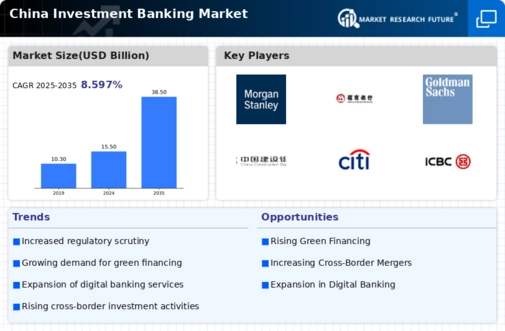
China Investment Banking Market Infographic
Purchase Options

China Investment Banking Market Summary

As per Market Research Future analysis, the China investment banking market Size was estimated at 11.1 USD Billion in 2024. The China investment banking market is projected to grow from 12.08 USD Billion in 2025 to 28.35 USD Billion by 2035, exhibiting a compound annual growth rate (CAGR) of 8% during the forecast period 2025 - 2035

Key Market Trends & Highlights

The China investment banking market is experiencing a transformative phase driven by regulatory changes and technological advancements.

  • Regulatory changes are reshaping compliance requirements, influencing investment banking operations.
  • Technological integration is enhancing efficiency and client engagement in financial services.
  • The focus on sustainable finance is gaining traction, reflecting a shift towards responsible investment practices.
  • Economic growth and increased foreign direct investment (FDI) are key drivers propelling the market forward.

Market Size & Forecast

2024 Market Size 11.1 (USD Billion)
2035 Market Size 28.35 (USD Billion)
CAGR (2025 - 2035) 8.9%

Major Players

Goldman Sachs (US), JPMorgan Chase (US), Morgan Stanley (US), Bank of America (US), Citigroup (US), Barclays (GB), Deutsche Bank (DE), Credit Suisse (CH), UBS (CH), RBC Capital Markets (CA)

Our Impact
Enabled $4.3B Revenue Impact for Fortune 500 and Leading Multinationals
Partnering with 2000+ Global Organizations Each Year
30K+ Citations by Top-Tier Firms in the Industry

China Investment Banking Market Trends

The investment banking market is currently experiencing a dynamic phase characterized by evolving regulatory frameworks and increasing competition among financial institutions. Recent reforms aimed at enhancing transparency and risk management are reshaping the operational landscape. These changes appear to foster a more robust environment for mergers and acquisitions, as firms seek to capitalize on emerging opportunities. Additionally, the rise of technology-driven solutions is influencing traditional practices, prompting banks to adapt their strategies to remain competitive. As a result, the market is witnessing a shift towards more innovative financial products and services, which could potentially enhance client engagement and satisfaction. Moreover, the investment banking market is likely to see a growing emphasis on sustainable finance. Stakeholders are increasingly prioritizing environmental, social, and governance (ESG) factors in their investment decisions. This trend suggests that firms may need to integrate ESG considerations into their advisory services and capital-raising activities. Furthermore, the demand for green bonds and sustainable investment vehicles is on the rise, indicating a shift in investor preferences. Overall, the investment banking market is poised for transformation, driven by regulatory changes, technological advancements, and a heightened focus on sustainability.

Regulatory Changes

Recent reforms in the investment banking market are aimed at enhancing transparency and risk management. These changes are likely to reshape operational practices, encouraging firms to adopt more stringent compliance measures. As a result, institutions may need to invest in advanced technologies to meet regulatory requirements.

Technological Integration

The integration of technology in the investment banking market is becoming increasingly prevalent. Financial institutions are adopting digital platforms and data analytics to streamline operations and improve client services. This trend suggests a shift towards more efficient and innovative financial solutions.

Focus on Sustainable Finance

There is a growing emphasis on sustainable finance within the investment banking market. Stakeholders are prioritizing ESG factors in their investment strategies, leading to an increased demand for green bonds and sustainable investment products. This trend indicates a potential shift in how firms approach capital raising and advisory services.

China Investment Banking Market Drivers

Increased Foreign Direct Investment (FDI)

China's investment banking market is significantly influenced by the influx of foreign direct investment (FDI). In recent years, FDI has shown a steady increase, with inflows reaching approximately $150 billion in 2025. This trend indicates a growing confidence among international investors in China's economic prospects. Investment banks are essential in this context, providing advisory services to foreign firms looking to enter the Chinese market or expand their operations. The investment banking market is likely to see heightened activity as these banks facilitate cross-border transactions, helping to bridge the gap between foreign investors and local enterprises.

Regulatory Environment and Compliance Needs

The investment banking market in China is shaped by a complex regulatory environment that necessitates compliance and risk management. Recent regulatory reforms have introduced new requirements for transparency and accountability, compelling investment banks to enhance their compliance frameworks. This shift is likely to drive demand for specialized services within the investment banking market, as firms seek to ensure adherence to evolving regulations. The ability to navigate these regulatory challenges effectively can provide a competitive advantage, positioning investment banks as trusted advisors in an increasingly scrutinized financial landscape.

Economic Growth and Investment Opportunities

The investment banking market in China is currently experiencing a surge due to robust economic growth. With a projected GDP growth rate of approximately 5.5% in 2025, the demand for capital raising and advisory services is likely to increase. This growth is driven by a burgeoning middle class and increased consumer spending, which creates numerous investment opportunities. As companies seek to expand and innovate, investment banks play a crucial role in facilitating mergers and acquisitions, initial public offerings, and other financial transactions. The investment banking market is thus positioned to benefit from this economic dynamism, as firms look to leverage financial expertise to navigate the evolving landscape.

Rising Demand for Financial Advisory Services

The investment banking market in China is witnessing a rising demand for financial advisory services, particularly in the context of corporate restructuring and strategic planning. As companies face increasing competition and market volatility, the need for expert guidance has become paramount. In 2025, the market for financial advisory services is expected to grow by approximately 8%, reflecting the critical role that investment banks play in helping firms navigate complex financial landscapes. The investment banking market is thus adapting to these needs, offering tailored solutions that address the unique challenges faced by businesses in a rapidly changing environment.

Technological Advancements and Digital Transformation

The investment banking market in China is undergoing a transformation driven by technological advancements. The integration of artificial intelligence, big data analytics, and blockchain technology is reshaping how investment banks operate. In 2025, it is anticipated that investment banks will allocate over 20% of their budgets to technology initiatives aimed at enhancing operational efficiency and client service. This digital transformation is likely to create new opportunities within the investment banking market, as firms leverage technology to streamline processes, improve decision-making, and offer innovative financial products.


Market Segment Insights

By Type: Mergers & Acquisitions Advisory (Largest) vs. Debt Capital Markets Underwriting (Fastest-Growing)

The China investment banking market exhibits a diverse distribution of market share across its segments. Mergers & Acquisitions Advisory retains a dominant position, being the largest segment in this landscape, mainly driven by increased corporate activities and strategic consolidations among firms. Following closely, Equity Capital Markets Underwriting has also established a significant presence, reflecting strong investor confidence and favorable market conditions for initial public offerings. The growth trends within these segments are influenced by several factors, including economic reforms, changes in regulations, and the expanding pool of private equity. Debt Capital Markets Underwriting has emerged as the fastest-growing segment, fueled by rising demand for corporate financing and increasing interest rates that prompt organizations to explore robust financing options. This dynamic environment presents ample opportunities for investment banks to innovate and expand their service offerings.

Mergers & Acquisitions Advisory (Dominant) vs. Debt Capital Markets Underwriting (Emerging)

Mergers & Acquisitions Advisory stands out as the dominant force in the China investment banking market, characterized by high-profile transactions and intricate deal structuring that require skilled advisory services. Its strength lies in the robust collaboration between corporate entities and investment banks, facilitating streamlined mergers that optimize growth strategies. Conversely, Debt Capital Markets Underwriting, while currently an emerging segment, is rapidly gaining momentum as corporations pursue flexible funding solutions to manage financial obligations. The shift from equity to debt instruments marks a significant trend within the market, driven by evolving investor preferences and a quest for efficient capital raises, showcasing the competitive adaptability of firms in response to changing economic conditions.

By End User: Individuals (Largest) vs. Corporate Institutions (Fastest-Growing)

In the China investment banking market, the distribution of market share among end users reveals that individuals dominate the landscape, benefiting from a wide array of tailored financial services. Corporate institutions, however, represent a rapidly growing segment characterized by increasing engagement in mergers, acquisitions, and capital markets, thereby expanding their share of the market significantly. Growth trends in this segment are driven by rising disposable incomes among individuals, leading to increased investments in financial products. On the other hand, corporate institutions are accelerating their uptake of investment banking services, motivated by strategic initiatives for expansion and restructuring. This dual growth reflects the evolving needs of the market, with both segments playing crucial roles in shaping the investment landscape.

Individuals: Dominant vs. Corporate Institutions: Emerging

Individuals in the China investment banking market hold a dominant position, primarily due to their increasing participation in wealth management and investment services. This segment benefits from a diverse range of financial advisories and personalized investment products, making it attractive to potential investors. In contrast, corporate institutions are emerging as a significant force, driven by their need for sophisticated financial solutions for growth and risk management. These institutions are increasingly seeking investment banking services to support complex transactions and strategic developments. As these two segments evolve, the competitive dynamics are expected to transform, emphasizing innovation and tailored offerings to address the distinct needs of individuals and corporate clients.

By Enterprise Size: Large Enterprises (Largest) vs. Small and Medium-Sized Enterprises (SMEs) (Fastest-Growing)

In the China investment banking market, Large Enterprises dominate the landscape, capturing a significant share of the overall market. Their robust operations and substantial capital requirements drive their relevance in this sector, positioning them as key clients for investment banking services, including M&A advisory and capital raising. Conversely, SMEs are emerging rapidly within this space, leveraging the increasing availability of financial technology and supportive regulatory frameworks, which are encouraging entrepreneurial growth. The growth trends within this segment are distinctly promising, especially for SMEs, which are adapting swiftly to new financial products and services designed to meet their unique needs. The shift in focus towards innovation and digitalization has been pivotal, as SMEs harness these advancements to improve efficiency and access funding options. As the market evolves, the demand for tailored investment banking solutions for SMEs is expected to surge, further enriching the competitive dynamics between these enterprise sizes.

Large Enterprises (Dominant) vs. Small and Medium-Sized Enterprises (SMEs) (Emerging)

Large Enterprises in the China investment banking market exhibit substantial strength, often characterized by their well-established presence and comprehensive financial portfolios. They typically engage in high-stakes transactions and complex financial services, which require sophisticated risk management and strategic planning. Their significant market share allows them to negotiate favorable terms in investment banking services, thus reinforcing their dominant position. On the other hand, SMEs are increasingly recognized as a vital growth segment. Their agility allows them to adapt to market changes more rapidly than larger firms, often leading to innovative business models and financial solutions. They are supported by governmental policies aimed at fostering entrepreneurship, making them a crucial focus area for investment banks looking to expand their client base and service offerings.

Get more detailed insights about China Investment Banking Market

Key Players and Competitive Insights

The investment banking market in China is characterized by a dynamic competitive landscape, driven by factors such as increasing capital market activities, a growing demand for advisory services, and the ongoing globalization of financial services. Major players like Goldman Sachs (US), JPMorgan Chase (US), and Morgan Stanley (US) are actively positioning themselves to capitalize on these trends. Goldman Sachs (US) has focused on expanding its footprint in the Chinese market through strategic partnerships and local collaborations, enhancing its advisory capabilities. Meanwhile, JPMorgan Chase (US) has been investing in technology to streamline operations and improve client engagement, indicating a strong commitment to digital transformation. Morgan Stanley (US) appears to be leveraging its global network to facilitate cross-border transactions, thereby enhancing its competitive edge in the region.
The business tactics employed by these firms reflect a nuanced understanding of the local market dynamics. The competitive structure of the investment banking market in China is moderately fragmented, with both domestic and international players vying for market share. This fragmentation allows for a diverse range of services and innovations, as firms localize their offerings to meet the specific needs of Chinese clients. The collective influence of these key players shapes the market, fostering an environment where innovation and client-centric strategies are paramount.
In September 2025, Goldman Sachs (US) announced a strategic partnership with a leading Chinese fintech firm to enhance its digital banking services. This move is significant as it not only strengthens Goldman Sachs' technological capabilities but also positions the firm to better serve the evolving needs of Chinese consumers, who increasingly favor digital solutions. Such partnerships are likely to become a cornerstone of competitive strategy in the region.
In October 2025, JPMorgan Chase (US) launched a new advisory service tailored specifically for Chinese state-owned enterprises (SOEs). This initiative underscores the bank's commitment to understanding the unique challenges faced by SOEs and providing bespoke solutions. By aligning its services with the needs of this critical segment, JPMorgan Chase is likely to solidify its market position and enhance client loyalty.
In August 2025, Morgan Stanley (US) expanded its investment banking team in Shanghai, focusing on attracting top talent from local firms. This strategic hiring initiative is indicative of Morgan Stanley's intent to deepen its local expertise and strengthen its advisory capabilities. By investing in human capital, the firm aims to enhance its service offerings and better navigate the complexities of the Chinese market.
As of November 2025, the investment banking market is witnessing trends such as digitalization, sustainability, and the integration of artificial intelligence (AI) into financial services. These trends are reshaping competitive dynamics, as firms increasingly seek to differentiate themselves through innovative solutions rather than price competition. Strategic alliances are becoming more prevalent, enabling firms to leverage complementary strengths and enhance their service offerings. Looking ahead, the competitive landscape is likely to evolve further, with a pronounced shift towards technology-driven differentiation and supply chain reliability, as firms adapt to the changing needs of their clients.

Key Companies in the China Investment Banking Market include

Industry Developments

Recent developments in the China Investment Banking Market have seen notable movements among key players. In September 2023, Haitong Securities launched a new equity capital markets platform aimed at expanding its service offerings. Meanwhile, Guotai Junan Securities has reported strong earnings growth, reflecting a robust market position, attributed to their diversified investment strategy. In a significant acquisition, China Merchants Bank reached an agreement in August 2023 to purchase a controlling stake in an overseas investment fund in line with its expansion plans, enhancing its international footprint.

Morgan Stanley and Goldman Sachs are also stepping up their investments in green finance, aligning with China's push toward sustainable development. On the market valuation front, China International Capital Corporation recorded a surge in its share prices over the last two years, attributed to increasing demand for initial public offerings and mergers and acquisitions within the technology sector. Furthermore, according to the People's Bank of China, investment banking activities have been bolstered by favorable policies and an influx of capital in recent quarters, indicating a vibrant environment for investments in various sectors across the country.

Future Outlook

China Investment Banking Market Future Outlook

The investment banking market in China is projected to grow at an 8.9% CAGR from 2025 to 2035, driven by technological advancements, regulatory changes, and increasing M&A activities.

New opportunities lie in:

  • Expansion of digital advisory services for SMEs
  • Development of green financing solutions for sustainable projects
  • Strategic partnerships with fintech firms for innovative product offerings

By 2035, the investment banking market is expected to be robust, driven by innovation and strategic growth initiatives.

Market Segmentation

China Investment Banking Market Type Outlook

  • Mergers & Acquisitions Advisory
  • Financial Sponsor/Syndicated Loans
  • Equity Capital Markets Underwriting
  • Debt Capital Markets Underwriting

China Investment Banking Market End User Outlook

  • Individuals
  • Corporate Institutions

China Investment Banking Market Enterprise Size Outlook

  • Large Enterprises
  • Small and Medium-Sized Enterprise (SMEs)

Report Scope

MARKET SIZE 2024 11.1(USD Billion)
MARKET SIZE 2025 12.08(USD Billion)
MARKET SIZE 2035 28.35(USD Billion)
COMPOUND ANNUAL GROWTH RATE (CAGR) 8.9% (2025 - 2035)
REPORT COVERAGE Revenue Forecast, Competitive Landscape, Growth Factors, and Trends
BASE YEAR 2024
Market Forecast Period 2025 - 2035
Historical Data 2019 - 2024
Market Forecast Units USD Billion
Key Companies Profiled Goldman Sachs (US), JPMorgan Chase (US), Morgan Stanley (US), Bank of America (US), Citigroup (US), Barclays (GB), Deutsche Bank (DE), Credit Suisse (CH), UBS (CH), RBC Capital Markets (CA)
Segments Covered Type, End User, Enterprise Size
Key Market Opportunities Integration of advanced analytics and artificial intelligence in investment banking services.
Key Market Dynamics Intensifying competition among domestic firms drives innovation and regulatory adaptation in the investment banking market.
Countries Covered China
Leave a Comment

FAQs

What is the expected market size of the China Investment Banking Market in 2024?

The China Investment Banking Market is expected to be valued at 15.53 USD Billion in 2024.

What will be the projected market size of the China Investment Banking Market by 2035?

By 2035, the China Investment Banking Market is projected to reach a valuation of 38.48 USD Billion.

What is the expected CAGR of the China Investment Banking Market from 2025 to 2035?

The expected CAGR for the China Investment Banking Market from 2025 to 2035 is 8.597%.

Which segment of the China Investment Banking Market is forecasted to have the highest value in 2035?

The Mergers & Acquisitions Advisory segment is forecasted to reach 10.84 USD Billion in 2035.

Who are the key players in the China Investment Banking Market?

Major players in the market include Haitong Securities, Morgan Stanley, Goldman Sachs, and China Merchants Bank among others.

What is the expected market size for the Financial Sponsor/Syndicated Loans segment in 2035?

The Financial Sponsor/Syndicated Loans segment is expected to reach 8.07 USD Billion by 2035.

What growth opportunities exist in the China Investment Banking Market?

The growth opportunities include increased demand for advisory services and improved access to capital markets.

How significant is the Debt Capital Markets Underwriting segment's value in 2024?

The Debt Capital Markets Underwriting segment is valued at 3.83 USD Billion in 2024.

What application areas are driving the growth of the China Investment Banking Market?

Mergers & Acquisitions, Equity Capital Raising, and Debt Issuance are key application areas driving market growth.

What challenges does the China Investment Banking Market currently face?

Challenges include regulatory constraints and heightened competition among major players in the market.

Download Free Sample

Kindly complete the form below to receive a free sample of this Report

Compare Licence

×
Features License Type
Single User Multiuser License Enterprise User
Price $4,950 $5,950 $7,250
Maximum User Access Limit 1 User Upto 10 Users Unrestricted Access Throughout the Organization
Free Customization
Direct Access to Analyst
Deliverable Format
Platform Access
Discount on Next Purchase 10% 15% 15%
Printable Versions