×
Request Free Sample ×

Kindly complete the form below to receive a free sample of this Report

* Please use a valid business email

Leading companies partner with us for data-driven Insights

clients tt-cursor
Hero Background

China Interventional Cardiology Market

ID: MRFR/HC/49440-HCR
200 Pages
Rahul Gotadki
February 2026

China Interventional Cardiology Market Research Report: Size, Share, Trend Analysis By Product Type (Coronary Stents, Balloon Catheters, Guidewires, IVUS Catheters, Other Devices), By Procedure Type (Coronary Angioplasty, Coronary Bypass Surgery, Peripheral Angioplasty, Transcatheter Aortic Valve Replacement), By End Users (Hospitals, Cardiac Catheterization Labs, Ambulatory Surgical Centers) and By Distribution Channel (Direct Sales, Distributors, Online Sales) - Growth Outlook & Industry Forecast 2025 To 2035

Share:
Download PDF ×

We do not share your information with anyone. However, we may send you emails based on your report interest from time to time. You may contact us at any time to opt-out.

China Interventional Cardiology Market Infographic
Purchase Options

China Interventional Cardiology Market Summary

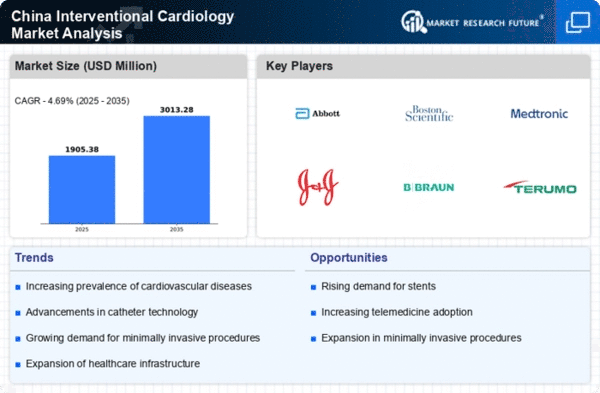
As per Market Research Future analysis, the China interventional cardiology market Size was estimated at 1820.03 USD Million in 2024. The China interventional cardiology market is projected to grow from 1905.38 USD Million in 2025 to 3013.28 USD Million by 2035, exhibiting a compound annual growth rate (CAGR) of 4.6% during the forecast period 2025 - 2035

Key Market Trends & Highlights

The China interventional cardiology market is poised for substantial growth driven by technological advancements and increasing healthcare demands.

  • Technological advancements in medical devices are transforming the interventional cardiology landscape in China.
  • The rising incidence of cardiovascular diseases is propelling the demand for interventional cardiology procedures.
  • The largest segment in this market is coronary interventions, while structural heart interventions are the fastest-growing segment.
  • Key market drivers include the increasing aging population and rising healthcare expenditure, which are likely to enhance market growth.

Market Size & Forecast

2024 Market Size 1820.03 (USD Million)
2035 Market Size 3013.28 (USD Million)
CAGR (2025 - 2035) 4.69%

Major Players

Abbott Laboratories (US), Boston Scientific Corporation (US), Medtronic plc (IE), Johnson & Johnson (US), B. Braun Melsungen AG (DE), Terumo Corporation (JP), Cardinal Health, Inc. (US), Siemens Healthineers AG (DE), Philips Healthcare (NL)

Our Impact
Enabled $4.3B Revenue Impact for Fortune 500 and Leading Multinationals
Partnering with 2000+ Global Organizations Each Year
30K+ Citations by Top-Tier Firms in the Industry

China Interventional Cardiology Market Trends

The interventional cardiology market is currently experiencing notable growth, driven by advancements in technology and an increasing prevalence of cardiovascular diseases. The rise in lifestyle-related health issues, such as obesity and diabetes, has led to a higher demand for interventional procedures. Furthermore, the Chinese government has been actively promoting healthcare reforms, which include investments in medical infrastructure and the adoption of innovative medical devices. This supportive environment appears to be fostering a more robust market for interventional cardiology solutions. In addition, the market is witnessing a shift towards minimally invasive techniques, which are preferred by both healthcare providers and patients. These methods not only reduce recovery times but also minimize complications associated with traditional surgical approaches. As a result, there is a growing emphasis on training healthcare professionals in these advanced techniques. The combination of technological innovation and a focus on patient-centered care suggests a promising outlook for the interventional cardiology market in the near future.

Technological Advancements

The interventional cardiology market is benefiting from rapid technological innovations. New devices and techniques are being developed, enhancing the effectiveness of procedures. These advancements include improved imaging technologies and the introduction of bioresorbable stents, which may lead to better patient outcomes.

Rising Cardiovascular Disease Incidence

There is a concerning increase in cardiovascular diseases, which is driving demand for interventional cardiology services. Factors such as urbanization and changing lifestyles contribute to this trend, prompting healthcare systems to prioritize cardiovascular health.

Government Support and Healthcare Reforms

The Chinese government is implementing various healthcare reforms aimed at improving access to medical services. Increased funding for healthcare infrastructure and the promotion of advanced medical technologies are likely to enhance the interventional cardiology market.

China Interventional Cardiology Market Drivers

Increasing Aging Population

The aging population in China is a critical driver for the interventional cardiology market. As life expectancy rises, the prevalence of age-related cardiovascular diseases increases, necessitating advanced interventional procedures. By 2025, it is projected that over 20% of the population will be aged 65 and above, leading to a higher demand for interventional cardiology services. This demographic shift compels healthcare providers to enhance their capabilities in treating complex cardiovascular conditions, thereby expanding the interventional cardiology market. Furthermore, the growing awareness among the elderly about heart health is likely to drive more patients to seek interventional treatments, contributing to market growth.

Rising Healthcare Expenditure

China's healthcare expenditure has been on an upward trajectory, which significantly impacts the interventional cardiology market. In recent years, the government has increased its healthcare budget, aiming to improve medical infrastructure and access to advanced treatments. By 2025, healthcare spending is expected to reach approximately 7% of GDP, facilitating investments in cutting-edge interventional cardiology technologies. This financial commitment enables hospitals to acquire state-of-the-art equipment and train medical personnel, ultimately enhancing patient outcomes. As healthcare resources become more available, the interventional cardiology market is likely to experience substantial growth, driven by improved access to innovative procedures.

Expansion of Health Insurance Coverage

The expansion of health insurance coverage in China is a pivotal factor driving the interventional cardiology market. Recent reforms have aimed to increase the accessibility of healthcare services, including interventional procedures, to a broader segment of the population. By 2025, it is anticipated that over 95% of the population will have some form of health insurance, reducing the financial burden on patients seeking treatment. This increased coverage is likely to encourage more individuals to opt for interventional cardiology services, as they can afford necessary procedures without significant out-of-pocket expenses. Consequently, this trend is expected to bolster the market, making advanced cardiovascular care more accessible.

Growing Awareness of Preventive Healthcare

There is a notable increase in awareness regarding preventive healthcare among the Chinese population, which is positively influencing the interventional cardiology market. Public health campaigns and educational initiatives have emphasized the importance of early detection and management of cardiovascular diseases. As a result, more individuals are seeking regular health check-ups and screenings, leading to earlier interventions. This proactive approach is likely to increase the demand for interventional cardiology procedures, as patients are more informed about their health risks. By 2025, this trend may contribute to a significant rise in the number of interventional procedures performed, thereby enhancing market growth.

Technological Innovations in Medical Devices

Technological innovations in medical devices are transforming the interventional cardiology market in China. The introduction of minimally invasive techniques and advanced imaging technologies has revolutionized treatment approaches, allowing for safer and more effective procedures. For instance, the development of drug-eluting stents and bioresorbable scaffolds has improved patient outcomes and reduced recovery times. As of 2025, the market for these advanced devices is projected to grow at a CAGR of over 10%, reflecting the increasing adoption of innovative solutions in interventional cardiology. This trend indicates a shift towards more efficient treatment modalities, which could further stimulate market expansion.


Market Segment Insights

By Product Type: Coronary Stents (Largest) vs. Balloon Catheters (Fastest-Growing)

In the China interventional cardiology market, the segment values demonstrate a varied distribution of market share, with Coronary Stents holding the largest share due to their critical role in treating coronary artery disease. Following closely are Balloon Catheters and Guidewires, which cater to a rising demand for minimally invasive procedures. IVUS Catheters and Other Devices contribute to the overall market, albeit to a lesser extent, highlighting the diverse array of technology available in this sector. Growth trends in this segment showcase a significant inclination towards advanced technologies, emphasizing the development of innovative devices that enhance procedural outcomes. Factors driving this growth include an increasing prevalence of cardiovascular diseases, rising health care expenditure, and a growing geriatric population. The need for efficient and effective treatment options is propelling the demand for advanced interventional devices in the China interventional cardiology market.

Coronary Stents (Dominant) vs. Guidewires (Emerging)

Coronary Stents are the dominant product type in the interventional cardiology segment, primarily due to their indispensable application in percutaneous coronary interventions. These devices are crucial for ensuring artery patency and preventing restenosis, hence being highly favored in clinical practices. On the other hand, Guidewires represent an emerging product type, vital in facilitating the placement and maneuvering of various interventional devices. As minimally invasive cardiac procedures gain traction, the demand for high-quality guidewires is increasing, driven by their role in enhancing procedural efficiency and safety. Both segments are essential, yet they occupy distinct positions within the market, reflecting differing consumer preferences and technological advancements.

By Procedure Type: Coronary Angioplasty (Largest) vs. Transcatheter Aortic Valve Replacement (Fastest-Growing)

In the China interventional cardiology market, the procedure type segment is largely dominated by Coronary Angioplasty, accounting for a significant market share. This procedure is favored due to its minimally invasive nature and favorable patient outcomes. Other notable procedures include Coronary Bypass Surgery and Peripheral Angioplasty, which have established positions but do not match the prevalence of Angioplasty. Growth trends indicate that Transcatheter Aortic Valve Replacement is emerging as the fastest-growing segment in this market. This rise can be attributed to advancements in technology and an increasing elderly population prone to cardiovascular diseases. Furthermore, the shift towards less invasive options reflects a broader trend in cardiac care, prompting healthcare providers to adopt innovative solutions.

Coronary Angioplasty (Dominant) vs. Transcatheter Aortic Valve Replacement (Emerging)

Coronary Angioplasty stands out as the dominant procedure within the interventional cardiology landscape, known for its efficacy in treating coronary artery disease. Its popularity stems from shorter recovery times and improved patient outcomes. In contrast, Transcatheter Aortic Valve Replacement is gaining traction as an emerging option, particularly for patients in high-risk categories who are not candidates for traditional open-heart surgery. This procedure offers a less invasive alternative for valve replacement, driving its adoption within the medical community as technologies continue to evolve, enhancing safety and effectiveness.

By End User: Hospitals (Largest) vs. Cardiac Catheterization Labs (Fastest-Growing)

In the China interventional cardiology market, the distribution of market share among end users highlights a significant dominance by hospitals, which continue to serve as primary centers for cardiology services. Cardiac catheterization labs are also crucial, though their share is smaller compared to hospitals. Ambulatory surgical centers are emerging, gaining traction mainly due to their efficiency and cost-effectiveness. Growth trends in this segment indicate a robust increase in procedures performed in hospitals, driven by advancements in technology and the rising prevalence of cardiovascular diseases. Meanwhile, cardiac catheterization labs are witnessing rapid expansion, fueled by a shift towards minimally invasive procedures and the increasing adoption of innovative cardiovascular devices. Ambulatory surgical centers are becoming a popular choice for outpatient procedures, enhancing patient convenience and reducing healthcare costs.

Hospitals (Dominant) vs. Cardiac Catheterization Labs (Emerging)

Hospitals play a dominant role in the China interventional cardiology market, equipped with advanced facilities and a wide range of cardiac services. They are often preferred by patients for their comprehensive care and multidisciplinary approach. The integration of state-of-the-art technologies in hospitals enhances their capacity to handle complex interventional procedures. Conversely, cardiac catheterization labs are emerging as vital entities, focusing on specific invasive cardiology procedures. Their growth is attributed to a trend towards specialized care, shorter recovery times, and increased patient throughput. These labs are designed for efficiency, often utilizing advanced imaging and diagnostic technologies, making them attractive for both patients and healthcare providers looking for streamlined interventional cardiac services.

By Distribution Channel: Direct Sales (Largest) vs. Online Sales (Fastest-Growing)

The distribution of sales in the interventional cardiology market shows a significant preference for Direct Sales, which stands out as the largest contributor to overall sales. Following this, Distributors play a crucial role in facilitating product availability, while Online Sales are emerging as a significant channel, especially with increasing digital adoption in healthcare procurement. As the market evolves, shifting consumer behaviors are expected to impact these distribution methods considerably. Growth trends indicate a robust shift towards Online Sales, driven by the convenience and efficiency of digital platforms. Additionally, the ongoing emphasis on direct engagement between manufacturers and healthcare providers reinforces Direct Sales as a dominant force. However, the rising trend of telehealth and e-commerce is propelling Online Sales as the fastest-growing segment. Distributors remain essential, contributing stability and market reach amidst these evolving dynamics.

Direct Sales (Dominant) vs. Online Sales (Emerging)

Direct Sales in the interventional cardiology market are characterized by direct engagement between manufacturers and healthcare providers, ensuring personalized service and tailored solutions. This dominant segment benefits from established relationships and an in-depth understanding of customer needs. Conversely, Online Sales are emerging rapidly, driven by an increasing inclination towards digital solutions. They offer advantages such as broader market access and reduced transaction times, appealing particularly to tech-savvy healthcare providers. As hospitals and clinics increasingly adopt online purchasing platforms, Online Sales are well-positioned to capture a significant share of the market in the coming years.

Get more detailed insights about China Interventional Cardiology Market

Key Players and Competitive Insights

The interventional cardiology market in China is characterized by a dynamic competitive landscape, driven by technological advancements, increasing prevalence of cardiovascular diseases, and a growing aging population. Major players such as Abbott Laboratories (US), Boston Scientific Corporation (US), and Medtronic plc (IE) are strategically positioned to leverage these growth drivers. Abbott Laboratories (US) focuses on innovation in device technology, particularly in transcatheter heart valves and coronary stents, while Boston Scientific Corporation (US) emphasizes expanding its product portfolio through strategic acquisitions and partnerships. Medtronic plc (IE) is enhancing its operational focus on digital health solutions, which aligns with the increasing demand for remote monitoring and telehealth services in cardiology. Collectively, these strategies contribute to a competitive environment that is increasingly centered on innovation and technological integration.Key business tactics employed by these companies include localizing manufacturing to reduce costs and optimize supply chains, which is particularly relevant in the context of China's regulatory landscape. The market structure appears moderately fragmented, with several key players holding substantial market shares. This fragmentation allows for a diverse range of products and services, fostering competition that drives innovation and enhances patient care.

In September Abbott Laboratories (US) announced the launch of its next-generation coronary stent system, which incorporates advanced drug-eluting technology aimed at improving patient outcomes. This strategic move is significant as it not only reinforces Abbott's commitment to innovation but also positions the company to capture a larger share of the growing coronary intervention market in China. The introduction of this product is expected to enhance procedural efficiency and patient recovery times, thereby addressing critical needs in the healthcare system.

In October Boston Scientific Corporation (US) expanded its partnership with a leading Chinese healthcare provider to enhance access to its interventional cardiology products across the country. This collaboration is strategically important as it allows Boston Scientific to penetrate deeper into the Chinese market, leveraging local expertise to navigate regulatory challenges and improve distribution channels. Such partnerships are likely to enhance the company's competitive positioning and facilitate the introduction of new technologies tailored to local needs.

In August Medtronic plc (IE) launched a comprehensive digital health platform designed to integrate with its existing cardiac devices, enabling real-time data sharing and analytics. This initiative reflects a growing trend towards digitalization in healthcare, particularly in cardiology, where remote monitoring is becoming increasingly vital. By investing in digital health solutions, Medtronic is not only enhancing patient engagement but also positioning itself as a leader in the integration of technology and patient care.

As of November current competitive trends in the interventional cardiology market include a pronounced shift towards digitalization, sustainability, and the integration of artificial intelligence (AI) in device development. Strategic alliances are increasingly shaping the landscape, enabling companies to pool resources and expertise to accelerate innovation. Looking ahead, competitive differentiation is likely to evolve from traditional price-based competition to a focus on technological advancements, supply chain reliability, and the ability to deliver superior patient outcomes. This shift underscores the importance of innovation and adaptability in maintaining a competitive edge in the rapidly evolving market.

Key Companies in the China Interventional Cardiology Market include

Industry Developments

Recent developments in the China Interventional Cardiology Market reflect significant advancements and transformations within the sector. Over the past few years, companies like Boston Scientific, Medtronic, and Abbott Laboratories have introduced innovative technologies aimed at enhancing cardiology procedures. As of September 2023, China's Ministry of Health announced new guidelines promoting the adoption of minimally invasive cardiac procedures, thereby creating a conducive environment for growth. In terms of mergers and acquisitions, Boston Scientific completed its acquisition of a local Chinese cardiac device company in April 2023, expanding its footprint in the region.

Similarly, Terumo Corporation has been increasing its investments, aiming to fortify its market share in interventional products.

Additionally, the growing aging population in China, coupled with rising incidences of cardiovascular diseases, has been a driving force in the market's expansion. MicroPort Scientific has also showcased its latest interventional cardiology offerings, reflecting a surge in research and development efforts in China. Overall, the combination of regulatory support, technological innovation, and strong market demand continues to propel the interventional cardiology market forward in China, making it one of the fastest-growing sectors in the healthcare industry.

Future Outlook

China Interventional Cardiology Market Future Outlook

The Interventional Cardiology Market in China is projected to grow at a 4.69% CAGR from 2025 to 2035, driven by technological advancements, increasing cardiovascular diseases, and rising healthcare expenditure.

New opportunities lie in:

  • Development of advanced catheter technologies for minimally invasive procedures.
  • Expansion of telehealth services for remote patient monitoring and follow-up.
  • Investment in AI-driven analytics for personalized treatment plans.

By 2035, the interventional cardiology market is expected to achieve substantial growth and innovation.

Market Segmentation

China Interventional Cardiology Market End User Outlook

  • Hospitals
  • Cardiac Catheterization Labs
  • Ambulatory Surgical Centers

China Interventional Cardiology Market Product Type Outlook

  • Coronary Stents
  • Balloon Catheters
  • Guidewires
  • IVUS Catheters
  • Other Devices

China Interventional Cardiology Market Procedure Type Outlook

  • Coronary Angioplasty
  • Coronary Bypass Surgery
  • Peripheral Angioplasty
  • Transcatheter Aortic Valve Replacement

China Interventional Cardiology Market Distribution Channel Outlook

  • Direct Sales
  • Distributors
  • Online Sales

Report Scope

MARKET SIZE 2024 1820.03(USD Million)
MARKET SIZE 2025 1905.38(USD Million)
MARKET SIZE 2035 3013.28(USD Million)
COMPOUND ANNUAL GROWTH RATE (CAGR) 4.69% (2025 - 2035)
REPORT COVERAGE Revenue Forecast, Competitive Landscape, Growth Factors, and Trends
BASE YEAR 2024
Market Forecast Period 2025 - 2035
Historical Data 2019 - 2024
Market Forecast Units USD Million
Key Companies Profiled Abbott Laboratories (US), Boston Scientific Corporation (US), Medtronic plc (IE), Johnson & Johnson (US), B. Braun Melsungen AG (DE), Terumo Corporation (JP), Cardinal Health, Inc. (US), Siemens Healthineers AG (DE), Philips Healthcare (NL)
Segments Covered Product Type, Procedure Type, End User, Distribution Channel
Key Market Opportunities Advancements in minimally invasive techniques enhance patient outcomes in the interventional cardiology market.
Key Market Dynamics Technological advancements and regulatory changes drive growth in the interventional cardiology market in China.
Countries Covered China
Leave a Comment

FAQs

What is the projected market size of the China Interventional Cardiology Market by 2035?

The China Interventional Cardiology Market is expected to be valued at 3.5 USD Billion by 2035.

What was the market size of the China Interventional Cardiology Market in 2024?

In 2024, the market is anticipated to be valued at 1.78 USD Billion.

What is the expected CAGR for the China Interventional Cardiology Market from 2025 to 2035?

The expected CAGR for the market during this period is 6.365%.

Which product segment will dominate the China Interventional Cardiology Market by 2035?

By 2035, the Coronary Stents segment is expected to be valued at 1.39 USD Billion.

Who are the key players in the China Interventional Cardiology Market?

Major players in the market include Boston Scientific, Medtronic, and Abbott Laboratories.

How much is the Guidewires segment expected to be valued in 2035?

The Guidewires segment is projected to be valued at 0.6 USD Billion in 2035.

What are the growth drivers for the China Interventional Cardiology Market?

Key growth drivers include rising cardiac diseases and advancements in medical technology.

What is the anticipated market growth rate for the Coronary Stents segment from 2024 to 2035?

The Coronary Stents segment is expected to experience significant growth leading to 1.39 USD Billion in 2035.

What is the market size for Balloon Catheters in 2024?

The Balloon Catheters segment is valued at 0.55 USD Billion in 2024.

How is the current global scenario affecting the China Interventional Cardiology Market?

The current global scenario is driving innovation and investment within the China Interventional Cardiology Market.

Download Free Sample

Kindly complete the form below to receive a free sample of this Report

Compare Licence

×
Features License Type
Single User Multiuser License Enterprise User
Price $4,950 $5,950 $7,250
Maximum User Access Limit 1 User Upto 10 Users Unrestricted Access Throughout the Organization
Free Customization
Direct Access to Analyst
Deliverable Format
Platform Access
Discount on Next Purchase 10% 15% 15%
Printable Versions