Advancements in Technology
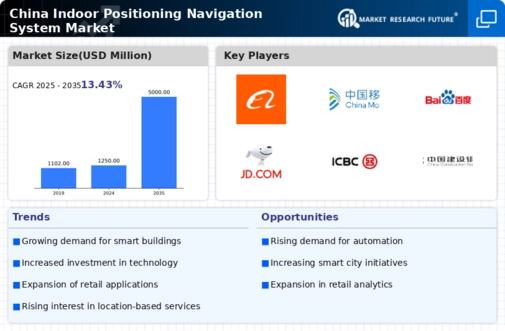
Technological advancements play a pivotal role in shaping The China Indoor Positioning Navigation System Market. Innovations such as Bluetooth Low Energy (BLE), Wi-Fi RTT, and Ultra-Wideband (UWB) are revolutionizing indoor navigation accuracy and reliability. For instance, BLE beacons are increasingly deployed in retail environments to provide real-time location data, enhancing customer engagement. The integration of artificial intelligence and machine learning algorithms further optimizes navigation systems, allowing for personalized user experiences. As these technologies evolve, they are expected to drive market growth, with estimates suggesting that the indoor positioning systems market in China could expand at a compound annual growth rate (CAGR) of over 20% in the coming years.
Rising E-commerce and Retail Sector
The rapid expansion of the e-commerce and retail sector in China serves as a significant driver for the indoor positioning navigation system market. With the rise of online shopping, brick-and-mortar stores are increasingly adopting indoor navigation systems to enhance customer experience and streamline operations. For example, retailers are utilizing indoor positioning to guide customers to specific products, thereby improving sales and customer satisfaction. The retail market in China is projected to reach USD 6 trillion by 2026, indicating a growing need for effective navigation solutions within physical stores. This trend underscores the importance of indoor positioning systems in bridging the gap between online and offline shopping experiences.
Increased Investment in Smart Cities
The push towards smart city initiatives in China significantly influences the indoor positioning navigation system market. The Chinese government has prioritized the development of smart cities, which incorporate advanced technologies to improve urban living. This includes the implementation of sophisticated navigation systems that facilitate efficient transportation and enhance public safety. As of 2025, it is anticipated that over 100 cities in China will have adopted smart city frameworks, creating a substantial demand for indoor positioning solutions. This trend not only fosters innovation but also attracts investments from both domestic and international players, further stimulating the growth of the indoor positioning navigation system market in China.
Enhanced Safety and Security Measures
The emphasis on safety and security within public spaces is a crucial driver for The China Indoor Positioning Navigation System Market. In light of increasing concerns regarding crowd management and emergency response, indoor navigation systems are being integrated into safety protocols in venues such as airports, stadiums, and shopping centers. These systems enable real-time tracking of individuals and facilitate efficient evacuation procedures during emergencies. Government regulations are increasingly mandating the implementation of such technologies to ensure public safety. As a result, the demand for advanced indoor positioning solutions is expected to rise, contributing to the overall growth of the indoor positioning navigation system market in China.
Growing Demand for Location-Based Services
The increasing demand for location-based services in The China Indoor Positioning Navigation System Market is a key driver. As urbanization accelerates, consumers and businesses alike seek efficient navigation solutions within complex environments such as shopping malls, airports, and hospitals. According to recent statistics, the market for location-based services in China is projected to reach USD 10 billion by 2026, indicating a robust growth trajectory. This demand is fueled by the proliferation of smartphones and IoT devices, which require precise indoor navigation capabilities. Consequently, companies are investing in advanced technologies to enhance user experience and operational efficiency, thereby propelling the growth of the indoor positioning navigation system market in China.