×
Request Free Sample ×

Kindly complete the form below to receive a free sample of this Report

* Please use a valid business email

Leading companies partner with us for data-driven Insights

clients tt-cursor
Hero Background

China Homeopathy Market

ID: MRFR/HC/43345-HCR
200 Pages
Rahul Gotadki
February 2026

China Homeopathy Market Research Report By Type (Tablets, Ointments, Biochemics, Tincture, Dilutions), By Application (Dermatology, Gastroenterology, Immunology, Neurology, Respiratory, Analgesic, Antipyretic)and By Source (Minerals, Animals, Plants) - Growth & Industry Forecast 2025 To 2035

Share:
Download PDF ×

We do not share your information with anyone. However, we may send you emails based on your report interest from time to time. You may contact us at any time to opt-out.

China Homeopathy Market Infographic
Purchase Options

China Homeopathy Market Summary

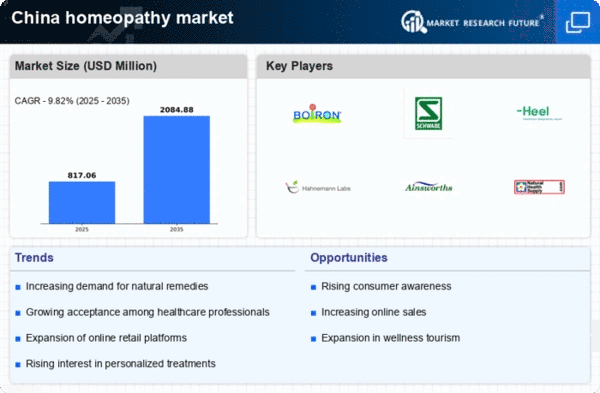
As per Market Research Future analysis, the China Homeopathy Market size was estimated at 744.0 USD Million in 2024. The Homeopathy market is projected to grow from 817.06 USD Million in 2025 to 2084.88 USD Million by 2035, exhibiting a compound annual growth rate (CAGR) of 9.8% during the forecast period 2025 - 2035

Key Market Trends & Highlights

The China homeopathy market is experiencing a notable shift towards natural remedies and integration with conventional healthcare.

  • The largest segment in the China homeopathy market is the herbal remedies segment, which continues to dominate due to cultural acceptance.
  • The fastest-growing segment is personalized homeopathic treatments, reflecting a trend towards tailored healthcare solutions.
  • Rising consumer awareness about the benefits of natural remedies is driving market growth, alongside increasing healthcare costs.
  • Government support and regulation are also significant drivers, fostering a more favorable environment for homeopathy in China.

Market Size & Forecast

2024 Market Size 744.0 (USD Million)
2035 Market Size 2084.88 (USD Million)
CAGR (2025 - 2035) 9.82%

Major Players

Boiron (FR), Schwabe (DE), Heel (DE), Hahnemann Laboratories (US), Ainsworths (GB), Natural Health Supply (US), Hyland's (US), SBL (IN), Dr. Reckeweg (DE)

Our Impact
Enabled $4.3B Revenue Impact for Fortune 500 and Leading Multinationals
Partnering with 2000+ Global Organizations Each Year
30K+ Citations by Top-Tier Firms in the Industry

China Homeopathy Market Trends

The China Homeopathy Market is experiencing notable growth, driven by increasing consumer awareness and a shift towards natural remedies. This trend appears to be influenced by a growing preference for holistic health solutions, as individuals seek alternatives to conventional medicine. The rise in chronic diseases and the desire for personalized treatment options further contribute to the expansion of this market. Additionally, the integration of homeopathy into mainstream healthcare practices suggests a potential for broader acceptance among healthcare professionals and patients alike. Moreover, the regulatory environment in China is evolving, with authorities recognizing the importance of traditional medicine, including homeopathy. This recognition may lead to enhanced support for research and development, potentially fostering innovation within the sector. As the market matures, it seems likely that consumer education and awareness campaigns will play a crucial role in shaping perceptions and driving demand. Overall, the homeopathy market appears poised for continued growth, reflecting changing consumer preferences and an increasing focus on wellness and preventive care.

Rising Demand for Natural Remedies

There is a noticeable increase in consumer interest in natural and alternative therapies. This trend is likely driven by a growing awareness of the potential side effects associated with conventional pharmaceuticals. As individuals seek safer and more holistic options, the homeopathy market is positioned to benefit from this shift.

Integration with Conventional Healthcare

The homeopathy market is witnessing a gradual integration with conventional healthcare systems. This trend suggests that healthcare providers are beginning to recognize the value of complementary therapies. Such integration may enhance the credibility of homeopathy and encourage more patients to explore these treatment options.

Focus on Personalized Medicine

There is a growing emphasis on personalized medicine within the homeopathy market. Consumers are increasingly seeking tailored treatment plans that address their unique health needs. This trend indicates a shift towards individualized care, which may enhance patient satisfaction and treatment outcomes.

China Homeopathy Market Drivers

Rising Healthcare Costs

As healthcare costs continue to escalate in China, many consumers are seeking cost-effective alternatives to conventional treatments. The homeopathy market presents an appealing option for those looking to manage their health without incurring high expenses. Homeopathic remedies are often more affordable than traditional pharmaceuticals, making them accessible to a broader demographic. This shift towards cost-conscious healthcare solutions is likely to drive demand for homeopathic products, as consumers prioritize value in their health expenditures. It is estimated that the homeopathy market could grow by approximately 20% as more individuals opt for these economical alternatives.

Increasing Consumer Awareness

The homeopathy market in China is experiencing a notable surge in consumer awareness regarding alternative medicine. This heightened awareness is largely attributed to the growing availability of information through digital platforms and social media. As consumers become more informed about the benefits and principles of homeopathy, they are increasingly seeking these remedies as viable options for health management. Reports indicate that approximately 30% of the population is now aware of homeopathic treatments, which is a significant increase from previous years. This trend suggests that the homeopathy market is likely to expand as more individuals explore these alternatives, potentially leading to a broader acceptance of homeopathy within the healthcare landscape.

Government Support and Regulation

The regulatory framework surrounding the homeopathy market in China is evolving, with government initiatives aimed at promoting alternative medicine. The Chinese government has recognized the importance of integrating traditional and alternative therapies into the healthcare system. Recent policies have been introduced to support the development of homeopathic practices, including funding for research and education. This regulatory support is expected to enhance the credibility of homeopathy, encouraging more practitioners to enter the field. As a result, the homeopathy market may witness growth driven by increased legitimacy and consumer trust, potentially leading to a market expansion of over 15% in the coming years.

Cultural Acceptance of Alternative Medicine

Cultural factors play a significant role in shaping the homeopathy market in China. The historical context of traditional Chinese medicine has fostered a general acceptance of alternative therapies among the population. This cultural inclination towards holistic and natural healing methods aligns well with the principles of homeopathy. As more individuals seek treatments that resonate with their cultural beliefs, the homeopathy market is poised for growth. The integration of homeopathy into the broader spectrum of traditional practices may enhance its appeal, potentially leading to an increase in market share as consumers gravitate towards familiar and culturally relevant health solutions.

Technological Advancements in Product Development

The homeopathy market is benefiting from technological advancements that facilitate the development of innovative homeopathic products. Enhanced research methodologies and production techniques are enabling manufacturers to create more effective and targeted remedies. This innovation is crucial in attracting a modern consumer base that values efficacy and quality. Furthermore, the rise of e-commerce platforms is making these products more accessible to consumers across China. As technology continues to evolve, it is likely that the homeopathy market will see an influx of new products, potentially increasing market penetration and consumer engagement.


Market Segment Insights

By Type: Tablets (Largest) vs. Ointments (Fastest-Growing)

In the China homeopathy market, the segment distribution shows that tablets dominate the market, holding a significant share due to their popularity and ease of use among consumers. Ointments, although smaller in market share compared to tablets, are rapidly gaining traction, appealing to consumers seeking topical solutions for various ailments. The balance between these two segments indicates diverse consumer preferences and highlights different therapeutic applications. Growth trends within the segment reveal that while tablets remain a trusted option among consumers, ointments are emerging as the fastest-growing segment. Factors contributing to this growth include increased awareness of homeopathic remedies, a rising trend in self-medication, and the convenience offered by ointments in treating localized conditions. This evolving landscape shows a promising trajectory for both segments in the years to come.

Tablets: Dominant vs. Ointments: Emerging

Tablets are characterized by their user-friendly formulation that allows for easy dosage and portability, making them a staple in homeopathic treatments. They cater to a wide range of ailments and boast a solid reputation, particularly among older demographics. In contrast, ointments are quickly becoming an emerging preference, particularly among younger consumers who favor natural and topical solutions. With their ability to deliver direct relief to affected areas, ointments cater to a growing demand for personalized and convenient treatment options. The rising consciousness about health and holistic remedies further fuels the growth of ointments, thereby creating a competitive dynamic between these two segments.

By Application: Dermatology (Largest) vs. Respiratory (Fastest-Growing)

In the China homeopathy market, the application segment reveals a dynamic distribution of market share, with dermatology leading the pack. This segment comprises various homeopathic remedies tailored to skin-related issues, making it a crucial player in the market landscape. In contrast, respiratory applications, which involve treatments for conditions such as asthma and allergies, are rapidly gaining traction among consumers seeking alternative therapies, indicating a shift in market preferences. The growth in the application segment is driven by increasing awareness around homeopathy, with gastroenterology and immunology also showcasing significant interest as health-conscious individuals embrace these natural alternatives. Notably, neurology and analgesic segments are carving out their niches, as innovative product offerings respond to healthcare demands. The preference for holistic and preventive approaches continues to fuel expansion across these applications, establishing a competitive environment in the homeopathy market.

Dermatology (Dominant) vs. Respiratory (Emerging)

Dermatology stands out as the dominant segment in the China homeopathy market, driven by a diverse range of products addressing various skin ailments. This segment's strength stems from a growing consumer preference for natural and non-invasive treatments for conditions like eczema and psoriasis. The availability of targeted homeopathic solutions has led to a sustained demand. Conversely, respiratory applications represent an emerging area, with increasing public awareness concerning air quality and respiratory health. As more individuals seek alternative treatments for chronic conditions such as allergies and asthma, the respiratory segment is rapidly evolving, attracting investments and innovations aimed at enhancing product efficacy. The drive towards preventive healthcare further elevates both segments, showcasing their respective roles in the growth trajectory of the market.

By Source: Plants (Largest) vs. Minerals (Fastest-Growing)

In the China homeopathy market, the segment distribution reveals that plants constitute the largest share, recognized for their diverse applications and consumer trust. Meanwhile, minerals are emerging as a significant player, capitalizing on the growing trends of mineral-based remedies and their perceived efficacy among consumers. As awareness about natural health solutions increases, both segments are expected to play crucial roles in market dynamics. Growth trends indicate a rising acceptance of homeopathic solutions, driven by shifting consumer preferences towards natural and holistic approaches to healthcare. The expansion of the minerals segment can be attributed to advancements in extraction and formulation techniques, enhancing product effectiveness. Additionally, increased education and marketing efforts regarding the benefits of homeopathic treatments are expected to fuel further growth in both plants and minerals, reinforcing their positions in this evolving market.

Plants (Dominant) vs. Minerals (Emerging)

Plants are the dominant source in the homeopathy segment, attributed to their extensive historical use in traditional medicine and a strong consumer preference for natural healing methods. The efficacy and safety of plant-based remedies resonate deeply with consumers, making this segment a staple in the market. On the other hand, minerals are the emerging force, gaining traction due to their unique benefits and the shift towards evidence-based homeopathy. This growth is fueled by rising consumer interest in integrated health solutions and the innovative development of mineral-based products that cater to specific health concerns, indicating a prosperous future for both segments.

Get more detailed insights about China Homeopathy Market

Key Players and Competitive Insights

The homeopathy market in China is characterized by a competitive landscape that is increasingly dynamic, driven by a growing consumer interest in alternative medicine and natural remedies. Key players such as Boiron (FR), Schwabe (DE), and Heel (DE) are strategically positioned to leverage this trend. Boiron (FR), known for its extensive range of homeopathic products, appears to focus on innovation and product diversification, which may enhance its market share. Schwabe (DE), with its strong emphasis on research and development, seems to prioritize the introduction of new formulations, thereby reinforcing its competitive edge. Meanwhile, Heel (DE) is likely concentrating on expanding its distribution channels, which could facilitate greater market penetration and accessibility for consumers.The business tactics employed by these companies reflect a nuanced understanding of the market's structure, which is moderately fragmented. Localizing manufacturing and optimizing supply chains are common strategies that these firms adopt to enhance operational efficiency and reduce costs. The collective influence of these key players shapes a competitive environment where agility and responsiveness to consumer preferences are paramount.

In October Boiron (FR) announced a strategic partnership with a local Chinese herbal medicine company to develop hybrid products that combine homeopathy with traditional Chinese medicine. This collaboration is significant as it not only broadens Boiron's product offerings but also aligns with the cultural preferences of Chinese consumers, potentially increasing market acceptance and sales.

In September Schwabe (DE) launched a new digital platform aimed at educating consumers about homeopathy and its benefits. This initiative is crucial as it reflects a growing trend towards digitalization in the healthcare sector, allowing Schwabe to engage directly with consumers and enhance brand loyalty. The platform may also serve as a valuable resource for healthcare professionals, thereby expanding Schwabe's influence in the market.

In August Heel (DE) expanded its manufacturing capabilities in China by investing in a new facility designed to produce homeopathic remedies tailored to local needs. This move is indicative of Heel's commitment to localizing its operations, which could lead to improved supply chain reliability and responsiveness to market demands. Such investments are likely to strengthen Heel's competitive position in the region.

As of November current trends in the homeopathy market include a pronounced shift towards digitalization, sustainability, and the integration of artificial intelligence in product development and consumer engagement. Strategic alliances are increasingly shaping the competitive landscape, enabling companies to pool resources and expertise. Looking ahead, it appears that competitive differentiation will evolve from traditional price-based competition to a focus on innovation, technological advancements, and the reliability of supply chains. This shift may redefine how companies position themselves in the market, emphasizing the importance of adaptability and consumer-centric strategies.

Key Companies in the China Homeopathy Market include

Industry Developments

Recent developments in the China Homeopathy Market reflect a growing acceptance and integration of homeopathic practices alongside traditional medicine. Companies like Boiron, Schwabe Pharmaceuticals, and Dabur are increasingly focusing on expanding their product lines to cater to the rising demand for natural remedies among consumers seeking alternatives to conventional medications. Collaborative efforts have been noted among local firms, fostering innovation in homeopathic formulations. In terms of market dynamics, there has been significant growth in valuations, driven by increasing consumer awareness and a shift towards holistic health approaches.

In October 2023, it was announced that Hahnemann Laboratories has entered into a strategic partnership to enhance its distribution network in China, aiming to improve access to its homeopathic products. In the past two years, major players have undergone substantial transformations, including the expansion of their operational capabilities in response to the evolving regulatory environment set forth by the National Medical Products Administration of China. The market continues to express resilience, with an emphasis on product efficacy and consumer trust.

The homeopathy market in China is marked by technological advancements and an overall positive outlook as it navigates through regulatory frameworks.

Future Outlook

China Homeopathy Market Future Outlook

The Homeopathy Market in China is projected to grow at a 9.82% CAGR from 2025 to 2035, driven by increasing consumer awareness and demand for alternative therapies.

New opportunities lie in:

  • Expansion of e-commerce platforms for homeopathic products
  • Development of personalized homeopathic treatment plans
  • Partnerships with wellness centers for integrated health solutions

By 2035, the market is expected to achieve substantial growth and increased consumer adoption.

Market Segmentation

China Homeopathy Market Type Outlook

  • Tablets
  • Ointments
  • Biochemicals
  • Tinctures
  • Dilutions

China Homeopathy Market Source Outlook

  • Minerals
  • Animals
  • Plants

China Homeopathy Market Application Outlook

  • Dermatology
  • Gastroenterology
  • Immunology
  • Neurology
  • Respiratory
  • Analgesic
  • Antipyretic

Report Scope

MARKET SIZE 2024 744.0(USD Million)
MARKET SIZE 2025 817.06(USD Million)
MARKET SIZE 2035 2084.88(USD Million)
COMPOUND ANNUAL GROWTH RATE (CAGR) 9.82% (2025 - 2035)
REPORT COVERAGE Revenue Forecast, Competitive Landscape, Growth Factors, and Trends
BASE YEAR 2024
Market Forecast Period 2025 - 2035
Historical Data 2019 - 2024
Market Forecast Units USD Million
Key Companies Profiled Boiron (FR), Schwabe (DE), Heel (DE), Hahnemann Laboratories (US), Ainsworths (GB), Natural Health Supply (US), Hyland's (US), SBL (IN), Dr. Reckeweg (DE)
Segments Covered Type, Application, Source
Key Market Opportunities Growing consumer interest in natural remedies enhances potential for homeopathy market expansion.
Key Market Dynamics Rising consumer interest in natural remedies drives growth in the homeopathy market amid evolving regulatory frameworks.
Countries Covered China
Leave a Comment

FAQs

What is the projected market size of the China Homeopathy Market by 2024?

The China Homeopathy Market is expected to be valued at 1.05 USD Billion in 2024.

What will be the estimated market size of the China Homeopathy Market by 2035?

By 2035, the market is expected to reach approximately 3.47 USD Billion.

What is the expected compound annual growth rate (CAGR) for the China Homeopathy Market from 2025 to 2035?

The expected CAGR for the China Homeopathy Market from 2025 to 2035 is 11.479%.

Which segment of the China Homeopathy Market is projected to have the largest value by 2035?

The Tablets segment is projected to be valued at 1.42 USD Billion by 2035.

What is the market value of the Ointments segment in the China Homeopathy Market in 2024?

The Ointments segment is valued at 0.25 USD Billion in the year 2024.

Who are the major players in the China Homeopathy Market?

Key players in the market include Homeopathy Works, Boiron, Hahnemann Laboratories, and Dabur, among others.

What is the projected market size for the Biochemics segment by 2035?

The Biochemics segment is expected to reach around 0.67 USD Billion by 2035.

How much is the Tincture segment valued at in 2024?

The Tincture segment of the China Homeopathy Market is valued at 0.1 USD Billion in 2024.

What is the anticipated market value of the Dilutions segment in 2035?

The Dilutions segment is expected to be valued at approximately 0.21 USD Billion by 2035.

What growth drivers are contributing to the expansion of the China Homeopathy Market?

Increasing consumer awareness and demand for alternative therapies are significant growth drivers in the market.

Download Free Sample

Kindly complete the form below to receive a free sample of this Report

Compare Licence

×
Features License Type
Single User Multiuser License Enterprise User
Price $4,950 $5,950 $7,250
Maximum User Access Limit 1 User Upto 10 Users Unrestricted Access Throughout the Organization
Free Customization
Direct Access to Analyst
Deliverable Format
Platform Access
Discount on Next Purchase 10% 15% 15%
Printable Versions