×
Request Free Sample ×

Kindly complete the form below to receive a free sample of this Report

* Please use a valid business email

Leading companies partner with us for data-driven Insights

clients tt-cursor
Hero Background

China Functional Beverages Market

ID: MRFR/FnB/44729-HCR
200 Pages
Snehal Singh
February 2026

China Functional Beverages Market Size, Share, Industry Trend & Analysis Research Report: By Type (Energy Drinks, Sports Beverages), By Function (HealthWellness, Weight Management) andBy Distribution Channel (Store, Non-store)- Forecast to 2035

Share:
Download PDF ×

We do not share your information with anyone. However, we may send you emails based on your report interest from time to time. You may contact us at any time to opt-out.

China Functional Beverages Market Infographic
Purchase Options

China Functional Beverages Market Summary

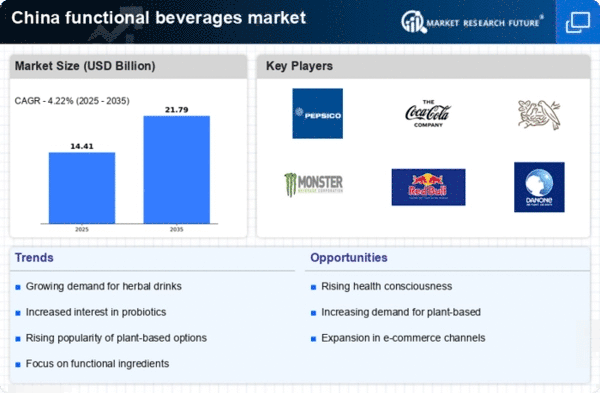
As per Market Research Future analysis, the China Functional Beverages Market size was estimated at 13.83 USD Billion in 2024. The China functional beverages market is projected to grow from 14.41 USD Billion in 2025 to 21.79 USD Billion by 2035, exhibiting a compound annual growth rate (CAGR) of 4.2% during the forecast period 2025 - 2035

Key Market Trends & Highlights

The China functional beverages market is experiencing robust growth driven by health consciousness and innovative product offerings.

  • The health and wellness focus continues to shape consumer preferences in the functional beverages market.
  • Natural ingredients are increasingly preferred, reflecting a shift towards cleaner labels and transparency.
  • E-commerce is rapidly growing, providing consumers with convenient access to a diverse range of functional beverages.
  • Rising health consciousness and increased disposable income are major drivers propelling market expansion.

Market Size & Forecast

2024 Market Size 13.83 (USD Billion)
2035 Market Size 21.79 (USD Billion)
CAGR (2025 - 2035) 4.22%

Major Players

PepsiCo (US), Coca-Cola (US), Nestle (CH), Monster Beverage Corporation (US), Red Bull GmbH (AT), Danone (FR), Kraft Heinz Company (US), Unilever (GB), Reed's Inc. (US)

Our Impact
Enabled $4.3B Revenue Impact for Fortune 500 and Leading Multinationals
Partnering with 2000+ Global Organizations Each Year
30K+ Citations by Top-Tier Firms in the Industry

China Functional Beverages Market Trends

The China Functional Beverages Market is experiencing notable growth, driven by increasing consumer awareness regarding health and wellness. This market encompasses a diverse range of products, including energy drinks, probiotic beverages, and fortified waters, which cater to the evolving preferences of health-conscious individuals. In recent years, there has been a marked shift towards natural ingredients, as consumers seek products that align with their desire for clean labels and transparency. This trend is further supported by a growing interest in functional benefits, such as improved digestion, enhanced energy levels, and immune support. As a result, manufacturers are innovating to create beverages that not only taste good but also provide tangible health benefits. Moreover, the rise of e-commerce platforms has transformed the way consumers access functional beverages. Online shopping offers convenience and a wider selection, allowing consumers to explore various brands and products with ease. This shift in purchasing behavior is likely to continue, as more individuals embrace digital solutions for their shopping needs. Additionally, the increasing popularity of fitness and wellness trends is propelling the demand for functional beverages, as consumers look for products that complement their active lifestyles. Overall, the functional beverages market is poised for sustained growth, driven by evolving consumer preferences and innovative product offerings.

Health and Wellness Focus

There is a growing emphasis on health and wellness among consumers, leading to increased demand for functional beverages that offer specific health benefits. Products that promote digestive health, boost immunity, and enhance energy levels are particularly sought after. This trend reflects a broader societal shift towards preventive health measures and a proactive approach to well-being.

Natural Ingredients Preference

Consumers are increasingly favoring beverages made with natural ingredients, steering away from artificial additives and preservatives. This preference aligns with the desire for transparency in product labeling and a cleaner, more wholesome consumption experience. Brands that prioritize natural formulations are likely to resonate more with health-conscious consumers.

E-commerce Growth

The rise of e-commerce is reshaping the functional beverages market, providing consumers with greater access to a variety of products. Online platforms facilitate convenient shopping experiences, allowing consumers to explore and purchase functional beverages from the comfort of their homes. This trend is expected to continue, as digital shopping becomes more ingrained in consumer behavior.

China Functional Beverages Market Drivers

Increased Disposable Income

The rise in disposable income among the Chinese population is a notable driver for the functional beverages market. As consumers have more financial resources, they are willing to invest in premium products that promise health benefits. This trend is particularly pronounced in urban areas, where consumers are increasingly seeking high-quality, functional beverages. The functional beverages market is likely to see a growth rate of around 12% in 2025, fueled by this increase in purchasing power. Brands that position themselves as premium and health-oriented are expected to thrive in this evolving economic landscape.

Rising Health Consciousness

The increasing awareness of health and wellness among consumers in China is a primary driver for the functional beverages market. As individuals become more informed about the benefits of nutrition and hydration, they are actively seeking products that offer health benefits. This trend is reflected in the market, where functional beverages that promote immunity, digestion, and overall well-being are gaining traction. In 2025, the market is projected to grow by approximately 15%, driven by this health-conscious consumer base. The functional beverages market is adapting to these demands by innovating and introducing new products that cater to specific health needs, thereby enhancing consumer engagement and loyalty.

Innovative Product Development

Innovation in product formulation and packaging is a significant driver for the functional beverages market. Companies are increasingly investing in research and development to create unique blends that incorporate superfoods, probiotics, and vitamins. This focus on innovation is crucial as it allows brands to differentiate themselves in a competitive landscape. In 2025, the market is expected to witness a surge in new product launches, with an estimated 20% of the market share attributed to innovative offerings. The functional beverages market is thus characterized by a dynamic environment where creativity and consumer preferences shape product lines, leading to enhanced market growth.

Urbanization and Lifestyle Changes

Rapid urbanization in China is reshaping consumer lifestyles, which in turn drives the functional beverages market. As more individuals move to urban areas, their dietary habits and consumption patterns evolve, often leading to a preference for convenient, on-the-go beverage options. This shift is particularly evident among younger demographics who prioritize health and convenience. The functional beverages market is responding to this trend by offering ready-to-drink options that cater to busy lifestyles. By 2025, urban consumers are projected to account for over 60% of the market, highlighting the importance of adapting to these changing dynamics.

Regulatory Support for Health Products

The Chinese government has been actively promoting health and wellness initiatives, which serves as a catalyst for the functional beverages market. Regulatory frameworks that support the development and marketing of health-oriented products encourage companies to innovate and expand their offerings. This supportive environment is likely to enhance consumer trust in functional beverages, leading to increased market penetration. The functional beverages market is expected to benefit from these regulatory measures, with a projected growth of 10% in 2025 as more consumers turn to functional beverages endorsed by health authorities.


Market Segment Insights

By Type: Functional Water (Largest) vs. Energy Drinks (Fastest-Growing)

In the China functional beverages market, the segment distribution reveals that Functional Water holds the largest share, appealing to health-conscious consumers seeking hydration options. Energy Drinks, while not as large in market share, are gaining traction rapidly, particularly among younger demographics looking for performance enhancement during sports and daily activities. Growth trends indicate a significant rise in demand for Energy Drinks, driven by increasing urbanization and lifestyle changes that favor convenient and health-oriented products. Additionally, the popularity of sports and fitness activities contributes to the expanding market for Sports Drinks, while Nutraceutical Drinks are emerging as consumers seek functional benefits from their beverages. 

Functional Water (Dominant) vs. Energy Drinks (Emerging)

Functional Water has established itself as a dominant force in the market, characterized by its appeal as a healthy and refreshing option free from artificial additives. It caters to a demographic that prioritizes wellness and seeks to maintain optimal hydration throughout their day. In contrast, Energy Drinks are emerging rapidly, capturing the attention of younger consumers, particularly those engaged in athletic activities or demanding lifestyles. These beverages often contain stimulants like caffeine and taurine, aiming to boost energy and cognitive function. As such, Energy Drinks are trending upward, reflecting growing consumer interest in products that promote vitality and performance.

By Target Audience: Health-conscious Consumers (Largest) vs. Fitness Enthusiasts (Fastest-Growing)

In the China functional beverages market, the target audience is primarily composed of health-conscious consumers, who hold the largest market share due to their increasing awareness of nutritional benefits and health impacts of beverages. This segment is characterized by a preference for natural ingredients and beverages that offer functional benefits such as enhanced immunity and hydration. Fitness enthusiasts, while currently smaller in market share, are rapidly gaining traction as more individuals adopt active lifestyles. Their rising demand for performance-enhancing products is driving innovation and new product development. The growth trends in the target audience segment are influenced by a larger wellness trend that is sweeping across consumers in China. Health-conscious consumers drive stable demand for functional beverages, while fitness enthusiasts are emerging as a dynamic force, especially among younger demographics. Busy professionals are also showing interest in convenient health solutions, contributing to overall segment growth. The elderly population is witnessing a rising trend in functional beverages aimed at improving health outcomes, creating diverse opportunities across all target audience segments in the market.

Health-conscious Consumers (Dominant) vs. Fitness Enthusiasts (Emerging)

Health-conscious consumers are the dominant force in the target audience segment, characterized by their demand for products that align with their wellness-oriented lifestyles. This group prioritizes functional benefits such as immunity support, gut health, and hydration, leading to increased consumption of beverages fortified with vitamins and probiotics. In contrast, fitness enthusiasts represent an emerging segment, increasingly focused on performance and recovery. They seek beverages tailored to enhance workouts and improve recovery times, showing a strong preference for protein-based drinks and energy boosters. Together, these segments shape the competitive landscape of the market, indicating a shift towards innovative and personalized offerings to cater to specific consumer needs.

By Distribution Channel: Supermarkets and Hypermarkets (Largest) vs. Online Retail (Fastest-Growing)

In the distribution channel segment, supermarkets and hypermarkets dominate the landscape, accounting for a significant share of the market in the China functional beverages market. These retail formats are preferred for their wide selection and convenient locations, allowing consumers easy access to a variety of functional beverages. In contrast, online retail is rapidly gaining traction, leveraging e-commerce trends and changing consumer behavior to capture a growing segment of the market. The growth trends in the distribution channel segment showcase a shift towards online shopping, particularly among the younger demographic who favor the convenience of door-to-door delivery and time savings. This transformation is further fueled by various digital marketing strategies and a surge in online advertising by brands looking to enhance visibility. Meanwhile, traditional stores like health and wellness stores maintain a steady client base, appealing to niche markets focused on specialized health products.

Supermarkets and Hypermarkets: Dominant vs. Online Retail: Emerging

Supermarkets and hypermarkets remain the dominant players in the distribution channels for the China functional beverages market due to their extensive product ranges and consumer familiarity. Their strategic locations and frequent promotions attract a large consumer base seeking convenience and variety. On the other hand, online retail emerges as an increasingly popular channel, driven by its accessibility and the growing trend of online shopping. This segment appeals particularly to tech-savvy consumers looking for the latest functional beverage trends, personalized shopping experiences, and home delivery options, thus reshaping how consumers engage with the market.

By Ingredient Type: Vitamins (Largest) vs. Herbal Extracts (Fastest-Growing)

In the China functional beverages market, the distribution of ingredient types showcases a diverse landscape. Vitamins hold the largest market share, favored for their health-boosting properties and consumer awareness. Meanwhile, herbal extracts are gaining momentum, appealing to a growing segment of health-conscious consumers seeking natural alternatives in their beverages. Growth trends in this segment reflect a shift towards clean-label products and functional ingredients. The increase in demand for herbal extracts is driven by their perceived health benefits and holistic approach to wellness. Conversely, vitamins maintain their stronghold as consumers prioritize nutritional supplementation in their daily routines, promoting sustained growth for both segments in the coming years.

Vitamins: Dominant vs. Herbal Extracts: Emerging

Vitamins are recognized as the dominant ingredient in functional beverages, driven by their association with health benefits like immune support and energy enhancement. The wide acceptance of vitamin-infused drinks, along with effective marketing strategies, has cemented their status. On the other hand, herbal extracts are emerging as a significant trend, propelled by consumer interest in natural ingredients and traditional remedies. Their versatility in flavor and function allows for innovative beverage formulations, attracting a niche market. As consumers increasingly seek products that offer both taste and health benefits, herbal extracts are expected to gain a larger share, complementing the established vitamin segment.

Get more detailed insights about China Functional Beverages Market

Key Players and Competitive Insights

The competitive dynamics within the functional beverages market are characterized by innovation, strategic partnerships, and a focus on health-conscious consumer trends. Major players such as PepsiCo (US), Coca-Cola (US), and Nestle (CH) are actively shaping the landscape through various strategic initiatives. PepsiCo (US) has been particularly focused on expanding its portfolio of health-oriented beverages, leveraging its extensive distribution network to reach a broader audience. Coca-Cola (US), on the other hand, has been investing in sustainable packaging solutions, which aligns with the growing consumer demand for environmentally friendly products. Nestle (CH) appears to be concentrating on enhancing its product formulations to include more functional ingredients, thereby appealing to health-conscious consumers. Collectively, these strategies indicate a competitive environment that is increasingly driven by innovation and sustainability.In terms of business tactics, companies are localizing manufacturing to reduce costs and improve supply chain efficiency. This approach not only enhances responsiveness to market demands but also allows for better alignment with local consumer preferences. The market structure is moderately fragmented, with several key players holding substantial market shares while also facing competition from emerging brands. The collective influence of these major companies is significant, as they set trends that smaller players often follow, thereby shaping the overall market dynamics.

In October Coca-Cola (US) announced a partnership with a leading health technology firm to develop a new line of functional beverages aimed at enhancing mental wellness. This strategic move underscores Coca-Cola's commitment to tapping into the growing wellness trend, which is increasingly influencing consumer purchasing decisions. By integrating technology into its product development, Coca-Cola (US) is likely to enhance its competitive edge in a market that values innovation.

In September PepsiCo (US) launched a new range of plant-based functional drinks designed to cater to the rising demand for vegan and health-oriented products. This initiative not only diversifies PepsiCo's product offerings but also positions the company favorably within a segment that is rapidly gaining traction among consumers. The emphasis on plant-based ingredients reflects a broader shift towards healthier lifestyles, which is becoming a key driver of market growth.

In August Nestle (CH) unveiled a new line of probiotic beverages aimed at improving gut health, further solidifying its position in the functional beverages sector. This launch is particularly significant as it aligns with increasing consumer awareness regarding digestive health. By focusing on probiotics, Nestle (CH) is likely to attract health-conscious consumers, thereby enhancing its market share in a competitive landscape.

As of November current trends in the functional beverages market are heavily influenced by digitalization, sustainability, and the integration of artificial intelligence in product development. Strategic alliances are becoming increasingly important, as companies seek to leverage each other's strengths to enhance their market positions. The competitive differentiation is expected to evolve, with a notable shift from price-based competition towards innovation, technology, and supply chain reliability. This transition suggests that companies that prioritize these aspects will likely emerge as leaders in the functional beverages market.

Key Companies in the China Functional Beverages Market include

Industry Developments

In recent months, the China Functional Beverages Market has continued to evolve rapidly, driven by changing consumer preferences towards health and wellness products. Yili Group has launched new lines of probiotic drinks, responding to increased demand for gut health solutions. Meanwhile, Red Bull is expanding its product range with flavors that cater specifically to local tastes, reinforcing its competitive stance. Heineken has introduced low-alcohol and non-alcoholic beer variants in a bid to capture the growing health-conscious demographic.

Coca-Cola has also been active, with a focus on sugar-free and functional beverage offerings, while China Mengniu Dairy is emphasizing its dairy-based functional beverages that appeal to fitness enthusiasts. In June 2023, PepsiCo completed the acquisition of a local health drink brand to boost its portfolio in the market. Moreover, Nongfu Spring has seen significant market valuation growth, attributed to its strong sales in bottled water enriched with functional additives. As of September 2023, the market remains buoyant, with major players continuously innovating to meet the demand for healthier beverage options amidst increasing competition.

Future Outlook

China Functional Beverages Market Future Outlook

The Functional Beverages Market in China is projected to grow at a 4.22% CAGR from 2025 to 2035, driven by health consciousness, innovation, and demand for convenience.

New opportunities lie in:

  • Development of personalized nutrition beverages using AI-driven data analytics.
  • Expansion of e-commerce platforms for direct-to-consumer sales.
  • Investment in sustainable packaging solutions to attract eco-conscious consumers.

By 2035, the market is expected to achieve robust growth, reflecting evolving consumer preferences and innovative product offerings.

Market Segmentation

China Functional Beverages Market Type Outlook

  • Energy Drinks
  • Sports Drinks
  • Nutraceutical Drinks
  • Functional Water
  • Tea-based Beverages

China Functional Beverages Market Ingredient Type Outlook

  • Vitamins
  • Herbal Extracts
  • Amino Acids
  • Probiotics
  • Electrolytes

China Functional Beverages Market Target Audience Outlook

  • Athletes
  • Health-conscious Consumers
  • Fitness Enthusiasts
  • Busy Professionals
  • Elderly

China Functional Beverages Market Distribution Channel Outlook

  • Supermarkets and Hypermarkets
  • Convenience Stores
  • Online Retail
  • Health and Wellness Stores
  • Specialty Stores

Report Scope

MARKET SIZE 2024 13.83(USD Billion)
MARKET SIZE 2025 14.41(USD Billion)
MARKET SIZE 2035 21.79(USD Billion)
COMPOUND ANNUAL GROWTH RATE (CAGR) 4.22% (2025 - 2035)
REPORT COVERAGE Revenue Forecast, Competitive Landscape, Growth Factors, and Trends
BASE YEAR 2024
Market Forecast Period 2025 - 2035
Historical Data 2019 - 2024
Market Forecast Units USD Billion
Key Companies Profiled PepsiCo (US), Coca-Cola (US), Nestle (CH), Monster Beverage Corporation (US), Red Bull GmbH (AT), Danone (FR), Kraft Heinz Company (US), Unilever (GB), Reed's Inc. (US)
Segments Covered Type, Target Audience, Distribution Channel, Ingredient Type
Key Market Opportunities Growing consumer demand for health-oriented products drives innovation in the functional beverages market.
Key Market Dynamics Rising consumer demand for health-oriented products drives innovation in the functional beverages market.
Countries Covered China
Leave a Comment

FAQs

What is the expected market size of the China Functional Beverages Market in 2024?

The China Functional Beverages Market is expected to be valued at 13.5 billion USD in 2024.

What will be the market size of the China Functional Beverages Market by 2035?

By 2035, the China Functional Beverages Market is projected to reach a value of 25.1 billion USD.

What is the expected CAGR for the China Functional Beverages Market from 2025 to 2035?

The expected CAGR for the China Functional Beverages Market from 2025 to 2035 is 5.8 percent.

Which segment of the China Functional Beverages Market is valued at 7.5 billion USD in 2024?

The Energy Drinks segment of the China Functional Beverages Market is valued at 7.5 billion USD in 2024.

What is the projected market size for Sports Beverages in 2035?

The Sports Beverages segment is expected to be valued at 11.0 billion USD by 2035.

Who are the major players in the China Functional Beverages Market?

Key players in the market include Yili Group, Red Bull, Heineken, CocaCola, and China Mengniu Dairy.

What is the market size of Energy Drinks in 2035?

The market size for Energy Drinks is expected to reach 14.1 billion USD by 2035.

What factors are driving the growth of the China Functional Beverages Market?

Growing health awareness and demand for convenience are key drivers for this market's growth.

How is the competitive landscape evolving in the China Functional Beverages Market?

The competitive landscape is becoming increasingly dynamic with both established and emerging brands entering the market.

What challenges does the China Functional Beverages Market face?

Challenges include regulatory hurdles and the need for continuous product innovation in a saturated market.

Download Free Sample

Kindly complete the form below to receive a free sample of this Report

Compare Licence

×
Features License Type
Single User Multiuser License Enterprise User
Price $4,950 $5,950 $7,250
Maximum User Access Limit 1 User Upto 10 Users Unrestricted Access Throughout the Organization
Free Customization
Direct Access to Analyst
Deliverable Format
Platform Access
Discount on Next Purchase 10% 15% 15%
Printable Versions