×
Request Free Sample ×

Kindly complete the form below to receive a free sample of this Report

* Please use a valid business email

Leading companies partner with us for data-driven Insights

clients tt-cursor
Hero Background

China Facial Recognition Market

ID: MRFR/SEM/45340-HCR
200 Pages
Aarti Dhapte
February 2026

China Facial Recognition Market Size, Share and Research Report: By Technology (3D Facial Recognition, 2D Facial Recognition, Thermal Imaging, Skin Texture Analysis, Others), By Service (Consulting, Cloud-Based Services), By Components (Hardware, Software) and By End-User (Government, BFSI, Commercial Retail, Automotive, Others) - Industry Forecast Till 2035

Share:
Download PDF ×

We do not share your information with anyone. However, we may send you emails based on your report interest from time to time. You may contact us at any time to opt-out.

China Facial Recognition Market Infographic
Purchase Options

China Facial Recognition Market Summary

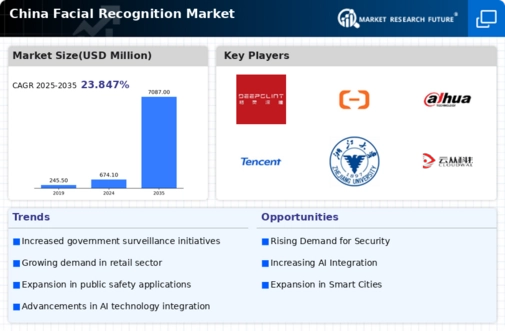
As per MRFR analysis, the China facial recognition market is projected to grow from USD 0.45 Billion in 2025 to USD 1.81 Billion by 2035, exhibiting a compound annual growth rate (CAGR) of 15.08% during the forecast period (2025 - 2035).

Key Market Trends & Highlights

The China facial recognition market is experiencing robust growth driven by technological advancements and increasing demand across various sectors.

  • The surveillance segment remains the largest contributor to the market, reflecting a strong emphasis on public safety.
  • Access control is the fastest-growing segment, indicating a rising need for secure entry systems in commercial spaces.
  • Government initiatives are pivotal in shaping the market landscape, while commercial applications are rapidly expanding.
  • Key market drivers include government support and the rising demand in retail and e-commerce, which are fueling adoption across sectors.

Market Size & Forecast

2024 Market Size 0.385 (USD Billion)
2035 Market Size 1.81 (USD Billion)
CAGR (2025 - 2035) 15.08%

Major Players

SenseTime (CN), Megvii (CN), iFlytek (CN), Hikvision (CN), CloudWalk (CN), Yitu Technology (CN), DeepGlint (CN), Face++ (CN), Zhejiang Dahua Technology (CN)

Our Impact
Enabled $4.3B Revenue Impact for Fortune 500 and Leading Multinationals
Partnering with 2000+ Global Organizations Each Year
30K+ Citations by Top-Tier Firms in the Industry

China Facial Recognition Market Trends

The China facial recognition market is currently experiencing a dynamic evolution, driven by advancements in artificial intelligence and machine learning technologies. This sector is characterized by a growing demand for enhanced security measures across various industries, including public safety, finance, and retail. The integration of facial recognition systems into surveillance infrastructure appears to be a key focus, as organizations seek to improve their operational efficiency and customer experience. Furthermore, the regulatory landscape is evolving, with authorities emphasizing the need for ethical considerations and data privacy, which may influence the adoption rates of these technologies. In addition, the market seems to be witnessing a surge in innovation, with numerous startups and established companies investing in research and development. This trend indicates a competitive environment where firms are striving to differentiate their offerings through improved accuracy and speed of recognition. As the china facial recognition market continues to mature, it is likely that partnerships between technology providers and end-users will become increasingly common, fostering a collaborative approach to addressing challenges and maximizing the potential of facial recognition applications.

Increased Adoption in Public Safety

The china facial recognition market is seeing a notable rise in the implementation of facial recognition technologies within public safety initiatives. Authorities are increasingly utilizing these systems to enhance surveillance capabilities, thereby improving crime prevention and response times. This trend suggests a growing reliance on technology to ensure community safety.

Focus on Data Privacy and Ethics

As the china facial recognition market expands, there is a heightened emphasis on data privacy and ethical considerations. Regulatory bodies are actively developing frameworks to govern the use of facial recognition technologies, which may impact how companies operate. This focus indicates a shift towards responsible innovation in the sector.

Integration with Smart City Initiatives

The china facial recognition market is becoming increasingly intertwined with smart city projects. Municipalities are exploring the use of facial recognition to streamline urban management and enhance citizen services. This integration reflects a broader trend of leveraging technology to create more efficient and responsive urban environments.

China Facial Recognition Market Drivers

Government Support and Regulation

The China facial recognition market benefits from robust government support and regulatory frameworks. The Chinese government has actively promoted the development and deployment of facial recognition technologies, viewing them as essential for enhancing public safety and national security. Policies such as the National AI Development Plan have allocated significant resources to AI technologies, including facial recognition. In 2023, the market was valued at approximately USD 7 billion, with projections indicating a compound annual growth rate of around 15% through 2026. This regulatory backing not only fosters innovation but also encourages investment in the sector, thereby solidifying China's position as a global leader in facial recognition technology.

Growing Awareness of Security Needs

The growing awareness of security needs among businesses and consumers is significantly influencing the China facial recognition market. With rising concerns over crime and safety, both public and private sectors are increasingly investing in facial recognition technologies to bolster security measures. In 2023, approximately 40% of enterprises in China reported implementing facial recognition systems as part of their security protocols. This trend is expected to persist as organizations recognize the potential of facial recognition to deter criminal activities and enhance overall safety. The heightened focus on security is likely to drive further adoption of facial recognition technologies across various sectors, including finance, transportation, and public services.

Integration with Surveillance Systems

The integration of facial recognition technology with existing surveillance systems is a key driver for the China facial recognition market. As urbanization accelerates, cities are increasingly adopting advanced surveillance solutions to enhance public safety. In 2025, it was estimated that over 60% of urban areas in China had implemented facial recognition-enabled surveillance systems. This integration allows for real-time monitoring and identification of individuals, thereby improving law enforcement capabilities. The synergy between facial recognition and surveillance technologies is likely to continue evolving, leading to more comprehensive security solutions that address urban challenges and enhance public safety measures.

Rising Demand in Retail and E-commerce

The China facial recognition market is experiencing a surge in demand from the retail and e-commerce sectors. Retailers are increasingly adopting facial recognition systems to enhance customer experience and streamline operations. For instance, major e-commerce platforms have integrated facial recognition for secure payment processes and personalized marketing strategies. In 2025, the retail sector accounted for nearly 30% of the total market share in facial recognition technologies, reflecting a growing trend towards automation and customer engagement. This demand is likely to continue as businesses seek innovative solutions to improve efficiency and customer satisfaction, further driving the growth of the facial recognition market in China.

Technological Advancements and Innovation

Technological advancements play a pivotal role in the growth of the China facial recognition market. Continuous improvements in algorithms, machine learning, and hardware capabilities have significantly enhanced the accuracy and efficiency of facial recognition systems. Companies are investing heavily in research and development to create more sophisticated solutions that can operate in diverse environments. In 2024, the introduction of 3D facial recognition technology marked a notable milestone, increasing the market's potential applications across various sectors, including security, finance, and healthcare. As innovation persists, the industry is expected to expand, with new applications emerging that could redefine user interaction and security protocols.


Market Segment Insights

By Application: Surveillance (Largest) vs. Access Control (Fastest-Growing)

In the China facial recognition market, the application segment displays a diverse range of uses, with surveillance leading the way as the largest contributor. This segment encompasses various facets, including public safety and crime prevention, significantly driving the adoption of facial recognition solutions across cities and urban areas. The second noteworthy application is access control, which is rapidly gaining traction, reflecting the increasing demand for secure entry points in both commercial and residential environments. Growth trends within the applications segment are fueled by several factors, including heightened security concerns and the transition to cashless transactions. Surveillance remains indispensable in enhancing safety measures, while access control applications are evolving to incorporate more innovative technologies like mobile access and biometric integrations. Both segments are witnessing technological advancements that cater to consumer needs and regulatory compliance, further accelerating their market presence.

Surveillance (Dominant) vs. Payment Processing (Emerging)

Surveillance stands as the dominant application in the China facial recognition market, as governments and enterprises prioritize security and public safety. This sector has leveraged facial recognition technology extensively to monitor public spaces and enhance crime detection capabilities, positioning itself as indispensable in urban management. Conversely, payment processing is emerging rapidly, driven by the increasing demand for seamless and secure transactions in retail and e-commerce. As cashless solutions gain popularity, payment processing is integrating facial recognition to provide a frictionless consumer experience, balancing convenience with security. Both applications demonstrate critical logistical considerations and regulatory adherence as they advance, each capturing target segments through tailored technology applications.

By End Use: Government (Largest) vs. Commercial (Fastest-Growing)

In the China facial recognition market, the distribution of market share among different end-use segments reveals that the government sector holds the largest share. This dominance is primarily driven by widespread adoption of facial recognition technology for security and surveillance purposes, including public safety and law enforcement. Conversely, the commercial sector is experiencing rapid growth as businesses increasingly implement facial recognition to enhance customer experiences and streamline operations across various industries such as retail and hospitality.

Government (Dominant) vs. Commercial (Emerging)

The government sector is at the forefront of the facial recognition market in China, leveraging this technology to bolster security measures and improve public safety responses. With significant investments in national security initiatives and smart city projects, government use is characterized by its focus on large-scale implementation and data integration across multiple public sectors. On the other hand, the commercial sector is emerging as a vibrant and rapidly expanding area, where businesses harness facial recognition to personalize services, increase operational efficiency, and manage access control. This trend reflects a growing acceptance of advanced technologies in everyday business processes, providing companies a competitive edge in the rapidly evolving market.

By Technology: 2D Recognition (Largest) vs. 3D Recognition (Fastest-Growing)

In the China facial recognition market, 2D Recognition holds the largest market share due to its widespread adoption in security and surveillance systems. This technology benefits from established infrastructure and compatibility with existing camera systems, which has led to its dominance across various applications. Meanwhile, 3D Recognition, while currently smaller in terms of market share, is rapidly gaining traction, particularly in high-security environments and advanced analytics, showcasing significant potential for future growth.

Technology: 2D Recognition (Dominant) vs. 3D Recognition (Emerging)

2D Recognition technology is characterized by its efficiency and cost-effectiveness, making it a preferred choice for a range of applications in China, including public safety and access control. Its ability to integrate seamlessly with existing monitoring systems has established it as a dominant player in the market. Conversely, 3D Recognition is an emerging technology that offers improved accuracy and security features, particularly in complex environments where facial alterations might occur. As technology advances, 3D Recognition is poised to capture a larger market share, driven by increasing demand for sophisticated security solutions and enhanced user experiences.

By Deployment Mode: On-premises (Largest) vs. Cloud-based (Fastest-Growing)

In the China facial recognition market, the deployment mode segment is characterized by a notable distribution among its leading categories: On-premises, Cloud-based, and Hybrid. Among these, On-premises solutions command the largest share, favored by organizations requiring tighter security and control over their data. Conversely, Cloud-based deployments are rapidly gaining traction due to their flexibility and scalability, appealing to businesses that seek to minimize their infrastructure costs and leverage advanced technologies without substantial upfront investment. Growth within this segment is driven by a combination of technological advancements and evolving security needs. The increasing integration of artificial intelligence and machine learning into facial recognition technologies has propelled Cloud-based solutions to the forefront, catering to a growing number of businesses that prioritize agility and faster deployment capabilities. Meanwhile, On-premises solutions remain vital for sectors with stringent compliance requirements, while Hybrid models emerge as a balanced option, combining both approaches to meet diverse organizational needs.

On-premises (Dominant) vs. Cloud-based (Emerging)

On-premises deployment remains the dominant mode in the China facial recognition market, primarily due to its capability to provide enhanced privacy and security features. Many enterprises opt for this mode to ensure that sensitive data is managed internally, facilitating compliance with stringent regulatory requirements. These solutions often leverage existing infrastructure, providing full control over the deployment and maintenance processes. In contrast, Cloud-based deployment is emerging as a valuable alternative, especially among smaller businesses looking for economical solutions. The Cloud model offers flexibility, easy updates, and integration with other services, allowing for rapid scalability. As organizations increasingly digitize their operations, both deployment modes are likely to coexist, catering to various organizational needs and preferences.

By Component: Hardware (Largest) vs. Software (Fastest-Growing)

In the China facial recognition market, the component segment is primarily divided into hardware, software, and services. Among these, hardware holds the largest market share, driven by the increasing deployment of facial recognition devices in security systems and public surveillance. The growth in demand for high-quality cameras and sensors has bolstered the hardware segment's dominance. However, software is emerging rapidly, fueled by advancements in AI and machine learning technologies, providing efficient recognition capabilities that enhance overall system performance.

Hardware (Dominant) vs. Software (Emerging)

The hardware segment within the China facial recognition market is characterized by its robust infrastructure, including cameras, sensors, and computing devices, which are pivotal for accurate face detection and recognition. This segment is driven by escalating government initiatives towards smart city projects and enhanced public safety measures. On the other hand, the software segment has become the fastest-growing area due to innovations in algorithm development and the increasing adoption of cloud-based solutions. This trend reflects a shift towards integrating advanced software technologies with existing hardware, providing comprehensive solutions that address various applications across industries, including retail, banking, and transportation.

Get more detailed insights about China Facial Recognition Market

Key Players and Competitive Insights

The competitive dynamics within the facial recognition market in China are characterized by rapid technological advancements and a growing emphasis on regulatory compliance. Key growth drivers include the increasing demand for security solutions across various sectors, such as public safety, finance, and retail. Major players like SenseTime (CN), Megvii (CN), and Hikvision (CN) are strategically positioned to leverage their technological prowess and extensive data resources. SenseTime (CN) focuses on innovation through continuous R&D investments, while Megvii (CN) emphasizes partnerships with local governments to enhance its market presence. Hikvision (CN), on the other hand, is expanding its product offerings to include AI-driven analytics, thereby shaping a competitive environment that prioritizes technological differentiation and strategic collaborations.

In terms of business tactics, companies are increasingly localizing manufacturing and optimizing supply chains to enhance operational efficiency. The market structure appears moderately fragmented, with several key players exerting significant influence. This fragmentation allows for a diverse range of solutions, catering to various customer needs while fostering healthy competition among the leading firms.

In December 2025, SenseTime (CN) announced a partnership with a major telecommunications provider to integrate its facial recognition technology into smart city initiatives. This collaboration is strategically important as it positions SenseTime (CN) at the forefront of urban digital transformation, potentially enhancing its market share in the rapidly evolving smart city sector. The integration of advanced facial recognition capabilities into urban infrastructure could lead to improved public safety and operational efficiency.

In November 2025, Megvii (CN) launched a new AI-driven facial recognition system tailored for the retail sector, aimed at enhancing customer experience through personalized services. This move is significant as it reflects Megvii's (CN) commitment to innovation and its ability to adapt to market demands. By focusing on retail applications, Megvii (CN) is likely to capture a growing segment of the market that prioritizes customer engagement and data-driven insights.

In October 2025, Hikvision (CN) expanded its product line to include advanced analytics features in its facial recognition systems, targeting the security and surveillance sectors. This strategic action underscores Hikvision's (CN) intent to differentiate itself through enhanced functionality, which may attract clients seeking comprehensive security solutions. The integration of analytics into facial recognition technology could provide clients with actionable insights, further solidifying Hikvision's (CN) competitive edge.

As of January 2026, current trends in the competitive landscape include a strong focus on digitalization, sustainability, and the integration of AI technologies. Strategic alliances are increasingly shaping the market, enabling companies to pool resources and expertise to drive innovation. Looking ahead, competitive differentiation is likely to evolve from traditional price-based competition to a focus on technological innovation, reliability in supply chains, and the ability to deliver tailored solutions. This shift may redefine the competitive landscape, emphasizing the importance of adaptability and forward-thinking strategies.

Key Companies in the China Facial Recognition Market include

Industry Developments

In recent months, the China Facial Recognition Market has seen significant developments, showcasing companies like DeepGlint, Alibaba Cloud, and SenseTime leading innovations. Notably, in July 2023, Dahua Technology announced an advancement in its intelligent surveillance solutions, integrating AI with facial recognition capabilities to enhance security in urban environments. Furthermore, CloudWalk's partnerships with local governments aim to deploy facial recognition systems for public safety and traffic management.

In terms of growth, the market's valuation has surged, driven by increasing applications across sectors such as finance, public safety, and smart cities, with a reported market value exceeding USD 3 billion in early 2023. Recent activities also include the acquisition of NetPosa by iFlytek in June 2023, strengthening their position in the AI and biometrics sector. Major happenings from the last two years include the launch of the national facial recognition database initiative by the Chinese government in March 2022, illustrating the strategic importance of this technology for national governance and security.

Companies like Megvii and Hikvision continue to expand their market reach, aided by government support and a growing consumer demand for smart technologies.

Future Outlook

China Facial Recognition Market Future Outlook

The China facial recognition market is projected to grow at a 15.08% CAGR from 2025 to 2035, driven by technological advancements, increasing security demands, and regulatory support.

New opportunities lie in:

  • Integration of facial recognition in smart city infrastructure
  • Development of AI-driven analytics for retail customer insights
  • Expansion of biometric payment systems in e-commerce platforms

By 2035, the market is expected to be robust, driven by innovation and widespread adoption.

Market Segmentation

China Facial Recognition Market End Use Outlook

  • Government
  • Commercial
  • Residential
  • Transportation
  • Education

China Facial Recognition Market Component Outlook

  • Hardware
  • Software
  • Services

China Facial Recognition Market Technology Outlook

  • 2D Recognition
  • 3D Recognition
  • Thermal Recognition
  • Facial Analytics
  • Cloud-based Solutions

China Facial Recognition Market Application Outlook

  • Surveillance
  • Access Control
  • Payment Processing
  • Healthcare
  • Retail

China Facial Recognition Market Deployment Mode Outlook

  • On-premises
  • Cloud-based
  • Hybrid

Report Scope

MARKET SIZE 20240.385(USD Billion)
MARKET SIZE 20250.45(USD Billion)
MARKET SIZE 20351.81(USD Billion)
COMPOUND ANNUAL GROWTH RATE (CAGR)15.08% (2024 - 2035)
REPORT COVERAGERevenue Forecast, Competitive Landscape, Growth Factors, and Trends
BASE YEAR2024
Market Forecast Period2025 - 2035
Historical Data2019 - 2024
Market Forecast UnitsUSD Billion
Key Companies ProfiledSenseTime (CN), Megvii (CN), iFlytek (CN), Hikvision (CN), CloudWalk (CN), Yitu Technology (CN), DeepGlint (CN), Face++ (CN), Zhejiang Dahua Technology (CN)
Segments CoveredApplication, End Use, Technology, Deployment Mode, Component
Key Market OpportunitiesIntegration of artificial intelligence in security systems enhances the china facial recognition market potential.
Key Market DynamicsRapid advancements in artificial intelligence drive competitive innovation in China's facial recognition market.
Countries CoveredChina
Leave a Comment

FAQs

What is the current valuation of the China facial recognition market?

As of 2024, the market valuation was 0.385 USD Billion.

What is the projected market size for the China facial recognition market by 2035?

The market is expected to reach a valuation of 1.81 USD Billion by 2035.

What is the expected CAGR for the China facial recognition market during the forecast period 2025 - 2035?

The market is anticipated to grow at a CAGR of 15.08% from 2025 to 2035.

Which companies are the key players in the China facial recognition market?

Key players include SenseTime, Megvii, iFlytek, Hikvision, CloudWalk, Yitu Technology, DeepGlint, Face++, and Zhejiang Dahua Technology.

What are the primary applications of facial recognition technology in China?

The main applications include Surveillance, Access Control, Payment Processing, Healthcare, and Retail.

How does the market segment by end use in the China facial recognition market?

The market segments by end use include Government, Commercial, Residential, Transportation, and Education.

What technologies are utilized in the China facial recognition market?

Technologies include 2D Recognition, 3D Recognition, Thermal Recognition, Facial Analytics, and Cloud-based Solutions.

What are the deployment modes for facial recognition solutions in China?

Deployment modes consist of On-premises, Cloud-based, and Hybrid solutions.

How is the China facial recognition market segmented by component?

The market is segmented into Hardware, Software, and Services.

What was the valuation of the Surveillance application in the China facial recognition market in 2024?

In 2024, the Surveillance application was valued at 0.15 USD Billion.

Download Free Sample

Kindly complete the form below to receive a free sample of this Report

Compare Licence

×
Features License Type
Single User Multiuser License Enterprise User
Price $4,950 $5,950 $7,250
Maximum User Access Limit 1 User Upto 10 Users Unrestricted Access Throughout the Organization
Free Customization
Direct Access to Analyst
Deliverable Format
Platform Access
Discount on Next Purchase 10% 15% 15%
Printable Versions