×
Request Free Sample ×

Kindly complete the form below to receive a free sample of this Report

* Please use a valid business email

Leading companies partner with us for data-driven Insights

clients tt-cursor
Hero Background

China Enterprise Communication Infrastructure Market

ID: MRFR/ICT/58169-HCR
200 Pages
Aarti Dhapte
February 2026

China Enterprise Communication Infrastructure Market Size, Share and Trends Analysis Report By Deployment (On-premise, Cloud), By End User (IT and Telecom, Manufacturing, BFSI, Healthcare, Government, Retail, Other End Users) and By Application (Consumer Experience, Enterprise Collaboration, Digital Business, Other Applications)-Forecast to 2035

Share:
Download PDF ×

We do not share your information with anyone. However, we may send you emails based on your report interest from time to time. You may contact us at any time to opt-out.

China Enterprise Communication Infrastructure Market Infographic
Purchase Options

China Enterprise Communication Infrastructure Market Summary

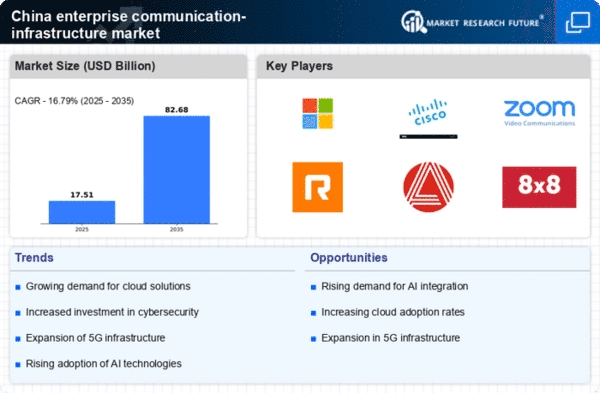
As per Market Research Future analysis, the China enterprise communication-infrastructure market size was estimated at 15.0 USD Billion in 2024. The China enterprise communication-infrastructure market is projected to grow from 17.51 USD Billion in 2025 to 82.68 USD Billion by 2035, exhibiting a compound annual growth rate (CAGR) of 16.7% during the forecast period 2025 - 2035

Key Market Trends & Highlights

The China enterprise communication-infrastructure market is experiencing robust growth driven by technological advancements and evolving workplace dynamics.

  • Cloud adoption and integration are becoming increasingly prevalent, enhancing communication efficiency across enterprises.
  • AI and automation are transforming communication processes, leading to improved decision-making and operational effectiveness.
  • The focus on security and compliance is intensifying as organizations seek to protect sensitive information in a digital landscape.
  • Rapid digital transformation and increased remote work culture are key drivers propelling the demand for unified communication solutions.

Market Size & Forecast

2024 Market Size 15.0 (USD Billion)
2035 Market Size 82.68 (USD Billion)
CAGR (2025 - 2035) 16.79%

Major Players

Microsoft (US), Cisco Systems (US), Zoom Video Communications (US), RingCentral (US), Avaya (US), 8x8 (US), Slack Technologies (US), Twilio (US), Alcatel-Lucent (FR)

Our Impact
Enabled $4.3B Revenue Impact for Fortune 500 and Leading Multinationals
Partnering with 2000+ Global Organizations Each Year
30K+ Citations by Top-Tier Firms in the Industry

China Enterprise Communication Infrastructure Market Trends

The enterprise communication-infrastructure market is currently experiencing a transformative phase. This transformation is driven by advancements in technology and evolving business needs. Organizations are increasingly adopting cloud-based solutions, which offer flexibility and scalability. This shift allows companies to enhance their communication capabilities while reducing operational costs. Furthermore, the integration of artificial intelligence and machine learning into communication tools is becoming more prevalent, enabling businesses to streamline processes and improve customer interactions. As a result, the demand for innovative communication solutions is on the rise, reflecting a broader trend towards digital transformation in various sectors. In addition, the emphasis on security and data privacy is intensifying within the enterprise communication-infrastructure market. Companies are prioritizing secure communication channels to protect sensitive information and comply with regulatory requirements. This focus on security is likely to drive investments in advanced encryption technologies and secure access protocols. Overall, the enterprise communication-infrastructure market is poised for significant growth, as organizations seek to enhance their communication strategies and adapt to the changing landscape of business operations.

Cloud Adoption and Integration

The shift towards cloud-based communication solutions is reshaping the enterprise communication-infrastructure market. Organizations are increasingly leveraging cloud technologies to enhance flexibility and scalability in their communication systems. This trend allows for seamless integration of various communication tools, fostering collaboration and efficiency.

AI and Automation in Communication

The incorporation of artificial intelligence and automation into communication tools is gaining traction. Businesses are utilizing AI-driven solutions to optimize workflows, improve customer service, and analyze communication patterns. This trend indicates a move towards more intelligent and responsive communication infrastructures.

Focus on Security and Compliance

As data privacy concerns grow, the enterprise communication-infrastructure market is seeing an increased focus on security measures. Organizations are investing in advanced encryption and secure communication protocols to safeguard sensitive information. This trend reflects the necessity for compliance with regulatory standards and the protection of corporate data.

China Enterprise Communication Infrastructure Market Drivers

Rapid Digital Transformation

The enterprise communication-infrastructure market in China is experiencing a surge due to rapid digital transformation across various sectors. Organizations are increasingly adopting digital tools to enhance operational efficiency and improve communication. This shift is evidenced by a reported growth rate of 15% in digital communication solutions in 2025. Companies are investing in advanced communication technologies to streamline workflows and foster collaboration among remote teams. As businesses transition to digital-first strategies, the demand for robust communication infrastructure is likely to escalate, driving market growth. Furthermore, the Chinese government's initiatives to promote digital economy development are expected to further bolster investments in this sector, indicating a promising outlook for the enterprise communication-infrastructure market in the coming years.

Increased Remote Work Culture

The rise of remote work culture in China has significantly impacted the enterprise communication-infrastructure market. As organizations adapt to flexible work arrangements, the need for reliable communication tools has become paramount. A survey indicates that 70% of companies in China plan to maintain remote work policies, which necessitates the implementation of effective communication solutions. This trend is pushing enterprises to invest in cloud-based communication platforms that facilitate seamless collaboration among distributed teams. The growing reliance on video conferencing, instant messaging, and collaborative tools is likely to drive demand for advanced communication infrastructure. Consequently, the enterprise communication-infrastructure market is poised for growth as businesses seek to enhance connectivity and productivity in a remote work environment.

Rising Cybersecurity Concerns

As the enterprise communication-infrastructure market evolves in China, rising cybersecurity concerns are becoming a significant driver of market growth. With increasing incidents of cyber threats, organizations are prioritizing secure communication solutions to protect sensitive information. A report suggests that 75% of enterprises in China are investing in advanced security measures for their communication infrastructure. This heightened focus on cybersecurity is prompting businesses to seek solutions that offer robust encryption, secure access controls, and compliance with regulatory standards. Consequently, the enterprise communication-infrastructure market is likely to see a surge in demand for secure communication technologies, as organizations strive to mitigate risks and safeguard their digital assets.

Government Initiatives and Support

Government initiatives aimed at enhancing digital infrastructure in China are playing a crucial role in shaping the enterprise communication-infrastructure market. The Chinese government has launched various programs to promote technological innovation and digital transformation, which includes substantial funding for communication infrastructure projects. In 2025, it is estimated that government investments in digital communication technologies will reach approximately $10 billion. These initiatives not only provide financial support but also create a favorable regulatory environment for businesses to adopt advanced communication solutions. As a result, the enterprise communication-infrastructure market will benefit from increased public sector collaboration and investment, fostering growth and innovation in the industry.

Growing Demand for Unified Communication Solutions

The enterprise communication-infrastructure market is witnessing a growing demand for unified communication solutions in China. Businesses are increasingly recognizing the value of integrating various communication channels into a single platform to enhance efficiency and user experience. A recent study indicates that 60% of enterprises are prioritizing the adoption of unified communication systems to streamline operations. This trend is driven by the need for seamless collaboration among employees, regardless of their location. As organizations seek to improve communication workflows, the enterprise communication-infrastructure market is expected to expand, with vendors offering innovative solutions that cater to this demand. The integration of voice, video, and messaging services into cohesive platforms is likely to become a key focus area for market players.


Market Segment Insights

By Deployment: Cloud (Largest) vs. On-premise (Fastest-Growing)

In the China enterprise communication-infrastructure market, the deployment segment is characterized by a competitive landscape between cloud-based solutions and traditional on-premise setups. Currently, cloud deployments hold the largest share, favored for their flexibility, scalability, and cost-effectiveness. Many businesses are transitioning towards cloud services, attracted by the reduced operational costs and the ease of integration with existing systems, which has fueled this segment's dominance. The growth trends for the deployment segment indicate a significant shift towards on-premise solutions, which are increasingly recognized for their security and control benefits. This segment is experiencing rapid growth as enterprises seek to maintain sensitive data in-house while benefiting from advancements in technology that enhance the efficiency of on-premise systems. As concerns about data privacy rise, on-premise deployments are positioned as the fastest-growing option in this arena.

Deployment: Cloud (Dominant) vs. On-premise (Emerging)

Cloud deployment is dominating the market due to its ability to offer businesses agility, reduced upfront costs, and the capacity for rapid scalability. It is particularly attractive to small and medium-sized enterprises (SMEs) that require flexibility without significant capital investment. Conversely, on-premise solutions are emerging as businesses prioritize data security and confidentiality, offering greater control over sensitive information. This trend is particularly significant in industries like finance and healthcare, where compliance with regulations mandates stringent data protection. As such, while cloud remains dominant, on-premise is carving out a substantial niche, driven by emerging needs for heightened security and personalized infrastructure.

By End-User: IT and Telecom (Largest) vs. Healthcare (Fastest-Growing)

In the China enterprise communication-infrastructure market, the IT and Telecom sector holds a significant portion, reflecting the critical role of connectivity and digital transformation in this industry. Other notable segments include Manufacturing, BFSI, Government, and Retail, each contributing to the overall market share through a variety of communication solutions tailored to their unique operational needs. Looking ahead, the Healthcare segment is emerging as the fastest-growing area due to the increasing demand for telehealth and digital communication solutions in medical facilities. The ongoing focus on improving operational efficiency and enhancing patient care is driving investment in communication technologies, making this segment a key player in the market's evolution.

IT and Telecom: Dominant vs. Healthcare: Emerging

The IT and Telecom sector remains dominant in the China enterprise communication-infrastructure market, characterized by its robust infrastructure and extensive adoption of advanced communication technologies. This dominance is bolstered by the increasing need for reliable networks and efficient communication systems. In contrast, the Healthcare segment is emerging rapidly, fueled by the digital transformation spurred by the COVID-19 pandemic. This sector is heavily investing in advanced communication solutions to support telemedicine and improve patient engagement. Both segments exhibit distinct characteristics: while IT and Telecom leverage established networks, Healthcare is rapidly adapting to new technologies, highlighting their unique positions within the market.

By Application: Enterprise Collaboration (Largest) vs. Digital Business (Fastest-Growing)

In the China enterprise communication-infrastructure market, the application segment is structured around various key areas, including Consumer Experience, Enterprise Collaboration, Digital Business, and Other Applications. Among these, Enterprise Collaboration has emerged as the largest segment, capturing a significant share driven by the increasing need for effective teamwork solutions and the adoption of digital tools. In contrast, the Digital Business segment, although smaller, is the fastest-growing area as companies embrace online strategies to enhance operational efficiency and customer interactions. Growth trends in the application segment are significantly influenced by technological advancements and shifts in consumer demands. The rise of remote work and collaboration tools has propelled Enterprise Collaboration forward, while Digital Business continues to expand rapidly as organizations seek to digitize processes and provide a seamless customer experience. Other Applications are experiencing stable growth, but they lack the explosive momentum seen in the leading segments. This shift indicates a transformative wave in enterprise communication needs across the market.

Consumer Experience (Dominant) vs. Other Applications (Emerging)

Consumer Experience is a dominant force in the application segment, reflecting a strategic focus on enhancing user engagement and satisfaction within the China enterprise communication-infrastructure market. Businesses prioritize tools that improve interaction with consumers, emphasizing personalization and real-time communication. Meanwhile, Other Applications represent a more emerging category that encompasses diverse uses, but it does not yet match the dedicated focus or advanced capabilities seen in Consumer Experience solutions. This segment includes functionalities that support niche markets or specific organizational needs, though it is often overshadowed by more established areas like Consumer Experience and Enterprise Collaboration. As enterprises adapt their strategies, these application domains are poised for evolving dynamics in user engagement and operational productivity.

Get more detailed insights about China Enterprise Communication Infrastructure Market

Key Players and Competitive Insights

The enterprise communication-infrastructure market in China is characterized by a dynamic competitive landscape, driven by rapid technological advancements and increasing demand for seamless communication solutions. Major players such as Microsoft (US), Cisco Systems (US), and Zoom Video Communications (US) are strategically positioned to leverage their innovative capabilities and extensive product portfolios. Microsoft (US) focuses on integrating AI-driven features into its communication tools, enhancing user experience and operational efficiency. Cisco Systems (US) emphasizes its robust security protocols and cloud-based solutions, catering to enterprises seeking reliable and secure communication infrastructures. Meanwhile, Zoom Video Communications (US) continues to expand its offerings, particularly in the realm of hybrid work solutions, which are increasingly relevant in the current market context. Collectively, these strategies contribute to a competitive environment that is both collaborative and competitive, as companies seek to differentiate themselves through innovation and customer-centric solutions.
Key business tactics employed by these companies include localizing manufacturing and optimizing supply chains to enhance responsiveness to market demands. The market structure appears moderately fragmented, with several key players holding substantial market shares while also facing competition from emerging startups. This fragmentation allows for diverse offerings and innovation, as companies strive to capture market segments through tailored solutions and strategic partnerships.
In October 2025, Microsoft (US) announced the launch of its new AI-powered communication platform, which integrates advanced analytics and machine learning capabilities. This strategic move is likely to enhance user engagement and streamline communication processes for enterprises, positioning Microsoft (US) as a leader in the AI integration trend within the market. The introduction of such innovative solutions may significantly influence customer preferences and set new benchmarks for communication efficiency.
In September 2025, Cisco Systems (US) unveiled its latest security enhancements for its communication infrastructure, focusing on end-to-end encryption and data protection. This initiative underscores Cisco's commitment to addressing growing concerns around cybersecurity, particularly as enterprises increasingly rely on digital communication channels. By prioritizing security, Cisco Systems (US) not only strengthens its market position but also builds trust among its clientele, which is crucial in today's data-sensitive environment.
In August 2025, Zoom Video Communications (US) expanded its partnership with various educational institutions to enhance remote learning capabilities. This strategic alliance aims to provide tailored communication solutions that cater specifically to the educational sector, reflecting Zoom's adaptability and responsiveness to market needs. Such partnerships are indicative of a broader trend where companies are aligning their offerings with specific industry requirements, thereby enhancing their competitive edge.
As of November 2025, current trends in the enterprise communication-infrastructure market are heavily influenced by digitalization, sustainability, and the integration of AI technologies. Strategic alliances are increasingly shaping the competitive landscape, as companies collaborate to enhance their service offerings and market reach. Looking ahead, it appears that competitive differentiation will evolve from traditional price-based competition to a focus on innovation, technological advancements, and supply chain reliability. This shift may redefine how companies position themselves in the market, emphasizing the importance of delivering value through cutting-edge solutions and sustainable practices.

Key Companies in the China Enterprise Communication Infrastructure Market include

Industry Developments

The China Enterprise Communication Infrastructure Market is witnessing significant developments, particularly with major players like JD.com, Tencent, Cisco, Oracle, ZTE, Huawei, Nokia, Avaya, Baidu, Lenovo, Microsoft, Ericsson, RingCentral, Alibaba Cloud, and VMware. Recent market movements indicate increased valuations driven by advancements in cloud and communication technologies, underscoring a recovery post-pandemic era. In July 2023, JD.com expanded its cloud service capabilities, enhancing its competitive edge in the enterprise segment.

Additionally, in August 2023, Alibaba Cloud announced new innovations in AI-driven communication solutions, further solidifying its market position. Current affairs reflect a trend toward integration and digitization, with many enterprises pivoting towards hybrid communication models. Notably, the merger between RingCentral and Avaya in September 2022 was pivotal, enabling a synergy that enhanced cloud-based communication offerings.

Moreover, ZTE announced a strategic alliance with Tencent in June 2023, focusing on enhancing smart communication infrastructure. The ongoing evolution in regulations supporting digital transformation is also shaping the landscape, indicating a robust growth trajectory for communication solutions in China.

Future Outlook

China Enterprise Communication Infrastructure Market Future Outlook

The enterprise communication-infrastructure market in China is projected to grow at a 16.79% CAGR from 2025 to 2035, driven by digital transformation and increased remote work.

New opportunities lie in:

  • Development of AI-driven communication tools for enhanced collaboration.
  • Expansion of cloud-based infrastructure solutions for scalability.
  • Integration of IoT devices to streamline communication processes.

By 2035, the market is expected to achieve substantial growth, driven by innovation and evolving business needs.

Market Segmentation

China Enterprise Communication Infrastructure Market End-User Outlook

  • IT and Telecom
  • Manufacturing
  • BFSI
  • Healthcare
  • Government
  • Retail
  • Other End Users

China Enterprise Communication Infrastructure Market Deployment Outlook

  • On-premise
  • Cloud

China Enterprise Communication Infrastructure Market Application Outlook

  • Consumer Experience
  • Enterprise Collaboration
  • Digital Business
  • Other Applications

Report Scope

MARKET SIZE 2024 15.0(USD Billion)
MARKET SIZE 2025 17.51(USD Billion)
MARKET SIZE 2035 82.68(USD Billion)
COMPOUND ANNUAL GROWTH RATE (CAGR) 16.79% (2025 - 2035)
REPORT COVERAGE Revenue Forecast, Competitive Landscape, Growth Factors, and Trends
BASE YEAR 2024
Market Forecast Period 2025 - 2035
Historical Data 2019 - 2024
Market Forecast Units USD Billion
Key Companies Profiled Microsoft (US), Cisco Systems (US), Zoom Video Communications (US), RingCentral (US), Avaya (US), 8x8 (US), Slack Technologies (US), Twilio (US), Alcatel-Lucent (FR)
Segments Covered Deployment, End-User, Application
Key Market Opportunities Integration of artificial intelligence in enterprise communication-infrastructure market enhances operational efficiency and user experience.
Key Market Dynamics Rapid technological advancements drive competitive dynamics in the enterprise communication-infrastructure market.
Countries Covered China
Leave a Comment

FAQs

What is the expected market size of the China Enterprise Communication Infrastructure Market in 2024?

The China Enterprise Communication Infrastructure Market is expected to be valued at 13.4 billion USD in 2024.

What is the projected market size for this sector in 2035?

The market is projected to reach a value of approximately 94.16 billion USD by 2035.

What is the expected compound annual growth rate (CAGR) for the market from 2025 to 2035?

The market is expected to exhibit a CAGR of 19.392 percent during the forecast period from 2025 to 2035.

What is the market size for On-premise deployment in 2024?

The On-premise deployment segment is valued at 4.5 billion USD in 2024.

How much is the Cloud deployment segment expected to be worth in 2035?

The Cloud deployment segment is anticipated to reach a value of 68.84 billion USD by 2035.

Who are the major players in the China Enterprise Communication Infrastructure Market?

Key players include JD.com, Tencent, Cisco, Oracle, ZTE, Huawei, Nokia, Avaya, Baidu, Lenovo, Microsoft, Ericsson, RingCentral, Alibaba Cloud, and VMware.

What growth drivers are fueling the expansion of this market?

Factors such as increasing digital transformation, remote work adoption, and the need for efficient communication solutions are driving market growth.

What impact do current global trends have on the market?

Current global trends, including technological advancements and the shift toward cloud solutions, significantly influence the market dynamics.

Which deployment type is expected to dominate the market by 2035?

The Cloud deployment type is expected to dominate the market by 2035 due to its scalability and cost-effectiveness.

What challenges might the China Enterprise Communication Infrastructure Market face in the near future?

Challenges may include regulatory hurdles, cybersecurity concerns, and the need for interoperability among various communication platforms.

Download Free Sample

Kindly complete the form below to receive a free sample of this Report

Compare Licence

×
Features License Type
Single User Multiuser License Enterprise User
Price $4,950 $5,950 $7,250
Maximum User Access Limit 1 User Upto 10 Users Unrestricted Access Throughout the Organization
Free Customization
Direct Access to Analyst
Deliverable Format
Platform Access
Discount on Next Purchase 10% 15% 15%
Printable Versions