×
Request Free Sample ×

Kindly complete the form below to receive a free sample of this Report

* Please use a valid business email

Leading companies partner with us for data-driven Insights

clients tt-cursor
Hero Background

China Endoprosthesis Market

ID: MRFR/MED/51367-HCR
200 Pages
Rahul Gotadki
February 2026

China Endoprosthesis Market Research Report By Product (Knee, Hip, Shoulder, Elbow, Finger/Hand, Ankle/Foot), By Knee (Primary, Partial, Revision Knee Replacement, Tumor, Custom Made), By Hip (Primary, Partial, Revision Hip Replacement, Tumor, Custom Made), By Shoulder (Primary, Revision Shoulder Replacement, Tumor, Custom Made) and By Elbow (Total Elbow, Radial Head Replacement, Tumor, Custom Made) - Growth & Industry Forecast 2025 To 2035

Share:
Download PDF ×

We do not share your information with anyone. However, we may send you emails based on your report interest from time to time. You may contact us at any time to opt-out.

China Endoprosthesis Market Infographic
Purchase Options

China Endoprosthesis Market Summary

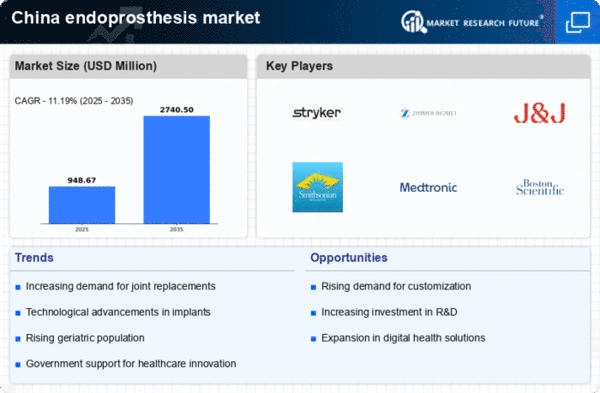
As per Market Research Future analysis, the China Endoprosthesis Market size was estimated at 853.2 USD Million in 2024. The Endoprosthesis market is projected to grow from 948.67 USD Million in 2025 to 2740.5 USD Million by 2035, exhibiting a compound annual growth rate (CAGR) of 11.1% during the forecast period 2025 - 2035

Key Market Trends & Highlights

The China endoprosthesis market is poised for substantial growth driven by technological advancements and increasing patient awareness.

  • Technological advancements in endoprosthesis are enhancing product efficacy and patient outcomes.
  • The orthopedic segment remains the largest, while the dental segment is the fastest-growing in the market.
  • Regulatory support is fostering innovation and expediting product approvals in the endoprosthesis sector.
  • Key market drivers include the rising geriatric population and increased investment in healthcare infrastructure.

Market Size & Forecast

2024 Market Size 853.2 (USD Million)
2035 Market Size 2740.5 (USD Million)
CAGR (2025 - 2035) 11.19%

Major Players

Stryker Corporation (US), Zimmer Biomet Holdings Inc (US), DePuy Synthes (US), Smith & Nephew plc (GB), Medtronic plc (IE), Boston Scientific Corporation (US), B. Braun Melsungen AG (DE), Aesculap AG (DE)

Our Impact
Enabled $4.3B Revenue Impact for Fortune 500 and Leading Multinationals
Partnering with 2000+ Global Organizations Each Year
30K+ Citations by Top-Tier Firms in the Industry

China Endoprosthesis Market Trends

The China Endoprosthesis Market is currently experiencing notable growth, driven by advancements in medical technology and an increasing aging population. The demand for joint replacement procedures, particularly hip and knee surgeries, is on the rise as more individuals seek solutions for degenerative joint diseases. Furthermore, the emphasis on minimally invasive surgical techniques is reshaping the landscape, as these methods often lead to quicker recovery times and reduced hospital stays. This shift not only enhances patient outcomes but also influences the preferences of healthcare providers and patients alike. In addition, the regulatory environment in China is evolving, with authorities implementing measures to streamline the approval process for new medical devices. This regulatory support is likely to encourage innovation and attract investments in the endoprosthesis market. Moreover, the growing awareness of the benefits of early intervention in joint-related issues is prompting healthcare professionals to advocate for timely surgical options. As a result, the market is poised for sustained expansion, reflecting a broader trend towards improved healthcare services and patient-centric approaches.

Technological Advancements

Innovations in materials and design are enhancing the performance and longevity of endoprostheses. Newer models are being developed with biocompatible materials that reduce the risk of rejection and improve integration with bone tissue. This trend is likely to attract more patients seeking effective solutions for joint issues.

Regulatory Support

The Chinese government is actively working to simplify the approval process for medical devices, including endoprostheses. This regulatory support is expected to foster a more favorable environment for manufacturers, encouraging the introduction of advanced products into the market.

Increased Patient Awareness

There is a growing awareness among patients regarding the benefits of early intervention for joint problems. This trend is leading to an increase in consultations and elective surgeries, as individuals become more proactive about their health and seek out surgical options for relief.

China Endoprosthesis Market Drivers

Rising Geriatric Population

The increasing geriatric population in China is a pivotal driver for the endoprosthesis market. As the population ages, the prevalence of degenerative diseases and conditions requiring surgical interventions rises. It is estimated that by 2030, approximately 25% of China's population will be over 60 years old. This demographic shift necessitates advanced medical solutions, including endoprostheses, to enhance mobility and quality of life. The demand for joint replacements, particularly hip and knee prostheses, is expected to surge, contributing to market growth. Furthermore, the endoprosthesis market is likely to see innovations tailored to the needs of older patients, such as materials that reduce the risk of complications and improve longevity of implants.

Government Initiatives and Funding

Government initiatives aimed at improving healthcare infrastructure and funding for medical technologies are crucial for the endoprosthesis market. The Chinese government has been increasing its investment in healthcare, with a focus on enhancing surgical capabilities and access to advanced medical devices. In recent years, funding for orthopedic research and development has seen a notable rise, which is expected to continue. This support is likely to foster innovation within the endoprosthesis market, enabling manufacturers to develop more effective and affordable solutions. Additionally, public health campaigns promoting joint health and mobility may further stimulate demand for endoprosthetic devices.

Growing Incidence of Lifestyle Diseases

The rising incidence of lifestyle-related diseases in China is a significant driver for the endoprosthesis market. Conditions such as obesity, diabetes, and osteoarthritis are becoming increasingly prevalent, leading to a higher demand for surgical interventions. It is estimated that by 2025, the number of knee replacement surgeries in China could increase by over 30% due to these health issues. The endoprosthesis market is likely to respond by offering a wider range of products tailored to address these specific conditions, thereby expanding its market reach. This trend underscores the need for effective solutions to manage the consequences of lifestyle diseases.

Technological Innovations in Prosthetics

Technological advancements in prosthetic design and materials are significantly influencing the endoprosthesis market. Innovations such as 3D printing and biocompatible materials are enhancing the customization and effectiveness of prosthetic devices. In 2025, the market for advanced prosthetics in China is projected to reach approximately $1.5 billion, driven by these technological improvements. Enhanced imaging techniques and robotic-assisted surgeries are also streamlining procedures, leading to better patient outcomes. The endoprosthesis market is likely to benefit from these developments, as they not only improve the functionality of prosthetics but also reduce recovery times, making them more appealing to both patients and healthcare providers.

Increased Investment in Healthcare Infrastructure

The ongoing investment in healthcare infrastructure in China is a vital driver for the endoprosthesis market. As the government prioritizes healthcare improvements, hospitals and clinics are being equipped with advanced surgical technologies and facilities. This expansion is expected to enhance the capacity for orthopedic surgeries, including those involving endoprostheses. By 2025, it is projected that healthcare spending in China will exceed $1 trillion, with a significant portion allocated to orthopedic care. The endoprosthesis market stands to gain from this trend, as improved infrastructure facilitates better access to surgical procedures and enhances patient outcomes.


Market Segment Insights

By Product: Knee (Largest) vs. Hip (Fastest-Growing)

In the China endoprosthesis market, the distribution of market share among segment values such as Knee, Hip, Shoulder, Elbow, Finger/Hand, and Ankle/Foot is varied. The Knee segment commands the largest share due to its widespread application and acceptance among patients and healthcare providers. Following closely, the Hip segment is emerging with considerable growth potential, capitalizing on increasing aging populations and rising incidences of hip-related ailments. Growth trends in this segment are driven by advancements in technology and surgical methods, leading to improved outcomes and faster recovery times for patients. Additionally, the rise in orthopedic surgeries and an increasing preference for minimally invasive procedures are catalyzing growth, particularly in the Hip segment, which is attracting significant investments and innovations aimed at enhancing patient experiences and outcomes.

Knee (Dominant) vs. Hip (Emerging)

The Knee segment is a dominant force in the China endoprosthesis market, characterized by its broad adoption among healthcare facilities and substantial patient demand. Its popularity stems from several factors, including high success rates in alleviating pain and restoring function, along with robust supporting data from clinical studies. Comparatively, the Hip segment is considered an emerging market player, driven by demographic shifts involving an aging population requiring more hip replacements. Innovations in hip prosthetics, including lighter materials and improved designs, are enhancing its market viability. As such, while the Knee segment remains dominant, the Hip segment shows potential for rapid growth as it taps into new technologies and patient-based care models.

By Knee: Primary (Largest) vs. Partial (Fastest-Growing)

In the China endoprosthesis market, the distribution of market share among the knee replacement segments reflects a clear preference for certain types. The Primary knee replacement segment leads the market, capturing the largest share due to its widespread use and acceptance among surgeons and patients alike. In contrast, the Partial segment is gaining traction, showing increased adoption owing to its lesser invasiveness and quicker recovery times, positioning it as a rapidly growing segment in the market. The growth trends for the knee replacement segments are influenced by several factors, including the aging population, increasing rates of knee-related disorders, and advancements in surgical techniques. The demand for less invasive procedures such as Partial knee replacement is on the rise, as patients seek faster recovery options. Additionally, the focus on personalized solutions, particularly in Custom Made prosthetics, is emerging as a significant driver of innovation and growth within the market.

Primary (Dominant) vs. Partial (Emerging)

The Primary knee replacement segment is recognized as the dominant force in the China endoprosthesis market, providing a reliable solution for a broad range of patients with severe osteoarthritis and knee injuries. This segment's strength lies in its established surgical protocols and high success rates. Meanwhile, the Partial segment is emerging, appealing to younger and more active patients who prefer a less invasive option that preserves healthy bone and tissue. As technologies improve and patient awareness increases, the Partial segment is set to capture a larger share of the market, influencing surgical practices and patient choices in the coming years.

By Hip: Primary (Largest) vs. Partial (Fastest-Growing)

In the China endoprosthesis market, the distribution of market share among various hip segment values indicates that the primary segment holds the largest share, reflecting its established presence and widespread usage among patients. Partial hip replacements are gaining traction, particularly due to advancements in surgical techniques and materials, appealing to a growing demographic seeking lower-risk options. Growth trends in the hip segment are notably driven by an aging population and increased incidence of hip-related health issues. Additionally, innovative technologies and improvements in implant longevity are boosting the demand for both primary and partial replacements. As awareness of hip replacement benefits spreads, patients are increasingly opting for partial replacements, which are becoming the fastest-growing choice in the market.

Primary: Dominant vs. Partial: Emerging

The primary hip replacement segment is considered dominant in the China endoprosthesis market, attributed to its comprehensive applications in treating severe hip joint issues. Its reliability and the extensive research backing its methodologies solidify its preference among orthopedic surgeons. Conversely, the partial hip replacement segment is emerging as a significant alternative due to its minimally invasive nature, which leads to quicker recovery times and less post-operative pain for patients. This emerging trend caters primarily to younger patients or those with less severe damage. As healthcare professionals advocate for personalized treatment plans, the appeal of partial hip replacements continues to rise, demonstrating a notable shift in patient and surgeon preferences.

By Shoulder: Primary (Largest) vs. Revision Shoulder Replacement (Fastest-Growing)

In the China endoprosthesis market, the shoulder segment consists of various values including Primary, Revision Shoulder Replacement, Tumor, and Custom Made. The Primary segment holds the largest share, reflecting its dominant position and widespread usage among healthcare providers. Meanwhile, the Revision Shoulder Replacement segment, although smaller, is witnessing significant growth, driven by an increase in the number of revision surgeries and improvements in surgical techniques. The growth trends in the shoulder segment are primarily influenced by the aging population and rising incidence of shoulder disorders among the population. Furthermore, advancements in technology and materials are enhancing the effectiveness of shoulder replacements, making them more appealing to both patients and surgeons. These factors contribute to the robust expansion of the Revision Shoulder Replacement segment, capturing the attention of market players.

Primary (Dominant) vs. Revision Shoulder Replacement (Emerging)

The Primary segment in the shoulder market is characterized by its established presence and extensive utilization in elective surgeries. This segment is known for its reliability and satisfactory outcomes, which have solidified its place as the dominant choice for both orthopedic surgeons and patients. On the other hand, the Revision Shoulder Replacement segment, while traditionally viewed as less significant, is emerging due to the increasing need for corrective surgeries resulting from complications from primary replacements. This growing demand is a direct consequence of improved diagnostic techniques and a better understanding of shoulder conditions, thus making it a focal point for innovation and investment within the market.

By Elbow: Total Elbow (Largest) vs. Radial Head Replacement (Fastest-Growing)

The elbow segment of the China endoprosthesis market is primarily driven by Total Elbow replacements, which hold a significant market share. This segment comprises various applications including Radial Head Replacement, Tumor prosthesis solutions, and Custom Made options. The distribution of market share highlights Total Elbow as a dominant force, while the Radial Head Replacement shows promising growth potential, driven by advancements in surgical techniques and increasing demand for customizable solutions. Growth trends in the elbow segment reveal a shift towards innovative prosthetic solutions catering to specific patient needs. Factors such as the rising incidence of elbow injuries, an aging population, and advancements in biocompatible materials contribute to the expansion of this market segment. Furthermore, the demand for customized products is pushing manufacturers to focus on R&D, ensuring that they remain competitive in this evolving landscape.

Total Elbow (Dominant) vs. Radial Head Replacement (Emerging)

Total Elbow replacements are characterized by their comprehensive approach to restoring elbow function and alleviating pain in patients with severe joint degeneration or injury. This segment is currently dominant due to its wide acceptance among orthopedic surgeons and the proven efficacy of total joint replacements in improving patient outcomes. On the other hand, Radial Head Replacement is gaining traction as an emerging option, particularly for patients with traumatic injuries. It offers less invasive solutions and quicker recovery times, appealing to a younger demographic. Both segments are thriving, with Total Elbow being a staple in orthopedic practices while Radial Head Replacement captures attention with its innovative designs and the focus on personalized treatment.

Get more detailed insights about China Endoprosthesis Market

Key Players and Competitive Insights

The endoprosthesis market exhibits a dynamic competitive landscape, characterized by rapid innovation and strategic maneuvers among key players. Major companies such as Stryker Corporation (US), Zimmer Biomet Holdings Inc (US), and DePuy Synthes (US) are at the forefront, leveraging their extensive portfolios and technological advancements to capture market share. Stryker Corporation (US) focuses on enhancing its product offerings through continuous innovation, particularly in minimally invasive surgical solutions, which aligns with the growing demand for less invasive procedures. Meanwhile, Zimmer Biomet Holdings Inc (US) emphasizes strategic partnerships and acquisitions to bolster its market presence, particularly in the Asia-Pacific region, where demand for orthopedic solutions is surging. DePuy Synthes (US) is also investing heavily in digital transformation initiatives, aiming to integrate AI and data analytics into its product development processes, thereby enhancing operational efficiency and customer engagement.The business tactics employed by these companies reflect a concerted effort to optimize supply chains and localize manufacturing. This approach not only reduces operational costs but also enhances responsiveness to regional market demands. The competitive structure of the market appears moderately fragmented, with several players vying for dominance. However, the collective influence of these key players is significant, as they set industry standards and drive innovation, thereby shaping the overall market dynamics.

In October Stryker Corporation (US) announced the launch of a new robotic-assisted surgical system designed to improve precision in joint replacement surgeries. This strategic move is likely to enhance Stryker's competitive edge by addressing the increasing demand for advanced surgical technologies that improve patient outcomes. The introduction of this system may also position Stryker as a leader in the robotic surgery segment, which is expected to grow substantially in the coming years.

In September Zimmer Biomet Holdings Inc (US) completed the acquisition of a leading digital health company, which is anticipated to enhance its capabilities in remote patient monitoring and data analytics. This acquisition underscores Zimmer Biomet's commitment to integrating digital health solutions into its product offerings, potentially transforming patient care and engagement. By leveraging this technology, the company may improve its service delivery and strengthen its market position in the rapidly evolving healthcare landscape.

In August DePuy Synthes (US) launched a new line of personalized orthopedic implants that utilize 3D printing technology. This initiative not only reflects the company's focus on innovation but also addresses the growing trend towards customized medical solutions. The ability to offer tailored implants could significantly enhance patient satisfaction and outcomes, thereby reinforcing DePuy Synthes's competitive positioning in the market.

As of November the competitive trends in the endoprosthesis market are increasingly defined by digitalization, sustainability, and the integration of AI technologies. Strategic alliances among companies are becoming more prevalent, facilitating knowledge sharing and resource optimization. Looking ahead, it appears that competitive differentiation will increasingly hinge on innovation and technological advancements rather than solely on price. Companies that prioritize supply chain reliability and invest in cutting-edge technologies are likely to emerge as leaders in this evolving landscape.

Key Companies in the China Endoprosthesis Market include

Industry Developments

The China Endoprosthesis Market is currently experiencing significant developments, particularly in the area of mergers and acquisitions. In September 2023, Stryker announced the acquisition of a local company focusing on advanced orthopedic solutions, enhancing its market presence in China. Additionally, in August 2023, Zimmer Biomet revealed plans to expand its footprint through a new production facility in Jiangsu, expected to boost output capacities significantly.

Recent government regulations aimed at increasing the accessibility of medical devices have also been a notable focus, with reforms being discussed in July 2023 to streamline the approval process for new products, which is likely to benefit companies like Johnson and Johnson and Medtronic. 

The market valuation of companies such as Changzhou Risheng Medical Instruments and Aesculap has seen positive growth attributed to increasing healthcare investments in mainland China. Over the last two years, companies in the endoprosthesis sector have been actively investing in Research and Development, improving product innovation and competitiveness in response to rising demand for orthopedic and trauma-related medical solutions in the region. With the ongoing emphasis on advanced medical technologies, the China Endoprosthesis Market continues to evolve and adapt to the changing landscape.

Future Outlook

China Endoprosthesis Market Future Outlook

The Endoprosthesis Market in China is projected to grow at 11.19% CAGR from 2025 to 2035, driven by technological advancements, increasing healthcare expenditure, and rising geriatric population.

New opportunities lie in:

  • Development of customized endoprosthesis solutions for niche markets.
  • Expansion of telehealth services for post-operative care management.
  • Investment in AI-driven predictive analytics for patient outcomes.

By 2035, the endoprosthesis market is expected to achieve substantial growth and innovation.

Market Segmentation

China Endoprosthesis Market Hip Outlook

  • Primary
  • Partial
  • Revision Hip Replacement
  • Tumor
  • Custom Made

China Endoprosthesis Market Knee Outlook

  • Primary
  • Partial
  • Revision Knee Replacement
  • Tumor
  • Custom Made

China Endoprosthesis Market Elbow Outlook

  • Total Elbow
  • Radial Head Replacement
  • Tumor
  • Custom Made

China Endoprosthesis Market Product Outlook

  • Knee
  • Hip
  • Shoulder
  • Elbow
  • Finger/Hand
  • Ankle/Foot

China Endoprosthesis Market Shoulder Outlook

  • Primary
  • Revision Shoulder Replacement
  • Tumor
  • Custom Made

Report Scope

MARKET SIZE 2024 853.2(USD Million)
MARKET SIZE 2025 948.67(USD Million)
MARKET SIZE 2035 2740.5(USD Million)
COMPOUND ANNUAL GROWTH RATE (CAGR) 11.19% (2025 - 2035)
REPORT COVERAGE Revenue Forecast, Competitive Landscape, Growth Factors, and Trends
BASE YEAR 2024
Market Forecast Period 2025 - 2035
Historical Data 2019 - 2024
Market Forecast Units USD Million
Key Companies Profiled Stryker Corporation (US), Zimmer Biomet Holdings Inc (US), DePuy Synthes (US), Smith & Nephew plc (GB), Medtronic plc (IE), Boston Scientific Corporation (US), B. Braun Melsungen AG (DE), Aesculap AG (DE)
Segments Covered Product, Knee, Hip, Shoulder, Elbow
Key Market Opportunities Advancements in biocompatible materials enhance patient outcomes in the endoprosthesis market.
Key Market Dynamics Rising demand for innovative endoprosthesis solutions driven by regulatory advancements and competitive technological developments.
Countries Covered China
Leave a Comment

FAQs

What is the projected market value of the China Endoprosthesis Market in 2024?

The China Endoprosthesis Market is expected to be valued at 853.5 million USD in 2024.

What is the expected market size of the China Endoprosthesis Market by 2035?

By 2035, the market is anticipated to reach a valuation of 3448.0 million USD.

What is the compound annual growth rate (CAGR) for the China Endoprosthesis Market from 2025 to 2035?

The expected CAGR for the China Endoprosthesis Market is 13.533% for the period from 2025 to 2035.

Which product segment holds the largest market value in 2024 within the China Endoprosthesis Market?

The Knee segment is projected to have the largest market value of 290.0 million USD in 2024.

What is the market value for the Hip segment of the China Endoprosthesis Market in 2035?

The Hip segment's market value is expected to reach 1000.0 million USD by 2035.

Who are the major players in the China Endoprosthesis Market?

Major players include Changzhou Risheng Medical Instruments, Aesculap, Smith & Nephew, Stryker, and Zimmer Biomet.

What market value is anticipated for the Shoulder segment in 2024 of the China Endoprosthesis Market?

The Shoulder segment is expected to be valued at 150.0 million USD in 2024.

What is the estimated value of the Elbow segment in the China Endoprosthesis Market by 2035?

The Elbow segment is anticipated to reach a value of 360.0 million USD by 2035.

What emerging trends are expected to drive the growth of the China Endoprosthesis Market?

Key trends driving growth include increasing elderly population and advancements in medical technology.

How has the competitive landscape evolved in the China Endoprosthesis Market recently?

There have been significant innovations and expansions by companies like Medtronic and MicroPort, enhancing competition.

Download Free Sample

Kindly complete the form below to receive a free sample of this Report

Compare Licence

×
Features License Type
Single User Multiuser License Enterprise User
Price $4,950 $5,950 $7,250
Maximum User Access Limit 1 User Upto 10 Users Unrestricted Access Throughout the Organization
Free Customization
Direct Access to Analyst
Deliverable Format
Platform Access
Discount on Next Purchase 10% 15% 15%
Printable Versions