×
Request Free Sample ×

Kindly complete the form below to receive a free sample of this Report

* Please use a valid business email

Leading companies partner with us for data-driven Insights

clients tt-cursor
Hero Background

China Electric Vehicle Market

ID: MRFR/AT/19953-HCR
128 Pages
Swapnil Palwe
October 2025

China Electric Vehicle Market Research Report Information By Drivetrain Type (Battery Electric Vehicles and Plug-in Hybrid Electric Vehicles), By Vehicle Type (Passenger Cars and Commercial Vehicles) – and China Market Forecast Till 2035

Share:
Download PDF ×

We do not share your information with anyone. However, we may send you emails based on your report interest from time to time. You may contact us at any time to opt-out.

China Electric Vehicle Market Infographic
Purchase Options

China Electric Vehicle Market Summary

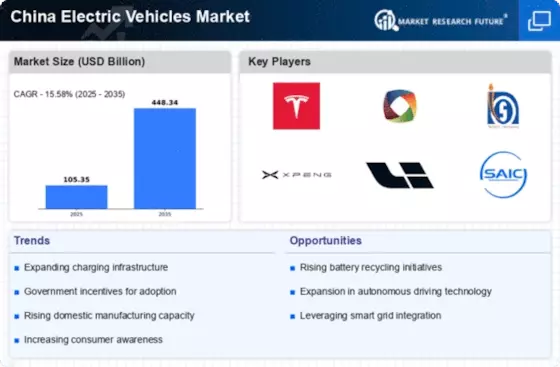
As per MRFR analysis, the China Electric Vehicle Market Size was estimated at 383.91 USD Billion in 2024. The China Electric Vehicle industry is projected to grow from 407.72 USD Billion in 2025 to 744.2 USD Billion by 2035, exhibiting a compound annual growth rate (CAGR) of 6.2 during the forecast period 2025 - 2035.

Key Market Trends & Highlights

The China Electric Vehicle Market is poised for robust growth driven by technological advancements and supportive government policies.

  • Technological advancements in battery efficiency and charging infrastructure are reshaping the market landscape.
  • Government policies in China are increasingly favoring electric vehicles, enhancing consumer adoption and market penetration.
  • Battery Electric Vehicles remain the largest segment, while Plug-in Hybrid Electric Vehicles are experiencing the fastest growth.
  • Infrastructure development and government incentives are key drivers propelling the expansion of the electric vehicle market.

Market Size & Forecast

2024 Market Size 383.91 (USD Billion)
2035 Market Size 744.2 (USD Billion)
CAGR (2025 - 2035) 6.2%

Major Players

Tesla (US), BYD (CN), SAIC Motor (CN), NIO (CN), Xpeng (CN), Geely (CN), Li Auto (CN), Changan Automobile (CN), Great Wall Motors (CN)

China Electric Vehicle Market Trends

The China Electric Vehicle Market is currently experiencing a transformative phase characterized by rapid advancements in technology and increasing consumer acceptance. The government has implemented various policies aimed at promoting electric vehicle adoption, which appears to be yielding positive results. Infrastructure development, particularly in charging stations, is expanding, thereby alleviating range anxiety among potential buyers. Furthermore, the market is witnessing a surge in domestic manufacturers, which seems to enhance competition and innovation. This competitive landscape may lead to improved vehicle offerings and potentially lower prices for consumers. In addition, environmental concerns are driving the demand for electric vehicles, as consumers become more aware of the ecological impact of traditional combustion engines. The shift towards sustainable transportation options is likely to continue, supported by both governmental initiatives and changing consumer preferences. As the market evolves, it is essential to monitor the interplay between technological advancements, regulatory frameworks, and consumer behavior, as these factors will shape the future trajectory of the China Electric Vehicle Market.

Technological Advancements

The China Electric Vehicle Market is witnessing rapid technological innovations, particularly in battery technology and autonomous driving features. These advancements are likely to enhance vehicle performance and safety, making electric vehicles more appealing to consumers.

Government Policies

Supportive government policies are playing a crucial role in the growth of the China Electric Vehicle Market. Incentives such as subsidies and tax breaks for electric vehicle purchases are encouraging consumers to transition from traditional vehicles.

Consumer Awareness

There is a growing awareness among consumers regarding the environmental benefits of electric vehicles. This shift in perception is likely to drive demand, as more individuals seek sustainable transportation solutions.

China Electric Vehicle Market Drivers

Urbanization Trends

Urbanization trends are significantly impacting the China Electric Vehicle Market. As more people migrate to urban areas, the demand for efficient and eco-friendly transportation solutions is increasing. Cities are facing challenges such as traffic congestion and air quality issues, prompting local governments to promote electric vehicles as a solution. In 2025, urban areas accounted for over 70% of electric vehicle sales in China, indicating a strong preference for electric mobility in densely populated regions. This trend is likely to continue, as urban planners increasingly incorporate electric vehicle infrastructure into city designs, further driving the growth of the China Electric Vehicle Market.

Government Incentives

Government incentives play a crucial role in shaping the China Electric Vehicle Market. Various subsidies and tax exemptions have been implemented to encourage the adoption of electric vehicles. For instance, consumers can receive substantial rebates on the purchase of electric vehicles, which can reduce the overall cost significantly. Additionally, local governments often provide incentives such as free parking and access to bus lanes for electric vehicle owners. These measures have resulted in a notable increase in electric vehicle sales, with over 6 million units sold in 2025 alone. Such financial incentives are likely to continue driving growth in the China Electric Vehicle Market.

Environmental Concerns

Growing environmental concerns are increasingly influencing consumer behavior in the China Electric Vehicle Market. As awareness of climate change and air pollution rises, more consumers are seeking sustainable transportation options. The Chinese government has set ambitious targets to reduce carbon emissions, aiming for peak emissions by 2030 and carbon neutrality by 2060. This commitment is likely to drive further investment in electric vehicle technology and infrastructure. Consequently, the demand for electric vehicles is expected to surge as consumers align their purchasing decisions with their environmental values, thereby propelling the growth of the China Electric Vehicle Market.

Technological Innovations

Technological innovations are transforming the landscape of the China Electric Vehicle Market. Advances in battery technology, such as solid-state batteries, are enhancing energy density and reducing charging times. As of October 2025, several manufacturers are introducing vehicles with ranges exceeding 800 kilometers on a single charge, which is a significant improvement. Moreover, the integration of artificial intelligence in electric vehicles is optimizing energy management and enhancing user experience. These innovations not only improve the performance of electric vehicles but also make them more appealing to consumers, thereby fostering growth in the China Electric Vehicle Market.

Infrastructure Development

The expansion of charging infrastructure is a pivotal driver for the China Electric Vehicle Market. As of October 2025, the number of public charging stations has surpassed 1.5 million, facilitating easier access for consumers. This extensive network not only alleviates range anxiety but also encourages potential buyers to consider electric vehicles as a viable option. Furthermore, the government has invested heavily in the development of fast-charging stations, which are crucial for long-distance travel. The presence of a robust charging infrastructure is likely to enhance consumer confidence and stimulate demand, thereby propelling the growth of the China Electric Vehicle Market.

Market Segment Insights

By Drivetrain Type: Battery Electric Vehicles (Largest) vs. Plug-in Hybrid Electric Vehicles (Fastest-Growing)

In the China Electric Vehicle Market, Battery Electric Vehicles (BEVs) represent the largest share of the drivetrain type segment, driven by increasing consumer demand for sustainable transportation solutions. The government's strong support in the form of subsidies and incentives significantly boosts the BEV segment, making it a preferred choice among urban consumers. On the other hand, Plug-in Hybrid Electric Vehicles (PHEVs), while currently occupying a smaller market share, are rapidly gaining traction due to their versatility and convenience. PHEVs appeal to consumers looking for an intermediate option between traditional vehicles and full electric vehicles, further widening the market dynamics.

Drivetrain Type: Battery Electric Vehicles (Dominant) vs. Plug-in Hybrid Electric Vehicles (Emerging)

Battery Electric Vehicles (BEVs) have firmly established themselves as the dominant force in the China Electric Vehicle Market, primarily due to advances in battery technology, extensive charging infrastructure, and favorable government policies. These vehicles operate solely on electric power, eliminating tailpipe emissions and enhancing energy efficiency, thereby attracting eco-conscious consumers. In contrast, Plug-in Hybrid Electric Vehicles (PHEVs) are emerging as a popular choice for consumers who appreciate the flexibility of having both electric and gasoline options. This segment is characterized by their ability to run on electric power in urban settings while maintaining a gasoline engine for longer journeys, making them appealing for a broader audience. As technology continues to improve, PHEVs are expected to see accelerated growth, capitalizing on the shift towards electrification in the automotive sector.

By Vehicle Type: Passenger Cars (Largest) vs. Commercial Vehicles (Fastest-Growing)

In the China Electric Vehicle Market, the passenger cars segment holds the largest market share, significantly outpacing alternative vehicle types. This sector benefits from rapid consumer acceptance and a shift toward eco-friendly transportation. The wide range of available models and competitive pricing strategies have contributed to passenger cars becoming the preferred choice among Chinese consumers, reflecting changing attitudes towards electric mobility. On the other hand, commercial vehicles, while smaller in share, are experiencing a remarkable growth trajectory. Factors such as urbanization, tightening emission regulations, and advancements in electric powertrain technology are driving businesses to transition from traditional fossil-fueled vehicles to electric options in this segment.

Passenger Cars (Dominant) vs. Commercial Vehicles (Emerging)

The passenger cars segment is the dominant force in the China Electric Vehicle Market, characterized by a diverse array of models catering to different consumer needs. This segment has seen significant advancements in battery technology, range capabilities, and compact designs, making electric cars more appealing. On the other hand, commercial vehicles represent an emerging segment in the electric landscape, driven by rising demand for sustainable logistics solutions. These vehicles are being increasingly adopted for urban deliveries, supported by government incentives and infrastructure development focused on electrification. Ultimately, while passenger cars maintain dominance, commercial electric vehicles are poised for significant growth as market dynamics shift.

Get more detailed insights about China Electric Vehicle Market

Regional Insights

North America : Innovation and Sustainability Focus

The North American electric vehicle market is witnessing significant growth, driven by increasing consumer demand for sustainable transportation and supportive government policies. The U.S. holds the largest market share at approximately 60%, followed by Canada at around 20%. Regulatory incentives, such as tax credits and emissions standards, are catalyzing this growth, encouraging manufacturers to invest in electric vehicle technology and infrastructure. Leading the charge in this market are key players like Tesla, which dominates with its innovative models and extensive charging network. Other notable companies include Ford and General Motors, which are ramping up their electric vehicle offerings. The competitive landscape is evolving, with traditional automakers and new entrants vying for market share, making North America a dynamic hub for electric vehicle development.

Europe : Regulatory-Driven Market Expansion

Europe is experiencing a rapid transformation in the electric vehicle market, primarily driven by stringent environmental regulations and ambitious climate goals. The European Union aims for at least 30 million electric vehicles on the road by 2030, with countries like Germany and France leading the charge, holding approximately 25% and 20% of the market share, respectively. This regulatory framework is fostering innovation and investment in EV infrastructure across the region. The competitive landscape is characterized by established automakers such as Volkswagen, BMW, and Renault, alongside emerging players like Rivian and Polestar. The presence of strong local manufacturers and a growing network of charging stations are enhancing consumer confidence in electric vehicles. As Europe pushes towards sustainability, the market is set for continued growth, with significant investments in battery technology and renewable energy integration.

Asia-Pacific : Emerging Powerhouse in EVs

The Asia-Pacific region is rapidly becoming a powerhouse in the electric vehicle market, with China leading the way as the largest market globally, holding approximately 50% of the total share. The growth is fueled by government initiatives promoting electric mobility, significant investments in charging infrastructure, and a growing consumer preference for eco-friendly vehicles. Countries like Japan and South Korea are also contributing to the market, with shares of around 15% and 10%, respectively. China's competitive landscape is dominated by local manufacturers such as BYD, NIO, and Xpeng, which are innovating rapidly to meet domestic and international demand. The presence of global players like Tesla further intensifies competition, driving advancements in technology and production efficiency. As the region continues to invest in electric vehicle technology, the Asia-Pacific market is poised for sustained growth and innovation.

Middle East and Africa : Emerging Market Potential

The Middle East and Africa region is on the cusp of an electric vehicle revolution, driven by increasing awareness of environmental issues and government initiatives aimed at reducing carbon emissions. While the market is still in its infancy, countries like South Africa and the UAE are leading the charge, with South Africa holding about 5% of the market share. The region's growth is supported by investments in renewable energy and infrastructure development, which are essential for EV adoption. The competitive landscape is evolving, with local manufacturers beginning to explore electric vehicle production. International players are also entering the market, attracted by the region's potential for growth. As governments implement policies to encourage electric vehicle use, the Middle East and Africa are set to become significant players in The China Electric Vehicle Market.

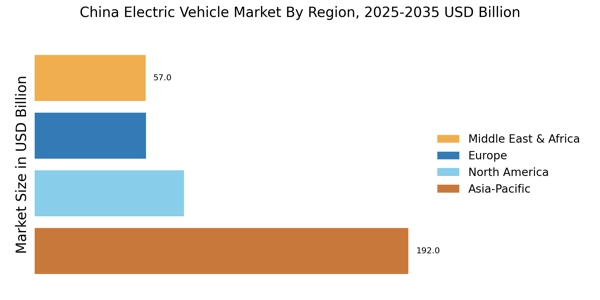
China Electric Vehicle Market Regional Image

Key Players and Competitive Insights

The China Electric Vehicle Market is currently characterized by intense competition and rapid growth, driven by a combination of government policies promoting green energy, technological advancements, and shifting consumer preferences towards sustainable transportation. Major players such as BYD (CN), Tesla (US), and NIO (CN) are at the forefront, each adopting distinct strategies that shape the competitive landscape. BYD (CN) focuses on vertical integration and battery technology, while Tesla (US) emphasizes innovation and brand loyalty. NIO (CN), on the other hand, is carving a niche with its premium electric vehicles and innovative battery-swapping technology, collectively contributing to a dynamic and evolving market environment.

Key business tactics employed by these companies include localizing manufacturing and optimizing supply chains to enhance efficiency and reduce costs. The market structure appears moderately fragmented, with numerous players vying for market share, yet dominated by a few key companies that exert considerable influence. This competitive structure fosters an environment where innovation and strategic partnerships are essential for maintaining a competitive edge.

In September 2025, BYD (CN) announced the opening of a new manufacturing facility in Chengdu, aimed at increasing production capacity to meet the surging demand for electric vehicles. This strategic move not only enhances BYD's operational capabilities but also positions the company to capitalize on the growing consumer interest in electric mobility, thereby reinforcing its market leadership.

In August 2025, Tesla (US) unveiled its latest model, the Model 2, which is designed to be more affordable and accessible to a broader audience. This launch signifies Tesla's commitment to expanding its market reach in China, where price sensitivity is a critical factor. By introducing a competitively priced model, Tesla aims to attract a new segment of consumers, potentially reshaping its market positioning in the region.

In July 2025, NIO (CN) entered into a strategic partnership with a leading battery manufacturer to enhance its battery technology and production capabilities. This collaboration is expected to bolster NIO's competitive advantage by improving the efficiency and performance of its electric vehicles, thereby appealing to tech-savvy consumers who prioritize cutting-edge technology in their purchasing decisions.

As of October 2025, the competitive trends in the China Electric Vehicle Market are increasingly defined by digitalization, sustainability, and the integration of artificial intelligence. Strategic alliances among key players are shaping the landscape, fostering innovation and enhancing supply chain reliability. Looking ahead, it is likely that competitive differentiation will evolve from traditional price-based competition to a focus on technological innovation and sustainable practices, as companies strive to meet the demands of an increasingly environmentally conscious consumer base.

Key Companies in the China Electric Vehicle Market market include

Industry Developments

October 2022: Toyota Motor Corporation introduced a compact electric sedan, set to be powered by batteries manufactured by BYD Co., with plans for production and distribution exclusively in China.

March 2021: Zhejiang Geely Holding Group, a major Chinese automaker and owner of Volvo, unveiled the introduction of its electric vehicle brand named Zeek. Zeek aims to enter the premium electric vehicle market segment in China, with a particular focus on competing with Tesla.

Future Outlook

China Electric Vehicle Market Future Outlook

The China Electric Vehicle Market is projected to grow at a 6.2% CAGR from 2024 to 2035, driven by technological advancements, government policies, and increasing consumer demand.

New opportunities lie in:

  • Expansion of battery recycling facilities to enhance sustainability.
  • Development of integrated charging networks for urban areas.
  • Investment in autonomous vehicle technology to capture emerging markets.

By 2035, the market is expected to solidify its leadership position globally.

Market Segmentation

China Electric Vehicle Market Vehicle Type Outlook

  • Passenger Cars
  • Commercial Vehicles

China Electric Vehicle Market Drivetrain Type Outlook

  • Battery Electric Vehicles
  • Plug-in Hybrid Electric Vehicles

Report Scope

MARKET SIZE 2024383.91(USD Billion)
MARKET SIZE 2025407.72(USD Billion)
MARKET SIZE 2035744.2(USD Billion)
COMPOUND ANNUAL GROWTH RATE (CAGR)6.2% (2024 - 2035)
REPORT COVERAGERevenue Forecast, Competitive Landscape, Growth Factors, and Trends
BASE YEAR2024
Market Forecast Period2025 - 2035
Historical Data2019 - 2024
Market Forecast UnitsUSD Billion
Key Companies ProfiledMarket analysis in progress
Segments CoveredMarket segmentation analysis in progress
Key Market OpportunitiesExpansion of charging infrastructure to support rapid electric vehicle adoption in urban areas.
Key Market DynamicsIntensifying competition among domestic and international manufacturers drives innovation and consumer adoption in the China Electric Vehicle Market.
Countries CoveredNorth America, Europe, APAC, South America, MEA

Leave a Comment

FAQs

What is the current valuation of the China Electric Vehicle Market?

As of 2024, the market valuation was 383.91 USD Billion.

What is the projected market size for the China Electric Vehicle Market by 2035?

The market is projected to reach 744.2 USD Billion by 2035.

What is the expected CAGR for the China Electric Vehicle Market from 2025 to 2035?

The expected CAGR during the forecast period 2025 - 2035 is 6.2%.

Which companies are the key players in the China Electric Vehicle Market?

Key players include Tesla, BYD, SAIC Motor, NIO, Xpeng, Geely, Li Auto, Changan Automobile, and Great Wall Motors.

What are the main segments of the China Electric Vehicle Market?

The main segments include Battery Electric Vehicles and Plug-in Hybrid Electric Vehicles.

Download Free Sample

Kindly complete the form below to receive a free sample of this Report

Compare Licence

×
Features License Type
Single User Multiuser License Enterprise User
Price $4,950 $5,950 $7,250
Maximum User Access Limit 1 User Upto 10 Users Unrestricted Access Throughout the Organization
Free Customization
Direct Access to Analyst
Deliverable Format
Platform Access
Discount on Next Purchase 10% 15% 15%
Printable Versions