×
Request Free Sample ×

Kindly complete the form below to receive a free sample of this Report

* Please use a valid business email

Leading companies partner with us for data-driven Insights

clients tt-cursor
Hero Background

China Edge AI Software Market

ID: MRFR/ICT/62416-HCR
200 Pages
Aarti Dhapte
February 2026

China Edge AI Software Market Research Report By Data Source (Video and Image Recognition, Speech Recognition, Biometric Data, Sensor Data, Mobile Data), By Component (Solution, Services) and By Application (Autonomous Vehicle, Access Management, Video Surveillance, Remote Monitoring & Predictive Maintenance, Telemetry, Energy Management, Others)- Forecast to 2035

Share:
Download PDF ×

We do not share your information with anyone. However, we may send you emails based on your report interest from time to time. You may contact us at any time to opt-out.

China Edge AI Software Market Infographic
Purchase Options

China Edge AI Software Market Summary

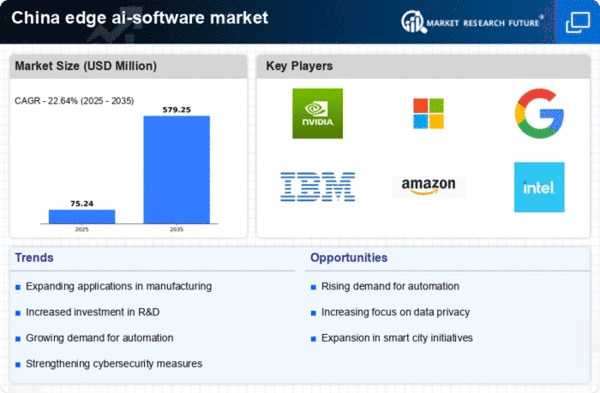
As per Market Research Future analysis, the China Edge AI Software Market size was estimated at 61.35 USD Million in 2024. The Edge Ai-software market is projected to grow from 75.24 USD Million in 2025 to 579.25 USD Million by 2035, exhibiting a compound annual growth rate (CAGR) of 22.6% during the forecast period 2025 - 2035

Key Market Trends & Highlights

The China edge AI-software market is experiencing robust growth driven by technological advancements and increasing sector adoption.

  • The market is witnessing increased adoption across various sectors, including manufacturing and healthcare.
  • Data security and privacy concerns are becoming paramount as organizations implement edge AI solutions.
  • Government support and regulation are fostering a conducive environment for market expansion.
  • Rising demand for real-time data processing and integration with IoT devices are key drivers propelling market growth.

Market Size & Forecast

2024 Market Size 61.35 (USD Million)
2035 Market Size 579.25 (USD Million)
CAGR (2025 - 2035) 22.64%

Major Players

NVIDIA (US), Microsoft (US), Google (US), IBM (US), Amazon (US), Intel (US), Qualcomm (US), Siemens (DE), Edge Impulse (US)

Our Impact
Enabled $4.3B Revenue Impact for Fortune 500 and Leading Multinationals
Partnering with 2000+ Global Organizations Each Year
30K+ Citations by Top-Tier Firms in the Industry

China Edge AI Software Market Trends

The China Edge AI Software Market is currently experiencing a transformative phase, driven by advancements in artificial intelligence and the increasing demand for real-time data processing. This market is characterized by the integration of AI capabilities into edge devices, enabling faster decision-making and improved operational efficiency. As industries such as manufacturing, healthcare, and transportation adopt these technologies, the need for robust edge ai-software solutions becomes more pronounced. The focus on reducing latency and enhancing data security is reshaping the landscape, as organizations seek to leverage AI at the edge to optimize their processes and gain a competitive edge. Moreover, the regulatory environment in China is evolving to support the growth of the edge ai-software market. Government initiatives aimed at fostering innovation and technological advancement are likely to encourage investment in this sector. The emphasis on smart cities and the Internet of Things (IoT) further propels the demand for edge ai-software, as these technologies require efficient data handling and processing capabilities. As the market matures, collaboration between technology providers and end-users is expected to increase, leading to the development of tailored solutions that address specific industry needs. This dynamic environment suggests a promising future for the edge ai-software market, with potential for significant growth and innovation.

Increased Adoption in Various Sectors

The edge ai-software market is witnessing heightened adoption across multiple sectors, including manufacturing, healthcare, and transportation. Organizations are increasingly recognizing the benefits of deploying AI at the edge to enhance operational efficiency and improve decision-making processes. This trend indicates a shift towards more intelligent systems that can process data locally, reducing reliance on centralized cloud solutions.

Focus on Data Security and Privacy

As the edge ai-software market expands, there is a growing emphasis on data security and privacy. Companies are prioritizing the implementation of robust security measures to protect sensitive information processed at the edge. This trend reflects a broader awareness of the potential risks associated with data breaches and the need for compliance with regulatory standards.

Government Support and Regulation

The regulatory landscape is evolving to support the edge ai-software market, with government initiatives aimed at promoting technological innovation. Policies encouraging research and development in AI technologies are likely to stimulate growth in this sector. This support may lead to increased investment and collaboration between public and private entities, fostering a conducive environment for market expansion.

China Edge AI Software Market Drivers

Focus on Energy Efficiency

Energy efficiency is emerging as a critical driver for the edge ai-software market in China. As organizations strive to reduce operational costs and minimize their carbon footprint, the demand for energy-efficient AI solutions is on the rise. Edge AI software can optimize energy consumption by processing data locally, which reduces the need for energy-intensive data transmission to cloud servers. This is particularly relevant in sectors such as manufacturing and logistics, where energy costs can significantly impact profitability. Recent studies suggest that implementing edge AI solutions can lead to energy savings of up to 30% in certain applications. Consequently, the edge ai-software market is likely to see increased investment as companies prioritize sustainability alongside technological advancement.

Integration with IoT Devices

The integration of edge ai-software with Internet of Things (IoT) devices is significantly influencing the market landscape in China. As IoT adoption accelerates, the need for intelligent edge computing solutions becomes increasingly apparent. Edge AI enables devices to process data locally, which is essential for applications requiring low latency and high reliability. For instance, smart cities and autonomous vehicles are leveraging edge AI to enhance their operational capabilities. The edge ai-software market is expected to benefit from this trend, with projections indicating that the number of connected IoT devices in China could reach over 1 billion by 2026. This proliferation of IoT devices necessitates robust edge AI solutions to manage and analyze the vast amounts of data generated, thereby driving market growth and innovation.

Advancements in AI Algorithms

The continuous advancements in AI algorithms are playing a pivotal role in shaping the edge ai-software market in China. Innovations in machine learning and deep learning techniques are enabling more sophisticated data analysis at the edge, allowing for improved accuracy and efficiency in various applications. These advancements are particularly beneficial in sectors such as healthcare, where real-time data analysis can lead to better patient outcomes. Furthermore, the edge ai-software market is witnessing a shift towards more adaptive and self-learning algorithms, which can enhance the performance of edge devices. As these technologies evolve, they are expected to drive further adoption of edge AI solutions across multiple industries, thereby fostering a competitive landscape that encourages ongoing research and development.

Rising Demand for Real-Time Data Processing

The edge ai-software market in China is experiencing a notable surge in demand for real-time data processing capabilities. Industries such as manufacturing, healthcare, and transportation are increasingly relying on edge AI solutions to analyze data at the source, thereby reducing latency and enhancing operational efficiency. This trend is driven by the need for immediate insights to support decision-making processes. According to recent estimates, the market for edge AI solutions in China is projected to grow at a CAGR of approximately 25% over the next five years. This growth is indicative of a broader shift towards decentralized computing, where data is processed closer to its origin, minimizing the need for extensive data transmission to centralized cloud servers. As a result, the edge ai-software market is poised to play a crucial role in the digital transformation of various sectors across the country.

Increased Investment in Smart Infrastructure

Investment in smart infrastructure is significantly impacting the edge ai-software market in China. The government and private sector are increasingly allocating resources towards developing smart cities, transportation systems, and energy grids that leverage edge AI technologies. This trend is driven by the need for enhanced efficiency, safety, and sustainability in urban environments. For instance, smart traffic management systems utilize edge AI to optimize traffic flow and reduce congestion. According to recent reports, investments in smart infrastructure are projected to exceed $500 billion by 2030 in China. This influx of capital is likely to accelerate the deployment of edge AI solutions, thereby expanding the market and creating new opportunities for innovation and collaboration.


Market Segment Insights

By Data Source: Video and Image Recognition (Largest) vs. Speech Recognition (Fastest-Growing)

Within the data source segment of the market, Video and Image Recognition holds the largest share, dominating the landscape due to its extensive applications in security, retail, and healthcare. Following closely, Speech Recognition showcases significant growth, driven by increasing demand for voice-activated technologies and AI personal assistants, capturing market attention and investment. Over the next few years, Biometric Data, Sensor Data, and Mobile Data also continue to expand, contributing substantially to the movement of AI applications in various sectors. The growth trajectory for these data sources is primarily influenced by advancements in machine learning algorithms, increased computational power, and the proliferation of IoT devices. With more industries adopting AI solutions for enhanced operational efficiency, the demand for Video and Image Recognition technology is expected to remain robust. Conversely, Speech Recognition is emerging rapidly, capturing the interest of tech companies aiming to improve user interface experiences, which is likely to facilitate its fast expansion in the market.

Video and Image Recognition (Dominant) vs. Speech Recognition (Emerging)

Video and Image Recognition is the dominant force in the data source segment, owing to its versatile applications across various industries including retail analytics, surveillance, and medical imaging. Its ability to analyze visual data with precision allows organizations to derive actionable insights, making it indispensable in decision-making processes. On the other hand, Speech Recognition is rapidly emerging as a crucial data source, driven by the increased smartphone usage and developments in natural language processing. This segment benefits from the rise in smart home devices and virtual assistants, which are revolutionizing user interactions with technology. While Video and Image Recognition continues to lead, Speech Recognition's growth potential is notable, indicating a shifting landscape towards more intuitive and accessible AI applications.

By Component: Solutions (Largest) vs. Services (Fastest-Growing)

In the China edge ai-software market, Solutions hold the largest market share among component segment values, driven by the increasing adoption of AI technologies across various industries. This segment encompasses a variety of applications and tools that enhance operational efficiencies and data analytics capabilities. In contrast, Services are rapidly gaining traction, reflecting a shift towards managed services and support for AI implementations. The growing dependency on AI solutions is encouraging organizations to seek comprehensive service offerings, boosting their market presence. The growth trajectory for the component segment is significantly influenced by technological advancements and the rising demand for smart automation. Solutions are evolving with enhanced features, attracting larger enterprises to invest heavily in their deployment. Conversely, the Services segment is experiencing the fastest growth, propelled by a surge in cloud-based solutions, customized service offerings, and the necessity for continuous support and training in AI methodologies. This dynamic indicates a transformative phase for both Solutions and Services in the market.

Solutions (Dominant) vs. Services (Emerging)

Solutions in the China edge ai-software market represent the dominant component value, primarily featuring sophisticated software packages designed for a range of AI applications. These solutions are tailored to meet the complex demands of industries such as manufacturing, healthcare, and finance, implementing AI for predictive analytics, operational efficiency, and decision-making support. Meanwhile, Services are emerging as a critical value in this market, focusing on providing consulting, integration, and maintenance services that assist organizations in realizing the full potential of AI technologies. This component delivers essential support, ensuring that enterprises can effectively leverage Solutions, thereby enhancing their operational capabilities and generating a robust ecosystem for AI integration.

By Application: Video Surveillance (Largest) vs. Autonomous Vehicles (Fastest-Growing)

In the China edge ai-software market, Video Surveillance holds the largest share among the application segments, reflecting its critical role in security and monitoring across various sectors. This segment leverages AI to enhance surveillance accuracy, making it a pivotal area of investment for organizations aiming to improve safety and operational efficiency. Conversely, Autonomous Vehicles, while currently smaller in market share, are rapidly gaining traction due to advancements in AI technology and increasing investments from tech giants and automotive manufacturers. The rising demand for smart transport solutions significantly contributes to its growth. Growth trends in the China edge ai-software market are fueled by the escalating need for enhanced security solutions and the rapid adoption of AI technologies across industries. Video Surveillance continues to evolve with features like real-time analytics and facial recognition, driving its dominance. On the other hand, Autonomous Vehicles are positioned for explosive growth as infrastructure developments and supportive government policies catalyze their integration into urban mobility. Emerging applications, such as energy management and telemetry, are also expanding their footprints, indicating a diversifying landscape for AI-driven applications.

Video Surveillance (Dominant) vs. Autonomous Vehicles (Emerging)

Video Surveillance remains the dominant application in the China edge ai-software market, characterized by its extensive deployment across retail, public safety, and other sectors. Its robustness in managing large-scale security operations is enhanced by AI capabilities such as facial recognition and behavior analysis. These features not only ensure safety but also streamline operations. In contrast, Autonomous Vehicles are an emerging segment, propelled by technological advancements and growing consumer interest in smart mobility solutions. This application is marked by innovation, with companies investing heavily in R&D to bring autonomous driving technologies to fruition. The intersection of AI and automotive technologies signifies a crucial phase for this segment, presenting both challenges and vast opportunities for growth.

Get more detailed insights about China Edge AI Software Market

Key Players and Competitive Insights

The edge ai-software market in China is characterized by a rapidly evolving competitive landscape, driven by technological advancements and increasing demand for intelligent solutions across various sectors. Major players such as NVIDIA (US), Microsoft (US), and IBM (US) are strategically positioned to leverage their extensive research and development capabilities, focusing on innovation and partnerships to enhance their market presence. These companies are not only investing in cutting-edge technologies but are also forming alliances with local firms to better navigate the unique challenges of the Chinese market, thereby shaping a competitive environment that emphasizes collaboration and technological integration.Key business tactics employed by these companies include localizing manufacturing and optimizing supply chains to reduce operational costs and improve service delivery. The market structure appears moderately fragmented, with a mix of established giants and emerging players vying for market share. This fragmentation allows for a diverse range of solutions, catering to various customer needs while fostering a competitive atmosphere that encourages innovation and rapid adaptation to market changes.

In October NVIDIA (US) announced a strategic partnership with a leading Chinese telecommunications company to develop edge AI solutions tailored for smart city applications. This collaboration is expected to enhance NVIDIA's footprint in the region, allowing it to leverage local expertise and infrastructure to deliver customized solutions that meet the specific needs of urban environments. The strategic importance of this partnership lies in its potential to accelerate the deployment of AI technologies in urban planning and management, positioning NVIDIA as a key player in the smart city initiative.

In September Microsoft (US) launched a new edge AI platform designed to facilitate real-time data processing for industrial applications. This platform aims to empower manufacturers in China to harness AI capabilities for predictive maintenance and operational efficiency. The introduction of this platform signifies Microsoft's commitment to enhancing its technological offerings in the region, potentially leading to increased market penetration and customer loyalty among industrial clients.

In August IBM (US) expanded its edge AI capabilities by acquiring a local startup specializing in machine learning algorithms. This acquisition is likely to bolster IBM's existing portfolio, enabling it to offer more sophisticated AI-driven solutions to its clients in China. The strategic move underscores IBM's focus on enhancing its technological capabilities and adapting to the local market's demands, which may result in a stronger competitive position in the edge AI landscape.

As of November current trends in the edge AI-software market include a pronounced shift towards digitalization, sustainability, and the integration of AI across various sectors. Strategic alliances are increasingly shaping the competitive landscape, as companies recognize the value of collaboration in driving innovation and expanding their reach. Looking ahead, competitive differentiation is expected to evolve, with a greater emphasis on innovation, technology, and supply chain reliability, rather than solely on price. This shift indicates a maturation of the market, where companies that prioritize technological advancements and strategic partnerships are likely to thrive.

Key Companies in the China Edge AI Software Market include

Industry Developments

Recent developments in the China Edge AI Software Market reflect substantial growth and innovation among key players. Companies such as Alibaba, and ByteDance are investing heavily in Edge AI capabilities to enhance real-time data processing and improve user experiences. 

iFlytek and Huawei expanded their collaboration on intelligent recognition software, further propelling advancements in voice recognition technologies.Furthermore, in August 2023, CloudWalk Technology announced its acquisition of a small AI startup, enhancing its portfolio in smart city solutions. Insititutions like the Ministry of Industry and Information Technology in China have highlighted the need for increased integration of AI in various sectors, paving the way for greater investment and development. 

Over the past two years, companies like Megvii and SenseTime have reported significant revenue increases, attributed to the rising demand for AI-driven solutions amid rapid urbanization. The government's supportive policies are driving competition among these firms, reinforcing China's ambition to lead in AI technology on a global scale.

Future Outlook

China Edge AI Software Market Future Outlook

The Edge AI Software Market in China is projected to grow at a 22.64% CAGR from 2025 to 2035, driven by advancements in IoT, data analytics, and machine learning.

New opportunities lie in:

  • Development of AI-driven predictive maintenance solutions for manufacturing sectors.
  • Integration of edge AI in smart city infrastructure for real-time data processing.
  • Creation of customized AI software for agriculture to enhance crop yield and resource management.

By 2035, the edge AI-software market is expected to achieve substantial growth and innovation.

Market Segmentation

China Edge AI Software Market Component Outlook

  • Solutions
  • Services

China Edge AI Software Market Application Outlook

  • Autonomous Vehicles
  • Access Management
  • Video Surveillance
  • Telemetry
  • Energy Management
  • Others

China Edge AI Software Market Data Source Outlook

  • Video and Image Recognition
  • Speech Recognition
  • Biometric Data
  • Sensor Data
  • Mobile Data

Report Scope

MARKET SIZE 2024 61.35(USD Million)
MARKET SIZE 2025 75.24(USD Million)
MARKET SIZE 2035 579.25(USD Million)
COMPOUND ANNUAL GROWTH RATE (CAGR) 22.64% (2025 - 2035)
REPORT COVERAGE Revenue Forecast, Competitive Landscape, Growth Factors, and Trends
BASE YEAR 2024
Market Forecast Period 2025 - 2035
Historical Data 2019 - 2024
Market Forecast Units USD Million
Key Companies Profiled NVIDIA (US), Microsoft (US), Google (US), IBM (US), Amazon (US), Intel (US), Qualcomm (US), Siemens (DE), Edge Impulse (US)
Segments Covered Data Source, Component, Application
Key Market Opportunities Integration of advanced machine learning algorithms enhances real-time data processing in the edge ai-software market.
Key Market Dynamics Rapid advancements in edge AI software drive competitive differentiation and regulatory adaptation in the technology sector.
Countries Covered China
Leave a Comment

FAQs

What is the expected market size of the China Edge AI Software Market in 2024?

The China Edge AI Software Market is expected to be valued at 71.05 million USD in the year 2024.

What will the market value of the China Edge AI Software Market be in 2035?

By the year 2035, the China Edge AI Software Market is projected to reach a value of 871.39 million USD.

What is the expected compound annual growth rate (CAGR) for the China Edge AI Software Market from 2025 to 2035?

The market is expected to experience a CAGR of 25.594% from 2025 to 2035.

What are the top applications contributing to the China Edge AI Software Market?

The key applications include Video and Image Recognition, Speech Recognition, Biometric Data, Sensor Data, and Mobile Data.

Which data source category has the highest projected market value in 2035?

The Sensor Data category is expected to have the highest projected market value at 220.0 million USD in 2035.

Which companies are considered major players in the China Edge AI Software Market?

Major players in the market include ZTE, iFlytek, CloudWalk Technology, SenseTime, DJI, Huawei, and others.

What is the expected market size for the Speech Recognition application in 2024?

The Speech Recognition application is anticipated to be valued at 15.0 million USD in the year 2024.

What growth opportunities exist within the China Edge AI Software Market?

Emerging trends and advancements in AI technology present significant growth opportunities within the market.

What challenges might impact the growth of the China Edge AI Software Market?

Challenges may arise from regulatory hurdles and competition among existing and emerging technology players.

How significant is the market size for Mobile Data in 2035?

The Mobile Data segment is projected to attain a market size of 195.39 million USD by the year 2035.

Download Free Sample

Kindly complete the form below to receive a free sample of this Report

Compare Licence

×
Features License Type
Single User Multiuser License Enterprise User
Price $4,950 $5,950 $7,250
Maximum User Access Limit 1 User Upto 10 Users Unrestricted Access Throughout the Organization
Free Customization
Direct Access to Analyst
Deliverable Format
Platform Access
Discount on Next Purchase 10% 15% 15%
Printable Versions