×
Request Free Sample ×

Kindly complete the form below to receive a free sample of this Report

* Please use a valid business email

Leading companies partner with us for data-driven Insights

clients tt-cursor
Hero Background

China Digital Trust Market

ID: MRFR/ICT/58266-HCR
200 Pages
Aarti Dhapte
February 2026

China Digital Trust Market Size, Share and Research Report: By End User (Finance, Banking, Healthcare, Government, Others), By Solution Type (Data Verification, Authentication, ID Authentication, Fraud Prevention, Compliance, Others), By Deployment Modal (On-Premises, Cloud-Based, Hybrid), By Organization Size (Large Enterprise, Small Business, Others) and By Digital Identity Type (Centralized Identity, Decentralized Identity, Federated Identity)- Industry Forecast to 2035

Share:
Download PDF ×

We do not share your information with anyone. However, we may send you emails based on your report interest from time to time. You may contact us at any time to opt-out.

China Digital Trust Market Infographic
Purchase Options

China Digital Trust Market Summary

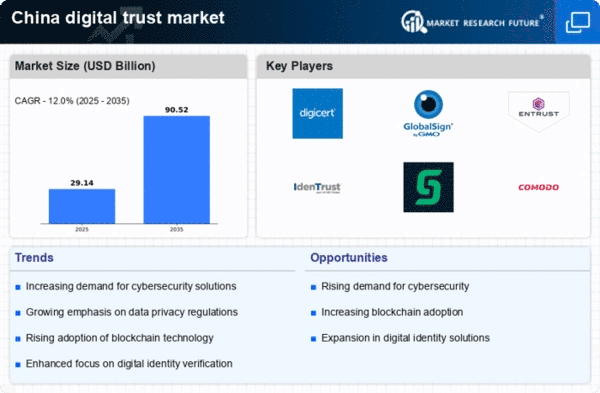
As per Market Research Future analysis, the China digital trust market Size was estimated at 26.02 USD Billion in 2024. The China digital trust market is projected to grow from 29.14 USD Billion in 2025 to 90.52 USD Billion by 2035, exhibiting a compound annual growth rate (CAGR) of 12% during the forecast period 2025 - 2035

Key Market Trends & Highlights

The China digital trust market is experiencing robust growth driven by increasing demand for data privacy and advanced security solutions.

  • The largest segment in the China digital trust market is data privacy solutions, reflecting a growing consumer focus on personal information protection.
  • Integration of advanced technologies, such as AI and blockchain, is transforming the landscape of digital trust solutions.
  • The fastest-growing segment is cybersecurity services, driven by the rising frequency of cyber threats and data breaches.
  • Key market drivers include growing cybersecurity concerns and evolving consumer expectations, which are shaping the demand for comprehensive digital trust solutions.

Market Size & Forecast

2024 Market Size 26.02 (USD Billion)
2035 Market Size 90.52 (USD Billion)
CAGR (2025 - 2035) 12.0%

Major Players

DigiCert (US), GlobalSign (BE), Entrust (US), IdenTrust (US), Sectigo (US), Comodo (US), Thales (FR), Symantec (US), Trustwave (US)

Our Impact
Enabled $4.3B Revenue Impact for Fortune 500 and Leading Multinationals
Partnering with 2000+ Global Organizations Each Year
30K+ Citations by Top-Tier Firms in the Industry

China Digital Trust Market Trends

The digital trust market is experiencing notable growth, driven by increasing concerns over data privacy and security. As organizations and individuals become more aware of the risks associated with digital transactions, the demand for reliable solutions is on the rise. This market encompasses various services, including identity verification, data protection, and secure communication. The evolving regulatory landscape further emphasizes the need for compliance, prompting businesses to invest in technologies that enhance trustworthiness. Consequently, the digital trust market is poised for expansion as stakeholders seek to establish secure environments for their operations. In addition, technological advancements are reshaping the digital trust market. Innovations such as blockchain and artificial intelligence are being integrated into trust solutions, enhancing their effectiveness and reliability. These technologies offer new ways to authenticate identities and secure transactions, which may lead to increased consumer confidence. As the digital landscape continues to evolve, the digital trust market is likely to adapt, ensuring that it meets the changing needs of users and businesses alike. The interplay between technology and trust will be crucial in shaping the future of this market.

Rising Demand for Data Privacy Solutions

There is a growing emphasis on data privacy, prompting organizations to seek advanced solutions that protect sensitive information. This trend reflects a broader societal shift towards valuing personal data security, influencing how businesses operate and engage with customers.

Integration of Advanced Technologies

The incorporation of technologies such as blockchain and artificial intelligence is transforming the digital trust market. These innovations enhance the security and efficiency of trust solutions, potentially leading to greater user adoption and confidence in digital transactions.

Regulatory Compliance as a Market Driver

The evolving regulatory environment is compelling businesses to prioritize compliance with data protection laws. This trend is driving investments in digital trust solutions, as organizations strive to meet legal requirements while maintaining customer trust.

China Digital Trust Market Drivers

Evolving Consumer Expectations

In China, consumer expectations regarding data protection and privacy are evolving rapidly. With a growing awareness of personal data rights, individuals are increasingly demanding transparency and accountability from businesses. This shift in consumer behavior is influencing the digital trust market, as companies strive to meet these expectations. A survey indicated that over 70% of Chinese consumers are concerned about how their data is used, which compels organizations to adopt digital trust solutions that enhance privacy and security. Consequently, the digital trust market is likely to expand as businesses prioritize consumer trust and invest in technologies that ensure data integrity and confidentiality.

Growing Cybersecurity Concerns

The digital trust market in China is experiencing a notable surge due to escalating cybersecurity threats. As businesses and consumers increasingly rely on digital platforms, the risk of data breaches and cyberattacks has intensified. Reports indicate that cybercrime costs could reach $10 trillion annually by 2025, prompting organizations to invest heavily in cybersecurity measures. This trend is likely to drive demand for digital trust solutions, as companies seek to protect sensitive information and maintain customer confidence. The digital trust market is thus positioned to benefit from heightened awareness and the necessity for robust security frameworks, which are essential for safeguarding digital assets.

Government Initiatives and Support

The Chinese government is actively promoting digital trust through various initiatives aimed at enhancing cybersecurity and data protection. Policies such as the Cybersecurity Law and the Personal Information Protection Law are designed to establish a regulatory framework that fosters trust in digital transactions. These regulations are expected to drive growth in the digital trust market, as compliance becomes a necessity for businesses operating in the digital landscape. The digital trust market is thus likely to see increased investment in compliance solutions, as organizations seek to align with government mandates and build consumer confidence in their digital operations.

Rise of E-commerce and Digital Transactions

The rapid growth of e-commerce in China is significantly impacting the digital trust market. As online shopping becomes increasingly prevalent, the need for secure payment systems and data protection measures is paramount. In 2025, e-commerce sales in China are projected to exceed $2 trillion, highlighting the critical importance of trust in digital transactions. This surge in online activity is likely to drive demand for digital trust solutions that ensure secure transactions and protect consumer data. The digital trust market is thus positioned to capitalize on this trend, as businesses seek to implement robust security measures to foster consumer confidence in their e-commerce platforms.

Technological Advancements in Security Solutions

Technological advancements are playing a pivotal role in shaping the digital trust market in China. Innovations such as artificial intelligence, blockchain, and advanced encryption techniques are enhancing the security landscape. These technologies offer new ways to protect data and ensure secure transactions, which is crucial in a rapidly digitizing economy. As organizations increasingly adopt these advanced security solutions, the digital trust market is likely to experience substantial growth. The integration of cutting-edge technologies not only improves security but also builds consumer trust, which is essential for the long-term success of digital platforms in China.


Market Segment Insights

By End User Industry: Finance and Banking (Largest) vs. Healthcare (Fastest-Growing)

The China digital trust market exhibits robust differentiation in its end user industry segments, with Finance and Banking holding a significant share. This dominance is attributed to the sector's critical reliance on secure digital transactions and data handling. Healthcare, while currently smaller, demonstrates an increasing footprint and is rapidly growing as institutions prioritize patient data confidentiality and secure digital communication. In recent years, the healthcare sector has emerged as the fastest-growing segment in the China digital trust market, driven by enhanced regulatory requirements and a shift towards digital health solutions. The rising need for secure electronic health records and telemedicine platforms has stimulated investments in digital trust services. The Finance and Banking sector, though stable, is also adapting to technological changes, pushing for innovative digital trust solutions to meet evolving customer demands.

Finance and Banking: Dominant vs. Healthcare: Emerging

The Finance and Banking sector is characterized by its extensive utilization of digital trust frameworks, ensuring secure transactions, identity verification, and fraud prevention. This segment remains a dominant force due to its established infrastructure, significant investment in security technologies, and regulatory frameworks that necessitate high security levels. In contrast, the Healthcare sector, while currently emerging, is rapidly adapting to the necessity for stringent digital trust solutions as the industry embraces digital transformation. This segment is witnessing increased investments as providers seek to protect sensitive patient information and comply with governmental regulations. Innovations such as blockchain for health records and secure messaging systems are gaining traction, solidifying Healthcare's position as a vital component in the overall China digital trust market.

By Solution Type: Data Verification (Largest) vs. Authentication (Fastest-Growing)

In the China digital trust market, Data Verification holds the largest market share, reflecting the substantial demand for reliable identification and verification methods among businesses. This segment is pivotal for enhancing consumer confidence and mitigating risks associated with digital transactions. Authentication, while having a smaller share currently, is experiencing rapid growth as organizations increasingly prioritize secure access mechanisms to protect sensitive information in the digital landscape. The growth trends in the segment reveal a shift towards more advanced solutions driven by the rising incidents of fraud and data breaches. Fraud Prevention continues to be a vital aspect as businesses seek to secure their operations against cyber threats. Compliance regulations are also creating new opportunities for innovation, prompting the emergence of robust solutions tailored to adhere to legal frameworks and enhance overall security in the digital trust ecosystem.

Data Verification: Dominant vs. Authentication: Emerging

Data Verification as a dominant solution type focuses on validating the authenticity of data and identities, playing a crucial role in regulatory compliance and risk management. This segment is characterized by its widely adopted technologies that ensure accuracy and minimize human error in data handling. Meanwhile, Authentication is an emerging solution that emphasizes securing access to digital platforms through various methods like biometrics and multi-factor authentication. The increasing reliance on digital platforms necessitates robust authentication mechanisms, making this segment a key growth area as businesses look to enhance security and build trust among users.

By Deployment Model: Cloud-Based (Largest) vs. On-Premises (Fastest-Growing)

In the deployment model segment of the China digital trust market, the distribution of market share reveals that the cloud-based deployment is currently the largest player, leading the market due to its scalability and flexibility offered to businesses. Conversely, the on-premises model, while smaller in market share, is experiencing rapid growth as organizations seek to maintain control over their data and comply with local regulations, thus creating a diverse deployment landscape. Growth trends suggest a pivotal shift towards hybrid models, as enterprises blend cloud and on-premises solutions to leverage advantages from both approaches. The increasing emphasis on cybersecurity and data sovereignty regulations bolsters the on-premises model's appeal. Additionally, improvements in cloud technologies and services catalyze further adoption in the cloud-based sector, positioning it favorably for continued market expansion in the future.

Cloud-Based (Dominant) vs. On-Premises (Emerging)

The cloud-based deployment model has established itself as the dominant force in the digital trust landscape, characterized by its broad adoption among enterprises seeking efficient and cost-effective solutions. Businesses benefit from reduced operational costs, quick scalability, and enhanced collaboration. This model supports ongoing digital transformation initiatives, allowing firms to innovate continuously. On the other hand, the on-premises model is regarded as an emerging choice among organizations prioritizing data security and compliance. Although it lags in market share, it is gaining traction due to its ability to provide greater data control and fulfill regulatory requirements that demand localized data handling. As such, both models cater to distinct needs within the evolving digital trust ecosystem.

By Organization Size: Large Enterprise (Largest) vs. Midmarket (Fastest-Growing)

In the China digital trust market, the organization size segment reveals distinctive dynamics between the various categories. Large Enterprises hold a substantial portion of market share, driven by their extensive resources and commitment to robust digital security measures. Midmarket companies are catching up, increasingly adopting advanced digital trust solutions, illustrating a significant shift in market dynamics as they contribute a growing percentage to the overall landscape. Examining growth trends, the Midmarket segment is emerging as the fastest-growing category. Growing digital transformation initiatives and heightened awareness of cybersecurity threats are key factors propelling this segment forward. Meanwhile, Large Enterprises continue to invest heavily in comprehensive digital trust strategies, aimed at ensuring compliance and fostering customer confidence, thus contributing to a balanced yet competitive environment within the market.

Large Enterprise: Dominant vs. Midmarket: Emerging

Large Enterprises are characterized by their considerable resources and established infrastructure, allowing them to implement sophisticated digital trust measures effectively. They often benefit from economies of scale and enjoy a dominant position in the market due to their ability to invest substantially in cutting-edge technologies and compliance frameworks. On the other hand, the Midmarket segment represents an emerging force, characterized by agility and adaptability. These organizations are increasingly recognizing the importance of digital trust and are swiftly adopting innovative solutions, often seeking tailored approaches to fit their specific needs. This shifting trend illustrates their growing relevance within the market landscape, as they strive to protect their operations and enhance customer trust.

By Digital Identity Type: Centralized Identity (Largest) vs. Decentralized Identity (Fastest-Growing)

In the China digital trust market, the distribution of market share among digital identity types shows Centralized Identity as the largest segment, dominating with significant adoption among organizations prioritizing control and security. The segment benefits from established infrastructures and trusted systems, attracting many businesses and institutions. In contrast, Decentralized Identity is emerging rapidly, capturing attention due to its promise of enhanced privacy and user control, appealing particularly to tech-savvy consumers and innovative organizations seeking flexibility in identity management. The growth trends within these segments are driven by technological advancements and increasing awareness of digital security. Centralized Identity's established presence continues to attract businesses invested in security, while Decentralized Identity grows as consumers demand more autonomy over their personal information. The increasing incidences of data breaches are pushing organizations to explore innovative identity solutions, further propelling the growth of decentralized models, indicating a shift towards broader adoption in digital identity management.

Centralized Identity (Dominant) vs. Decentralized Identity (Emerging)

Centralized Identity has established itself as the dominant force in the digital trust landscape, primarily due to its structured framework which enables organizations to maintain control over user data while ensuring compliance with regulatory standards. This model is favored by enterprises looking for reliability and streamlined user experiences. Conversely, Decentralized Identity is hailed as an emerging model, focusing on user empowerment, autonomy, and privacy. It utilizes blockchain technology to provide users with control over their personal information, aligning with the growing need for transparency and security in digital interactions. This segment is gaining traction as solutions become more user-friendly and businesses recognize the value of enhanced trust in keeping consumer data secure.

Get more detailed insights about China Digital Trust Market

Key Players and Competitive Insights

The digital trust market is currently characterized by a dynamic competitive landscape, driven by increasing demand for secure digital transactions and data protection. Key players are actively positioning themselves through innovation and strategic partnerships, which collectively shape the market's evolution. For instance, DigiCert (US) has focused on enhancing its certificate management solutions, aiming to streamline security for enterprises. Meanwhile, GlobalSign (BE) emphasizes its commitment to digital identity verification, leveraging advanced technologies to bolster trust in online interactions. Entrust (US) is also notable for its investments in cloud-based security solutions, reflecting a broader trend towards digital transformation in the sector.In terms of business tactics, companies are increasingly localizing their operations to better serve regional markets, which appears to be a response to the growing demand for tailored solutions. The competitive structure of the market seems moderately fragmented, with several players vying for market share. However, the influence of major companies is significant, as they set benchmarks for innovation and customer service, thereby shaping the overall market dynamics.

In October DigiCert (US) announced a strategic partnership with a leading cloud service provider to enhance its digital certificate offerings. This collaboration is expected to facilitate seamless integration of security features into cloud applications, thereby addressing the rising concerns over data breaches. Such a move not only strengthens DigiCert's market position but also aligns with the increasing shift towards cloud-based solutions.

In September GlobalSign (BE) launched a new identity verification service aimed at e-commerce platforms. This initiative is particularly strategic, as it addresses the growing need for secure online transactions amidst rising cyber threats. By enhancing its service portfolio, GlobalSign is likely to attract more businesses seeking reliable digital trust solutions, thereby expanding its market reach.

In August Entrust (US) expanded its operations in Asia by opening a new regional office in Shanghai. This expansion is indicative of Entrust's strategy to tap into the rapidly growing digital trust market in Asia, where demand for secure digital solutions is surging. The establishment of a local presence may enhance customer engagement and support, positioning Entrust favorably against its competitors.

As of November the competitive trends in the digital trust market are increasingly defined by digitalization, sustainability, and the integration of artificial intelligence (AI). Strategic alliances are becoming more prevalent, as companies recognize the value of collaboration in enhancing their service offerings. Looking ahead, it appears that competitive differentiation will increasingly hinge on innovation and technological advancements rather than solely on pricing strategies. The emphasis on supply chain reliability and the ability to deliver cutting-edge solutions will likely dictate future success in this evolving landscape.

Key Companies in the China Digital Trust Market include

Industry Developments

China RealDID, the nation's decentralized identifier system for real-name identity verification, was officially introduced in December 2023 by the First Research Institute of the Ministry of Public Security and the state-backed BSN blockchain network. Blockchain-based identity verification and cross-border KYC compliance are supported by this system in the Greater Bay Area, which serves more than 1.4 billion citizens.Ant Group disclosed its intention to enhance privacy, real-name compliance, and accessible identity ecosystems through the development of decentralized identity (DID) technology in April 2024. 

Support for visually impaired users is provided under the Marrakesh Treaty, and its applications encompass inclusive services.In August 2023, Tencent was granted a Privacy-Friendly Gold Certificate by the Privacy Commissioner for Personal Data of Hong Kong, which acknowledged its exceptional performance in the areas of personal data protection, governance policies, violation notification mechanisms, and executive-level privacy supervision.

A national initiative to incorporate blockchain-based infrastructure into China's core digital and data management system by 2029 was declared by the National Development and Reform Commission (NDRC) in January 2025. Smart contracts, regulated digital identity, and digital trust are emphasized as essential components of a unified data ecosystem in the policy.

Future Outlook

China Digital Trust Market Future Outlook

The digital trust market in China is projected to grow at a 12.0% CAGR from 2025 to 2035, driven by increasing cybersecurity needs and regulatory compliance.

New opportunities lie in:

  • Development of AI-driven identity verification solutions
  • Expansion of blockchain-based data integrity services
  • Implementation of advanced encryption technologies for cloud services

By 2035, the digital trust market is expected to be robust, reflecting substantial growth and innovation.

Market Segmentation

China Digital Trust Market Solution Type Outlook

  • Data Verification
  • Authentication
  • ID Authentication
  • Fraud Prevention
  • Compliance
  • Others

China Digital Trust Market Deployment Model Outlook

  • On-Premises
  • Cloud-Based
  • Hybrid

China Digital Trust Market End User Industry Outlook

  • Finance and Banking
  • Healthcare
  • Government
  • Others

China Digital Trust Market Organization Size Outlook

  • Large Enterprise
  • Midmarket
  • Small Business
  • Others

China Digital Trust Market Digital Identity Type Outlook

  • Centralized Identity
  • Decentralized Identity
  • Federated Identity

Report Scope

MARKET SIZE 2024 26.02(USD Billion)
MARKET SIZE 2025 29.14(USD Billion)
MARKET SIZE 2035 90.52(USD Billion)
COMPOUND ANNUAL GROWTH RATE (CAGR) 12.0% (2025 - 2035)
REPORT COVERAGE Revenue Forecast, Competitive Landscape, Growth Factors, and Trends
BASE YEAR 2024
Market Forecast Period 2025 - 2035
Historical Data 2019 - 2024
Market Forecast Units USD Billion
Key Companies Profiled DigiCert (US), GlobalSign (BE), Entrust (US), IdenTrust (US), Sectigo (US), Comodo (US), Thales (FR), Symantec (US), Trustwave (US)
Segments Covered End User Industry, Solution Type, Deployment Model, Organization Size, Digital Identity Type
Key Market Opportunities Integration of advanced cybersecurity measures to enhance consumer confidence in the digital trust market.
Key Market Dynamics Rising regulatory scrutiny and technological advancements drive growth in the digital trust market.
Countries Covered China
Leave a Comment

FAQs

What is the expected market size of the China Digital Trust Market in 2024?

The China Digital Trust Market is expected to be valued at 26.02 USD Billion in 2024.

What will be the market value of the China Digital Trust Market in 2035?

The market is projected to reach 91.43 USD Billion by 2035.

What is the expected CAGR for the China Digital Trust Market from 2025 to 2035?

The expected CAGR for the market is 12.104 % during the period from 2025 to 2035.

Which segment is anticipated to be the largest in the China Digital Trust Market by 2035?

The Finance segment is expected to dominate with a value of 28.35 USD Billion by 2035.

How much is the Banking segment of the China Digital Trust Market expected to grow by 2035?

The Banking segment is anticipated to grow to 23.23 USD Billion by 2035.

What are the key players in the China Digital Trust Market?

Major players include PICC, JD.com, Ant Group, Tencent, and Alibaba among others.

How much is the Healthcare segment of the market projected to be worth in 2035?

The Healthcare segment is projected to reach 16.07 USD Billion by 2035.

What is the expected market size for the Government segment by 2035?

The Government segment is anticipated to be valued at 10.7 USD Billion by 2035.

What opportunities exist in the China Digital Trust Market?

There are significant opportunities for innovation in sectors such as Finance, Banking, and Government.

What trends are shaping the China Digital Trust Market?

Key trends include the increasing demand for security solutions across various industries and digitalization initiatives.

Download Free Sample

Kindly complete the form below to receive a free sample of this Report

Compare Licence

×
Features License Type
Single User Multiuser License Enterprise User
Price $4,950 $5,950 $7,250
Maximum User Access Limit 1 User Upto 10 Users Unrestricted Access Throughout the Organization
Free Customization
Direct Access to Analyst
Deliverable Format
Platform Access
Discount on Next Purchase 10% 15% 15%
Printable Versions