×
Request Free Sample ×

Kindly complete the form below to receive a free sample of this Report

* Please use a valid business email

Leading companies partner with us for data-driven Insights

clients tt-cursor
Hero Background

China Dehydrated Fruits & Vegetables Market

ID: MRFR/FnB/42909-HCR
128 Pages
Tejas Chaudhary
February 2026

China Dehydrated Fruits and Vegetables Market Size, Share, Industry Trend & Analysis Research Report: By Application Outlook (Supermarket/Hypermarket, Specialty Retailers, Convenience Stores, E-Commerce, Others) andBy Type Outlook (Dehydrated Fruits, Dehydrated Vegetables)- Forecast to 2035

Share:
Download PDF ×

We do not share your information with anyone. However, we may send you emails based on your report interest from time to time. You may contact us at any time to opt-out.

China Dehydrated Fruits & Vegetables Market Infographic
Purchase Options

China Dehydrated Fruits & Vegetables Market Summary

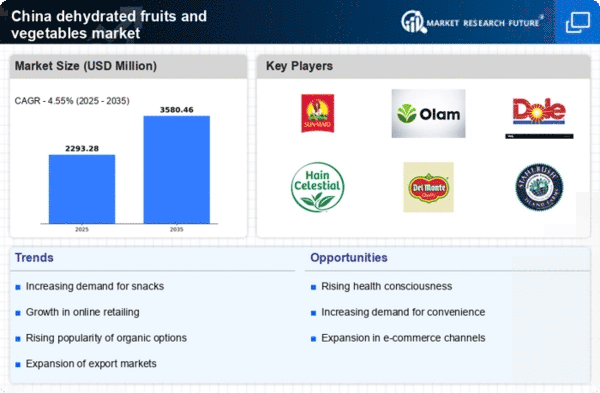
As per Market Research Future analysis, the China Dehydrated Fruits & Vegetables Market size was estimated at 2193.48 USD Million in 2024. the China Dehydrated Fruits & Vegetables Market is projected to grow from 2293.28 USD Million in 2025 to 3580.46 USD Million by 2035, exhibiting a compound annual growth rate (CAGR) of 4.5% during the forecast period 2025 - 2035

Key Market Trends & Highlights

The China dehydrated fruits-vegetables market is experiencing robust growth driven by health trends and convenience.

  • Health consciousness is significantly driving demand for dehydrated fruits and vegetables in China.
  • The convenience and portability of dehydrated products appeal to busy urban consumers.
  • E-commerce expansion is facilitating greater access to dehydrated food products across various demographics.
  • Rising urbanization and increased focus on nutritional value are key drivers propelling market growth.

Market Size & Forecast

2024 Market Size 2193.48 (USD Million)
2035 Market Size 3580.46 (USD Million)
CAGR (2025 - 2035) 4.55%

Major Players

Sun-Maid Growers of California (US), Olam International (SG), Dole Food Company (US), Hain Celestial Group (US), Del Monte Foods (US), Stahlbush Island Farms (US), Paradise Fruits Solutions (DE), Kraft Heinz Company (US)

Our Impact
Enabled $4.3B Revenue Impact for Fortune 500 and Leading Multinationals
Partnering with 2000+ Global Organizations Each Year
30K+ Citations by Top-Tier Firms in the Industry

China Dehydrated Fruits & Vegetables Market Trends

The China Dehydrated Fruits & Vegetables Market is experiencing notable growth, driven by increasing consumer demand for convenient and healthy food options. As lifestyles become busier, individuals are seeking products that offer nutritional benefits without compromising on convenience. This trend is particularly evident in urban areas, where the fast-paced environment encourages the consumption of ready-to-eat snacks. Additionally, the rising awareness of the health benefits associated with dehydrated fruits and vegetables, such as extended shelf life and retention of nutrients, further propels market expansion. The market is also witnessing innovations in packaging and preservation techniques, which enhance product appeal and longevity. Moreover, the evolving dietary preferences among consumers, including a shift towards plant-based diets, contribute to the growing popularity of dehydrated fruits and vegetables. This shift is likely to be supported by an increasing number of health-conscious individuals who prioritize natural and organic products. The market is also benefiting from the expansion of e-commerce platforms, which facilitate easier access to a variety of dehydrated products. As a result, the dehydrated fruits-vegetables market is poised for continued growth, reflecting changing consumer behaviors and preferences in the food sector.

Health Consciousness Driving Demand

The rising awareness of health and wellness among consumers is significantly influencing the dehydrated fruits-vegetables market. Individuals are increasingly seeking nutritious snacks that align with their health goals, leading to a surge in demand for products that offer essential vitamins and minerals. This trend is likely to continue as more people prioritize their dietary choices.

Convenience and Portability

The fast-paced lifestyle of modern consumers is fostering a preference for convenient food options. Dehydrated fruits and vegetables are perceived as easy-to-carry snacks that require no preparation. This convenience factor is particularly appealing to busy professionals and students, thereby driving market growth.

E-commerce Expansion

The growth of online shopping platforms is transforming the way consumers access dehydrated fruits and vegetables. E-commerce provides a wider selection of products and brands, making it easier for consumers to find and purchase their preferred items. This trend is expected to enhance market reach and accessibility.

China Dehydrated Fruits & Vegetables Market Drivers

Increased Focus on Nutritional Value

There is a growing awareness among Chinese consumers regarding the nutritional benefits of dehydrated fruits and vegetables. As health consciousness rises, individuals are more inclined to incorporate nutrient-dense foods into their diets. Dehydrated products retain essential vitamins and minerals, making them an attractive option for health-oriented consumers. The dehydrated fruits-vegetables market is witnessing a surge in demand as consumers seek alternatives to fresh produce that may spoil quickly. Reports indicate that the market for dehydrated fruits and vegetables in China could reach a valuation of $1 billion by 2026, reflecting a robust growth trajectory. This increasing focus on nutrition is likely to drive innovation in product offerings, with manufacturers emphasizing health benefits, thereby enhancing the appeal of the dehydrated fruits-vegetables market.

Growing Demand for Snack Alternatives

The shift in consumer preferences towards healthier snack options is driving the growth of the dehydrated fruits-vegetables market in China. As individuals become more health-conscious, they are seeking alternatives to traditional snacks that are often high in sugar and unhealthy fats. Dehydrated fruits and vegetables offer a nutritious and convenient snacking option, appealing to a wide demographic. Market data indicates that the demand for healthy snacks is expected to increase by 20% over the next few years, with dehydrated products playing a crucial role in this trend. This growing inclination towards healthier snacking habits is likely to propel the dehydrated fruits-vegetables market, as consumers prioritize nutrition without compromising on taste.

Rising Urbanization and Lifestyle Changes

The rapid urbanization in China is reshaping consumer lifestyles, leading to an increased demand for convenient food options. As urban populations grow, individuals often seek quick meal solutions that fit their busy schedules. This trend is particularly evident in metropolitan areas where the dehydrated fruits-vegetables market is experiencing heightened interest. Urban consumers are increasingly inclined to purchase dehydrated products due to their ease of storage and preparation. The market is projected to grow at a CAGR of approximately 8% over the next five years, driven by this urban lifestyle shift. Furthermore, the availability of dehydrated fruits and vegetables in urban retail outlets enhances accessibility, further propelling market growth. As a result, the dehydrated fruits-vegetables market is likely to benefit from the ongoing urbanization trend, catering to the needs of a fast-paced society.

Sustainability and Environmental Awareness

Sustainability is becoming a pivotal concern for consumers in China, influencing their purchasing decisions. The dehydrated fruits-vegetables market is positioned to benefit from this trend, as dehydrated products typically have a lower carbon footprint compared to fresh produce. The reduced need for refrigeration and longer shelf life contribute to less food waste, aligning with the growing environmental consciousness among consumers. As more individuals prioritize sustainable choices, the demand for dehydrated fruits and vegetables is expected to rise. Market analysts suggest that the emphasis on eco-friendly practices could lead to a 15% increase in sales within the next few years. This shift towards sustainability is likely to reshape the dehydrated fruits-vegetables market, encouraging producers to adopt greener practices and appeal to environmentally aware consumers.

Technological Advancements in Food Processing

Technological innovations in food processing are significantly impacting the dehydrated fruits-vegetables market in China. Advanced dehydration techniques, such as freeze-drying and vacuum drying, enhance the quality and flavor retention of dehydrated products. These technologies not only improve the nutritional profile but also extend the shelf life of fruits and vegetables, making them more appealing to consumers. As manufacturers adopt these cutting-edge methods, the market is likely to witness an influx of high-quality dehydrated products. The integration of technology in food processing could potentially lead to a market growth rate of 10% annually, as consumers increasingly seek superior quality and taste. Consequently, the dehydrated fruits-vegetables market stands to gain from these advancements, fostering a competitive landscape that prioritizes innovation.


Market Segment Insights

By Application: E-Commerce (Largest) vs. Supermarket/Hypermarket (Fastest-Growing)

In the market, E-Commerce stands out as the largest segment, capturing a significant share of the total sales of dehydrated fruits and vegetables. Supermarket/Hypermarket also holds a notable portion of the market, providing substantial availability and driving accessibility for consumers. Specialty Retailers, Convenience Stores, and Others contribute smaller portions to the overall market dynamics but remain crucial for niche targeting and customer engagement. Currently, the E-Commerce segment is fueled by convenience and the increasing trend of online shopping among consumers seeking dehydrated products. Meanwhile, Supermarket/Hypermarket is emerging rapidly, capitalizing on their broad physical reach and promotional capabilities. Growth in health consciousness is driving demand, making these retail formats more competitive as they adapt to consumer needs and preferences.

E-Commerce (Dominant) vs. Supermarket/Hypermarket (Emerging)

E-Commerce has become the dominant retail channel in the China dehydrated fruits-vegetables market, appealing to tech-savvy consumers who value convenience and variety. The ease of purchasing products online has revolutionized how consumers access dehydrated fruits and vegetables. On the other hand, Supermarket/Hypermarket is an emerging player, showcasing more agility in adapting to health trends and consumer preferences. These brick-and-mortar retailers leverage their extensive networks and promotional strategies to enhance customer engagement. Additionally, they are increasingly incorporating health-oriented products, allowing them to attract a broader customer base. As health trends continue to rise, both segments are expected to evolve in their strategies to capture market share.

By Type: Dehydrated Fruits (Largest) vs. Dehydrated Vegetables (Fastest-Growing)

In the China dehydrated fruits-vegetables market, dehydrated fruits hold the largest market share, driven by rising consumer demand for healthy snacks and convenience foods. Popular varieties such as apples and mangoes are leading the segment, captivating health-conscious consumers. On the other hand, dehydrated vegetables are emerging robustly, appealing to both the food processing industry and households seeking quick meal solutions. The growth of the dehydrated vegetables segment is fueled by a growing trend towards plant-based diets and the convenience of long shelf life. Health awareness is significant, as more consumers opt for minimally processed foods with nutritional benefits. This evolving consumer preference is spurring innovations in the market, driving new product formulations and increasing the visibility of dehydrated vegetables in retail outlets.

Dehydrated Fruits (Dominant) vs. Dehydrated Vegetables (Emerging)

Dehydrated fruits are well-established in the China dehydrated fruits-vegetables market, characterized by their strong brand presence and extensive availability in retail channels. They cater to a wide demographic, from health enthusiasts to kids looking for tasty snacks. The variety of flavors and textures available contributes to their appeal. In contrast, dehydrated vegetables represent an emerging segment, gaining traction due to their versatility and increasing incorporation in culinary applications. Their ability to retain nutrients while providing convenience is capturing the attention of a growing segment of health-conscious consumers and chefs, establishing them as a vital component in the evolving market landscape.

Get more detailed insights about China Dehydrated Fruits & Vegetables Market

Key Players and Competitive Insights

The dehydrated fruits-vegetables market in China exhibits a dynamic competitive landscape, characterized by a blend of innovation and strategic partnerships among key players. Companies such as Olam International (SG), Dole Food Company (US), and Hain Celestial Group (US) are at the forefront, leveraging their operational strengths to capture market share. Olam International (SG) focuses on sustainability and supply chain optimization, which appears to resonate well with the increasing consumer demand for eco-friendly products. Dole Food Company (US) emphasizes product diversification and innovation, particularly in developing new flavors and health-oriented offerings. Hain Celestial Group (US) is strategically positioned through its commitment to organic and natural products, appealing to health-conscious consumers. Collectively, these strategies contribute to a competitive environment that is increasingly driven by consumer preferences for quality and sustainability.The business tactics employed by these companies reflect a nuanced understanding of the market structure, which is moderately fragmented. Localizing manufacturing and optimizing supply chains are prevalent strategies that enhance operational efficiency and reduce costs. The collective influence of these key players shapes the market dynamics, as they navigate challenges such as fluctuating raw material prices and evolving consumer preferences. This competitive structure allows for both established brands and emerging players to coexist, fostering innovation and variety in product offerings.
In October Olam International (SG) announced a new partnership with a local Chinese agricultural cooperative to enhance its sourcing capabilities for dehydrated fruits. This strategic move is likely to bolster Olam's supply chain resilience while ensuring a steady supply of high-quality raw materials. By collaborating with local producers, Olam International (SG) not only strengthens its market position but also aligns with the growing trend of supporting local economies and sustainable practices.
In September Dole Food Company (US) launched a new line of organic dehydrated fruit snacks aimed at the health-conscious segment of the market. This initiative reflects Dole's commitment to innovation and meeting consumer demands for healthier snack options. The introduction of these products is expected to enhance Dole's brand equity and attract a broader customer base, particularly among younger consumers who prioritize health and wellness.
In August Hain Celestial Group (US) expanded its distribution network in China by partnering with major e-commerce platforms. This strategic action is indicative of the increasing importance of digital channels in reaching consumers. By enhancing its online presence, Hain Celestial Group (US) positions itself to capitalize on the growing trend of online shopping, particularly for health-oriented products, thereby increasing its market penetration.
As of November the competitive trends in the dehydrated fruits-vegetables market are increasingly defined by digitalization, sustainability, and the integration of advanced technologies such as AI. Strategic alliances are becoming more prevalent, as companies seek to enhance their capabilities and market reach. The shift from price-based competition to a focus on innovation, technology, and supply chain reliability is evident. Moving forward, competitive differentiation will likely hinge on the ability to adapt to these trends, with companies that prioritize sustainability and technological integration poised to lead the market.

Key Companies in the China Dehydrated Fruits & Vegetables Market include

Industry Developments

The China Dehydrated Fruits and Vegetables Market has witnessed several notable developments recently, characterized by the growth potential of key players such as Zhejiang Ziniu Food Co Ltd, China Minmetals Corporation, and Dingxin Agriculture Group. As of August 2023, these companies have benefited from the increasing demand for healthy snacks and convenience foods, leading to significant market valuation growth. In terms of mergers and acquisitions, Wan Zhong Agricultural Development Co Ltd and Ceres Global Ag Corp have been actively seeking expansion opportunities, notably through strategic partnerships aimed at creating synergies in production and distribution channels.

This trend aligns with the overarching goal of enhancing supply chain efficiencies within the industry. Furthermore, initiatives to improve organic product offerings conducted by Hangzhou Yuhuan Agricultural Development Co Ltd have contributed to elevating the market's competitive landscape. Over the last few years, particularly from 2021 to 2023, the surge in consumer preference for plant-based products and the rising awareness about nutrition have provided a solid foundation for the growth of the dehydrated fruits and vegetables segment, making China a significant hub for sourcing and manufacturing in this domain.

Future Outlook

China Dehydrated Fruits & Vegetables Market Future Outlook

The dehydrated fruits-vegetables market in China is projected to grow at a 4.55% CAGR from 2025 to 2035, driven by increasing health consciousness and demand for convenience.

New opportunities lie in:

  • Expansion of e-commerce platforms for direct consumer sales. Development of innovative packaging solutions to enhance shelf life. Strategic partnerships with food manufacturers for ingredient sourcing.

By 2035, the market is expected to achieve robust growth, reflecting evolving consumer preferences.

Market Segmentation

China Dehydrated Fruits & Vegetables Market Type Outlook

  • Dehydrated Fruits
  • Dehydrated Vegetables

China Dehydrated Fruits & Vegetables Market Application Outlook

  • Supermarket/Hypermarket
  • Specialty Retailers
  • Convenience Stores
  • E-Commerce
  • Others

Report Scope

MARKET SIZE 2024 2193.48(USD Million)
MARKET SIZE 2025 2293.28(USD Million)
MARKET SIZE 2035 3580.46(USD Million)
COMPOUND ANNUAL GROWTH RATE (CAGR) 4.55% (2025 - 2035)
REPORT COVERAGE Revenue Forecast, Competitive Landscape, Growth Factors, and Trends
BASE YEAR 2024
Market Forecast Period 2025 - 2035
Historical Data 2019 - 2024
Market Forecast Units USD Million
Key Companies Profiled Sun-Maid Growers of California (US), Olam International (SG), Dole Food Company (US), Hain Celestial Group (US), Del Monte Foods (US), Stahlbush Island Farms (US), Paradise Fruits Solutions (DE), Kraft Heinz Company (US)
Segments Covered Application, Type
Key Market Opportunities Growing consumer demand for healthy snacks drives innovation in the dehydrated fruits-vegetables market.
Key Market Dynamics Rising consumer demand for healthy snacks drives innovation in the dehydrated fruits-vegetables market.
Countries Covered China
Leave a Comment

FAQs

What is the projected market size of the China Dehydrated Fruits and Vegetables Market in 2024?

The projected market size of the China Dehydrated Fruits and Vegetables Market in 2024 is valued at 3.0 USD Billion.

What is the expected market size of the China Dehydrated Fruits and Vegetables Market by 2035?

The expected market size of the China Dehydrated Fruits and Vegetables Market by 2035 is valued at 5.0 USD Billion.

What is the Compound Annual Growth Rate (CAGR) for the China Dehydrated Fruits and Vegetables Market from 2025 to 2035?

The CAGR for the China Dehydrated Fruits and Vegetables Market from 2025 to 2035 is expected to be 4.753%.

Which application segment is anticipated to have the largest market share in 2024?

The Supermarket/Hypermarket application segment is anticipated to have the largest market share, valued at 1.2 USD Billion in 2024.

What is the projected value of the Specialty Retailers segment in 2035?

The projected value of the Specialty Retailers segment in 2035 is 1.2 USD Billion.

What market share is expected for Convenience Stores in 2024?

Convenience Stores are expected to have a market share valued at 0.5 USD Billion in 2024.

How much is the E-Commerce segment projected to be worth by 2035?

The E-Commerce segment is projected to be worth 0.7 USD Billion by 2035.

Who are the key players in the China Dehydrated Fruits and Vegetables Market?

Key players include Zhejiang Ziniu Food Co Ltd, China Minmetals Corporation, Dingxin Agriculture Group, and Ceres Global Ag Corp among others.

What is the anticipated market value for the 'Others' application segment in 2024?

The anticipated market value for the 'Others' application segment in 2024 is 0.1 USD Billion.

What growth opportunities exist for the China Dehydrated Fruits and Vegetables Market?

There are growth opportunities driven by increasing consumer preferences for convenience foods and health-conscious eating habits.

Download Free Sample

Kindly complete the form below to receive a free sample of this Report

Compare Licence

×
Features License Type
Single User Multiuser License Enterprise User
Price $4,950 $5,950 $7,250
Maximum User Access Limit 1 User Upto 10 Users Unrestricted Access Throughout the Organization
Free Customization
Direct Access to Analyst
Deliverable Format
Platform Access
Discount on Next Purchase 10% 15% 15%
Printable Versions