Increased Focus on Cost Efficiency
Cost efficiency remains a pivotal driver in the containers as-a-service market within China. Organizations are increasingly recognizing the financial benefits associated with containerization, which allows for optimized resource utilization and reduced operational costs. By adopting containers, companies can minimize infrastructure expenses and streamline their development processes. Recent analyses indicate that businesses can achieve up to 30% savings in operational costs by transitioning to container-based architectures. This financial incentive is particularly appealing to small and medium-sized enterprises (SMEs) that are looking to enhance their competitiveness without incurring significant capital expenditures. Thus, the containers as-a-service market is likely to see accelerated adoption as organizations prioritize cost-effective solutions.
Growing Interest in DevOps Practices
The containers as-a-service market in China is significantly influenced by the growing interest in DevOps practices. As organizations strive to enhance collaboration between development and operations teams, containerization emerges as a key enabler. The ability to create consistent environments across development, testing, and production stages facilitates smoother workflows and faster deployment cycles. This trend is particularly relevant in the technology sector, where rapid innovation is essential. Data suggests that companies implementing DevOps methodologies can achieve deployment frequency increases of up to 200 times. Consequently, the containers as-a-service market is poised to benefit from this shift, as more organizations adopt container technologies to support their DevOps initiatives.
Rising Demand for Scalable Solutions
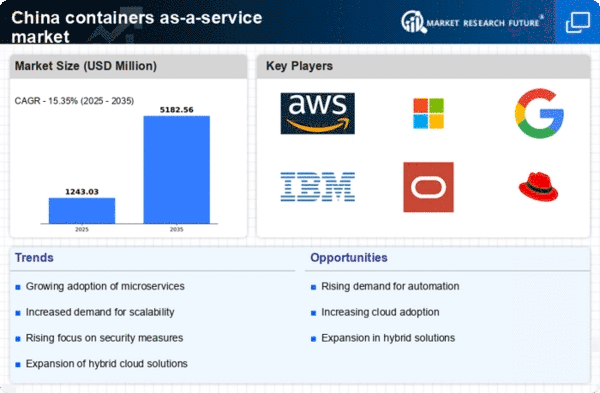
The containers as-a-service market in China experiences a notable surge in demand for scalable solutions. As businesses increasingly seek to enhance operational efficiency, the flexibility offered by containerization becomes paramount. This trend is particularly evident in sectors such as e-commerce and finance, where rapid scaling is essential to meet fluctuating consumer demands. According to recent data, the market is projected to grow at a CAGR of approximately 25% over the next five years. This growth is driven by the need for organizations to deploy applications quickly and efficiently, thereby reducing time-to-market. Consequently, the containers as-a-service market is positioned to benefit significantly from this rising demand, as companies prioritize agility and responsiveness in their IT strategies.
Emergence of AI and Machine Learning Integration
The integration of artificial intelligence (AI) and machine learning (ML) technologies is becoming a significant driver for the containers as-a-service market in China. As businesses seek to harness the power of AI and ML, the need for scalable and efficient computing resources becomes critical. Containers provide an ideal environment for deploying AI and ML models, allowing for rapid experimentation and iteration. This trend is particularly evident in sectors such as healthcare and finance, where data-driven decision-making is paramount. The containers as-a-service market is likely to see increased investment as organizations recognize the potential of containerization to enhance their AI and ML capabilities. Furthermore, the ability to manage complex workloads efficiently positions containers as a vital component in the future of technology-driven enterprises.
Government Initiatives Supporting Cloud Adoption
In China, government initiatives aimed at promoting cloud adoption play a crucial role in the containers as-a-service market. The Chinese government has implemented various policies to encourage digital transformation across industries, which includes substantial investments in cloud infrastructure. For instance, the 'New Infrastructure' initiative emphasizes the development of data centers and cloud computing technologies. This supportive regulatory environment is likely to foster growth in the containers as-a-service market, as businesses leverage these advancements to modernize their IT frameworks. Furthermore, the government's focus on enhancing cybersecurity measures aligns with the adoption of container technologies, which are perceived as more secure and efficient. As a result, the containers as-a-service market is expected to thrive under these favorable conditions.