×
Request Free Sample ×

Kindly complete the form below to receive a free sample of this Report

* Please use a valid business email

Leading companies partner with us for data-driven Insights

clients tt-cursor
Hero Background

China Blended Learning Market

ID: MRFR/ICT/57557-HCR
200 Pages
Aarti Dhapte
February 2026

China Blended Learning Market Size, Share and Trends Analysis Report By Type (Hardware, Content, System, Solutions) and By Application (Pre-primary School, Primary School, Middle School, High School)- Forecast to 2035

Share:
Download PDF ×

We do not share your information with anyone. However, we may send you emails based on your report interest from time to time. You may contact us at any time to opt-out.

China Blended Learning Market Infographic
Purchase Options

China Blended Learning Market Summary

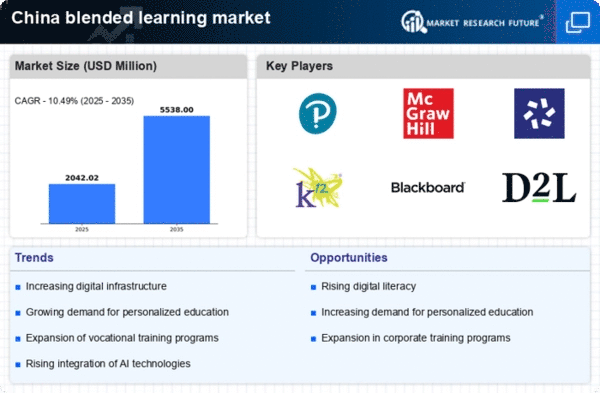
As per Market Research Future analysis, the China Blended Learning Market size was estimated at 1848.15 USD Million in 2024. The Blended Learning market is projected to grow from 2042.02 USD Million in 2025 to 5538.0 USD Million by 2035, exhibiting a compound annual growth rate (CAGR) of 10.4% during the forecast period 2025 - 2035

Key Market Trends & Highlights

The China blended learning market is experiencing robust growth driven by technological integration and a shift towards personalized education.

  • The largest segment in the China blended learning market is corporate training, reflecting a growing emphasis on employee development.
  • The fastest-growing segment is personalized learning solutions, indicating a shift towards tailored educational experiences.
  • Integration of advanced technology in education is becoming increasingly prevalent, enhancing the learning experience across various platforms.
  • Government support for educational innovation and rising demand for flexible learning solutions are key drivers propelling market expansion.

Market Size & Forecast

2024 Market Size 1848.15 (USD Million)
2035 Market Size 5538.0 (USD Million)
CAGR (2025 - 2035) 10.49%

Major Players

Pearson (GB), McGraw-Hill (US), Cengage Learning (US), K12 Inc. (US), Blackboard (US), D2L (CA), Instructure (US), Edmodo (US), Skillsoft (US)

Our Impact
Enabled $4.3B Revenue Impact for Fortune 500 and Leading Multinationals
Partnering with 2000+ Global Organizations Each Year
30K+ Citations by Top-Tier Firms in the Industry

China Blended Learning Market Trends

The China Blended Learning Market in China is currently experiencing a notable transformation, driven by advancements in technology and a growing demand for flexible educational solutions. This market encompasses a combination of traditional face-to-face instruction and online learning, allowing for a more personalized and engaging educational experience. As educational institutions and corporate training programs increasingly adopt blended learning models, the emphasis on integrating digital tools and resources into curricula becomes more pronounced. This shift enhances accessibility and caters to diverse learning preferences, fostering a more inclusive environment for learners. Moreover, the rise of mobile technology and the proliferation of internet access across urban and rural areas in China further support the expansion of the blended learning market. Educational stakeholders are recognizing the potential of online platforms to complement traditional teaching methods, leading to innovative approaches in curriculum design and delivery. The focus on lifelong learning and continuous professional development is also contributing to the growth of this market, as individuals seek to enhance their skills in an ever-evolving job landscape. Overall, the blended learning market appears poised for continued growth, reflecting the changing dynamics of education in China.

Integration of Technology in Education

The incorporation of advanced technologies into educational practices is a prominent trend within the blended learning market. Institutions are increasingly utilizing digital tools such as learning management systems, virtual classrooms, and interactive content to enhance the learning experience. This trend indicates a shift towards more engaging and effective teaching methodologies.

Focus on Personalized Learning

There is a growing emphasis on personalized learning experiences in the blended learning market. Educators are tailoring their approaches to meet the unique needs of individual learners, allowing for greater flexibility and adaptability in educational pathways. This trend suggests a move towards more student-centered learning environments.

Expansion of Corporate Training Programs

The blended learning market is witnessing an increase in corporate training initiatives that leverage blended learning methodologies. Companies are adopting these models to provide employees with flexible training options that combine online resources with in-person workshops. This trend highlights the importance of continuous learning in the professional sphere.

China Blended Learning Market Drivers

Cultural Shift Towards Lifelong Learning

There is a notable cultural shift in China towards lifelong learning, which is influencing the blended learning market. As the economy evolves, individuals are increasingly seeking opportunities to enhance their skills and knowledge throughout their lives. This shift is reflected in the growing enrollment in adult education programs, with a reported increase of 20% in participation over the past year. The blended learning market is well-suited to meet the needs of these lifelong learners, offering flexible and accessible learning options. Educational institutions and training providers are likely to adapt their offerings to align with this cultural trend, further driving the growth of blended learning solutions.

Corporate Investment in Employee Development

The corporate sector in China is increasingly recognizing the value of employee development, which significantly impacts the blended learning market. Companies are investing in training programs that incorporate blended learning methodologies to enhance workforce skills. Recent data suggests that corporate training expenditures have risen by 15% annually, with a substantial portion allocated to blended learning initiatives. This trend indicates a shift towards more effective training solutions that combine online modules with in-person workshops. As organizations seek to improve employee performance and retention, the blended learning market is likely to benefit from this growing investment in professional development.

Government Support for Educational Innovation

The Chinese government actively promotes educational innovation, which significantly influences the blended learning market. Initiatives such as the 'New Generation Artificial Intelligence Development Plan' aim to integrate advanced technologies into education. This support is reflected in increased funding for educational technology, with the government allocating approximately $1.5 billion to enhance digital learning infrastructure. Such investments are likely to foster the growth of blended learning solutions, as educational institutions adopt hybrid models that combine traditional and digital learning methods. The emphasis on improving educational quality and accessibility aligns with the objectives of the blended learning market, creating a conducive environment for its expansion.

Rising Demand for Flexible Learning Solutions

In China, the demand for flexible learning solutions is on the rise, driven by the diverse needs of learners. The blended learning market is particularly well-positioned to address this demand, as it offers a combination of online and face-to-face learning experiences. Recent surveys indicate that over 70% of students prefer learning environments that allow for flexibility in scheduling and content delivery. This trend is further supported by the increasing number of working professionals seeking to upskill while managing their careers. Consequently, educational institutions and training providers are likely to invest in blended learning programs to cater to this growing audience, thereby enhancing the market's potential.

Technological Advancements in Educational Tools

Technological advancements play a crucial role in shaping the blended learning market in China. The proliferation of mobile devices and high-speed internet access has transformed how educational content is delivered. As of 2025, approximately 85% of urban households have access to the internet, facilitating the adoption of online learning platforms. Moreover, innovations such as artificial intelligence and virtual reality are being integrated into educational tools, enhancing the learning experience. These advancements not only improve engagement but also provide personalized learning pathways, which are essential for the blended learning market's growth. Educational institutions are increasingly leveraging these technologies to create more interactive and effective learning environments.


Market Segment Insights

By Type: Content (Largest) vs. Hardware (Fastest-Growing)

The market share distribution within the China blended learning market showcases that content emerges as the largest segment, capturing a significant share due to its fundamental role in delivering educational materials. Hardware follows closely, with its reliance evident in the adoption of various devices that facilitate blended learning experiences. The system and solutions segments, while important, exhibit smaller market shares in comparison, contributing to a diverse ecosystem that supports blended learning initiatives. Despite content leading in market share, hardware is recognized as the fastest-growing segment. This growth is driven by advancements in technology, increasing demand for interactive learning tools, and the rising importance of personalized learning experiences. As institutions upgrade their infrastructures, the hardware segment is expected to see significant investments, propelling its development and adoption in the upcoming years.

Content (Dominant) vs. Hardware (Emerging)

In the China blended learning market, content stands out as the dominant segment, heavily influencing the structure and delivery of educational programs. It encompasses various forms such as e-books, videos, and interactive modules that address diverse learning needs. Essentially, content drives engagement and retention rates among learners. Conversely, the hardware segment, characterized by devices like tablets and interactive whiteboards, is deemed emerging due to rapid technological advancements and increased accessibility. As educational institutions and learners prioritize quality hardware to optimize their learning experiences, this segment is gaining traction and is poised for significant growth, forecasting an exciting shift in blended learning dynamics.

By Application: Primary School (Largest) vs. High School (Fastest-Growing)

In the China blended learning market, the application segment is noticeably diverse, with a strong emphasis on education levels such as pre-primary, primary, middle, and high schools. Among these, primary schools hold the largest market share, showcasing the crucial role of foundational education in leveraging blended learning methodologies. High school education, however, presents an intriguing contrast with its rapid growth, driven by increased digital adoption and a demand for personalized learning experiences among older students. Growth trends within this segment are largely influenced by technological advancements and changing pedagogical approaches, fostering a more integrated learning environment. The demand for flexible learning solutions continues to rise, particularly in high schools, where students seek resources that cater to varied learning styles. As educational technology gains traction, the blended learning approach is set to redefine traditional learning paradigms, enhancing engagement and achievement levels.

Primary School (Dominant) vs. High School (Emerging)

In the China blended learning market, primary schools stand out as a dominant segment due to the critical importance of early education in shaping students' adaptability to new learning methods. This segment benefits from robust support mechanisms, including government initiatives aimed at integrating technology into classrooms. In contrast, high schools are emerging as a significant segment, characterized by their increasing adoption of innovative blended learning solutions. This shift is largely attributed to students' desire for autonomy and personalized learning experiences, leading to tailored educational offerings. As educational priorities evolve, the interplay between these segments highlights a transition towards more dynamic, learner-centric approaches, positioning high schools as a key player in the ongoing evolution of the blended learning landscape.

Get more detailed insights about China Blended Learning Market

Key Players and Competitive Insights

The blended learning market in China is characterized by a dynamic competitive landscape, driven by rapid technological advancements and an increasing demand for flexible educational solutions. Key players such as Pearson (GB), McGraw-Hill (US), and Blackboard (US) are actively shaping the market through strategic initiatives focused on innovation and regional expansion. These companies are leveraging digital transformation to enhance their offerings, thereby creating a competitive environment that emphasizes adaptability and responsiveness to market needs.
In terms of business tactics, companies are increasingly localizing their operations to better cater to the unique educational requirements of the Chinese market. This localization often involves optimizing supply chains and establishing partnerships with local educational institutions. The market appears moderately fragmented, with several key players exerting influence, yet the collective strategies of these companies suggest a trend towards consolidation as they seek to enhance their market presence and operational efficiency.
In October 2025, Pearson (GB) announced a partnership with a leading Chinese technology firm to develop an AI-driven learning platform tailored for local students. This strategic move is likely to enhance Pearson's competitive edge by integrating advanced technology into its educational offerings, thereby addressing the growing demand for personalized learning experiences. Such initiatives may position Pearson favorably in a market that increasingly values innovation and technological integration.
Similarly, in September 2025, McGraw-Hill (US) launched a new suite of blended learning resources specifically designed for the Chinese curriculum. This initiative reflects McGraw-Hill's commitment to regional adaptation and its understanding of local educational standards. By aligning its products with the needs of Chinese educators and students, McGraw-Hill appears to be reinforcing its market position and expanding its reach within this competitive landscape.
Moreover, in August 2025, Blackboard (US) expanded its operations in China by establishing a new regional office aimed at enhancing customer support and engagement. This strategic expansion indicates Blackboard's intent to deepen its market penetration and foster closer relationships with educational institutions. Such moves are indicative of a broader trend where companies prioritize localized support to enhance user experience and satisfaction.
As of November 2025, the blended learning market is witnessing significant trends such as the integration of AI technologies, a focus on sustainability, and the ongoing digitalization of educational content. Strategic alliances among key players are increasingly shaping the competitive landscape, fostering innovation and collaboration. Looking ahead, it seems that competitive differentiation will likely evolve from traditional price-based strategies to a focus on technological innovation, supply chain reliability, and the ability to deliver tailored educational solutions that meet the diverse needs of learners in China.

Key Companies in the China Blended Learning Market include

Industry Developments

The "Artificial Intelligence Empowering Education" effort, started by China's Ministry of Education in March 2024, has accelerated the integration of blended learning by extending AI-driven features on the National Smart Education Public Service Platform and testing AI-enhanced demonstrations in classrooms.

The debut of the xPad2 tablet by Xueersi (under TAL Education) in September 2023, which was powered by the company's proprietary MathGPT model and 10 AI tools, resulted in a 46 percent rise in group revenue. In H1 2024, sales of AI tablets increased by 136.6 percent over the previous year.

VIPKid announced its entry into international blended courses in January 2024, broadening the range of content available to Chinese students studying overseas. Furthermore, the percentage of Chinese colleges that offered blended learning increased from 45 percent in 2021 to almost 68 percent in 2024, indicating broad institutional adoption.

Additionally, blended learning is a crucial component of organisational training, and the corporate e-learning industry brought in over USD 6 billion in 2024, with a 20 percent compound annual growth rate anticipated through 2030. These changes show how China's blended learning market is developing quickly because to AI initiatives, educational technology, institutional adoption, and business training.

Future Outlook

China Blended Learning Market Future Outlook

The blended learning market in China is projected to grow at a 10.49% CAGR from 2025 to 2035, driven by technological advancements and increasing demand for flexible education solutions.

New opportunities lie in:

  • Development of AI-driven personalized learning platforms
  • Expansion of corporate training programs utilizing blended methodologies
  • Partnerships with educational institutions for hybrid course offerings

By 2035, the blended learning market is expected to achieve substantial growth and innovation.

Market Segmentation

China Blended Learning Market Type Outlook

  • Hardware
  • Content
  • System
  • Solutions

China Blended Learning Market Application Outlook

  • Pre-primary School
  • Primary School
  • Middle School
  • High School

Report Scope

MARKET SIZE 2024 1848.15(USD Million)
MARKET SIZE 2025 2042.02(USD Million)
MARKET SIZE 2035 5538.0(USD Million)
COMPOUND ANNUAL GROWTH RATE (CAGR) 10.49% (2025 - 2035)
REPORT COVERAGE Revenue Forecast, Competitive Landscape, Growth Factors, and Trends
BASE YEAR 2024
Market Forecast Period 2025 - 2035
Historical Data 2019 - 2024
Market Forecast Units USD Million
Key Companies Profiled Pearson (GB), McGraw-Hill (US), Cengage Learning (US), K12 Inc. (US), Blackboard (US), D2L (CA), Instructure (US), Edmodo (US), Skillsoft (US)
Segments Covered Type, Application
Key Market Opportunities Integration of advanced technologies enhances personalized learning experiences in the blended learning market.
Key Market Dynamics Rising demand for personalized education solutions drives innovation in the blended learning market.
Countries Covered China
Leave a Comment

FAQs

What is the projected market size of the China Blended Learning Market in 2024?

The projected market size of the China Blended Learning Market in 2024 is valued at 2.3 billion USD.

What is the expected market size for the China Blended Learning Market by 2035?

The expected market size for the China Blended Learning Market by 2035 is 10.5 billion USD.

What is the expected CAGR for the China Blended Learning Market from 2025 to 2035?

The expected CAGR for the China Blended Learning Market from 2025 to 2035 is 14.802 percent.

Which sector is expected to hold the largest market share in the China Blended Learning Market?

The Hardware sector is expected to hold the largest market share, projected to be valued at 4.1 billion USD by 2035.

Who are the key players in the China Blended Learning Market?

Key players in the China Blended Learning Market include Hujiang EdTech, TAL Education Group, and New Oriental Education & Technology Group among others.

What is the market size of the Content segment in 2024?

The market size of the Content segment in 2024 is valued at 0.8 billion USD.

What is driving the growth of the China Blended Learning Market?

The growth of the China Blended Learning Market is driven by increasing demand for personalized learning solutions and technological advancements.

What challenges does the China Blended Learning Market face?

The China Blended Learning Market faces challenges such as the need for regulatory compliance and rapid technological changes.

What opportunities exist in the China Blended Learning Market?

Opportunities in the China Blended Learning Market include expansion into untapped rural areas and the rise of mobile learning solutions.

How significantly will the System segment grow by 2035?

The System segment is projected to grow significantly, reaching a valuation of 2.8 billion USD by 2035.

Download Free Sample

Kindly complete the form below to receive a free sample of this Report

Compare Licence

×
Features License Type
Single User Multiuser License Enterprise User
Price $4,950 $5,950 $7,250
Maximum User Access Limit 1 User Upto 10 Users Unrestricted Access Throughout the Organization
Free Customization
Direct Access to Analyst
Deliverable Format
Platform Access
Discount on Next Purchase 10% 15% 15%
Printable Versions