×
Request Free Sample ×

Kindly complete the form below to receive a free sample of this Report

* Please use a valid business email

Leading companies partner with us for data-driven Insights

clients tt-cursor
Hero Background

China Barotrauma Market

ID: MRFR/HC/52656-HCR
200 Pages
Rahul Gotadki
February 2026

China Barotrauma Market Research Report By Type (Ear, Sinus, Pulmonary Barotrauma) - Growth & Industry Forecast 2025 To 2035

Share:
Download PDF ×

We do not share your information with anyone. However, we may send you emails based on your report interest from time to time. You may contact us at any time to opt-out.

China Barotrauma Market Infographic
Purchase Options

China Barotrauma Market Summary

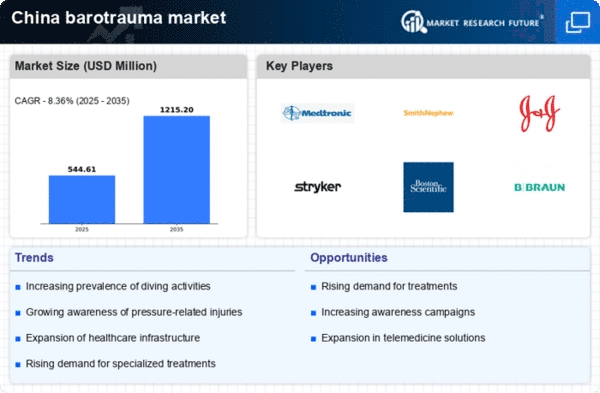
As per Market Research Future analysis, the China barotrauma market Size was estimated at 502.59 USD Million in 2024. The China barotrauma market is projected to grow from 544.61 USD Million in 2025 to 1215.2 USD Million by 2035, exhibiting a compound annual growth rate (CAGR) of 8.3% during the forecast period 2025 - 2035

Key Market Trends & Highlights

The China barotrauma market is experiencing growth driven by technological advancements and increased awareness.

  • Technological advancements in treatment are enhancing patient outcomes and recovery times.
  • Increased awareness and education regarding barotrauma are leading to higher demand for preventive measures.
  • Regulatory changes and compliance are shaping the market landscape, ensuring safer practices in diving and related activities.
  • The rising incidence of diving activities and advancements in medical technology are key drivers of market growth.

Market Size & Forecast

2024 Market Size 502.59 (USD Million)
2035 Market Size 1215.2 (USD Million)
CAGR (2025 - 2035) 8.36%

Major Players

Medtronic (US), Smith & Nephew (GB), Johnson & Johnson (US), Stryker (US), Boston Scientific (US), B. Braun Melsungen AG (DE), ConvaTec Group (GB), Hollister Incorporated (US)

Our Impact
Enabled $4.3B Revenue Impact for Fortune 500 and Leading Multinationals
Partnering with 2000+ Global Organizations Each Year
30K+ Citations by Top-Tier Firms in the Industry

China Barotrauma Market Trends

The barotrauma market is currently experiencing notable developments, driven by a combination of increasing awareness regarding the condition and advancements in medical technology. Barotrauma, which occurs due to pressure changes affecting the body, particularly during activities such as diving or flying, has garnered attention from healthcare providers and patients alike. In recent years, there has been a growing emphasis on preventive measures and effective treatment options, which has led to a rise in demand for specialized medical devices and therapies. This trend is further supported by the increasing number of recreational divers and air travelers, who are more likely to seek medical assistance for pressure-related injuries. Moreover, the regulatory environment surrounding the barotrauma market is evolving, with government bodies implementing stricter guidelines to ensure patient safety and product efficacy. This regulatory focus is likely to encourage innovation among manufacturers, as they strive to meet the new standards. Additionally, educational initiatives aimed at both healthcare professionals and the public are expected to enhance understanding of barotrauma, potentially leading to earlier diagnosis and treatment. As a result, the market is poised for growth, with opportunities for new entrants and established players to expand their offerings and improve patient outcomes.

Technological Advancements in Treatment

Recent innovations in medical technology are transforming the barotrauma market. New devices and therapies are being developed to enhance treatment efficacy and patient safety. These advancements may include improved diagnostic tools and minimally invasive procedures, which could lead to better outcomes for individuals affected by barotrauma.

Increased Awareness and Education

There is a growing emphasis on awareness and education regarding barotrauma among both healthcare providers and the general public. Initiatives aimed at informing individuals about the risks associated with pressure changes are likely to contribute to earlier diagnosis and treatment, thereby positively impacting the market.

Regulatory Changes and Compliance

The regulatory landscape for the barotrauma market is evolving, with government agencies implementing stricter guidelines. These changes may drive manufacturers to innovate and improve their products to comply with new standards, ultimately benefiting patient care and safety.

China Barotrauma Market Drivers

Advancements in Medical Technology

Innovations in medical technology are playing a crucial role in shaping the barotrauma market in China. The introduction of advanced diagnostic tools and treatment modalities has improved the management of barotrauma cases. For instance, the integration of telemedicine and mobile health applications allows for timely intervention and monitoring of patients. Additionally, the development of minimally invasive surgical techniques has enhanced recovery outcomes for individuals suffering from barotrauma. As these technologies become more accessible, healthcare providers are likely to adopt them, thereby increasing the overall efficiency of treatment. This technological evolution not only enhances patient care but also stimulates growth within the barotrauma market, as healthcare facilities invest in state-of-the-art equipment and training.

Government Initiatives and Funding

Government initiatives aimed at improving healthcare infrastructure in China are expected to positively impact the barotrauma market. Increased funding for medical research and development has led to enhanced treatment protocols and educational programs for healthcare professionals. The Chinese government has allocated substantial resources to address various health issues, including those related to diving and aviation. This focus on health improvement is likely to result in better training for medical personnel, ultimately leading to more effective management of barotrauma cases. Furthermore, public health campaigns aimed at raising awareness about the risks associated with pressure changes may contribute to a more informed population, thereby driving demand for barotrauma-related services and products.

Growing Sports and Adventure Tourism

The surge in sports and adventure tourism in China is a significant driver for the barotrauma market. As more tourists engage in activities such as scuba diving, skydiving, and mountaineering, the likelihood of barotrauma incidents increases. This trend is particularly evident in regions known for their natural beauty and adventure sports, where the influx of tourists has led to a corresponding rise in the need for medical services related to pressure-related injuries. The barotrauma market stands to benefit from this growth, as healthcare providers and facilities adapt to meet the needs of both local and international tourists. Additionally, partnerships between tourism operators and medical facilities may emerge, further enhancing the market's potential.

Rising Incidence of Diving Activities

The increasing popularity of recreational diving in China has led to a higher incidence of barotrauma cases. As more individuals engage in diving, the barotrauma market experiences a corresponding rise in demand for treatment options. Reports indicate that the number of certified divers in China has grown by approximately 15% annually, contributing to a greater awareness of the risks associated with diving. This trend necessitates the development of specialized medical services and products aimed at addressing barotrauma, thereby driving growth in the market. Furthermore, the expansion of diving tourism in coastal regions is likely to further amplify the need for effective barotrauma management solutions, positioning the barotrauma market for significant expansion in the coming years.

Increased Focus on Occupational Health

The heightened emphasis on occupational health and safety in various industries in China is influencing the barotrauma market. Industries such as aviation, underwater welding, and deep-sea exploration are particularly susceptible to barotrauma risks. As companies prioritize employee health and safety, there is a growing demand for training programs and medical services that address these specific risks. Regulatory bodies are likely to implement stricter guidelines regarding occupational health, prompting businesses to invest in preventive measures and treatment options for barotrauma. This focus on occupational health not only enhances worker safety but also drives growth in the barotrauma market, as organizations seek to mitigate risks associated with pressure changes.


Market Segment Insights

By Type: Ear Barotrauma (Largest) vs. Pulmonary Barotrauma (Fastest-Growing)

In the China barotrauma market, the largest segment is ear barotrauma, which significantly captures a major share of the overall market. This dominance can be attributed to the prevalence of ear-related conditions in various demographics, especially among those involved in diving and aviation. Meanwhile, pulmonary barotrauma is witnessing rapid growth as awareness of respiratory health issues increases, and more individuals seek medical attention for conditions related to lung pressure changes. The growth trends for these segments indicate a rising demand for targeted therapies and services. Innovations in medical technology and an increase in air travel are vital drivers behind the growth of pulmonary barotrauma. Meanwhile, the stable nature of ear barotrauma ensures its sustained position within the market, although emerging trends in preventive healthcare may begin to shift consumer focus as education around barotrauma expands.

Ear Barotrauma (Dominant) vs. Sinus Barotrauma (Emerging)

Ear barotrauma represents the dominant segment within the market due to its wide recognition and incidence among populations engaged in activities with rapid altitude changes. The condition typically arises when pressure differences affect the middle ear, leading to discomfort or pain. Conversely, sinus barotrauma, while emerging, is gaining attention as more individuals recognize the connection between sinus issues and pressure changes when diving or flying. This segment is growing, fueled by increased awareness and educational initiatives that highlight the effects of pressure on sinus health. As medical practitioners promote preventive measures and treatments, sinus barotrauma is poised to expand, carving out its niche in the market.

By Diagnosis: Otoscopy (Largest) vs. X-ray (Fastest-Growing)

In the China barotrauma market, the diagnosis segment is characterized by a diverse array of diagnostic tools. Otoscopy holds the largest market share due to its fundamental role in directly visualizing the ear structure and identifying barotrauma. Following otoscopy, diagnostic techniques such as X-ray and CT scans also contribute significantly to market dynamics, with X-ray showing a remarkable increase in demand driven by its rapid and accessible diagnostic capabilities. The growth trends in this market segment are heavily influenced by advancements in imaging technologies and the rising awareness of barotrauma among both patients and healthcare professionals. The integration of digital tools and enhanced imaging techniques are leading to improved diagnostic accuracy, which in turn fuels the adoption of various diagnostic modalities. Consequently, X-ray is emerging as the fastest-growing method due to its efficiency and cost-effectiveness, appealing to a broader range of healthcare facilities.

Otoscopy (Dominant) vs. MRI (Emerging)

Otoscopy is recognized as the dominant diagnostic tool within the segment of the China barotrauma market, providing essential insights into ear health and conditions like barotrauma. Its simplicity and effectiveness make it the first choice for clinicians. In contrast, Magnetic Resonance Imaging (MRI) is emerging as a notable player, particularly for cases that require detailed imaging of soft tissues beyond what otoscopy can provide. As MRI technology becomes more accessible and cost-effective, its use is expected to grow, catering to complex cases and providing comprehensive assessments for patients experiencing severe barotrauma symptoms.

By Treatment: Pressure Relief (Largest) vs. Medications (Fastest-Growing)

The treatment segment within the China barotrauma market is characterized by a diverse range of approaches, including pressure relief, medications, surgery, oxygen treatment, recompression therapy, and others. Pressure relief holds the largest market share, signifying its established role in addressing barotrauma cases effectively. Medications, while currently a smaller share, are rapidly gaining traction, representing a significant area of growth, particularly as new pharmaceutical interventions are introduced. Growth trends in this segment are driven by advancements in medical technology and increased awareness of barotrauma conditions. As the population engages more in aquatic activities, the incidence of barotrauma increases, thus prompting greater demand for effective treatment solutions. Additionally, ongoing research into innovative medications and treatment methods signifies a dynamic market, fostering continuous improvement and development.

Pressure Relief (Dominant) vs. Medications (Emerging)

Pressure relief techniques dominate the treatment segment of the China barotrauma market due to their long-standing effectiveness in alleviating symptoms and preventing further complications. Techniques like controlled decompression and mechanical assistance are widely adopted, making them a first-line option for healthcare providers. In contrast, medications are an emerging value within this market, showing rapid development thanks to pharmaceutical innovations. These medications focus on managing pain, inflammation, and other related symptoms, paving the way for enhanced patient outcomes. As more healthcare practitioners recognize the benefits of combining traditional pressure relief methods with novel drug therapies, the dynamic between these two segment values will likely evolve, leading to a more integrated treatment approach.

By End-User: Hospitals and Clinics (Largest) vs. Trauma Centers (Fastest-Growing)

In the China barotrauma market, hospitals and clinics hold the largest share due to their extensive use of advanced medical technologies and services. This segment accounts for a significant portion of the overall market, making it a key player in the healthcare ecosystem. Trauma centers, while smaller in share, are becoming increasingly prominent as emergency medical care evolves, driving an urgent need for barotrauma management solutions. Growth trends indicate that trauma centers are rapidly expanding due to rising instances of traumatic injuries and the need for specialized care. This surge is driven by increasing awareness among healthcare providers about the effectiveness of targeted treatments for barotrauma. Additionally, the growth of pharmaceutical and medical device companies, which are essential in providing innovative solutions, is enhancing the capabilities within these end-user segments, contributing to higher overall market growth.

Hospitals and Clinics (Dominant) vs. Trauma Centers (Emerging)

Hospitals and clinics represent the dominant force in the China barotrauma market, leveraging their broad infrastructure and access to a wide patient base. They are equipped with advanced diagnostic and treatment facilities, thus ensuring comprehensive care for patients suffering from barotrauma. In contrast, trauma centers are emerging as pivotal players, focusing on rapid response and specialized treatment for acute conditions, including barotrauma. Their growth is propelled by the rising prevalence of accidents and efficient medical protocols that prioritize immediate care. As both segments evolve, the collaboration between hospitals, clinics, and trauma centers will foster improved patient outcomes, enhancing the overall healthcare delivery system.

Get more detailed insights about China Barotrauma Market

Key Players and Competitive Insights

The barotrauma market exhibits a competitive landscape characterized by a blend of innovation, strategic partnerships, and regional expansion. Key players such as Medtronic (US), Johnson & Johnson (US), and Stryker (US) are actively shaping the market dynamics through their focused operational strategies. Medtronic (US) emphasizes technological advancements in its product offerings, particularly in minimally invasive solutions, which align with the growing demand for effective treatment options. Meanwhile, Johnson & Johnson (US) leverages its extensive distribution network to enhance market penetration, while Stryker (US) is known for its commitment to research and development, driving innovation in surgical instruments and devices tailored for barotrauma treatment. Collectively, these strategies foster a competitive environment that prioritizes quality and efficacy in patient care.In terms of business tactics, companies are increasingly localizing manufacturing to reduce costs and enhance supply chain efficiency. This approach not only mitigates logistical challenges but also allows for quicker response times to market demands. The competitive structure of the barotrauma market appears moderately fragmented, with several players vying for market share. However, the influence of major companies remains substantial, as they set industry standards and drive technological advancements that smaller firms often follow.

In October Medtronic (US) announced a strategic partnership with a leading Chinese healthcare provider to enhance the distribution of its barotrauma treatment devices across the region. This collaboration is poised to significantly expand Medtronic's market reach and improve access to advanced treatment options for patients in China, thereby reinforcing its competitive position. The partnership underscores the importance of local alliances in navigating the complexities of the Chinese healthcare landscape.

In September Johnson & Johnson (US) launched a new line of barotrauma management products designed specifically for the Asian market. This product line incorporates feedback from local healthcare professionals, indicating a tailored approach to meet regional needs. The launch not only strengthens Johnson & Johnson's product portfolio but also highlights its commitment to understanding and addressing the unique challenges faced by healthcare providers in China.

In August Stryker (US) completed the acquisition of a local medical device manufacturer specializing in barotrauma solutions. This acquisition is expected to enhance Stryker's technological capabilities and expand its product offerings in the Chinese market. By integrating local expertise and resources, Stryker aims to accelerate innovation and improve its competitive edge in a rapidly evolving market.

As of November the barotrauma market is increasingly influenced by trends such as digitalization, sustainability, and the integration of artificial intelligence (AI) in product development. Companies are forming strategic alliances to leverage shared resources and expertise, which is reshaping the competitive landscape. The shift from price-based competition to a focus on innovation and technology is evident, as firms prioritize supply chain reliability and advanced solutions to differentiate themselves in a crowded market. Looking ahead, the competitive differentiation will likely evolve further, with an emphasis on sustainable practices and cutting-edge technology driving future growth.

Key Companies in the China Barotrauma Market include

Industry Developments

In recent developments, the China Barotrauma Market has witnessed significant growth and activity among key players such as Beijing Tongrentang, China Biologic Products Holdings, and Hengrui Medicine. In August 2023, China Resources Pharmaceutical Group announced a strategic partnership aimed at advancing its portfolio in the barotrauma treatment sector. This partnership reflects the growing focus on enhancing product offerings to address market needs. Furthermore, the market has seen an increasing valuation, with companies innovating and expanding their Research and Development capabilities, which is anticipated to improve patient outcomes and market competitiveness.

Over the last two to three years, a notable merger occurred when Jiangsu Hengrui Medicine acquired a smaller biotechnology firm in June 2022, streamlining its production capabilities. Additionally, the ongoing globalization of the pharmaceutical landscape has prompted firms like Sinopharm Group and Guangdong Yichao Pharmaceutical to bolster their international presence, responding to increased demand for effective treatments. The developments in regulatory frameworks by the Chinese government to bolster healthcare initiatives are further contributing to a robust environment for barotrauma medical advancements, highlighting an ongoing commitment to improving patient care in China.

Future Outlook

China Barotrauma Market Future Outlook

The Barotrauma Market in China is projected to grow at 8.36% CAGR from 2025 to 2035, driven by increasing awareness and advancements in treatment technologies.

New opportunities lie in:

  • Development of portable hyperbaric oxygen therapy devices
  • Expansion of telemedicine services for remote consultations
  • Investment in training programs for healthcare professionals on barotrauma management

By 2035, the market is expected to achieve substantial growth and innovation.

Market Segmentation

China Barotrauma Market Type Outlook

  • ear barotrauma
  • sinus barotrauma
  • pulmonary (lung) barotrauma

China Barotrauma Market End-User Outlook

  • hospitals and clinics
  • trauma centers
  • pharmaceutical companies
  • medical device companies
  • academic and research institutes
  • others

China Barotrauma Market Diagnosis Outlook

  • otoscopy
  • X-ray
  • Computed Tomography (CT) scan
  • pulmonary function test
  • lung perfusion scan
  • Magnetic Resonance Imaging (MRI)
  • pulse oximetry
  • others

China Barotrauma Market Treatment Outlook

  • pressure relief
  • medications
  • surgery
  • oxygen treatment
  • recompression therapy
  • others

Report Scope

MARKET SIZE 2024 502.59(USD Million)
MARKET SIZE 2025 544.61(USD Million)
MARKET SIZE 2035 1215.2(USD Million)
COMPOUND ANNUAL GROWTH RATE (CAGR) 8.36% (2025 - 2035)
REPORT COVERAGE Revenue Forecast, Competitive Landscape, Growth Factors, and Trends
BASE YEAR 2024
Market Forecast Period 2025 - 2035
Historical Data 2019 - 2024
Market Forecast Units USD Million
Key Companies Profiled Medtronic (US), Smith & Nephew (GB), Johnson & Johnson (US), Stryker (US), Boston Scientific (US), B. Braun Melsungen AG (DE), ConvaTec Group (GB), Hollister Incorporated (US)
Segments Covered Type, Diagnosis, Treatment, End-User
Key Market Opportunities Advancements in diagnostic technologies enhance treatment options in the barotrauma market.
Key Market Dynamics Rising demand for advanced diagnostic tools drives innovation in the barotrauma market.
Countries Covered China
Leave a Comment

FAQs

What is the expected market size of the China Barotrauma Market in 2024?

The China Barotrauma Market is expected to be valued at 338.0 million USD in 2024.

What is the projected market size of the China Barotrauma Market in 2035?

By 2035, the China Barotrauma Market is anticipated to reach a valuation of 1550.0 million USD.

What is the compound annual growth rate (CAGR) for the China Barotrauma Market from 2025 to 2035?

The market is expected to witness a CAGR of 14.849% during the forecast period from 2025 to 2035.

Which type of barotrauma is expected to have the largest market share by 2035?

Ear barotrauma is projected to hold the largest market share, valued at 465.0 million USD in 2035.

What is the market value for pulmonary barotrauma in 2024?

The market value for pulmonary barotrauma is estimated at 158.0 million USD in 2024.

Who are the major players in the China Barotrauma Market?

Key players include Beijing Tongrentang, China Biologic Products Holdings, and Shanghai Jahwa United Co, among others.

What is the anticipated market value for sinus barotrauma in 2035?

The market value for sinus barotrauma is expected to reach 370.0 million USD by 2035.

What market trend is driving the growth of the China Barotrauma Market?

The rise in healthcare awareness and technological advancements are key trends driving market growth.

How has the competitive landscape of the China Barotrauma Market evolved recently?

The competitive landscape has intensified with new entrants and existing players enhancing their product offerings.

What challenges does the China Barotrauma Market currently face?

Challenges include regulatory hurdles and the need for continuous innovation in treatment methods.

Download Free Sample

Kindly complete the form below to receive a free sample of this Report

Compare Licence

×
Features License Type
Single User Multiuser License Enterprise User
Price $4,950 $5,950 $7,250
Maximum User Access Limit 1 User Upto 10 Users Unrestricted Access Throughout the Organization
Free Customization
Direct Access to Analyst
Deliverable Format
Platform Access
Discount on Next Purchase 10% 15% 15%
Printable Versions