×
Hero Background
English
Chinese
French
Japanese
Korean
German
Spanish

Cashew Milk Market Share

ID: MRFR/FnB/5883-HCR
90 Pages
Snehal Singh
October 2025

Cashew Milk Market Research Report Information by Category (Conventional, Organic) Packaging Type (Bottles, Cartons, Others) Distribution Channel (Store Based, Non-store Based) Region (North America, Europe, Asia-Pacific, RoW) — Global Forecast till 2035

Share:
Download PDF ×

We do not share your information with anyone. However, we may send you emails based on your report interest from time to time. You may contact us at any time to opt-out.

Cashew Milk Market Infographic
Purchase Options

Market Share

Cashew Milk Market Share Analysis

In the rapidly growing Cashew Milk Market, companies strategically deploy market share positioning strategies to navigate a landscape shaped by changing consumer preferences and a rising demand for plant-based alternatives. Cashew milk, known for its creamy texture and nutty flavor, prompts companies to adopt various strategies to meet the evolving needs of consumers seeking dairy alternatives that align with health, taste, and sustainability considerations.

One central strategy in the Cashew Milk Market is product innovation. Companies invest in research and development to create a diverse range of cashew milk products tailored to different consumer preferences. Variations in flavor profiles, thickness, and the inclusion of additional nutrients or flavors allow companies to capture a larger market share by offering a variety of choices that cater to diverse tastes and dietary requirements.

Pricing strategies play a pivotal role in market share positioning, given the competitiveness of the plant-based milk market. Some companies adopt a cost-effective pricing approach, positioning their cashew milk products competitively to appeal to a broad range of consumers. Others may opt for premium pricing, emphasizing factors such as the quality of cashews used, organic certifications, or unique formulations. The pricing strategy chosen shapes brand perception and influences the market share a company can secure within different segments of the market.

Marketing and branding efforts are crucial for creating awareness and establishing a distinct identity in the Cashew Milk Market. Companies invest in marketing campaigns that highlight the natural creaminess, nutty flavor, and health benefits of their cashew milk products. Collaborations with nutritionists, endorsements from plant-based influencers, and engaging social media content contribute to building brand credibility. The goal is to position cashew milk as a delicious and nutritious dairy alternative, influencing purchasing decisions and consolidating market share among consumers seeking plant-based options.

Distribution channels play a vital role in ensuring the widespread availability of cashew milk products. Companies strategically partner with supermarkets, specialty stores, and online platforms to reach a broad consumer base. The accessibility of these products through various channels contributes to market share positioning, as convenience is a significant factor influencing purchasing decisions for consumers seeking plant-based milk alternatives.

Adapting to the growing emphasis on sustainability, companies are increasingly incorporating considerations of responsible sourcing and eco-friendly practices into their market share positioning strategies in the Cashew Milk Market. Brands that highlight ethical sourcing of cashews, environmentally friendly production processes, and sustainable packaging resonate with environmentally conscious consumers. By aligning with these values, companies position themselves as leaders in providing cashew milk options that meet the sustainability expectations of both environmentally conscious consumers and those seeking plant-based alternatives.

Author
Snehal Singh
Assistant Manager - Research

High acumen in analyzing complex macro & micro markets with more than 6 years of work experience in the field of market research. By implementing her analytical skills in forecasting and estimation into market research reports, she has expertise in Packaging, Construction, and Equipment domains. She handles a team size of 20-25 resources and ensures smooth running of the projects, associated marketing activities, and client servicing.

Leave a Comment

FAQs

Which region will lead the cashew milk market?

North America will lead the cashew milk market.

What are the key factors driving the cashew milk market?

Rising prevalence of lactose intolerance and demand for unsweetened cashew milk are the key factors driving the cashew milk market.

Who are the key players profiled in the cashew milk market?

Key players profiled in the cashew milk market include RITA Food & Drink Co., Ltd. (Vietnam), Earth’s Own Food Company Inc. (Canada), Elmhurst Milked Direct LLC (US), Plenish Cleanse Ltd. (UK), Pacific Foods (US), Califia Farms (US), Rude Health (UK), Forager Project (US), Danone S.A.(France), and Hain Celestial Group (US).

Which category segment will dominate the cashew milk market?

Conventional segment will dominate the cashew milk market.

Which packaging type segment will have the largest share in the cashew milk market?

Cartons will have the largest share in the cashew milk market.

Market Summary

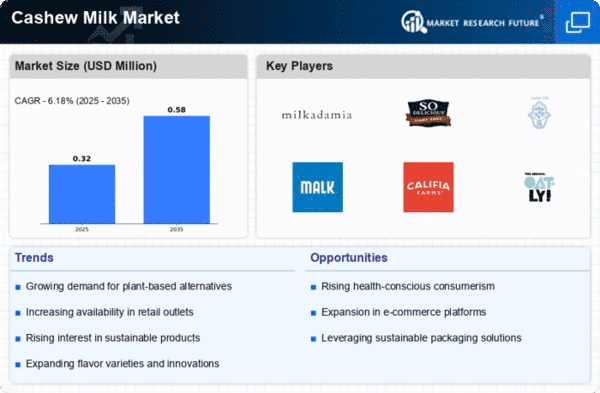
As per MRFR analysis, the Cashew Milk Market Size was estimated at 0.301 USD Million in 2024. The Cashew Milk industry is projected to grow from 0.323 in 2025 to 0.585 by 2035, exhibiting a compound annual growth rate (CAGR) of 6.18 during the forecast period 2025 - 2035.

Key Market Trends & Highlights

The Cashew Milk Market is experiencing robust growth driven by health trends and sustainability.

  • North America remains the largest market for cashew milk, reflecting a strong consumer preference for dairy alternatives.
  • The Asia-Pacific region is emerging as the fastest-growing market, driven by increasing health consciousness and demand for plant-based products.
  • The beverages segment dominates the market, while the coffee creamer segment is witnessing rapid growth due to innovative product offerings.
  • Rising demand for dairy alternatives and the nutritional benefits of cashew milk are key drivers propelling market expansion.

Market Size & Forecast

2024 Market Size 0.301 (USD Million)
2035 Market Size 0.585 (USD Million)
CAGR (2025 - 2035) 6.18%
Largest Regional Market Share in 2024 North America

Major Players

<p>Milkadamia (AU), So Delicious Dairy Free (US), Nutty Life (AU), MALK Organics (US), Califia Farms (US), Oatly (SE), Koko Dairy Free (GB), Almond Breeze (US)</p>

Market Trends

The cashew milk Market is currently experiencing a notable transformation, driven by a growing consumer preference for plant-based alternatives. This shift is largely influenced by increasing awareness regarding health benefits associated with nut-based beverages, as well as a rising inclination towards sustainable and environmentally friendly products. As consumers become more health-conscious, they appear to gravitate towards options that offer nutritional advantages without compromising on taste. This trend suggests a potential for cashew milk to carve out a significant niche within the broader dairy alternatives sector. Moreover, the Cashew Milk Market seems to be benefiting from innovative product developments and marketing strategies that appeal to diverse consumer segments. Companies are increasingly focusing on enhancing flavor profiles and fortifying their offerings with additional nutrients, which may attract a wider audience. The expansion of distribution channels, including online platforms, further indicates a strategic move to meet the evolving demands of consumers. As the market continues to evolve, it is likely that cashew milk will gain traction among those seeking healthier, plant-based options, thereby solidifying its position in the competitive landscape of dairy alternatives.

Rising Health Consciousness

The Cashew Milk Market is witnessing a surge in demand as consumers become more health-conscious. This trend indicates a preference for beverages that offer nutritional benefits, such as lower calories and higher vitamins, compared to traditional dairy products.

Sustainability Focus

There is a growing emphasis on sustainability within the Cashew Milk Market. Consumers are increasingly seeking products that align with their values regarding environmental impact, leading to a preference for plant-based options that are perceived as more eco-friendly.

Product Innovation

Innovation plays a crucial role in the Cashew Milk Market, with companies introducing new flavors and formulations. This trend suggests that brands are actively working to diversify their offerings, catering to varied consumer tastes and dietary needs.

Cashew Milk Market Market Drivers

Diverse Product Offerings

The Global Cashew Milk Market Industry is witnessing innovation through diverse product offerings, catering to a wide range of consumer preferences. Manufacturers are introducing flavored cashew milk, fortified options, and ready-to-drink formats, which enhance the appeal of cashew milk to various demographics. This diversification is crucial in attracting not only health-conscious consumers but also those seeking convenient and tasty alternatives to dairy. As a result, the market is expected to grow at a compound annual growth rate of 14.67% from 2025 to 2035. The introduction of new products may stimulate consumer interest and expand market reach.

Market Growth Projections

The Global Cashew Milk Market Industry is poised for substantial growth, with projections indicating a market value of 600.5 USD Million by 2035. This anticipated growth is underpinned by a compound annual growth rate of 14.67% from 2025 to 2035. The increasing consumer preference for plant-based alternatives, coupled with rising health consciousness and sustainability trends, suggests a robust market trajectory. As the industry evolves, it is likely to witness innovations in product offerings and distribution strategies, further enhancing its appeal. The projected figures underscore the potential for cashew milk to become a staple in the beverage market.

Rising Health Consciousness

The Global Cashew Milk Market Industry is experiencing a surge in demand driven by increasing health consciousness among consumers. As individuals become more aware of the health benefits associated with plant-based diets, cashew milk emerges as a favorable alternative to dairy. Rich in vitamins and minerals, cashew milk is perceived as a healthier option, particularly for those with lactose intolerance or dairy allergies. This trend is reflected in the projected market value of 133.3 USD Million in 2024, indicating a growing preference for nutritious beverages. The shift towards healthier lifestyles is likely to sustain the industry's growth trajectory in the coming years.

Sustainable and Ethical Consumption

Sustainability is becoming a pivotal factor influencing consumer choices in the Global Cashew Milk Market Industry. As environmental concerns escalate, consumers are increasingly seeking products that align with their values regarding sustainability and ethical sourcing. Cashew milk, often produced with a lower carbon footprint compared to traditional dairy, appeals to eco-conscious consumers. This trend is likely to contribute to the market's expansion, with projections indicating a market value of 600.5 USD Million by 2035. The emphasis on sustainable practices may further enhance brand loyalty and consumer trust, thereby driving sales in the cashew milk sector.

Growing Vegan and Plant-Based Trends

The Global Cashew Milk Market Industry is significantly influenced by the growing trends towards veganism and plant-based diets. As more individuals adopt these lifestyles, the demand for dairy alternatives, including cashew milk, is on the rise. This shift is not merely a fad; it reflects a broader societal change towards healthier and more sustainable eating habits. The increasing number of vegan products available in the market is likely to further propel the growth of cashew milk, as consumers seek diverse options. The industry's expansion is indicative of a larger movement towards plant-based consumption, which is expected to continue shaping market dynamics.

Increased Availability in Retail Channels

The Global Cashew Milk Market Industry is benefiting from increased availability across various retail channels. Supermarkets, health food stores, and online platforms are expanding their offerings of cashew milk, making it more accessible to consumers. This enhanced distribution network is crucial in meeting the rising demand for plant-based alternatives. As consumers seek convenient purchasing options, the growth of e-commerce is particularly noteworthy. The combination of traditional and online retail strategies is likely to bolster sales, contributing to the overall market growth. The accessibility of cashew milk is expected to play a significant role in shaping consumer purchasing behavior.

Market Segment Insights

By Application: Beverages (Largest) vs. Coffee Creamer (Fastest-Growing)

<p>The application segment of the cashew milk market is primarily dominated by the beverages category, which accounts for a significant portion of market share. This category appeals to both consumers seeking plant-based alternatives and those looking for healthier beverage options. Following beverages, cooking and baking applications are also noteworthy, although they capture a smaller share of the market. Coffee creamer is emerging as a rapidly growing segment, reflecting increasing consumer awareness and preference for dairy-free options in daily routines.</p>

<p>Beverages: Dominant vs. Coffee Creamer: Emerging</p>

<p>The beverages segment of the cashew milk market capitalizes on shifting consumer preferences toward healthier, plant-based dietary choices, making it the dominant category. The versatility of cashew milk as a beverage aligns with growing trends in health and wellness among consumers. On the other hand, coffee creamer is an emerging segment that has seen accelerated growth due to a rising trend of dairy-free products in coffee consumption. This shift is driven by the increasing number of lactose-intolerant individuals and evolving consumer attitudes toward veganism and sustainability, positioning coffee creamer as a promising area for innovation within the market.</p>

By Distribution Channel: Supermarkets (Largest) vs. Online Retail (Fastest-Growing)

<p>In the Cashew Milk Market, distribution shares are predominantly led by supermarkets, which remain a favorite shopping destination for consumers due to their wide selection and convenience. Health food stores and specialty stores also play a significant role in catering to niche markets, but they hold a smaller market share. Online retail has surged in popularity, appealing to health-conscious consumers looking for convenience and a broader selection, significantly increasing its overall share in recent years.</p>

<p>Supermarkets (Dominant) vs. Online Retail (Emerging)</p>

<p>In the Cashew Milk Market, supermarkets are the dominant distribution channel, offering a comprehensive range of products, competitive pricing, and the benefit of accessibility. Their established presence and customer loyalty provide them with a competitive advantage. On the other hand, online retail is rapidly emerging as a significant player in this market segment. The convenience, variety, and personalized shopping experience it offers align well with modern consumer preferences, particularly among millennials and health-conscious shoppers. As more consumers transition to online shopping, this channel is expected to continue its upward trajectory, challenging the traditional dominance of supermarkets.</p>

By End Use: Households (Largest) vs. Food Service (Fastest-Growing)

<p>In the Cashew Milk Market, households represent the largest segment, driven by increasing awareness of plant-based diets and health-conscious consumers. This segment has seen significant engagement due to the versatility of cashew milk as a substitute for dairy, appealing to various dietary preferences and restrictions. Meanwhile, the food service sector, including cafes and restaurants, is rapidly gaining traction, responding to the growing demand for dairy alternatives and vegan options. The growth in the food service segment can be attributed to the trend of incorporating healthier, plant-based ingredients in menus. Chefs and restaurant owners are increasingly recognizing the versatility of cashew milk in various culinary applications, leading to creative uses in smoothies, sauces, and desserts. This segment's response to consumer preferences for healthier dining options positions it for substantial growth in the coming years.</p>

<p>Household (Dominant) vs. Food Service (Emerging)</p>

<p>The household segment of the Cashew Milk Market is characterized by its broad consumer base and significant market presence. As more people shift towards plant-based diets for health, ethical, and environmental reasons, households have emerged as the dominant force in driving demand for cashew milk. This segment benefits from various marketing strategies, including online promotions and educational campaigns highlighting the health advantages of cashew milk. On the other hand, the food service segment, while currently considered emerging, is experiencing rapid growth due to the increasing popularity of plant-based options in cafes and restaurants. Establishments are actively incorporating cashew milk into their menus, catering to the preferences of a more health-conscious clientele, thereby enhancing its market position.</p>

By Formulation: Unsweetened (Largest) vs. Flavored (Fastest-Growing)

<p>In the Cashew Milk Market, the formulation segment exhibits a varied distribution, with unsweetened cashew milk leading the market as the largest segment. Unsweetened varieties are particularly favored for their natural taste and versatility, appealing to health-conscious consumers who prioritize low-sugar options. Conversely, flavored cashew milks, including vanilla and chocolate variants, are gaining traction and rapidly capturing market share due to their added taste appeal, particularly among younger demographics and those seeking alternative dairy options. The growth trends in the formulation segment reflect changing consumer preferences and a shift towards healthier lifestyles. The demand for unsweetened cashew milk continues to drive the market, supported by an increasing awareness of health benefits and dietary choices. Meanwhile, flavored variants are becoming popular as innovative product development introduces exciting flavors and fortification options, contributing to their status as the fastest-growing segment in the cashew milk market.</p>

<p>Unsweetened: Dominant vs. Flavored: Emerging</p>

<p>Unsweetened cashew milk holds a dominant position in the market, primarily due to its appeal among consumers looking for a clean, natural beverage without added sugars. This formulation is particularly popular among fitness enthusiasts and individuals with dietary restrictions who seek plant-based alternatives without compromising on health. In contrast, <a href="https://www.marketresearchfuture.com/reports/flavored-cashew-milk-market-38296" target="_blank">flavored cashew milk</a> represents an emerging trend where brands are spatially innovating to capture the tastes of younger consumers. Flavored varieties, which often include sweeteners and added ingredients, cater to those looking for indulgence combined with the health benefits of nut-based milk. As such, both formulations fulfill distinct consumer needs within the market, ensuring varied growth prospects.</p>

Get more detailed insights about Cashew Milk Market Research Report – Global Forecast till 2027

Regional Insights

North America : Market Leader in Cashew Milk

North America is poised to maintain its leadership in the cashew milk market, holding a significant market share of 15% as of 2024. The growth is driven by increasing consumer demand for plant-based alternatives, health consciousness, and a shift towards sustainable products. Regulatory support for dairy alternatives further fuels this trend, with various initiatives promoting plant-based diets. The competitive landscape is robust, featuring key players such as So Delicious Dairy Free, Califia Farms, and MALK Organics. The U.S. leads the market, with innovative product offerings and extensive distribution networks. The presence of established brands and new entrants enhances market dynamics, catering to diverse consumer preferences and dietary needs.

Europe : Emerging Market for Alternatives

Europe is rapidly emerging as a significant player in the cashew milk market, with a market share of 10% in 2024. The region's growth is propelled by rising health awareness, environmental concerns, and a shift towards veganism. Regulatory frameworks are increasingly supportive of plant-based products, encouraging innovation and market entry. Leading countries include Germany, the UK, and France, where consumer interest in dairy alternatives is surging. Key players like Oatly and Koko Dairy Free are capitalizing on this trend, offering a variety of cashew milk products. The competitive landscape is characterized by a mix of established brands and local producers, enhancing product diversity and availability.

Asia-Pacific : Emerging Powerhouse in Alternatives

Asia-Pacific is witnessing a gradual rise in the cashew milk market, currently holding a market share of 5% as of 2024. The growth is driven by increasing health consciousness and a shift towards plant-based diets among urban populations. Regulatory initiatives promoting healthier food options are also contributing to this trend, encouraging local production and consumption of dairy alternatives. Countries like Australia and New Zealand are leading the charge, with brands such as Milkadamia and Nutty Life gaining traction. The competitive landscape is evolving, with both local and international players entering the market, enhancing product offerings and catering to diverse consumer preferences.

Middle East and Africa : Developing Market for Alternatives

The Middle East and Africa region is developing a nascent cashew milk market, with a market share of 6% in 2024. The growth is driven by increasing awareness of health benefits associated with plant-based diets and a gradual shift in consumer preferences. Regulatory bodies are beginning to recognize the importance of promoting dairy alternatives, which is expected to catalyze market growth. Countries like South Africa and the UAE are at the forefront, with emerging brands exploring the cashew milk segment. The competitive landscape is still in its infancy, but the presence of international players is beginning to shape market dynamics, offering consumers more choices and fostering local production.

Key Players and Competitive Insights

The Cashew Milk Market is currently characterized by a dynamic competitive landscape, driven by increasing consumer demand for plant-based alternatives and a growing awareness of health and sustainability. Key players such as Milkadamia (AU), So Delicious Dairy Free (US), and Califia Farms (US) are strategically positioning themselves through innovation and regional expansion. For instance, Milkadamia (AU) has focused on enhancing its product line with organic certifications, which appeals to health-conscious consumers. Similarly, Califia Farms (US) has been expanding its distribution channels, ensuring its products are accessible in both retail and online platforms, thereby shaping a competitive environment that emphasizes availability and product diversity.

In terms of business tactics, companies are increasingly localizing manufacturing to reduce supply chain complexities and enhance sustainability. The market appears moderately fragmented, with several players vying for market share, yet the collective influence of major companies is significant. This competitive structure allows for a variety of product offerings, catering to diverse consumer preferences while fostering innovation across the sector.

In November 2025, So Delicious Dairy Free (US) announced the launch of a new cashew milk product line that incorporates functional ingredients aimed at enhancing gut health. This strategic move not only diversifies their product portfolio but also aligns with the growing trend of health-focused food products. The introduction of such innovative offerings is likely to strengthen their market position and attract health-conscious consumers.

In October 2025, Califia Farms (US) entered into a partnership with a leading e-commerce platform to enhance its online presence and streamline direct-to-consumer sales. This initiative reflects a broader trend towards digital transformation within the food and beverage sector, allowing Califia to reach a wider audience and adapt to changing consumer shopping behaviors. Such strategic actions are indicative of the company's commitment to leveraging technology for competitive advantage.

In September 2025, Milkadamia (AU) expanded its operations by opening a new manufacturing facility in the U.S., aimed at increasing production capacity and reducing shipping times. This expansion not only signifies a commitment to meeting rising demand but also enhances operational efficiency, positioning Milkadamia favorably against competitors. The establishment of local production facilities is a critical strategy in the current market, as it allows for quicker response times to consumer needs.

As of December 2025, the competitive trends within the Cashew Milk Market are increasingly defined by digitalization, sustainability, and the integration of advanced technologies. Strategic alliances are becoming more prevalent, as companies recognize the value of collaboration in enhancing product offerings and market reach. Looking ahead, competitive differentiation is likely to evolve from traditional price-based strategies to a focus on innovation, technological advancements, and supply chain reliability. This shift underscores the importance of adaptability in a rapidly changing market landscape.

Key Companies in the Cashew Milk Market market include

Industry Developments

    • In September 2019, Z Natural Foods Company introduced its new product –cashew milk powder. This initiative stood as a break from conventional milk to enable consumers to use mild cashew-flavored milk. The powder is convenient to use and mess-free.
    • In 2016, Danone procured White Wave Foods, an American soy milk manufacturing company for about USD 12 billion. This helped Danone increase the span of its product variety in lactose-free foods.
    • Forager Project, a vegan food product company in San Francisco, launched a few new products – coconut milk and coconut cashew yogurt. This yogurt has exceptional qualities such as creamy texture, high-fat, and delicious yogurt with both coconut and cashew flavors. 
    • In November 2018, Morrisons, the UK-based supermarket chain launched its range of organic vegan kinds of milk, including cashew nut milk. They applied innovative packaging for the kinds of milk to attract their consumers.
    • Benni Alimentos, a Brazilian food & beverage company, introduced its soluble cashew nut milk powder. This vegan milk powder has a shelf-life of up to 2 years.

Report Outlook

This report compiles all information about the growth of the global cashew milk market over the forecast period. There are different sections presented that help to get full-fledged information such as opportunities, challenges, drivers, Covid-19 analysis, regional analysis, competitive landscape, and others. All the information is gathered from reliable primary and secondary sources to provide the expected details of the cashew milk market analysis. 

Report Detail 

    • Historic Period: 2015-2020
    • Base Year: 2020
    • Forecast Period: 2020-2027

Geographically

    • North America
    • Europe 
    • Asia-Pacific
    • Rest of the world (RoW)

Future Outlook

Cashew Milk Market Future Outlook

<p>The <a href="https://www.marketresearchfuture.com/reports/cashew-milk-market-7352" target="_blank">cashew milk</a> Market is projected to grow at a 6.18% CAGR from 2024 to 2035, driven by rising health consciousness, plant-based trends, and innovative product offerings.</p>

New opportunities lie in:

  • <p>Expansion into emerging markets with tailored marketing strategies.</p>
  • <p>Development of fortified cashew milk products targeting health-conscious consumers.</p>
  • <p>Partnerships with cafes and restaurants for exclusive cashew milk beverages.</p>

<p>By 2035, the <a href="https://www.marketresearchfuture.com/reports/cashew-milk-market-7352" target="_blank">cashew milk</a> Market is expected to achieve substantial growth and diversification.</p>

Market Segmentation

Cashew Milk Market End Use Outlook

  • Household
  • Food Service
  • Cafes
  • Restaurants

Cashew Milk Market Application Outlook

  • Beverages
  • Cooking
  • Baking
  • Coffee Creamer

Cashew Milk Market Formulation Outlook

  • Unsweetened
  • Sweetened
  • Flavored
  • Fortified

Cashew Milk Market Distribution Channel Outlook

  • Supermarkets
  • Online Retail
  • Health Food Stores
  • Specialty Stores

Report Scope

MARKET SIZE 20240.301(USD Million)
MARKET SIZE 20250.323(USD Million)
MARKET SIZE 20350.585(USD Million)
COMPOUND ANNUAL GROWTH RATE (CAGR)6.18% (2024 - 2035)
REPORT COVERAGERevenue Forecast, Competitive Landscape, Growth Factors, and Trends
BASE YEAR2024
Market Forecast Period2025 - 2035
Historical Data2019 - 2024
Market Forecast UnitsUSD Million
Key Companies ProfiledMilkadamia (AU), So Delicious Dairy Free (US), Nutty Life (AU), MALK Organics (US), Califia Farms (US), Oatly (SE), Koko Dairy Free (GB), Almond Breeze (US)
Segments CoveredApplication, Distribution Channel, End Use, Formulation
Key Market OpportunitiesGrowing consumer preference for plant-based alternatives drives innovation in the Cashew Milk Market.
Key Market DynamicsRising consumer preference for plant-based alternatives drives innovation and competition in the cashew milk market.
Countries CoveredNorth America, Europe, APAC, South America, MEA

FAQs

Which region will lead the cashew milk market?

North America will lead the cashew milk market.

What are the key factors driving the cashew milk market?

Rising prevalence of lactose intolerance and demand for unsweetened cashew milk are the key factors driving the cashew milk market.

Who are the key players profiled in the cashew milk market?

Key players profiled in the cashew milk market include RITA Food &amp; Drink Co., Ltd. (Vietnam), Earth’s Own Food Company Inc. (Canada), Elmhurst Milked Direct LLC (US), Plenish Cleanse Ltd. (UK), Pacific Foods (US), Califia Farms (US), Rude Health (UK), Forager Project (US), Danone S.A.(France), and Hain Celestial Group (US).

Which category segment will dominate the cashew milk market?

Conventional segment will dominate the cashew milk market.

Which packaging type segment will have the largest share in the cashew milk market?

Cartons will have the largest share in the cashew milk market.

  1. Executive Summary
  2. Scope of the Report
    1. Market Definition
    2. Scope of the Study
      1. Research Objectives
      2. Assumptions & Limitations
    3. Market Structure
  3. Market
    1. Research Methodology
    2. Research Process
    3. Secondary Research
    4. Primary Research
    5. Forecast Model
  4. Market Landscape
    1. Supply Chain Analysis
  5. Raw Material Suppliers
  6. Manufacturers/Producers
  7. Distributors/Retailers/Wholesalers/E-Commerce
  8. End Users
    1. Porter’s Five Forces Analysis
      1. Threat of New Entrants
      2. Bargaining Power of Buyers
      3. Bargaining Power of Suppliers
      4. Threat of Substitutes
      5. Internal Rivalry
  9. Market Dynamics
    1. of Global Cashew Milk Market
    2. Introduction
    3. Drivers
    4. Restraints
    5. Opportunities
    6. Challenges
  10. Global Cashew Milk
  11. Market, by Category
    1. Introduction
    2. Conventional
      1. Market
      2. Market Estimates & Forecast,
    3. Estimates & Forecast, 2020–2027
    4. by Region, 2020–2027
    5. Organic
      1. Market Estimates & Forecast,
      2. Market Estimates & Forecast, by Region, 2020–2027
  12. Global Cashew Milk Market, by Packaging Type
    1. Introduction
      1. Market Estimates & Forecast, 2020–2027
    2. Bottles
  13. Market Estimates & Forecast, by Region, 2020–2027
    1. Cartons
      1. Market Estimates & Forecast, 2020–2027
      2. Market Estimates
    2. & Forecast, by Region, 2020–2027
    3. Others
      1. Market Estimates
      2. Market Estimates & Forecast, by Region,
    4. & Forecast, 2020–2027
  14. Global Cashew Milk Market, by Distribution Channel
    1. Introduction
    2. Store Based
      1. Supermarkets & Hypermarkets
      2. Convenience Stores
      3. Others
    3. & Forecast, by Region, 2020–2027
    4. Market Estimates & Forecast, 2020–2027
    5. Forecast, by Region, 2020–2027
    6. & Forecast, 2020–2027
    7. Region, 2020–2027
    8. Non-store Based
      1. Market Estimates &
      2. Market Estimates & Forecast, by Region,
    9. Forecast, 2020–2027
  15. Global Cashew Milk Market, by Region
    1. Introduction
    2. North America
      1. Market Estimates & Forecast, 2020–2027
      2. Market Estimates & Forecast, by Category, 2020–2027
  16. Market Estimates & Forecast, by Packaging Type, 2020–2027
    1. Estimates & Forecast, by Distribution Channel, 2020–2027
    2. & Forecast, by Category, 2020–2027
    3. Forecast, by Packaging Type, 2020–2027
    4. Forecast, by Distribution Channel, 2020–2027
    5. Market Estimates & Forecast, 2020–2027
    6. Forecast, by Category, 2020–2027
    7. by Packaging Type, 2020–2027
    8. by Distribution Channel, 2020–2027
    9. & Forecast, 2020–2027
    10. Category, 2020–2027
    11. Type, 2020–2027
    12. Channel, 2020–2027
  17. Market
  18. US
  19. Market Estimates & Forecast, 2020–2027
  20. Market Estimates
  21. Market Estimates &
  22. Market Estimates &
  23. Canada
  24. Market Estimates &
  25. Market Estimates & Forecast,
  26. Market Estimates & Forecast,
  27. Mexico
  28. Market Estimates
  29. Market Estimates & Forecast, by
  30. Market Estimates & Forecast, by Packaging
  31. Market Estimates & Forecast, by Distribution
    1. Europe
      1. Market Estimates & Forecast,
      2. Market Estimates & Forecast, by Category, 2020–2027
      3. Market Estimates & Forecast, by Packaging Type, 2020–2027
  32. Market Estimates & Forecast, by Distribution Channel, 2020–2027
    1. Germany
  33. Market Estimates & Forecast, 2020–2027
  34. Market Estimates & Forecast, by Category, 2020–2027
    1. Estimates & Forecast, by Packaging Type, 2020–2027
    2. Estimates & Forecast, by Distribution Channel, 2020–2027
    3. & Forecast, by Category, 2020–2027
    4. Forecast, by Packaging Type, 2020–2027
    5. Forecast, by Distribution Channel, 2020–2027
    6. Market Estimates & Forecast, 2020–2027
    7. Forecast, by Category, 2020–2027
    8. by Packaging Type, 2020–2027
    9. by Distribution Channel, 2020–2027
    10. & Forecast, 2020–2027
    11. Category, 2020–2027
    12. Type, 2020–2027
    13. Channel, 2020–2027
  35. Market
  36. Market
  37. France
  38. Market Estimates & Forecast, 2020–2027
  39. Market Estimates
  40. Market Estimates &
  41. Market Estimates &
  42. Italy
  43. Market Estimates &
  44. Market Estimates & Forecast,
  45. Market Estimates & Forecast,
  46. Spain
  47. Market Estimates
  48. Market Estimates & Forecast, by
  49. Market Estimates & Forecast, by Packaging
  50. Market Estimates & Forecast, by Distribution
  51. UK
  52. Market Estimates & Forecast,
  53. Market Estimates & Forecast, by Category, 2020–2027
  54. Market Estimates & Forecast, by Packaging Type, 2020–2027
  55. Market Estimates & Forecast, by Distribution Channel, 2020–2027
  56. Rest of Europe
  57. Market Estimates & Forecast, 2020–2027
  58. Market Estimates & Forecast, by Category, 2020–2027
  59. Market Estimates & Forecast, by Packaging Type, 2020–2027
  60. Market Estimates & Forecast, by Distribution Channel, 2020–2027
    1. Asia-Pacific
  61. Market Estimates & Forecast, 2020–2027
  62. Market Estimates & Forecast, by Category, 2020–2027
    1. Estimates & Forecast, by Packaging Type, 2020–2027
    2. & Forecast, by Distribution Channel, 2020–2027
    3. Market Estimates & Forecast, 2020–2027
    4. Forecast, by Category, 2020–2027
    5. by Packaging Type, 2020–2027
    6. by Distribution Channel, 2020–2027
    7. & Forecast, 2020–2027
    8. Category, 2020–2027
    9. Type, 2020–2027
    10. Channel, 2020–2027
  63. Market
  64. Market Estimates
  65. China
  66. Market Estimates &
  67. Market Estimates & Forecast,
  68. Market Estimates & Forecast,
  69. India
  70. Market Estimates
  71. Market Estimates & Forecast, by
  72. Market Estimates & Forecast, by Packaging
  73. Market Estimates & Forecast, by Distribution
  74. Japan
  75. Market Estimates & Forecast,
  76. Market Estimates & Forecast, by Category, 2020–2027
  77. Market Estimates & Forecast, by Packaging Type, 2020–2027
  78. Market Estimates & Forecast, by Distribution Channel, 2020–2027
  79. Australia & New Zealand
  80. Market Estimates & Forecast,
  81. Market Estimates & Forecast, by Category, 2020–2027
  82. Market Estimates & Forecast, by Packaging Type, 2020–2027
  83. Market Estimates & Forecast, by Distribution Channel, 2020–2027
  84. Rest of Asia-Pacific
  85. Market Estimates & Forecast, 2020–2027
  86. Market Estimates & Forecast, by Category, 2020–2027
  87. Market Estimates & Forecast, by Packaging Type, 2020–2027
  88. Market Estimates & Forecast, by Distribution Channel, 2020–2027
    1. Rest of the World (RoW)
  89. Market Estimates & Forecast, 2020–2027
  90. Market Estimates & Forecast, by Category, 2020–2027
  91. Market Estimates & Forecast, by Packaging Type, 2020–2027
    1. Estimates & Forecast, by Distribution Channel, 2020–2027
    2. America
  92. Market
  93. South
  94. Market Estimates & Forecast, 2020–2027
  95. Market Estimates & Forecast, by Category, 2020–2027
    1. Estimates & Forecast, by Packaging Type, 2020–2027
    2. Estimates & Forecast, by Distribution Channel, 2020–2027
    3. Middle East
  96. Market
  97. Market
  98. The
  99. Market Estimates & Forecast, 2020–2027
  100. Market Estimates & Forecast, by Category, 2020–2027
    1. Estimates & Forecast, by Packaging Type, 2020–2027
    2. Estimates & Forecast, by Distribution Channel, 2020–2027
    3. & Forecast, by Category, 2020–2027
    4. Forecast, by Packaging Type, 2020–2027
    5. Forecast, by Distribution Channel, 2020–2027
  101. Market
  102. Market
  103. Africa
  104. Market Estimates & Forecast, 2020–2027
  105. Market Estimates
  106. Market Estimates &
  107. Market Estimates &
  108. Company Landscape
    1. Introduction
    2. Market Strategy
    3. Key Development Analysis
    4. (Expansions/ Mergers and Acquisitions/ Joint Ventures/ New Product Developments/
    5. Agreements/ Investments
  109. Company Profiles
    1. Hain Celestial Group
      1. Company Overview
      2. Financial Updates
      3. Product/Business
      4. Strategy
      5. Key Developments
    2. Segment Overview
    3. SWOT Analysis
    4. Danone S.A.
      1. Company Overview
      2. Financial
      3. Product/Business Segment Overview
      4. Strategy
      5. Key Developments
      6. SWOT Analysis
    5. Updates
    6. Forager Project
      1. Company Overview
      2. Financial Updates
      3. Product/Business
      4. Strategy
      5. Key Developments
    7. Segment Overview
    8. SWOT Analysis
    9. Rude Health
      1. Company Overview
      2. Financial
      3. Product/Business Segment Overview
      4. Strategy
      5. Key Developments
      6. SWOT Analysis
    10. Updates
    11. Califia Farms
      1. Financial Updates
      2. Product/Business Segment
      3. Strategy
      4. Key Developments
      5. SWOT Analysis
    12. Company Overview
    13. Overview
    14. Pacific Foods
      1. Company Overview
      2. Financial Updates
      3. Product/Business Segment Overview
      4. Strategy
      5. SWOT Analysis
    15. Key Developments
    16. Plenish Cleanse Ltd.
      1. Financial Updates
      2. Product/Business Segment
      3. Strategy
      4. Key Developments
      5. SWOT Analysis
    17. Company Overview
    18. Overview
    19. Elmhurst Milked Direct LLC
      1. Company Overview
      2. Financial
      3. Product/Business Segment Overview
      4. Strategy
      5. Key Developments
      6. SWOT Analysis
    20. Updates
    21. Earth’s Own
      1. Company Overview
      2. Financial Updates
      3. Product/Business Segment Overview
      4. Strategy
      5. Key
      6. SWOT Analysis
    22. Food Company Inc.
    23. Developments
    24. RITA Food & Drink Co.Ltd.
      1. Company Overview
      2. Financial Updates
      3. Product/Business
      4. Strategy
      5. Key Developments
    25. Segment Overview
    26. SWOT Analysis
  110. Conclusion
  111. LIST OF TABLES
  112. Global
  113. Cashew Milk Market, by Region, 2020–2027 (USD Million)
  114. Global
  115. Cashew Milk Market, by Category, 2020–2027 (USD Million)
  116. Global
  117. Cashew Milk Market, by Packaging Type, 2020–2027 (USD Million)
    1. Table
  118. Global Cashew Milk Market, by Distribution Channel, 2020–2027 (USD Million)
  119. North America: Cashew Milk Market, by Country, 2020–2027 (USD
    1. Million)
  120. North America: Cashew Milk Market, by Category, 2020–2027
    1. (USD Million)
  121. North America: Cashew Milk Market, by Packaging Type,
  122. North America: Cashew Milk Market, by
    1. Distribution Channel, 2020–2027 (USD Million)
  123. US: Cashew Milk
  124. Market, by Category, 2020–2027 (USD Million)
  125. US: Cashew Milk
  126. Market, by Packaging Type, 2020–2027 (USD Million)
  127. US: Cashew
  128. Milk Market, by Distribution Channel, 2020–2027 (USD Million)
    1. Table
  129. Canada: Cashew Milk Market, by Category, 2020–2027 (USD Million)
    1. Table
  130. Canada: Cashew Milk Market, by Packaging Type, 2020–2027 (USD Million)
  131. Canada: Cashew Milk Market, by Distribution Channel, 2020–2027
    1. (USD Million)
  132. Mexico: Cashew Milk Market, by Category, 2020–2027
    1. (USD Million)
  133. Mexico: Cashew Milk Market, by Packaging Type, 2020–2027
    1. (USD Million)
  134. Mexico: Cashew Milk Market, by Distribution Channel,
  135. Europe: Cashew Milk Market, by Country,
  136. Europe: Cashew Milk Market, by Category,
  137. Europe: Cashew Milk Market, by Packaging
    1. Type, 2020–2027 (USD Million)
  138. Europe: Cashew Milk Market, by
    1. Distribution Channel, 2020–2027 (USD Million)
  139. Germany: Cashew
  140. Milk Market, by Category, 2020–2027 (USD Million)
  141. Germany:
  142. Cashew Milk Market, by Packaging Type, 2020–2027 (USD Million)
    1. Table
  143. Germany: Cashew Milk Market, by Distribution Channel, 2020–2027 (USD Million)
  144. France: Cashew Milk Market, by Category, 2020–2027 (USD Million)
  145. France: Cashew Milk Market, by Packaging Type, 2020–2027 (USD
    1. Million)
  146. France: Cashew Milk Market, by Distribution Channel, 2020–2027
    1. (USD Million)
  147. Italy: Cashew Milk Market, by Category, 2020–2027
    1. (USD Million)
  148. Italy: Cashew Milk Market, by Packaging Type, 2020–2027
    1. (USD Million)
  149. Italy: Cashew Milk Market, by Distribution Channel,
  150. Spain: Cashew Milk Market, by Category,
  151. Spain: Cashew Milk Market, by Packaging
    1. Type, 2020–2027 (USD Million)
  152. Spain: Cashew Milk Market, by
    1. Distribution Channel, 2020–2027 (USD Million)
  153. UK: Cashew Milk
  154. Market, by Category, 2020–2027 (USD Million)
  155. UK: Cashew Milk
  156. Market, by Packaging Type, 2020–2027 (USD Million)
  157. UK: Cashew
  158. Milk Market, by Distribution Channel, 2020–2027 (USD Million)
    1. Table
  159. Rest of Europe: Cashew Milk Market, by Category, 2020–2027 (USD Million)
  160. Rest of Europe: Cashew Milk Market, by Packaging Type, 2020–2027
    1. (USD Million)
  161. Rest of Europe: Cashew Milk Market, by Distribution
    1. Channel, 2020–2027 (USD Million)
  162. Asia-Pacific: Cashew Milk
  163. Market, by Country, 2020–2027 (USD Million)
  164. Asia-Pacific: Cashew
  165. Milk Market, by Category, 2020–2027 (USD Million)
  166. Asia-Pacific:
  167. Cashew Milk Market, by Packaging Type, 2020–2027 (USD Million)
    1. Table
  168. Asia-Pacific: Cashew Milk Market, by Distribution Channel, 2020–2027 (USD
    1. Million)
  169. China: Cashew Milk Market, by Category, 2020–2027
    1. (USD Million)
  170. China: Cashew Milk Market, by Packaging Type, 2020–2027
    1. (USD Million)
  171. China: Cashew Milk Market, by Distribution Channel,
  172. India: Cashew Milk Market, by Category,
  173. India: Cashew Milk Market, by Packaging
    1. Type, 2020–2027 (USD Million)
  174. India: Cashew Milk Market, by
    1. Distribution Channel, 2020–2027 (USD Million)
  175. Japan: Cashew
  176. Milk Market, by Category, 2020–2027 (USD Million)
  177. Japan: Cashew
  178. Milk Market, by Packaging Type, 2020–2027 (USD Million)
  179. Japan:
  180. Cashew Milk Market, by Distribution Channel, 2020–2027 (USD Million)
    1. Table
  181. Australia and New Zealand: Cashew Milk Market, by Category, 2020–2027 (USD
    1. Million)
  182. Australia and New Zealand: Cashew Milk Market, by Packaging
    1. Type, 2020–2027 (USD Million)
  183. Australia and New Zealand: Cashew
  184. Milk Market, by Distribution Channel, 2020–2027 (USD Million)
    1. Table
  185. Rest of Asia-Pacific: Cashew Milk Market, by Category, 2020–2027 (USD Million)
  186. Rest of Asia-Pacific: Cashew Milk Market, by Packaging Type, 2020–2027
    1. (USD Million)
  187. Rest of Asia-Pacific: Cashew Milk Market, by Distribution
    1. Channel, 2020–2027 (USD Million)
  188. Rest of the World (RoW): Cashew
  189. Milk Market, by Country, 2020–2027 (USD Million)
  190. Rest of the
  191. World (RoW): Cashew Milk Market, by Category, 2020–2027 (USD Million)
  192. Rest of the World (RoW): Cashew Milk Market, by Packaging Type, 2020–2027
    1. (USD Million)
  193. Rest of the World (RoW): Cashew Milk Market, by Distribution
    1. Channel, 2020–2027 (USD Million)
  194. South America: Cashew Milk
  195. Market, by Category, 2020–2027 (USD Million)
  196. South America:
  197. Cashew Milk Market, by Packaging Type, 2020–2027 (USD Million)
    1. Table
  198. South America: Cashew Milk Market, by Distribution Channel, 2020–2027 (USD
    1. Million)
  199. Middle East: Cashew Milk Market, by Category, 2020–2027
    1. (USD Million)
  200. Middle East: Cashew Milk Market, by Packaging Type,
  201. Middle East: Cashew Milk Market, by
    1. Distribution Channel, 2020–2027 (USD Million)
  202. Africa: Cashew
  203. Milk Market, by Category, 2020–2027 (USD Million)
  204. Africa: Cashew
  205. Milk Market, by Packaging Type, 2020–2027 (USD Million)
  206. Africa:
  207. Cashew Milk Market, by Distribution Channel, 2020–2027 (USD Million)
    1. LIST
  208. OF FIGURES
  209. Global Cashew Milk Market Segmentation
    1. FIGURE
  210. Forecast Research Methodology
  211. Five Forces Analysis of Global Cashew
    1. Milk Market
  212. Value Chain of Global Cashew Milk Market
    1. FIGURE 5
  213. Share of Global Cashew Milk Market in 2020, by Country (%)
  214. Global
  215. Cashew Milk Market, by Region, 2020–2027,
  216. Global Cashew Milk
  217. Market Size, by Category, 2020
  218. Share of Global Cashew Milk Market,
    1. by Category, 2020–2027 (%)
  219. Global Cashew Milk Market Size, by
    1. Packaging Type, 2020
  220. Share of Global Cashew Milk Market, by Packaging
    1. Type, 2020–2027 (%)
  221. Global Cashew Milk Market Size, by Distribution
    1. Channel, 2020
  222. Share of Global Cashew Milk Market, by Distribution
    1. Channel, 2020–2027 (%)

Cashew Milk Market Segmentation

Market Segmentation Overview

  • Detailed segmentation data will be available in the full report
  • Comprehensive analysis by multiple parameters
  • Regional and country-level breakdowns
  • Market size forecasts by segment
Infographic

Free Sample Request

Kindly complete the form below to receive a free sample of this Report

Get Free Sample

Customer Strories

Compare Licence

×
Features License Type
Single User Multiuser License Enterprise User
Price $4,950 $5,950 $7,250
Maximum User Access Limit 1 User Upto 10 Users Unrestricted Access Throughout the Organization
Free Customization
Direct Access to Analyst
Deliverable Format
Platform Access
Discount on Next Purchase 10% 15% 15%
Printable Versions