×
Request Free Sample ×

Kindly complete the form below to receive a free sample of this Report

* Please use a valid business email

Leading companies partner with us for data-driven Insights

clients tt-cursor
Hero Background

Canada Zig Bee Automation Market

ID: MRFR/ICT/60161-HCR
200 Pages
Aarti Dhapte
February 2026

Canada Zigbee Automation Market Size, Share and Trends Analysis Report By Application (Smart Home Automation, Industrial Automation, Smart Healthcare, Smart Lighting, Smart Agriculture), By End Use (Residential, Commercial, Industrial), By Component (Sensors, Actuators, Controllers, Gateways) and By Network Topology (Star Topology, Mesh Topology, Cluster Tree Topology)-Forecast to 2035

Share:
Download PDF ×

We do not share your information with anyone. However, we may send you emails based on your report interest from time to time. You may contact us at any time to opt-out.

Canada Zig Bee Automation Market Infographic
Purchase Options

Canada Zig Bee Automation Market Summary

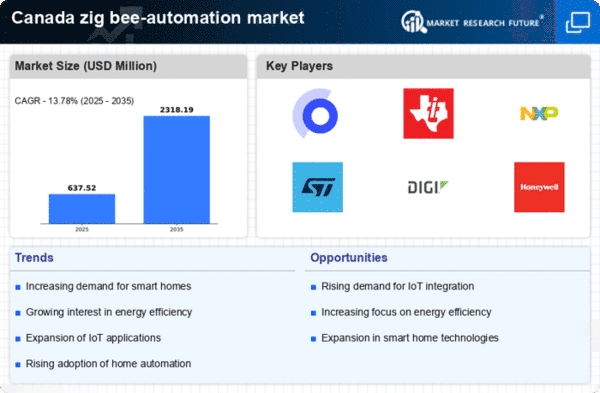
As per Market Research Future analysis, the Canada Zig Bee Automation Market size was estimated at 560.31 USD Million in 2024. The Zig Bee-automation market is projected to grow from 637.52 USD Million in 2025 to 2318.19 USD Million by 2035, exhibiting a compound annual growth rate (CAGR) of 13.7% during the forecast period 2025 - 2035

Key Market Trends & Highlights

The Canada Zig Bee-automation market is experiencing robust growth driven by technological advancements and increasing consumer demand.

  • The market is witnessing increased adoption of smart home devices, particularly in urban areas.
  • Energy efficiency remains a focal point, with consumers seeking solutions that reduce utility costs.
  • Regulatory support for automation technologies is enhancing market accessibility and consumer trust.
  • Rising demand for home automation solutions and government incentives for smart technology adoption are key drivers of market growth.

Market Size & Forecast

2024 Market Size 560.31 (USD Million)
2035 Market Size 2318.19 (USD Million)
CAGR (2025 - 2035) 13.78%

Major Players

Silicon Labs (US), Texas Instruments (US), NXP Semiconductors (NL), STMicroelectronics (CH), Digi International (US), Honeywell (US), Philips (NL), Zigbee Alliance (US)

Our Impact
Enabled $4.3B Revenue Impact for Fortune 500 and Leading Multinationals
Partnering with 2000+ Global Organizations Each Year
30K+ Citations by Top-Tier Firms in the Industry

Canada Zig Bee Automation Market Trends

The is currently evolving, driven by the increasing demand for smart home technologies and the growing emphasis on energy efficiency. As consumers become more aware of the benefits of automation, there is a marked shift towards integrating zig bee protocols into various devices. This trend is further supported by advancements in wireless communication technologies, which enhance connectivity and interoperability among devices. The market appears to be expanding as manufacturers focus on developing innovative solutions that cater to the needs of both residential and commercial sectors. Moreover, the regulatory landscape in Canada is evolving to support the adoption of zig bee-automation technologies. Government initiatives aimed at promoting energy-efficient solutions are likely to bolster market growth. The emphasis on sustainability and reducing carbon footprints aligns well with the capabilities of zig bee technologies, which facilitate efficient energy management. As a result, stakeholders in the Canada Zig Bee Automation Market are increasingly collaborating with regulatory bodies to ensure compliance and to leverage potential incentives. This collaborative approach may enhance the overall market landscape, fostering a more robust environment for innovation and growth.

Increased Adoption of Smart Home Devices

The zig bee-automation market is witnessing a surge in the adoption of smart home devices. Consumers are increasingly inclined towards solutions that offer convenience, security, and energy efficiency. This trend is likely to drive demand for zig bee-enabled products, as they provide seamless connectivity and interoperability among various devices.

Focus on Energy Efficiency

There is a growing emphasis on energy efficiency within the zig bee-automation market. As environmental concerns rise, consumers and businesses are seeking solutions that minimize energy consumption. Zig bee technologies facilitate this by enabling better energy management and monitoring, which could lead to significant cost savings.

Regulatory Support for Automation Technologies

The zig bee-automation market benefits from supportive regulatory frameworks in Canada. Government initiatives aimed at promoting automation and energy-efficient technologies are likely to create a favorable environment for market growth. This support may encourage innovation and investment in zig bee solutions.

Canada Zig Bee Automation Market Drivers

Increased Focus on Sustainable Living

The is benefiting from a focus on sustainable living practices.. As environmental awareness grows, consumers are seeking solutions that reduce energy consumption and promote eco-friendly lifestyles. Zig bee technology facilitates energy-efficient automation by allowing users to monitor and control their energy usage in real-time. This capability is particularly appealing in a market where energy costs are rising. According to recent data, homes equipped with zig bee-enabled devices can achieve energy savings of up to 30%. This trend aligns with the broader movement towards sustainability, encouraging manufacturers to develop products that not only enhance convenience but also contribute to environmental conservation. The zig bee-automation market is thus positioned to thrive as consumers prioritize sustainability in their purchasing decisions.

Rising Demand for Home Automation Solutions

The is seeing a surge in demand for home automation solutions.. This trend is driven by consumers' increasing desire for convenience, security, and energy management. As more households adopt smart technologies, the market is projected to grow at a compound annual growth rate (CAGR) of approximately 15% over the next five years. The integration of zig bee technology into various devices allows for seamless communication and control, enhancing user experience. Furthermore, the growing awareness of the benefits of automation, such as remote monitoring and control, is likely to propel the zig bee-automation market forward. This shift towards smart living is not only transforming residential spaces but also influencing the design and functionality of new products in the market.

Technological Advancements in Zig Bee Protocols

Technological advancements in zig bee protocols are significantly impacting the zig bee-automation market in Canada. Innovations in wireless communication technology are enhancing the efficiency and reliability of zig bee devices. These advancements enable better interoperability among devices, which is crucial for creating a cohesive smart home ecosystem. As manufacturers continue to improve the performance of zig bee-enabled products, the market is expected to witness an influx of new applications and use cases. The introduction of low-power, high-performance devices is likely to attract more consumers, further driving market growth. Additionally, the ongoing development of security features within zig bee protocols is addressing consumer concerns regarding data privacy and device security, thereby fostering greater trust in automation technologies.

Growing Integration of IoT in Residential Spaces

The growing integration of Internet of Things (IoT) technologies in residential spaces is significantly influencing the zig bee-automation market in Canada. As IoT devices become more prevalent, the demand for seamless connectivity and interoperability among devices is increasing. Zig bee technology, known for its low-power and reliable communication capabilities, is well-suited for IoT applications. This integration allows for enhanced automation, enabling users to control multiple devices from a single platform. The market is likely to see a rise in innovative applications that leverage IoT capabilities, such as smart lighting, security systems, and climate control. As consumers become more accustomed to interconnected devices, the zig bee-automation market is poised for substantial growth, driven by the desire for smarter, more efficient living environments.

Government Incentives for Smart Technology Adoption

Government incentives aimed at promoting smart technology adoption are playing a crucial role in the zig bee-automation market in Canada. Various provincial and federal programs are designed to encourage homeowners to invest in energy-efficient and automated solutions. These initiatives often include rebates, tax credits, and grants for the installation of smart home devices. Such financial support is likely to lower the barrier to entry for consumers, making zig bee-enabled products more accessible. As a result, the market is expected to expand as more households take advantage of these incentives. Furthermore, government policies that promote innovation in automation technologies are fostering a favorable environment for the zig bee-automation market, potentially leading to increased competition and product diversity.


Market Segment Insights

By Application: Smart Home Automation (Largest) vs. Smart Healthcare (Fastest-Growing)

The Canada zig bee-automation market reveals a diverse application landscape, with Smart Home Automation holding the largest share. This segment has captured significant market interest due to increasing consumer preferences for convenience and control of home environments. In contrast, Smart Healthcare, while smaller in share, demonstrates dynamic growth potential as healthcare providers adopt automation solutions to enhance patient care efficiency, showcasing a growing trend toward integrated health technologies. Growth in the Canada zig bee-automation market is fueled by rising consumer demand for interconnected devices in homes and the critical need for automation in healthcare, necessitated by the ongoing improvement of health services. Additional drivers include advancements in IoT technology and government initiatives promoting smart infrastructure, facilitating a stronger foothold for sectors like Smart Lighting and Smart Agriculture, which play vital roles in energy efficiency and resource management.

Smart Home Automation (Dominant) vs. Smart Agriculture (Emerging)

Smart Home Automation stands out as the dominant force in the Canada zig bee-automation market, characterized by seamless user experience and the ability to integrate various home devices under a single platform. This segment benefits from trends such as energy efficiency and enhanced security features. On the other hand, Smart Agriculture represents an emerging segment, leveraging automation technologies to improve productivity in farming. It focuses on precision agriculture techniques which lead to optimized resource use and improved crop yields, indicating a promising future as more farmers adopt these technologies to meet the increasing food demand.

By End Use: Residential (Largest) vs. Commercial (Fastest-Growing)

The market share distribution within the end-use segments of the Canada zig bee-automation market reveals a clear dominance of the residential sector, which captures the largest share. This segment benefits from a growing trend of smart home adoption, leading to an increased demand for automation technologies that enhance convenience and energy efficiency. In contrast, the commercial segment, though smaller in comparison, showcases significant growth potential driven by the need for improved operational efficiencies and cost savings in various business environments. Growth trends in the Canada zig bee-automation market are primarily influenced by innovation and technological advancements. The residential segment continues to see a rise in smart devices and home automation systems, appealing to consumers focused on sustainability and ease of use. Meanwhile, the commercial segment is rapidly evolving, with businesses investing in automation solutions for better resource management. The pandemic further accelerated this trend, as companies sought to enhance their remote management capabilities and improve workforce safety through automation.

Residential (Dominant) vs. Commercial (Emerging)

The residential segment in the Canada zig bee-automation market is characterized by its extensive integration of smart devices, including smart lighting, security systems, and climate control, making it the dominant force in the market. This segment is heavily influenced by consumers' desires for convenience and energy efficiency, fostering a robust ecosystem of interconnected technologies. In contrast, the commercial segment emerges with distinct characteristics that cater to business environments, focusing on automation solutions that streamline operations and reduce costs. Although currently smaller, the commercial segment is rapidly gaining traction due to increasing awareness of automation benefits and technological advancements that provide tailored solutions for various business needs. As companies shift towards automation, the commercial segment is poised for substantial growth.

By Component: Sensors (Largest) vs. Actuators (Fastest-Growing)

In the Canada zig bee-automation market, the component segment displays varied market share distribution among its key values. Sensors command the largest share, reflecting their critical role in data acquisition and environmental monitoring. Actuators, while smaller in share compared to sensors, are rapidly gaining ground, driven by advancements in automation technology and increasing demand for efficient control mechanisms across industries. The growth trends in this segment are characterized by the escalating adoption of smart solutions in various sectors, which fuels the need for sophisticated sensors and actuators. The burgeoning Internet of Things (IoT) ecosystem also plays a pivotal role, enhancing the interconnectivity of devices and systems. As businesses seek to optimize processes, the demand for controllers and gateways is expected to grow, reflecting their essential role in system integration and management.

Sensors: Dominant vs. Actuators: Emerging

In the Canada zig bee-automation market, sensors are recognized as the dominant component, offering diverse capabilities such as temperature, humidity, and motion sensing, which are essential for various automation applications. Their widespread usage across industries helps maintain a significant lead in market presence. In contrast, actuators stand out as the emerging component, characterized by innovative designs that facilitate precise control in automated systems. As industries increasingly prioritize efficiency and responsiveness, the demand for actuators is surging. Together, these components underscore the essential nature of automation technology, with sensors providing the necessary data and actuators executing commands to enhance operational performance.

By Network Topology: Star Topology (Largest) vs. Mesh Topology (Fastest-Growing)

In the Canada zig bee-automation market, Star Topology holds a significant market share, primarily due to its simplicity and ease of deployment. This topology is preferred by many users for its straightforward architecture and reliable performance, which contributes to its dominant position. Conversely, Mesh Topology, though currently smaller in market share, is rapidly gaining traction as more devices require robust connectivity and reliability, especially in dense environments.

Star Topology (Dominant) vs. Mesh Topology (Emerging)

Star Topology is characterized by its central node connecting all other nodes, ensuring a streamlined communication path which offers high reliability and fault tolerance. Meanwhile, Mesh Topology provides multiple pathways for data transmission, enhancing resilience and minimizing the risk of communication failures. The emergence of Mesh Topology in the Canada zig bee-automation market is driven by the increasing demand for smart home applications, wherein the need for enhanced connectivity and flexibility is paramount. This juxtaposition of topologies illustrates the ongoing transformation in network structures driven by technological advancements and user needs.

Get more detailed insights about Canada Zig Bee Automation Market

Key Players and Competitive Insights

The zig bee-automation market is currently characterized by a dynamic competitive landscape, driven by technological advancements and increasing demand for smart home and industrial automation solutions. Key players such as Silicon Labs (US), Texas Instruments (US), and NXP Semiconductors (NL) are strategically positioned to leverage their expertise in wireless communication technologies. These companies focus on innovation and partnerships to enhance their product offerings and expand their market reach. Their collective strategies contribute to a moderately fragmented market structure, where competition is intensifying as new entrants emerge alongside established firms.In terms of business tactics, companies are increasingly localizing manufacturing and optimizing supply chains to enhance operational efficiency. This approach not only reduces costs but also improves responsiveness to market demands. The competitive structure of the zig bee-automation market appears to be moderately fragmented, with several key players exerting influence over market dynamics. The presence of both large corporations and smaller innovators fosters a diverse ecosystem that encourages technological advancements and competitive pricing.

In October Silicon Labs (US) announced a strategic partnership with a leading smart home device manufacturer to integrate their Zigbee technology into a new line of products. This collaboration is expected to enhance the interoperability of smart devices, thereby improving user experience and expanding market penetration. Such partnerships are indicative of a broader trend where companies seek to create ecosystems that facilitate seamless connectivity among devices, which is crucial for the growth of the zig bee-automation market.

In September Texas Instruments (US) launched a new series of Zigbee-enabled microcontrollers aimed at industrial automation applications. This product line is designed to enhance energy efficiency and reduce operational costs for manufacturers. The introduction of these microcontrollers reflects Texas Instruments' commitment to innovation and its strategic focus on addressing the specific needs of industrial clients, thereby solidifying its position in the market.

In August NXP Semiconductors (NL) expanded its Zigbee product portfolio by acquiring a smaller tech firm specializing in IoT solutions. This acquisition is likely to bolster NXP's capabilities in developing advanced Zigbee solutions, enabling it to offer more comprehensive services to its clients. Such strategic moves highlight the importance of mergers and acquisitions in enhancing technological capabilities and market presence in the zig bee-automation sector.

As of November current trends in the zig bee-automation market include a strong emphasis on digitalization, sustainability, and the integration of artificial intelligence (AI) into automation solutions. Strategic alliances among key players are shaping the competitive landscape, fostering innovation and collaboration. Looking ahead, it is anticipated that competitive differentiation will increasingly rely on technological advancements and supply chain reliability, rather than solely on price. This shift underscores the importance of innovation and adaptability in maintaining a competitive edge in the evolving market.

Key Companies in the Canada Zig Bee Automation Market include

Industry Developments

The Canada Zigbee Automation Market has experienced significant developments recently, with a growing focus on smart home solutions and energy management systems. Sinopé Technologies, a smart-device manufacturer based in Québec, has been producing and distributing Zigbee-compatible thermostats, switches, and smart plugs for Canadian residences since at least 2022. This will continue through 2025. Its products are officially certified to function with ecosystems such as Apple HomeKit, Samsung SmartThings, Hubitat, and Hydro-Québec's Neviweb platform.

These Zigbee products facilitate the integration of residential automation systems throughout Canada.Honeywell and Cisco jointly introduced a building energy-management solution that is propelled by AI in August 2024. This solution combines Cisco Spaces and Honeywell Forge Sustainability+. Real-time occupancy data is employed by this platform to regulate HVAC, lighting, and other systems on a large scale. Although it is not specific to Zigbee, it demonstrates the heightened collaboration on interoperable connectivity platforms and smart-building standards in Canada's commercial structures.

Future Outlook

Canada Zig Bee Automation Market Future Outlook

The is projected to grow at a CAGR of 13.78% from 2025 to 2035., driven by advancements in IoT technology, increased demand for energy efficiency, and smart home integration.

New opportunities lie in:

  • Development of integrated smart home systems leveraging Zigbee protocols.
  • Expansion of Zigbee-enabled industrial automation solutions for manufacturing.
  • Creation of customized Zigbee-based energy management systems for commercial buildings.

By 2035, the zig bee-automation market is expected to achieve substantial growth and innovation.

Market Segmentation

Canada Zig Bee Automation Market End Use Outlook

  • Residential
  • Commercial
  • Industrial

Canada Zig Bee Automation Market Component Outlook

  • Sensors
  • Actuators
  • Controllers
  • Gateways

Canada Zig Bee Automation Market Application Outlook

  • Smart Home Automation
  • Industrial Automation
  • Smart Healthcare
  • Smart Lighting
  • Smart Agriculture

Canada Zig Bee Automation Market Network Topology Outlook

  • Star Topology
  • Mesh Topology
  • Cluster Tree Topology

Report Scope

MARKET SIZE 2024 560.31(USD Million)
MARKET SIZE 2025 637.52(USD Million)
MARKET SIZE 2035 2318.19(USD Million)
COMPOUND ANNUAL GROWTH RATE (CAGR) 13.78% (2025 - 2035)
REPORT COVERAGE Revenue Forecast, Competitive Landscape, Growth Factors, and Trends
BASE YEAR 2024
Market Forecast Period 2025 - 2035
Historical Data 2019 - 2024
Market Forecast Units USD Million
Key Companies Profiled Silicon Labs (US), Texas Instruments (US), NXP Semiconductors (NL), STMicroelectronics (CH), Digi International (US), Honeywell (US), Philips (NL), Zigbee Alliance (US)
Segments Covered Application, End Use, Component, Network Topology
Key Market Opportunities Integration of smart home devices driving demand in the zig bee-automation market.
Key Market Dynamics Rising demand for energy-efficient solutions drives innovation in Zigbee automation technologies across various sectors.
Countries Covered Canada
Leave a Comment

FAQs

What is the expected market size of the Canada Zigbee Automation Market in 2024?

The Canada Zigbee Automation Market is expected to be valued at 558.6 USD million in 2024.

What will be the projected market value of the Canada Zigbee Automation Market by 2035?

By 2035, the Canada Zigbee Automation Market is projected to reach 1207.4 USD million.

What is the expected compound annual growth rate (CAGR) for the Canada Zigbee Automation Market from 2025 to 2035?

The expected CAGR for the Canada Zigbee Automation Market is 7.259% for the period from 2025 to 2035.

Which application segment is projected to have the highest market value in the Canada Zigbee Automation Market in 2035?

The Smart Agriculture segment is projected to have the highest market value at 307.4 USD million in 2035.

What will be the market size for Smart Home Automation in Canada by 2035?

The market size for Smart Home Automation in Canada is expected to reach 250.0 USD million by 2035.

What are the key players in the Canada Zigbee Automation Market?

Key players include Cisco, Philips, Honeywell, Amazon, and NXP Semiconductors among others.

What is the projected market size for Industrial Automation in Canada by 2035?

The market size for Industrial Automation in Canada is expected to reach 300.0 USD million by 2035.

What market value is anticipated for Smart Healthcare in the Canada Zigbee Automation Market by 2035?

Smart Healthcare is anticipated to reach a market value of 150.0 USD million by 2035.

What impact do emerging trends have on the growth of the Canada Zigbee Automation Market?

Emerging trends are likely to drive substantial growth, leading to increased investments and innovations.

How significant is the Smart Lighting application in the Canada Zigbee Automation Market by 2035?

Smart Lighting is expected to achieve a market value of 200.0 USD million in Canada by 2035.

Download Free Sample

Kindly complete the form below to receive a free sample of this Report

Compare Licence

×
Features License Type
Single User Multiuser License Enterprise User
Price $4,950 $5,950 $7,250
Maximum User Access Limit 1 User Upto 10 Users Unrestricted Access Throughout the Organization
Free Customization
Direct Access to Analyst
Deliverable Format
Platform Access
Discount on Next Purchase 10% 15% 15%
Printable Versions