×
Request Free Sample ×

Kindly complete the form below to receive a free sample of this Report

* Please use a valid business email

Leading companies partner with us for data-driven Insights

clients tt-cursor
Hero Background

Canada Virtual Desktop Infrastructure Market

ID: MRFR/ICT/56417-HCR
200 Pages
Aarti Dhapte
February 2026

Canada Virtual Desktop Infrastructure Market Size, Share and Research Report: By Component (Software, Service), By Application (IT & Telecommunication, Media & Entertainment, Education, Healthcare, BFSI, Government, Retail & Manufacturing) and By Type (On-Premise, Cloud-based)- Industry Forecast to 2035

Share:
Download PDF ×

We do not share your information with anyone. However, we may send you emails based on your report interest from time to time. You may contact us at any time to opt-out.

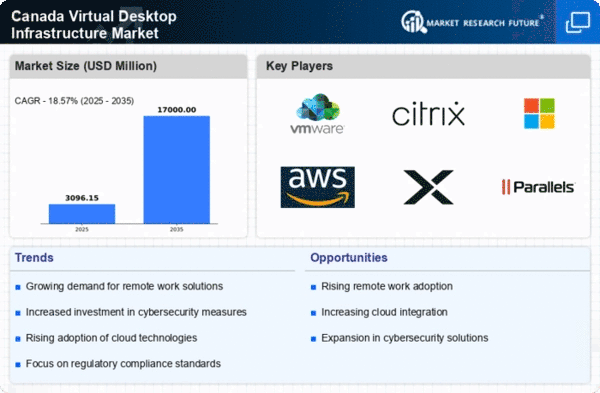
Canada Virtual Desktop Infrastructure Market Infographic
Purchase Options

Canada Virtual Desktop Infrastructure Market Summary

As per Market Research Future analysis, the Canada Virtual Desktop Infrastructure Market size was estimated at 2611.24 USD Million in 2024. The Canada virtual desktop-infrastructure market is projected to grow from 3096.15 USD Million in 2025 to 17000.0 USD Million by 2035, exhibiting a compound annual growth rate (CAGR) of 18.5% during the forecast period 2025 - 2035

Key Market Trends & Highlights

The Canada virtual desktop-infrastructure market is experiencing robust growth driven by evolving technological needs and sector-specific demands.

  • The education sector emerges as the largest segment, showcasing increased adoption of virtual desktop solutions.
  • The healthcare sector is identified as the fastest-growing segment, reflecting a heightened focus on secure and compliant digital environments.
  • There is a notable trend towards integration with cloud services, enhancing flexibility and scalability for organizations.
  • Key market drivers include the growing demand for remote work solutions and rising cybersecurity concerns, which are shaping the market landscape.

Market Size & Forecast

2024 Market Size 2611.24 (USD Million)
2035 Market Size 17000.0 (USD Million)
CAGR (2025 - 2035) 18.57%

Major Players

VMware (US), Citrix Systems (US), Microsoft (US), Amazon Web Services (US), Nutanix (US), Parallels (US), Google (US), IBM (US), Oracle (US)

Our Impact
Enabled $4.3B Revenue Impact for Fortune 500 and Leading Multinationals
Partnering with 2000+ Global Organizations Each Year
30K+ Citations by Top-Tier Firms in the Industry

Canada Virtual Desktop Infrastructure Market Trends

The market is experiencing notable growth, driven by the increasing demand for remote work solutions and the need for enhanced security measures. Organizations are increasingly adopting virtual desktop solutions to streamline operations, reduce costs, and improve flexibility. This trend is particularly evident in sectors such as education, healthcare, and finance, where secure access to applications and data is paramount. As businesses continue to embrace digital transformation, the Canada Virtual Desktop Infrastructure Market is poised for further expansion, with innovations in cloud computing and virtualization technologies playing a crucial role. In addition, the emphasis on sustainability and energy efficiency is influencing the adoption of virtual desktop solutions. Companies are recognizing the potential for reduced energy consumption and lower carbon footprints through centralized management of desktop environments. This shift not only aligns with corporate social responsibility goals but also offers potential cost savings. As the virtual desktop-infrastructure market evolves, it is likely to attract more investments and partnerships, fostering a competitive landscape that encourages continuous improvement and innovation.

Increased Adoption in Education Sector

Educational institutions are increasingly implementing virtual desktop solutions to facilitate remote learning and enhance collaboration among students and faculty. This trend is driven by the need for accessible and secure learning environments, allowing students to access resources from various devices.

Focus on Security and Compliance

Organizations are prioritizing security in their virtual desktop strategies, particularly in sectors that handle sensitive data. Enhanced security measures, such as multi-factor authentication and data encryption, are becoming standard practices to ensure compliance with regulations.

Integration with Cloud Services

The integration of virtual desktop solutions with cloud services is gaining traction, enabling organizations to leverage scalable resources and improve operational efficiency. This trend allows for greater flexibility in managing workloads and enhances the overall user experience.

Canada Virtual Desktop Infrastructure Market Drivers

Rising Cybersecurity Concerns

Cybersecurity remains a critical concern for organizations across Canada, significantly impacting the virtual desktop-infrastructure market. With the increasing frequency of cyberattacks, businesses are prioritizing the protection of sensitive data and applications. A recent survey indicated that 75% of Canadian IT leaders consider cybersecurity a top priority in their technology investments. Virtual desktop solutions offer enhanced security features, such as centralized management and data encryption, which are essential for safeguarding corporate information. As organizations seek to mitigate risks associated with data breaches and ensure compliance with regulations, the demand for secure virtual desktop infrastructures is expected to rise. This heightened focus on cybersecurity is likely to drive growth in the virtual desktop-infrastructure market, as companies invest in solutions that provide robust protection against evolving threats.

Increased Focus on Cost Efficiency

Cost efficiency is becoming a pivotal driver for the virtual desktop-infrastructure market in Canada. Organizations are increasingly recognizing the potential for significant cost savings through the adoption of virtual desktop solutions. By centralizing desktop management and reducing the need for physical hardware, companies can lower operational expenses. A study revealed that businesses utilizing virtual desktop infrastructures can reduce IT costs by up to 30%. This financial incentive is particularly appealing to small and medium-sized enterprises (SMEs) that may have limited budgets for IT infrastructure. As organizations strive to optimize their expenditures while maintaining productivity, The market is likely to see increased investment. This focus on cost efficiency is expected to propel the growth of the market as more companies seek to implement solutions that deliver both financial and operational benefits.

Growing Demand for Remote Work Solutions

The virtual desktop-infrastructure market in Canada is experiencing a notable surge in demand for remote work solutions. As organizations increasingly adopt flexible work arrangements, the need for secure and efficient remote access to desktop environments has become paramount. According to recent data, approximately 60% of Canadian companies have implemented or are planning to implement remote work policies. This shift necessitates robust virtual desktop solutions that can support diverse workforces while ensuring data security and compliance. The ability to provide employees with seamless access to applications and data from any location is driving investments in virtual desktop technologies. Consequently, this trend is likely to propel the growth of the virtual desktop-infrastructure market, as businesses seek to enhance productivity and maintain operational continuity in a remote work landscape.

Regulatory Compliance and Data Sovereignty

Regulatory compliance and data sovereignty are critical factors influencing the virtual desktop-infrastructure market in Canada. With stringent data protection laws, such as the Personal Information Protection and Electronic Documents Act (PIPEDA), organizations must ensure that their data management practices align with legal requirements. Virtual desktop solutions can facilitate compliance by providing centralized control over data access and storage. Furthermore, the need for data sovereignty, which mandates that data be stored within national borders, is driving the demand for local virtual desktop solutions. As Canadian businesses navigate the complexities of regulatory frameworks, The market is likely to benefit from increased investments in compliant solutions. This focus on regulatory adherence is expected to shape the future landscape of the market, as organizations prioritize secure and compliant virtual desktop environments.

Technological Advancements in Virtualization

Technological advancements in virtualization are significantly influencing the virtual desktop-infrastructure market in Canada. Innovations such as improved graphics processing capabilities, enhanced user experience, and more efficient resource management are making virtual desktop solutions increasingly attractive to businesses. For instance, the introduction of GPU virtualization allows for better performance in graphics-intensive applications, which is particularly beneficial for sectors like design and engineering. Furthermore, the integration of artificial intelligence and machine learning into virtualization technologies is streamlining operations and optimizing resource allocation. As these advancements continue to evolve, they are likely to enhance the appeal of virtual desktop infrastructures, driving adoption across various industries in Canada. This trend suggests a promising future for the virtual desktop-infrastructure market as organizations leverage cutting-edge technologies to improve efficiency and user satisfaction.


Market Segment Insights

By Component: Software (Largest) vs. Service (Fastest-Growing)

In the Canada virtual desktop-infrastructure market, the Software component holds a significant portion of the market share, establishing itself as the largest segment. This dominance is attributed to the growing demand for robust software solutions that enhance the efficiency of virtual desktop environments. Organizations are increasingly investing in advanced software tools that facilitate seamless integration and management of virtual services, contributing to the overall growth of this segment. Conversely, the Service component is emerging as the fastest-growing segment within the market. The surge in remote work and the need for cloud services have propelled the demand for virtual desktop services. Businesses are recognizing the value of managed services and support systems, which are vital for ensuring optimal performance and reliability. This trend indicates a shift towards more service-oriented solutions that complement existing software offerings.

Software (Dominant) vs. Service (Emerging)

The Software segment of the Canada virtual desktop-infrastructure market is characterized by a wide array of applications and tools that empower businesses to effectively manage their virtual workspaces. As the dominant component, it encompasses various solutions tailored to enhance user experience, security, and accessibility. Meanwhile, the Service segment is gaining traction and is recognized as an emerging player, driven by the rising demand for customized support and managed services. This segment focuses on providing businesses with the necessary infrastructure and ongoing support, ensuring that virtual desktop environments operate efficiently. Together, these components highlight the market's shift towards integrated solutions that combine robust software capabilities with comprehensive service offerings.

By Application: IT & Telecommunication (Largest) vs. Media & Entertainment (Fastest-Growing)

In the Canada virtual desktop-infrastructure market, the application segment reflects diverse needs across various industries. IT & Telecommunication leads the market with the largest share, benefiting from the growing demand for centralized management and security in enterprise environments. This segment is closely followed by Healthcare and BFSI, which also showcase considerable market shares due to their reliance on secure and efficient data management. The growth trends are significantly influenced by the increasing adoption of remote work environments and the need for efficient resource management. Media & Entertainment is experiencing rapid growth, driven by a surge in digital content consumption and the requirement for robust infrastructure to support streaming services. Education and Government sectors are also evolving, embracing virtual solutions to enhance accessibility and flexibility.

IT & Telecommunication: Dominant vs. Media & Entertainment: Emerging

The IT & Telecommunication segment in the Canada virtual desktop-infrastructure market is characterized by its robust infrastructure, which accommodates the needs of businesses requiring high levels of security and data management. This segment benefits from advancements in technology and a strong commitment to providing reliable services. As more companies transition to virtual environments, the demand for IT solutions continues to grow. Meanwhile, the Media & Entertainment sector presents an emerging opportunity, focused on delivering high-quality streaming services and managing the complexities of digital media. This sector is rapidly innovating to keep pace with consumer demands, signaling a shift towards more flexible and scalable solutions that cater to real-time content delivery and engagement.

By Type: Cloud-based (Largest) vs. On-Premise (Fastest-Growing)

The Canada virtual desktop-infrastructure market exhibits a notable distribution between on-premise and cloud-based solutions. The cloud-based segment holds the largest market share, appealing to organizations looking for scalability and flexibility. On-premise solutions, while historically significant, are now facing competition due to shifting preferences towards cloud technologies. Growth trends indicate a strong shift towards cloud-based infrastructure, driven by the need for remote access and enhanced collaboration tools. Businesses are increasingly recognizing the benefits of managed services, which offer cost efficiency and reduced IT overhead. Meanwhile, the on-premise segment is evolving, growing at an accelerated pace as enterprises seek hybrid solutions that combine the security of on-premise systems with the versatility of cloud deployments.

Infrastructure: Cloud-based (Dominant) vs. On-Premise (Emerging)

In the Canada virtual desktop-infrastructure market, cloud-based solutions are dominant due to their advanced features and user-friendly interfaces. They offer companies the ability to scale resources dynamically, enabling faster deployment and reduced time-to-value. Conversely, the on-premise segment is emerging as businesses seek enhanced data security and customization options. While cloud solutions provide flexibility and mobility, on-premise deployments cater to organizations with stringent compliance and data governance requirements. The competition between these segments fuels innovation, as providers endeavor to offer integrated solutions that retain the benefits of both approaches.

Get more detailed insights about Canada Virtual Desktop Infrastructure Market

Key Players and Competitive Insights

The virtual desktop-infrastructure market is currently characterized by a dynamic competitive landscape, driven by the increasing demand for remote work solutions and the need for enhanced data security. Major players such as VMware (US), Citrix Systems (US), and Microsoft (US) are at the forefront, each adopting distinct strategies to solidify their market positions. VMware (US) focuses on innovation through its cloud-based solutions, while Citrix Systems (US) emphasizes partnerships to enhance its service offerings. Microsoft (US), leveraging its extensive ecosystem, integrates its virtual desktop solutions with other cloud services, thereby creating a comprehensive user experience. Collectively, these strategies contribute to a competitive environment that is both collaborative and competitive, as companies seek to differentiate themselves through technology and service quality.
Key business tactics within this market include localizing services to meet regional demands and optimizing supply chains to enhance efficiency. The competitive structure appears moderately fragmented, with several key players holding substantial market shares. This fragmentation allows for a variety of service offerings, catering to diverse customer needs. The influence of these major companies is significant, as they not only set industry standards but also drive innovation through their respective technological advancements.
In October 2025, VMware (US) announced a strategic partnership with a leading cybersecurity firm to enhance its virtual desktop security features. This move is likely to bolster VMware's competitive edge by addressing growing concerns over data breaches and security vulnerabilities in remote work environments. By integrating advanced security protocols, VMware aims to reassure clients about the safety of their data, which is increasingly critical in today’s digital landscape.
In September 2025, Citrix Systems (US) launched a new version of its virtual desktop service, incorporating AI-driven analytics to optimize user experience. This development suggests a shift towards more intelligent systems that can adapt to user behavior, potentially increasing productivity and satisfaction. The integration of AI not only enhances the functionality of Citrix's offerings but also positions the company as a leader in innovation within the market.
In November 2025, Microsoft (US) unveiled a new pricing model for its virtual desktop services, aimed at making them more accessible to small and medium-sized enterprises (SMEs). This strategic adjustment indicates a recognition of the need to cater to a broader customer base, particularly as SMEs increasingly seek cost-effective solutions for remote work. By lowering barriers to entry, Microsoft may expand its market share and foster greater adoption of its services among smaller businesses.
As of November 2025, current trends in the virtual desktop-infrastructure market are heavily influenced by digitalization, sustainability, and the integration of AI technologies. Strategic alliances are becoming increasingly important, as companies collaborate to enhance their service offerings and address evolving customer needs. Looking ahead, competitive differentiation is likely to shift from price-based strategies to a focus on innovation, technological advancements, and supply chain reliability. This evolution suggests that companies will need to invest in research and development to stay ahead in a rapidly changing market.

Key Companies in the Canada Virtual Desktop Infrastructure Market include

Industry Developments

The Canada Virtual Desktop Infrastructure Market has seen dynamic developments recently, with a notable emphasis on cloud computing and remote work solutions. Major companies like Microsoft and Citrix are focusing on enhancing their VDI offerings in response to the growing demand for remote work flexibility. In particular, Microsoft's Azure Virtual Desktop is gaining traction among businesses seeking secure and scalable solutions. 

Meanwhile, VMware and Amazon Web Services are collaborating with Canadian enterprises to streamline their VDI deployments, enhancing productivity and security levels. There have been significant movements in the market landscape, particularly a merger between Citrix and a prominent Canadian software firm in August 2023, aimed at bolstering its VDI capabilities in the region. 

The market has witnessed substantial growth, with revenue projections showing a continued upward trend spurred by increasing remote work adoption. Furthermore, government initiatives are promoting digital transformation within businesses across Canada, pushing companies to adopt advanced virtualization technologies. As organizations adapt to hybrid work models, the need for efficient VDI solutions remains critical, impacting overall market valuations positively.


Future Outlook

Canada Virtual Desktop Infrastructure Market Future Outlook

The virtual desktop-infrastructure market is projected to grow at an 18.57% CAGR from 2025 to 2035, driven by increasing remote work adoption, cloud integration, and enhanced security needs.

New opportunities lie in:

  • Development of tailored VDI solutions for SMEs
  • Expansion of managed services for enterprise clients
  • Integration of AI-driven analytics for performance optimization

By 2035, the market is expected to achieve substantial growth, driven by innovation and strategic investments.

Market Segmentation

Canada Virtual Desktop Infrastructure Market Type Outlook

  • On-Premise
  • Cloud-based

Canada Virtual Desktop Infrastructure Market Component Outlook

  • Software
  • Service

Canada Virtual Desktop Infrastructure Market Application Outlook

  • IT & Telecommunication
  • Media & Entertainment
  • Education
  • Healthcare
  • BFSI
  • Government
  • Retail & Manufacturing

Report Scope

MARKET SIZE 2024 2611.24(USD Million)
MARKET SIZE 2025 3096.15(USD Million)
MARKET SIZE 2035 17000.0(USD Million)
COMPOUND ANNUAL GROWTH RATE (CAGR) 18.57% (2025 - 2035)
REPORT COVERAGE Revenue Forecast, Competitive Landscape, Growth Factors, and Trends
BASE YEAR 2024
Market Forecast Period 2025 - 2035
Historical Data 2019 - 2024
Market Forecast Units USD Million
Key Companies Profiled VMware (US), Citrix Systems (US), Microsoft (US), Amazon Web Services (US), Nutanix (US), Parallels (US), Google (US), IBM (US), Oracle (US)
Segments Covered Component, Application, Type
Key Market Opportunities Growing demand for remote work solutions drives innovation in the virtual desktop-infrastructure market.
Key Market Dynamics Growing demand for remote work solutions drives innovation and competition in the virtual desktop-infrastructure market.
Countries Covered Canada
Leave a Comment

FAQs

What is the projected market size of the Canada Virtual Desktop Infrastructure Market for 2024?

The Canada Virtual Desktop Infrastructure Market is expected to be valued at 1.18 billion USD in 2024.

What will be the market value of the Canada Virtual Desktop Infrastructure Market by 2035?

By 2035, the market is anticipated to reach a value of 8.32 billion USD.

What is the expected compound annual growth rate (CAGR) for the Canada Virtual Desktop Infrastructure Market from 2025 to 2035?

The expected CAGR for the market from 2025 to 2035 is 19.445%.

What is the market size for software within the Canada Virtual Desktop Infrastructure Market in 2024?

In 2024, the market size for software within the Canada Virtual Desktop Infrastructure Market is valued at 0.6 billion USD.

What will the market size for software be in 2035?

The market size for software is projected to grow to 4.4 billion USD by 2035.

How much is the service segment valued at in 2024 for the Canada Virtual Desktop Infrastructure Market?

The service segment is expected to be valued at 0.58 billion USD in 2024.

What is the expected market size for the service segment by 2035?

By 2035, the service segment is projected to increase in size to 3.92 billion USD.

Who are the key players in the Canada Virtual Desktop Infrastructure Market?

Key players in the market include Microsoft, Citrix, Cisco, IBM, and Amazon Web Services.

What are some emerging trends in the Canada Virtual Desktop Infrastructure Market?

Emerging trends include increased cloud adoption and enhanced remote work solutions.

What factors are driving growth in the Canada Virtual Desktop Infrastructure Market?

Growth drivers include the rising demand for flexible work environments and efficient IT management.

Download Free Sample

Kindly complete the form below to receive a free sample of this Report

Compare Licence

×
Features License Type
Single User Multiuser License Enterprise User
Price $4,950 $5,950 $7,250
Maximum User Access Limit 1 User Upto 10 Users Unrestricted Access Throughout the Organization
Free Customization
Direct Access to Analyst
Deliverable Format
Platform Access
Discount on Next Purchase 10% 15% 15%
Printable Versions