×
Request Free Sample ×

Kindly complete the form below to receive a free sample of this Report

* Please use a valid business email

Leading companies partner with us for data-driven Insights

clients tt-cursor
Hero Background

Canada Technical Illustration Software Market

ID: MRFR/ICT/63699-HCR
200 Pages
Aarti Dhapte
February 2026

Canada Technical Illustration Software Market Size, Share and Trends Analysis Report By Application (Engineering, Manufacturing, Medical, Academic, Marketing), By Deployment Mode (On-Premise, Cloud-Based), By End User (Small and Medium Enterprises, Large Enterprises, Freelancers), By Features (3D Rendering, Vector Graphics, Animation, Color Management) and By Industry Vertical (Aerospace, Automotive, Healthcare, Education, Consumer Goods)- Forecast to 2035

Share:
Download PDF ×

We do not share your information with anyone. However, we may send you emails based on your report interest from time to time. You may contact us at any time to opt-out.

Canada Technical Illustration Software Market Infographic
Purchase Options

Canada Technical Illustration Software Market Summary

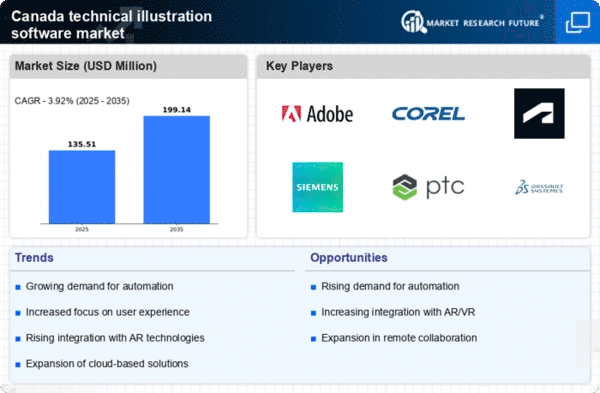
As per Market Research Future analysis, the Canada Technical Illustration Software Market size was estimated at 130.4 USD Million in 2024. The Canada technical illustration-software market is projected to grow from 135.51 USD Million in 2025 to 199.14 USD Million by 2035, exhibiting a compound annual growth rate (CAGR) of 3.9% during the forecast period 2025 - 2035

Key Market Trends & Highlights

The Canada technical illustration-software market is experiencing a transformative shift driven by technological advancements and evolving user needs.

  • The integration of AR and VR technologies is reshaping the capabilities of technical illustration software.
  • There is a notable shift towards cloud-based solutions, enhancing accessibility and collaboration among users.
  • The focus on sustainability is becoming increasingly prominent, influencing software development practices.
  • Rising demand for visual communication and technological advancements in software development are key drivers propelling market growth.

Market Size & Forecast

2024 Market Size 130.4 (USD Million)
2035 Market Size 199.14 (USD Million)
CAGR (2025 - 2035) 3.92%

Major Players

Adobe Systems (US), Corel Corporation (CA), Autodesk (US), Siemens (DE), PTC (US), Dassault Systèmes (FR), TechSmith Corporation (US), Ashampoo GmbH & Co. KG (DE)

Our Impact
Enabled $4.3B Revenue Impact for Fortune 500 and Leading Multinationals
Partnering with 2000+ Global Organizations Each Year
30K+ Citations by Top-Tier Firms in the Industry

Canada Technical Illustration Software Market Trends

the Canada Technical Illustration Software Market is experiencing a notable evolution, driven by advancements in technology and increasing demand for high-quality visual communication. In Canada, industries such as engineering, manufacturing, and education are increasingly adopting these tools to enhance their documentation and presentation capabilities. The integration of augmented reality (AR) and virtual reality (VR) into technical illustrations is becoming more prevalent, allowing for immersive experiences that facilitate better understanding of complex concepts. Furthermore, the rise of remote work has prompted organizations to seek software solutions that enable collaboration and sharing of illustrations across various platforms, thereby enhancing productivity and efficiency. In addition, the emphasis on sustainability and eco-friendly practices is influencing the technical illustration-software market. Companies are now prioritizing software that supports digital workflows, reducing the need for physical materials and minimizing their environmental footprint. As a result, there is a growing interest in cloud-based solutions that offer flexibility and scalability. The convergence of these trends suggests a dynamic landscape for the technical illustration-software market, with opportunities for innovation and growth in the coming years.

Integration of AR and VR Technologies

The incorporation of augmented reality and virtual reality technologies into technical illustration software is gaining traction. This trend allows users to create more engaging and interactive visual content, enhancing the learning experience and improving comprehension of complex subjects.

Shift Towards Cloud-Based Solutions

There is a noticeable shift towards cloud-based technical illustration software, driven by the need for remote collaboration and accessibility. These solutions enable users to access their work from various devices, facilitating teamwork and streamlining workflows.

Focus on Sustainability

The technical illustration-software market is increasingly influenced by sustainability concerns. Companies are seeking software that supports digital processes, reducing reliance on physical materials and promoting eco-friendly practices in their operations.

Canada Technical Illustration Software Market Drivers

Growth of the E-Learning Sector

The expansion of the e-learning sector in Canada is significantly influencing the technical illustration-software market. With the increasing reliance on online education platforms, there is a heightened demand for engaging and informative visual content. Reports indicate that the e-learning market in Canada is projected to grow at a CAGR of 10% over the next five years. This growth is prompting educational institutions and corporate training programs to invest in technical illustration software to create compelling instructional materials. The ability to produce clear and visually appealing illustrations is essential for enhancing learner engagement and retention. Consequently, the technical illustration-software market is expected to benefit from this trend. More organizations recognize the importance of high-quality visuals in their educational offerings..

Rising Demand for Visual Communication

The increasing need for effective visual communication across various sectors in Canada is driving the technical illustration-software market. Industries such as engineering, manufacturing, and education are increasingly relying on visual aids to convey complex information. This trend is evidenced by a reported growth of approximately 15% in the adoption of technical illustrations in educational materials alone. As organizations seek to enhance clarity and engagement, the demand for sophisticated software that can produce high-quality illustrations is likely to rise. Furthermore, the integration of visual content into marketing strategies is becoming more prevalent, suggesting that companies are recognizing the value of technical illustrations in capturing audience attention. Consequently, this growing emphasis on visual communication is expected to significantly impact the technical illustration-software market, leading to increased investments in innovative software solutions.

Increased Focus on Remote Collaboration

The shift towards remote work and collaboration is reshaping the landscape of the technical illustration-software market. As teams become more geographically dispersed, the need for tools that facilitate collaboration on visual projects is becoming paramount. Software that allows multiple users to work on illustrations in real-time is gaining traction, as it enhances productivity and streamlines workflows. This trend is particularly relevant in industries such as architecture and engineering, where collaborative design processes are essential. the technical illustration-software market is likely to see an uptick in demand for features that support remote collaboration. This includes cloud-based storage and sharing capabilities.. As organizations adapt to new working environments, the ability to collaborate effectively on visual content will be a critical factor in the success of technical illustration software.

Regulatory Compliance and Standardization

The increasing emphasis on regulatory compliance and standardization across various industries in Canada is driving the technical illustration-software market. Industries such as healthcare, manufacturing, and construction are subject to stringent regulations that require accurate and detailed documentation. Technical illustrations play a crucial role in meeting these compliance standards, as they provide clear representations of processes, products, and safety protocols. As companies strive to adhere to regulatory requirements, the demand for software that can produce compliant illustrations is likely to grow. Furthermore, the need for standardization in technical documentation is prompting organizations to invest in software solutions that ensure consistency and accuracy in their visual content. This trend suggests that the technical illustration-software market will continue to expand as businesses prioritize compliance and quality in their documentation practices.

Technological Advancements in Software Development

The rapid pace of technological advancements is a key driver for the technical illustration-software market in Canada. Innovations in artificial intelligence (AI) and machine learning are enabling software developers to create more intuitive and user-friendly applications. These advancements allow for automation in the illustration process, reducing the time and effort required to produce high-quality visuals. For instance, AI-driven tools can analyze user preferences and suggest design elements, enhancing the overall user experience. Additionally, the integration of 3D modeling capabilities is becoming more common, allowing users to create dynamic and interactive illustrations. As a result, the technical illustration-software market is likely to witness a surge in demand for these advanced features. Businesses seek to leverage cutting-edge technology to improve their visual communication efforts..


Market Segment Insights

By Application: Engineering (Largest) vs. Medical (Fastest-Growing)

The Canada technical illustration-software market displays diverse application segments, with Engineering commanding the largest share. This segment benefits from robust demand across various industries, leveraging advanced software for design and drafting. Medical applications are gaining traction, driven by the need for precision in medical device illustrations and educational materials. In terms of growth trends, the Medical segment is emerging as the fastest-growing sector, propelled by technological advancements and increasing investments in healthcare. Enhanced visualization tools for medical purposes significantly drive demand, coupled with an expanding base of users in educational institutions. As these trends continue, both Engineering and Medical applications are expected to evolve, catering to the needs of their respective fields.

Engineering: Dominant vs. Medical: Emerging

The Engineering segment is characterized by its substantial presence in the Canada technical illustration-software market, attracting clients from construction, automotive, and aerospace industries. Its dominance is rooted in the necessity for detailed technical drawings and simulations that enhance project accuracy and efficiency. Conversely, the Medical segment is witnessing rapid growth due to rising healthcare innovations and the demand for high-quality illustrations for devices and procedures. This segment is marked by increasing use of software for educational purposes, enabling better training and understanding in the medical field. As such, while Engineering remains a staple of the market, Medical is paving the way for innovative growth opportunities.

By Deployment Mode: Cloud-Based (Largest) vs. On-Premise (Fastest-Growing)

In the Canada technical illustration-software market, the deployment mode is significantly influenced by increasing preference for cloud-based solutions. The cloud-based segment holds a major share, driven by the demand for easy accessibility, lower maintenance costs, and scalability. Meanwhile, on-premise solutions, albeit smaller in market share, are experiencing a surge in adoption from organizations prioritizing data control and security. Growth trends indicate a shift towards cloud-based offerings as businesses adapt to remote work and digital transformation. However, the on-premise segment is witnessing a resurgence as companies seek to keep sensitive information secure and comply with regulations. This dynamic creates a competitive landscape where both segments can thrive, driven by evolving consumer needs and technological advancements.

Deployment Mode: Cloud-Based (Dominant) vs. On-Premise (Emerging)

In the Canada technical illustration-software market, cloud-based deployment stands out as the dominant choice for enterprises, favored for its inherent flexibility and cost-effectiveness. Companies are increasingly gravitating toward solutions that offer real-time collaboration capabilities and automatic updates, ensuring competitiveness in a fast-paced environment. Conversely, on-premise solutions are being recognized as an emerging alternative, attracting clients with stringent data security requirements and customization needs. This segment is characterized by its ability to provide complete control over hardware and software configurations, appealing particularly to industries where data integrity is paramount, thus marking a unique position within the broader landscape.

By End User: Small and Medium Enterprises (Largest) vs. Freelancers (Fastest-Growing)

In the Canada technical illustration-software market, Small and Medium Enterprises (SMEs) command the largest share, reflecting their substantial role in leveraging technology for efficient operations. Meanwhile, Large Enterprises hold a notable but smaller segment of the market. The presence of SMEs highlights a trend where organizations of all sizes are increasingly adopting software solutions to enhance their technical illustration processes and overall productivity. Freelancers, however, are emerging as the fastest-growing segment, driven by the rise of the gig economy and an increasing number of independent professionals seeking specialized technical tools. This growth is supported by the increasing demand for personalized design services, which pushes these users to adopt flexible software solutions that cater to their unique needs, enhancing their market competitiveness.

Small and Medium Enterprises (Dominant) vs. Freelancers (Emerging)

Small and Medium Enterprises are characterized by their agility and flexibility, allowing them to quickly adapt to new software innovations. They typically possess limited budgets, prompting a cautious yet strategic investment in technical illustration tools that promise the best return on investment. In contrast, Freelancers represent a burgeoning market segment that values customizable and user-friendly solutions. With an increasing number of independent professionals demanding high-quality illustration tools tailored to their personal workflows, this segment is rapidly evolving. These differences highlight the distinct needs of SMEs focused on growth and efficiency, compared to Freelancers who prioritize versatility and innovation in their work.

By Features: 3D Rendering (Largest) vs. Animation (Fastest-Growing)

In the Canada technical illustration-software market, the distribution of market share among the features segment is notably diverse. 3D Rendering holds the largest share, reflecting its widespread adoption in design and visualization processes across various industries. On the other hand, Animation is emerging as a significant contender, rapidly gaining traction due to its increasing application in media, entertainment, and education sectors. Growth trends point towards a vibrant landscape for the features segment, driven by advancements in technology and changing consumer demands. The rise of virtual and augmented reality has propelled 3D Rendering to new heights, while Animation's growth is fueled by the demand for interactive content across digital platforms. As businesses seek innovative ways to engage audiences, these segments are well-positioned for continued expansion in the coming years.

3D Rendering (Dominant) vs. Animation (Emerging)

3D Rendering is characterized by its ability to create realistic visual representations of products and environments, making it essential for industries such as architecture, engineering, and product design. This feature allows for immersive presentations and has become a standard in the design process. In contrast, Animation serves as an emerging force, showcasing dynamic storytelling and visual appeal that resonate particularly with younger audiences. It is increasingly utilized in advertising, online courses, and social media. While 3D Rendering remains dominant, Animation is carving out its niche, promising innovative applications and a growing market presence in the digital landscape.

By Industry Vertical: Aerospace (Largest) vs. Automotive (Fastest-Growing)

The distribution of market share in the Canada technical illustration-software market reveals a strong presence for segments like Aerospace, Automotive, Healthcare, Education, and Consumer Goods. Among these, Aerospace stands out as the largest, reflecting significant investments in design and development processes. In contrast, Automotive, while holding a smaller share, is characterized by rapid growth, driven by innovation in vehicle technology and increasing demand for advanced illustration tools. Looking at growth trends, the Aerospace segment benefits from ongoing technological advancements and regulatory requirements for precision in design. Meanwhile, the Automotive sector is witnessing a surge due to the shift toward electric vehicles and smart technology integration. This convergence of technology and design in both industries propels further advancements in the market, indicating robust potential for continued growth in the coming years.

Aerospace: Dominant vs. Automotive: Emerging

The Aerospace segment commands a dominant position in the Canada technical illustration-software market, characterized by its need for high-precision tools and detailed visualizations that support complex designs. Companies in this sector focus on safety and compliance, leading to a steady demand for advanced illustration software. In contrast, the Automotive segment is emerging rapidly due to the ongoing transformation in vehicle production, emphasizing user experience and connectivity. This sector is leveraging technical illustration to enhance product development cycles and streamline communication among stakeholders. As consumers increasingly expect sophisticated vehicle features, the demand for innovative illustration solutions continues to rise, positioning the Automotive segment as a key growth player.

Get more detailed insights about Canada Technical Illustration Software Market

Key Players and Competitive Insights

The technical illustration-software market in Canada is characterized by a dynamic competitive landscape, driven by rapid technological advancements and increasing demand for high-quality visual communication tools. Key players such as Adobe Systems (US), Corel Corporation (CA), and Autodesk (US) are at the forefront, each adopting distinct strategies to enhance their market positioning. Adobe Systems (US) continues to innovate its Creative Cloud suite, focusing on integrating AI capabilities to streamline workflows and improve user experience. Corel Corporation (CA) emphasizes localized solutions tailored to Canadian industries, enhancing its appeal through regional partnerships. Meanwhile, Autodesk (US) is heavily investing in cloud-based solutions, reflecting a broader trend towards digital transformation in the industry. Collectively, these strategies contribute to a competitive environment that is increasingly focused on innovation and customer-centric solutions.In terms of business tactics, companies are increasingly localizing their offerings and optimizing supply chains to better serve the Canadian market. The competitive structure appears moderately fragmented, with several players vying for market share, yet the influence of major companies remains substantial. This duality fosters a competitive atmosphere where innovation and customer engagement are paramount, as smaller firms often seek to differentiate themselves through niche offerings or specialized services.

In October Adobe Systems (US) announced the launch of a new AI-driven feature within its technical illustration software, aimed at automating repetitive tasks and enhancing design efficiency. This strategic move underscores Adobe's commitment to leveraging cutting-edge technology to maintain its competitive edge. By integrating AI, Adobe not only improves user productivity but also positions itself as a leader in the evolving landscape of technical illustration.

In September Corel Corporation (CA) expanded its partnership with local educational institutions to provide tailored training programs for technical illustration software. This initiative is strategically significant as it not only fosters brand loyalty among future professionals but also enhances Corel's visibility in the educational sector. By investing in local talent development, Corel strengthens its market presence and aligns its offerings with the needs of emerging designers.

In August Autodesk (US) unveiled a new cloud-based collaboration tool designed specifically for technical illustrators, facilitating real-time feedback and project management. This development is crucial as it reflects Autodesk's focus on enhancing collaborative workflows, which are increasingly vital in a remote working environment. By prioritizing cloud solutions, Autodesk positions itself to meet the demands of modern design teams, thereby reinforcing its competitive stance.

As of November the competitive trends in the technical illustration-software market are heavily influenced by digitalization, sustainability, and the integration of AI technologies. Strategic alliances are becoming more prevalent, as companies recognize the value of collaboration in driving innovation. Looking ahead, it is likely that competitive differentiation will increasingly pivot from price-based strategies to those centered on technological innovation and supply chain reliability. This shift suggests a future where companies that prioritize advanced features and seamless user experiences will thrive in an ever-evolving market.

Key Companies in the Canada Technical Illustration Software Market include

Industry Developments

The Canada Technical Illustration Software Market is experiencing notable developments. PTC continues to innovate its products, enhancing features that facilitate dynamic technical illustrations, while Autodesk focuses on strengthening its cloud-based offerings to cater to remote and hybrid working environments that have gained traction post-2020. Moreover, Siemens has been strengthening its strategic partnerships, particularly with Esri, to enhance geospatial capabilities in technical illustrations. 

In terms of market valuation, companies like Adobe Systems have seen growth driven by increased demand for digital content creation tools, supporting their market position. Additionally, in August 2022, Corel Corporation announced the acquisition of Gravit Designer, expanding its portfolio of design tools, while TechSmith reported a rise in utilization of its products due to the eLearning boom. 

The market's focus on user interface improvements and enhanced functionality is expected to significantly influence future developments in Canada technical illustration landscape.

Future Outlook

Canada Technical Illustration Software Market Future Outlook

The Technical Illustration Software Market is projected to grow at 3.92% CAGR from 2025 to 2035, driven by technological advancements and increasing demand for visual communication.

New opportunities lie in:

  • Integration of AI-driven features for automated illustration generation.
  • Expansion into augmented reality applications for enhanced user engagement.
  • Development of subscription-based models for continuous revenue streams.

By 2035, the market is expected to achieve robust growth, reflecting evolving industry needs.

Market Segmentation

Canada Technical Illustration Software Market End User Outlook

  • Small and Medium Enterprises
  • Large Enterprises
  • Freelancers

Canada Technical Illustration Software Market Features Outlook

  • 3D Rendering
  • Vector Graphics
  • Animation
  • Color Management

Canada Technical Illustration Software Market Application Outlook

  • Engineering
  • Manufacturing
  • Medical
  • Academic
  • Marketing

Canada Technical Illustration Software Market Deployment Mode Outlook

  • On-Premise
  • Cloud-Based

Canada Technical Illustration Software Market Industry Vertical Outlook

  • Aerospace
  • Automotive
  • Healthcare
  • Education
  • Consumer Goods

Report Scope

MARKET SIZE 2024 130.4(USD Million)
MARKET SIZE 2025 135.51(USD Million)
MARKET SIZE 2035 199.14(USD Million)
COMPOUND ANNUAL GROWTH RATE (CAGR) 3.92% (2025 - 2035)
REPORT COVERAGE Revenue Forecast, Competitive Landscape, Growth Factors, and Trends
BASE YEAR 2024
Market Forecast Period 2025 - 2035
Historical Data 2019 - 2024
Market Forecast Units USD Million
Key Companies Profiled Adobe Systems (US), Corel Corporation (CA), Autodesk (US), Siemens (DE), PTC (US), Dassault Systèmes (FR), TechSmith Corporation (US), Ashampoo GmbH & Co. KG (DE)
Segments Covered Application, Deployment Mode, End User, Features, Industry Vertical
Key Market Opportunities Integration of augmented reality features enhances user engagement in the technical illustration-software market.
Key Market Dynamics Growing demand for advanced technical illustration-software driven by evolving design standards and regulatory compliance in Canada.
Countries Covered Canada
Leave a Comment

FAQs

What is the expected market size of the Canada Technical Illustration Software Market in 2024?

In 2024, the Canada Technical Illustration Software Market is expected to be valued at 194.4 million USD.

What will be the projected market value of the Canada Technical Illustration Software Market by 2035?

By 2035, the market is anticipated to reach a valuation of 339.2 million USD.

What is the expected compound annual growth rate (CAGR) for the Canada Technical Illustration Software Market from 2025 to 2035?

The market is projected to experience a CAGR of 5.191 percent from 2025 to 2035.

Which application segment is expected to dominate the Canada Technical Illustration Software Market?

The Engineering application segment is expected to dominate, with a market value of 60.0 million USD in 2024.

How much is the Manufacturing application segment expected to grow between 2024 and 2035?

The Manufacturing segment is expected to grow from 45.0 million USD in 2024 to 78.0 million USD by 2035.

What are the market values for the Medical application segment in 2024 and 2035?

In 2024, the Medical application segment is valued at 30.0 million USD, projected to grow to 50.0 million USD by 2035.

Who are some of the major players in the Canada Technical Illustration Software Market?

Key players in this market include PTC, Kdan Mobile, Siemens, Autodesk, and Adobe Systems.

What is the expected market size for the Marketing application segment in 2024?

The Marketing application segment is expected to be valued at 34.4 million USD in 2024.

What challenges could affect the growth of the Canada Technical Illustration Software Market?

Key challenges may include rapid technological advances and competition from emerging software solutions.

How is the growth of the Canada Technical Illustration Software Market expected to impact regional developments?

The growth of the market will likely stimulate technological advancements and innovation across multiple Canadian industries.

Download Free Sample

Kindly complete the form below to receive a free sample of this Report

Compare Licence

×
Features License Type
Single User Multiuser License Enterprise User
Price $4,950 $5,950 $7,250
Maximum User Access Limit 1 User Upto 10 Users Unrestricted Access Throughout the Organization
Free Customization
Direct Access to Analyst
Deliverable Format
Platform Access
Discount on Next Purchase 10% 15% 15%
Printable Versions