×
Request Free Sample ×

Kindly complete the form below to receive a free sample of this Report

* Please use a valid business email

Leading companies partner with us for data-driven Insights

clients tt-cursor
Hero Background

Canada Spices Market

ID: MRFR/FnB/46276-HCR
128 Pages
Snehal Singh
February 2026

Canada Spices Market Size, Share, Industry Trend & Analysis Research Report By Type (Garlic, Ginger, Turmeric, Cumin, Cinnamon, Pepper, Others), By Category (Organic, Conventional), By Form (Whole, Ground/Powder, Others) andBy End Use (Food Retail, Food Service, Food Processing)- Forecast to 2035.

Share:
Download PDF ×

We do not share your information with anyone. However, we may send you emails based on your report interest from time to time. You may contact us at any time to opt-out.

Canada Spices Market Infographic
Purchase Options

Canada Spices Market Summary

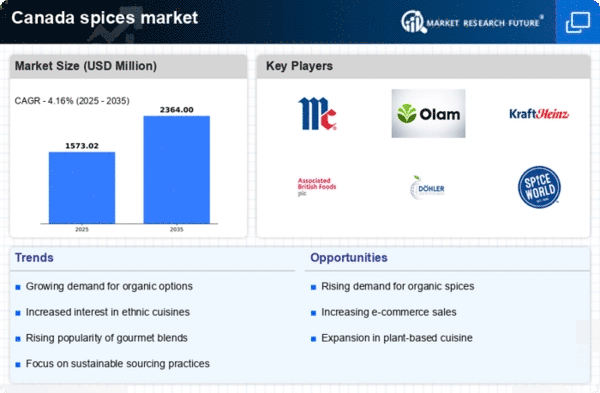
As per Market Research Future analysis, the Canada Spices Market size was estimated at 1510.2 USD Million in 2024. The Spices market is projected to grow from 1573.02 USD Million in 2025 to 2364.0 USD Million by 2035, exhibiting a compound annual growth rate (CAGR) of 4.1% during the forecast period 2025 - 2035

Key Market Trends & Highlights

The Canada spices market is experiencing a dynamic shift towards health-conscious and ethically sourced products.

  • The health and wellness focus is driving consumers towards organic and natural spice options.
  • Ethnic cuisine popularity is expanding the market, with diverse flavors gaining traction among Canadian consumers.
  • Sustainability and ethical sourcing are becoming essential, influencing purchasing decisions across various demographics.
  • Rising demand for organic spices and culinary innovation are key drivers propelling market growth.

Market Size & Forecast

2024 Market Size 1510.2 (USD Million)
2035 Market Size 2364.0 (USD Million)
CAGR (2025 - 2035) 4.16%

Major Players

McCormick & Company (US), Olam International (SG), Kraft Heinz Company (US), Associated British Foods (GB), Döhler Group (DE), Spice World (US), Badia Spices (US), Frontier Co-op (US)

Our Impact
Enabled $4.3B Revenue Impact for Fortune 500 and Leading Multinationals
Partnering with 2000+ Global Organizations Each Year
30K+ Citations by Top-Tier Firms in the Industry

Canada Spices Market Trends

The Canada Spices Market in Canada is currently experiencing a dynamic evolution, driven by changing consumer preferences and an increasing interest in culinary diversity. As individuals become more adventurous in their cooking, the demand for a wide variety of spices is on the rise. This shift is reflected in the growing popularity of ethnic cuisines, which often incorporate unique spice blends. Furthermore, the health benefits associated with various spices are becoming more recognized, leading to a surge in their usage not only in traditional dishes but also in health-conscious recipes. The market appears to be adapting to these trends, with retailers expanding their offerings to include organic and specialty spices, catering to a more discerning consumer base. In addition, the spices market is influenced by sustainability concerns, as consumers increasingly seek products that are ethically sourced and environmentally friendly. This trend is prompting suppliers to adopt more transparent practices regarding sourcing and production. The rise of e-commerce platforms is also reshaping the landscape, allowing consumers to access a broader range of spices from various regions. As the market continues to evolve, it seems poised for further growth, driven by innovation and a commitment to meeting the diverse needs of Canadian consumers.

Health and Wellness Focus

There is a noticeable trend towards incorporating spices known for their health benefits into everyday diets. Consumers are increasingly aware of the nutritional advantages of spices, such as turmeric and ginger, which are often associated with anti-inflammatory properties. This focus on wellness is influencing purchasing decisions, as individuals seek to enhance their meals with ingredients that promote better health.

Ethnic Cuisine Popularity

The growing interest in ethnic cuisines is significantly impacting the spices market. Canadians are exploring diverse culinary traditions, leading to an increased demand for spices that are integral to these cuisines. This trend is encouraging retailers to stock a wider variety of spices, including those used in Indian, Middle Eastern, and Asian cooking, thereby enriching the culinary landscape.

Sustainability and Ethical Sourcing

Sustainability is becoming a critical consideration for consumers in the spices market. There is a rising demand for spices that are sourced ethically and produced with minimal environmental impact. This trend is prompting suppliers to adopt more sustainable practices, ensuring that their products align with the values of environmentally conscious consumers.

Canada Spices Market Drivers

E-commerce Growth in Spice Sales

The spices market in Canada is witnessing a significant transformation due to the rapid growth of e-commerce. Online shopping has become a preferred method for consumers seeking convenience and variety in their spice purchases. Recent statistics reveal that online spice sales have increased by over 20% in the past year, driven by the pandemic-induced shift towards digital shopping. E-commerce platforms provide consumers with access to a wider range of spices, including hard-to-find varieties and specialty blends. This trend not only benefits consumers but also allows spice producers to reach a broader audience. As e-commerce continues to expand, it is likely to play a crucial role in shaping the future of the spices market.

Rising Demand for Organic Spices

The spices market in Canada is experiencing a notable shift towards organic products. Consumers are increasingly prioritizing health-conscious choices, leading to a surge in demand for organic spices. According to recent data, the organic spices segment has grown by approximately 15% annually, reflecting a broader trend in the food industry. This growth is driven by heightened awareness of the benefits of organic farming practices, which are perceived to be more environmentally friendly and healthier. As a result, retailers are expanding their organic offerings to meet consumer preferences, thereby influencing the overall dynamics of the spices market. The increasing availability of organic spices in supermarkets and specialty stores further supports this trend, making it easier for consumers to access these products.

Increased Interest in Culinary Tourism

Culinary tourism is emerging as a significant driver for the spices market in Canada. As travelers seek authentic food experiences, there is a growing interest in local spices and flavors. This trend is encouraging restaurants and food producers to highlight regional spices, thereby boosting their visibility and sales. Data suggests that culinary tourism has contributed to a 12% increase in the demand for locally sourced spices. This interest not only supports local economies but also fosters a deeper appreciation for the cultural significance of spices. As culinary tourism continues to gain traction, it is expected to further influence the spices market, encouraging consumers to explore and experiment with diverse flavors.

Culinary Innovation and Experimentation

The spices market in Canada is significantly influenced by culinary innovation and experimentation. Chefs and home cooks alike are increasingly exploring diverse flavor profiles, leading to a rise in the use of exotic spices. This trend is evident in the growing popularity of fusion cuisine, which combines elements from various culinary traditions. Data indicates that the introduction of new spice blends has contributed to a 10% increase in spice sales over the past year. As consumers seek unique dining experiences, the demand for specialty spices is likely to continue to rise. This evolving culinary landscape encourages spice manufacturers to innovate and create new products, thereby enhancing the overall appeal of the spices market.

Focus on Sustainable Packaging Solutions

Sustainability is becoming a pivotal concern within the spices market in Canada, particularly regarding packaging. Consumers are increasingly aware of environmental issues and are demanding more sustainable packaging options. This shift is prompting spice manufacturers to explore eco-friendly materials and practices. Recent surveys indicate that approximately 70% of consumers prefer products with sustainable packaging, which is influencing purchasing decisions. As a result, companies are investing in innovative packaging solutions that reduce waste and environmental impact. This focus on sustainability not only aligns with consumer values but also enhances brand loyalty. The spices market is likely to see continued growth in this area as manufacturers adapt to meet these evolving consumer expectations.


Market Segment Insights

By Type: Garlic (Largest) vs. Ginger (Fastest-Growing)

In the Canada spices market, the segment values exhibit a diverse distribution of market shares, with Garlic leading due to its widespread usage across various culinary applications. Ginger follows closely, gaining traction for its health benefits and versatility in cooking and beverages. Other spices such as Turmeric, Cumin, and Cinnamon also contribute to the overall dynamics, catering to niche markets and evolving consumer tastes, but they hold a smaller share compared to the front-runners. Growth trends in this segment are favorable, spearheaded by the rising consumer awareness regarding health and wellness. Garlic remains a staple for its flavor and health properties, while Ginger stands out as the fastest-growing segment, driven by increasing demand for natural ingredients in food and holistic remedies. The surge in popularity of ethnic cuisines also fuels demand for diverse spices, enhancing both Garlic's established position and Ginger's rapid ascent in the market.

Garlic (Dominant) vs. Ginger (Emerging)

Garlic is firmly established as the dominant spice in the Canada spices market, known for its robust flavor and numerous health benefits, including its anti-inflammatory properties. It is utilized in countless recipes, making it a pantry essential for many households. Ginger, while emerging, is quickly gaining popularity due to its versatility in cooking and beverages as well as its recognized health advantages like aiding digestion and boosting immunity. Its appeal is further enhanced by the growing trend toward natural and organic products. Both spices are integral to the market, but Garlic's historical prominence contrasts with Ginger's rapid expansion, showcasing the evolving preferences of consumers.

By Category: Organic (Largest) vs. Conventional (Fastest-Growing)

In the Canada spices market, the segment is primarily dominated by Organic spices, capturing a substantial share due to increasing health awareness among consumers. The preference for organic products has led to a shift in purchasing patterns, with Organic products now being the preferred choice among health-conscious individuals and culinary enthusiasts seeking authenticity in their flavors. On the other hand, Conventional spices also hold a significant market share, appealing to budget-conscious consumers and those who prioritize availability and variety over organic certifications. Looking ahead, the growth trends in the Canada spices market indicate a robust increase in the demand for Organic spices driven by rising consumer awareness regarding the benefits of organic eating. The emphasis on sustainability and clean-label products is propelling this segment to greater heights. Meanwhile, Conventional spices are gaining momentum as they adapt to changing consumer preferences by enhancing product quality and offering diverse options that cater to a broader audience, marking them as the fastest-growing segment in the market.

Organic (Dominant) vs. Conventional (Emerging)

Organic spices are characterized by their cultivation without synthetic fertilizers and pesticides, thus appealing to a growing number of health-conscious consumers who prioritize natural ingredients. Their dominance stems from a consumer shift towards healthier eating habits and greater transparency in food sourcing. Conversely, Conventional spices, though considered an emerging segment due to their recent market strategies focused on quality improvement and accessibility, remain vital for cost-conscious consumers. This segment benefits from established supply chains and broader distribution networks, making these products readily available, although they do not possess the 'premium' label of Organic options. As consumer preferences continue to evolve, both segments are expected to carve out significant niches within the overall market.

By Form: Whole (Largest) vs. Ground/Powder (Fastest-Growing)

In the Canada spices market, the distribution among the 'Form' segment reveals that Whole spices hold the largest market share due to their popularity in traditional cooking and perceived freshness. Ground/Powder spices are also significant, appealing to convenience-seeking consumers, while the 'Others' category consists of less common formats, contributing a minor share overall. Notably, as culinary trends evolve, the demand for high-quality, versatile Whole spices continues to solidify their strong position in the market. Growth trends in the Canada spices market indicate a rising preference for Ground/Powder spices, categorized as the fastest-growing segment. This growth can be attributed to the expanding commercial food sector and an increasing number of consumers opting for pre-ground options in their daily cooking. The convenience and ease of use associated with Ground/Powder spices align well with contemporary lifestyles, while Whole spices remain favored for their flavor retention and authenticity in culinary applications.

Whole (Dominant) vs. Ground/Powder (Emerging)

Whole spices are characterized by their intact forms, which contribute to a longer shelf life and enhanced flavor retention, making them highly favored by chefs and home cooks alike in the Canada spices market. Their dominance in the market is underscored by a growing consumer inclination towards traditional cooking methods and the use of fresh ingredients. In contrast, Ground/Powder spices, though categorized as emerging, have rapidly gained traction due to their convenience and versatility, appealing to a busy demographic looking for quick meal solutions. This juxtaposition highlights the ongoing evolution within the segment, where Whole spices maintain a premium status while Ground/Powder options cater to the modern consumer's need for efficiency.

By End Use: Food Retail (Largest) vs. Food Processing (Fastest-Growing)

In the Canada spices market, the distribution of market share among the end-use segments reveals that Food Retail holds the largest share, owing to the increasing demand from consumers for diverse culinary experiences at home. This segment benefits from the trend of home cooking and the popularity of specialty foods, driving retailers to offer a wide range of spices to cater to evolving consumer preferences. On the other hand, Food Processing is identified as the fastest-growing segment, propelled by the rising popularity of ready-to-eat meals and convenience foods. As more consumers seek convenience without sacrificing flavor and quality, food processors are heavily investing in high-quality spices to enhance their products, signaling a shift towards an increasingly competitive landscape in the market.

Food Retail: Dominant vs. Food Processing: Emerging

Food Retail in the Canada spices market stands out as a dominant segment, driven by consumer trends favoring home cooking and gourmet experiences. Retailers are responding by expanding their spice offerings, introducing unique blends and organic options to attract health-conscious consumers. In contrast, Food Processing is an emerging segment gaining momentum, as manufacturers focus on delivering convenience through flavorful, pre-packaged meals. This segment is increasingly important as it aligns with consumer preferences for quick meal solutions without compromising on taste. The growth in Food Processing indicates a dynamic shift in the market, positioning it as a key area of interest for both investors and producers.

Get more detailed insights about Canada Spices Market

Key Players and Competitive Insights

The spices market in Canada is characterized by a competitive landscape that is both dynamic and multifaceted. Key growth drivers include increasing consumer interest in culinary diversity, health-conscious eating, and the rising popularity of organic and natural products. Major players such as McCormick & Company (US), Olam International (SG), and Kraft Heinz Company (US) are strategically positioned to leverage these trends. McCormick & Company (US) focuses on innovation and product development, particularly in the realm of organic spices, while Olam International (SG) emphasizes sustainability and supply chain transparency. Kraft Heinz Company (US) is enhancing its portfolio through strategic acquisitions and partnerships, thereby shaping a competitive environment that is increasingly focused on quality and sustainability.In terms of business tactics, companies are localizing manufacturing to reduce costs and improve supply chain efficiency. The market structure appears moderately fragmented, with a mix of large multinational corporations and smaller, niche players. This fragmentation allows for a diverse range of products and price points, catering to various consumer preferences. The collective influence of these key players is significant, as they drive innovation and set quality standards that smaller competitors often strive to meet.

In October McCormick & Company (US) announced a partnership with a leading Canadian organic farm to enhance its supply of locally sourced spices. This strategic move not only strengthens McCormick's commitment to sustainability but also positions the company to better meet the growing demand for organic products among Canadian consumers. By integrating local sourcing into its supply chain, McCormick is likely to improve its brand image and customer loyalty.

In September Olam International (SG) launched a new line of sustainably sourced spices aimed at the health-conscious consumer segment. This initiative reflects Olam's ongoing commitment to sustainability and innovation, as it seeks to differentiate its offerings in a crowded market. The introduction of this product line may enhance Olam's competitive edge by appealing to consumers who prioritize ethical sourcing and health benefits in their purchasing decisions.

In August Kraft Heinz Company (US) completed the acquisition of a regional spice manufacturer, which is expected to expand its market share in Canada. This acquisition aligns with Kraft Heinz's strategy to diversify its product offerings and strengthen its presence in the spices market. By integrating this regional player, Kraft Heinz may enhance its distribution capabilities and product range, thereby positioning itself more favorably against competitors.

As of November current competitive trends in the spices market include a strong emphasis on digitalization, sustainability, and the integration of artificial intelligence in supply chain management. Strategic alliances are increasingly shaping the landscape, as companies collaborate to enhance product offerings and operational efficiencies. Looking ahead, competitive differentiation is likely to evolve from traditional price-based competition to a focus on innovation, technology, and supply chain reliability. This shift suggests that companies that prioritize these areas will be better positioned to capture market share and meet the evolving demands of consumers.

Key Companies in the Canada Spices Market include

Industry Developments

Recent developments in the Canada Spices Market indicate a growing trend among consumers prioritizing organic and sustainably sourced products, with companies like Simply Organic and Frontier Coop leading the charge in meeting this demand. Notably, McCormick Canada has reported a significant increase in market valuation, driven by innovative product launches and a focus on plant-based seasoning options within the past year. In terms of mergers and acquisitions, there have been no recent announcements involving the specified companies like Olam International or Badia Spices that have been publicly confirmed in media outlets as of October 2023.

However, the market has seen heightened competition, especially among culinary-focused firms such as Penzeys Spices and Spice Kitchen, which are enhancing their brand offerings to capture a larger consumer base. Over the past two years, events such as a surge in e-commerce for spice products and participation in the Canadian Greenhouse Conference in September 2022 spotlighted the efforts of industry players to adapt to market preferences. Additionally, collaboration between local suppliers and spice companies has been prominent, fostering a stronger supply chain in the Canadian market.

Future Outlook

Canada Spices Market Future Outlook

The Spices Market in Canada is projected to grow at a 4.16% CAGR from 2025 to 2035, driven by increasing consumer demand for natural flavors and health benefits.

New opportunities lie in:

  • Expansion of e-commerce platforms for spice sales
  • Development of organic spice product lines
  • Investment in sustainable sourcing and packaging solutions

By 2035, the spices market is expected to achieve robust growth and increased market share.

Market Segmentation

Canada Spices Market Form Outlook

  • Whole
  • Ground/Powder
  • Others

Canada Spices Market Type Outlook

  • Garlic
  • Ginger
  • Turmeric
  • Cumin
  • Cinnamon
  • Pepper
  • Others

Canada Spices Market End Use Outlook

  • Food Retail
  • Food Service
  • Food Processing

Canada Spices Market Category Outlook

  • Organic
  • Conventional

Report Scope

MARKET SIZE 2024 1510.2(USD Million)
MARKET SIZE 2025 1573.02(USD Million)
MARKET SIZE 2035 2364.0(USD Million)
COMPOUND ANNUAL GROWTH RATE (CAGR) 4.16% (2025 - 2035)
REPORT COVERAGE Revenue Forecast, Competitive Landscape, Growth Factors, and Trends
BASE YEAR 2024
Market Forecast Period 2025 - 2035
Historical Data 2019 - 2024
Market Forecast Units USD Million
Key Companies Profiled McCormick & Company (US), Olam International (SG), Kraft Heinz Company (US), Associated British Foods (GB), Döhler Group (DE), Spice World (US), Badia Spices (US), Frontier Co-op (US)
Segments Covered Type, Category, Form, End Use
Key Market Opportunities Growing demand for organic spices driven by health-conscious consumer preferences in Canada.
Key Market Dynamics Rising consumer demand for organic spices drives innovation and competition among local suppliers in Canada.
Countries Covered Canada
Leave a Comment

FAQs

What is the expected market size of the Canada Spices Market in 2024?

The Canada Spices Market is expected to be valued at 1.01 USD Billion in 2024.

What will be the projected market size of the Canada Spices Market by 2035?

By 2035, the Canada Spices Market is projected to reach 1.57 USD Billion.

What is the expected Compound Annual Growth Rate (CAGR) for the Canada Spices Market from 2025 to 2035?

The expected CAGR for the Canada Spices Market from 2025 to 2035 is 4.139%.

Which spices will see significant market growth, and what are their projected values by 2035?

Garlic is projected to reach 0.45 USD Billion, Ginger 0.39 USD Billion, Turmeric 0.32 USD Billion, Cumin 0.23 USD Billion, and Cinnamon 0.18 USD Billion by 2035.

Who are some of the major players in the Canada Spices Market?

Major players in the Canada Spices Market include Olam International, McCormick Canada, and Penzeys Spices, among others.

What is the market size for Garlic in the Canada Spices Market in 2024?

The market size for Garlic in the Canada Spices Market is valued at 0.3 USD Billion in 2024.

What are the prospects for the Canada Spices Market considering its growth rate?

The Canada Spices Market is poised for positive growth with a steady CAGR of 4.139% from 2025 to 2035.

What is the anticipated value of the Ginger segment in the Canada Spices Market by 2035?

The Ginger segment is anticipated to reach a value of 0.39 USD Billion by 2035.

What challenges might affect the growth of the Canada Spices Market?

Challenges may include supply chain disruptions and fluctuating raw material prices impacting the Canada Spices Market.

How will the Cinnamon segment perform in terms of market value until 2035?

The Cinnamon segment is expected to grow from 0.11 USD Billion in 2024 to 0.18 USD Billion in 2035.

Download Free Sample

Kindly complete the form below to receive a free sample of this Report

Compare Licence

×
Features License Type
Single User Multiuser License Enterprise User
Price $4,950 $5,950 $7,250
Maximum User Access Limit 1 User Upto 10 Users Unrestricted Access Throughout the Organization
Free Customization
Direct Access to Analyst
Deliverable Format
Platform Access
Discount on Next Purchase 10% 15% 15%
Printable Versions