×
Request Free Sample ×

Kindly complete the form below to receive a free sample of this Report

* Please use a valid business email

Leading companies partner with us for data-driven Insights

clients tt-cursor
Hero Background

Canada Software Defined Perimeter Market

ID: MRFR/ICT/62645-HCR
200 Pages
Aarti Dhapte
February 2026

Canada Software Defined Perimeter Market Size, Share and Research Report: By Deployment (Cloud, On-Premise) and By Enterprise Type (SMEs, Large Enterprises) - Industry Forecast to 2035

Share:
Download PDF ×

We do not share your information with anyone. However, we may send you emails based on your report interest from time to time. You may contact us at any time to opt-out.

Canada Software Defined Perimeter Market Infographic
Purchase Options

Canada Software Defined Perimeter Market Summary

As per Market Research Future analysis, the Canada Software Defined Perimeter Market size was estimated at 930.4 USD Million in 2024. The Software Defined-perimeter market is projected to grow from 1026.7 USD Million in 2025 to 2750.0 USD Million by 2035, exhibiting a compound annual growth rate (CAGR) of 10.3% during the forecast period 2025 - 2035

Key Market Trends & Highlights

The Canada software defined-perimeter market is experiencing robust growth driven by evolving security needs and technological advancements.

  • The market is witnessing increased adoption of Zero Trust architectures as organizations prioritize security.
  • Integration with cloud services is becoming a critical focus, enhancing flexibility and scalability for businesses.
  • Compliance and regulatory standards are driving organizations to adopt software defined-perimeter solutions to mitigate risks.
  • Rising cybersecurity threats and the shift towards remote work are major drivers propelling market growth.

Market Size & Forecast

2024 Market Size 930.4 (USD Million)
2035 Market Size 2750.0 (USD Million)
CAGR (2025 - 2035) 10.35%

Major Players

Cisco Systems (US), Palo Alto Networks (US), VMware (US), Zscaler (US), Cloudflare (US), Fortinet (US), Check Point Software Technologies (IL), Akamai Technologies (US)

Our Impact
Enabled $4.3B Revenue Impact for Fortune 500 and Leading Multinationals
Partnering with 2000+ Global Organizations Each Year
30K+ Citations by Top-Tier Firms in the Industry

Canada Software Defined Perimeter Market Trends

The Canada Software Defined Perimeter Market is currently experiencing notable growth in Canada. This growth is driven by an increasing demand for enhanced security measures in the face of evolving cyber threats. Organizations are increasingly recognizing the limitations of traditional perimeter security, which often fails to protect sensitive data and applications. As a result, there is a shift towards adopting software defined-perimeter solutions that offer dynamic access controls and improved visibility into network activities. This transition is further supported by the rise of remote work and the need for secure access to corporate resources from various locations. Consequently, businesses are investing in innovative technologies that facilitate secure connections and protect against unauthorized access. In addition, the regulatory landscape in Canada is evolving, with stricter data protection laws prompting organizations to reassess their security strategies. The software defined-perimeter market appears to be well-positioned to address these compliance requirements. It provides robust security frameworks that align with regulatory standards. Furthermore, the collaboration between government entities and private sectors is fostering an environment conducive to the development and implementation of advanced security solutions. As organizations continue to prioritize cybersecurity, The software defined-perimeter market is likely to expand. This expansion will offer new opportunities for vendors and service providers in the coming years.

Increased Adoption of Zero Trust Architectures

Organizations are increasingly implementing zero trust principles within their security frameworks. This approach emphasizes the need for continuous verification of user identities and device security, regardless of their location. By adopting zero trust architectures, businesses can enhance their security posture and mitigate risks associated with unauthorized access.

Integration with Cloud Services

The software defined-perimeter market is witnessing a trend towards integration with cloud services. As more organizations migrate to cloud environments, the need for secure access to these resources becomes paramount. Solutions that seamlessly connect on-premises infrastructure with cloud applications are gaining traction, enabling businesses to maintain security across hybrid environments.

Focus on Compliance and Regulatory Standards

With the increasing emphasis on data protection regulations, organizations are prioritizing compliance in their security strategies. The software defined-perimeter market is adapting to these requirements by offering solutions that align with local and international standards. This focus on compliance not only helps organizations avoid penalties but also builds trust with customers.

Canada Software Defined Perimeter Market Drivers

Increased Cloud Adoption

The rapid adoption of cloud services in Canada is reshaping the software defined-perimeter market. As businesses migrate to cloud-based solutions, the need for secure access to these environments becomes paramount. Software defined-perimeter technologies provide a means to establish secure connections between users and cloud resources, thereby enhancing data protection. In 2025, it is estimated that over 70% of Canadian enterprises will utilize cloud services, creating a substantial market for software defined-perimeter solutions. This trend suggests that organizations are increasingly recognizing the importance of securing their cloud environments, which could lead to a compound annual growth rate of 18% for the software defined-perimeter market. The integration of cloud services with security frameworks is likely to be a key driver of innovation and investment in this sector.

Shift Towards Remote Work

The transition to remote work has fundamentally altered the landscape of corporate security in Canada. As organizations embrace flexible work arrangements, the need for secure access to corporate resources from various locations has surged. The software defined-perimeter market is poised to benefit from this shift, as it provides a robust framework for securing remote connections. In 2025, it is anticipated that over 60% of Canadian employees will work remotely at least part-time, necessitating solutions that ensure secure access to sensitive information. This trend indicates a growing reliance on software defined-perimeter technologies, which can effectively manage user access and protect against potential vulnerabilities associated with remote work environments. Consequently, the market is expected to see a substantial increase in adoption rates as businesses prioritize security in their remote work strategies.

Rising Cybersecurity Threats

The software defined-perimeter market in Canada is experiencing growth due to the increasing frequency and sophistication of cyber threats. Organizations are compelled to adopt advanced security measures to protect sensitive data and maintain operational integrity. In 2025, it is estimated that cybercrime could cost Canadian businesses upwards of $10 billion annually. This alarming trend drives the demand for software defined-perimeter solutions, which offer enhanced security by creating a secure access environment. As companies seek to mitigate risks associated with data breaches and unauthorized access, the software defined-perimeter market is likely to expand significantly, with a projected growth rate of 15% annually. The urgency to safeguard digital assets is a primary catalyst for investment in these innovative security frameworks.

Regulatory Compliance Pressures

In Canada, regulatory compliance is becoming increasingly stringent, particularly in sectors such as finance and healthcare. Organizations are required to adhere to various data protection regulations, which necessitate the implementation of robust security measures. The software defined-perimeter market is well-positioned to address these compliance challenges, as it offers solutions that facilitate secure data access and management. In 2025, it is projected that compliance-related investments will account for approximately 25% of total IT security budgets in Canada. This growing emphasis on regulatory adherence is likely to drive demand for software defined-perimeter solutions, as organizations seek to avoid costly penalties and reputational damage associated with non-compliance. The intersection of compliance requirements and security needs presents a significant opportunity for growth within the software defined-perimeter market.

Demand for Enhanced User Experience

In the competitive landscape of Canadian businesses, providing a seamless user experience is crucial. The software defined-perimeter market is responding to this demand by offering solutions that not only enhance security but also improve accessibility for users. Organizations are increasingly seeking technologies that allow for secure, yet user-friendly access to applications and data. In 2025, it is projected that companies prioritizing user experience in their security strategies will see a 20% increase in employee productivity. This focus on balancing security with usability is likely to drive the adoption of software defined-perimeter solutions, as they enable organizations to maintain robust security postures while ensuring that users can efficiently access necessary resources. The interplay between security and user experience is expected to be a significant factor influencing the growth of the software defined-perimeter market.


Market Segment Insights

By Deployment Model: Cloud (Largest) vs. Hybrid (Fastest-Growing)

In the Canada software defined-perimeter market, the deployment model segment is seeing significant variations in market share among cloud, on-premises, and hybrid solutions. Currently, cloud deployment is leading the market, dominating the share due to its flexibility and scalability, attracting a wide range of businesses. On-premises solutions, while established, are seeing slower adoption and growth, holding a more niche position compared to the innovative features offered by cloud and hybrid offerings. The growth trends indicate that hybrid deployment models are emerging rapidly, driven by organizations seeking to optimize resources and enhance security. The demand for a seamless blend of both cloud and on-premises benefits propels hybrid solutions to the forefront, making them the fastest-growing segment. As enterprises increasingly prioritize security and compliance, hybrid solutions provide a tailored approach to meet diverse IT requirements.

Cloud (Dominant) vs. Hybrid (Emerging)

Cloud deployment remains the dominant force in the Canada software defined-perimeter market, showcasing its ability to offer scalability, flexibility, and reduced operational costs. The convenience of managing resources in the cloud allows organizations to adapt quickly to market changes. In contrast, hybrid deployment is emerging as a strong alternative, particularly among businesses that demand the benefits of both environments. Hybrid solutions provide companies with increased control over their data and applications while still leveraging cloud capabilities for extended functionality and innovation. This growing preference for hybrid models reflects a shift towards more versatile IT infrastructures, allowing greater agility and compliance with local regulations.

By Solution Type: Identity and Access Management (Largest) vs. Application Security (Fastest-Growing)

In the Canada software defined-perimeter market, the distribution of market shares among solution types reveals Identity and Access Management as the largest segment, commanding a notable share of the overall market. Following closely are Network Security and Endpoint Security, which exhibit substantial relevance but do not overshadow the dominance of Identity and Access Management. Application Security is emerging as a key player, gaining traction in response to increasing cybersecurity threats and the requirement for robust application protection. The growth trends in this segment are significantly influenced by the rising demand for enhanced security measures across various industries. As cyber threats evolve, organizations are prioritizing investments in Identity and Access Management solutions to better control user access and safeguard sensitive data. Meanwhile, Application Security is the fastest-growing segment, driven by the surge in application development and the need for secure coding practices. Continued advancements in technology and regulatory compliance requirements further stimulate growth within this segment.

Identity and Access Management (Dominant) vs. Application Security (Emerging)

Identity and Access Management represents a dominant force within the Canada software defined-perimeter market, characterized by its critical role in ensuring user access control and identity verification across digital environments. Its comprehensive capabilities offer organizations the tools necessary to secure sensitive information while managing user identities effectively. In contrast, Application Security, as an emerging segment, is gaining momentum due to the explosive growth of cloud-based applications and the increasing focus on cybersecurity. This segment addresses vulnerabilities present in software applications through a variety of protective measures, appealing to organizations striving for compliance and security in their development processes. Both segments play vital roles, albeit at different stages of market acceptance and maturity.

By Organization Size: Small and Medium Enterprises (Largest) vs. Large Enterprises (Fastest-Growing)

In the Canada software defined-perimeter market, the distribution of market share is experienced remarkably between Small and Medium Enterprises (SMEs) and Large Enterprises, with SMEs holding the largest stake. This reflects their increasing need for robust security solutions as they scale operations and digitalize processes. On the other hand, while Large Enterprises have a significant presence, their share is rapidly growing as they seek advanced perimeter security solutions to address their diverse and complex security challenges. Growth trends within this segment indicate that SMEs are adapting swiftly, capitalizing on innovative technologies to enhance their security posture amidst rising cyber threats. Conversely, Large Enterprises are investing in comprehensive security infrastructures at an accelerating rate. The demand for customizable and scalable security solutions is driving this growth, as organizations of all sizes recognize the critical need for effective perimeter management.

Small and Medium Enterprises: Dominant vs. Large Enterprises: Emerging

Small and Medium Enterprises (SMEs) are characterized by their agility and faster adoption of innovative technologies, making them a dominant force in the Canada software defined-perimeter market. Their preference for flexible, cost-effective security solutions enables them to manage resources efficiently while safeguarding sensitive data. Large Enterprises are emerging strongly in this market, driven by the necessity for advanced security measures to protect vast networks and sophisticated infrastructures. They are increasingly opting for integrated security solutions that offer scalability and comprehensive threat management, which positions them well as significant players in the rapidly evolving landscape of cybersecurity.

By End User Industry: BFSI (Largest) vs. Healthcare (Fastest-Growing)

In the Canada software defined-perimeter market, the BFSI sector holds the largest market share, attributed to its critical need for security solutions in financial transactions and data management. The Government sector follows next, focusing on safeguarding sensitive information and ensuring compliance with regulations. Healthcare is witnessing notable growth as organizations seek to protect patient data and comply with health standards, making it vital in the evolving digital landscape. Growth in the Canada software defined-perimeter market is driven by increasing cyber threats and the need for robust security frameworks across industries. The BFSI sector is investing heavily in advanced security technologies, while Government entities are prioritizing infrastructure enhancement. Healthcare is emerging as a fast-growing sector due to the escalating demand for secure patient information management systems, thereby highlighting the vital role of security solutions in maintaining privacy and trust in digital communications.

BFSI (Dominant) vs. Healthcare (Emerging)

The BFSI sector is characterized by its rigorous security requirements, necessitating advanced solutions to mitigate risks associated with financial data breaches. This dominance reflects the industry's focus on implementing comprehensive cybersecurity measures to safeguard assets and maintain consumer confidence. In contrast, the Healthcare sector is considered an emerging player, rapidly adapting to changes in regulations and technological advancements. This segment prioritizes protecting sensitive patient information while developing secure data exchange practices among health service providers. As these segments evolve, a strong emphasis on compliance, risk management, and innovative security solutions is becoming the hallmark of their market strategies.

Get more detailed insights about Canada Software Defined Perimeter Market

Key Players and Competitive Insights

The software defined-perimeter market is currently characterized by a dynamic competitive landscape, driven by the increasing demand for secure remote access and the growing complexity of cyber threats. Major players such as Cisco Systems (US), Palo Alto Networks (US), and Zscaler (US) are strategically positioning themselves through innovation and partnerships. Cisco Systems (US) focuses on integrating advanced security features into its networking solutions, while Palo Alto Networks (US) emphasizes its cloud-native security offerings. Zscaler (US) continues to enhance its zero-trust architecture, which is becoming increasingly vital in the current security paradigm. Collectively, these strategies not only enhance their market presence but also shape the competitive environment by setting high standards for security and performance.Key business tactics within this market include localizing services and optimizing supply chains to better meet regional demands. The competitive structure appears moderately fragmented, with several key players holding substantial market shares. This fragmentation allows for a diverse range of solutions, catering to various customer needs. However, the influence of major players remains significant, as they often set the trends that smaller companies follow, thereby shaping the overall market dynamics.

In October Cisco Systems (US) announced a strategic partnership with a leading cloud service provider to enhance its software defined-perimeter solutions. This collaboration aims to integrate advanced analytics and machine learning capabilities into their offerings, thereby improving threat detection and response times. The strategic importance of this partnership lies in its potential to provide customers with a more robust security framework, addressing the evolving landscape of cyber threats.

In September Palo Alto Networks (US) launched a new suite of security tools designed specifically for hybrid work environments. This initiative reflects the company's commitment to adapting to the changing work dynamics and ensuring that security measures are in place for both on-premises and remote users. The launch is significant as it positions Palo Alto Networks (US) as a leader in providing comprehensive security solutions that cater to the needs of modern enterprises.

In August Zscaler (US) expanded its global footprint by entering into a strategic alliance with a prominent telecommunications provider in Canada. This move is aimed at enhancing its service delivery capabilities and providing localized support to its customers. The strategic importance of this expansion is underscored by the growing demand for secure access solutions in the region, which Zscaler (US) is well-positioned to meet.

As of November current trends in the software defined-perimeter market include a strong emphasis on digitalization, AI integration, and sustainability. Strategic alliances are increasingly shaping the competitive landscape, allowing companies to leverage each other's strengths and enhance their service offerings. Looking ahead, competitive differentiation is likely to evolve from traditional price-based competition to a focus on innovation, technology, and supply chain reliability. This shift indicates a growing recognition that long-term success will depend on the ability to deliver cutting-edge solutions that address the complex security challenges faced by organizations today.

Key Companies in the Canada Software Defined Perimeter Market include

Industry Developments

Recent developments in the Canada Software Defined Perimeter Market indicate a robust growth trajectory, driven by increasing demand for secure network solutions. Companies like Dell Technologies, Zscaler, and Cisco Systems are at the forefront, investing significantly in enhancing their offerings to meet the rising security needs of enterprises. For instance, in September 2023, Cisco Systems announced an upgrade to its security services portfolio, emphasizing advanced Software Defined Perimeter capabilities to bolster client protection against cyber threats. 

Additionally, Cato Networks has been expanding its operations by enhancing partnerships with local enterprises to deliver tailored security solutions, reflecting a strong demand in Canada.In terms of mergers and acquisitions, one notable event occurred in August 2023 when Palo Alto Networks acquired a Canadian cybersecurity company to expand its market reach and enhance its Software Defined Perimeter capabilities. 

This trend of consolidation is expected to continue, as firms are keen to build comprehensive security frameworks. The Canadian government has also prioritized cybersecurity, reflecting the growing importance of secure network infrastructure in the nation's digital development strategy. The cumulative efforts of these companies and initiatives are significantly impacting the market dynamics, ensuring an increasingly secure digital landscape in Canada.

Future Outlook

Canada Software Defined Perimeter Market Future Outlook

The Software Defined Perimeter Market is projected to grow at a 10.35% CAGR from 2025 to 2035, driven by increasing cybersecurity threats and the demand for secure remote access.

New opportunities lie in:

  • Development of AI-driven security analytics tools for real-time threat detection.
  • Integration of software defined-perimeter solutions with IoT devices for enhanced security.
  • Expansion of managed security services tailored for small and medium enterprises.

By 2035, the software defined-perimeter market is expected to be robust, reflecting substantial growth and innovation.

Market Segmentation

Canada Software Defined Perimeter Market Solution Type Outlook

  • Identity and Access Management
  • Network Security
  • Application Security
  • Endpoint Security

Canada Software Defined Perimeter Market Deployment Model Outlook

  • Cloud
  • On-Premises
  • Hybrid

Canada Software Defined Perimeter Market End User Industry Outlook

  • BFSI
  • Government
  • Healthcare
  • IT and Telecom
  • Retail

Canada Software Defined Perimeter Market Organization Size Outlook

  • Small and Medium Enterprises
  • Large Enterprises

Report Scope

MARKET SIZE 2024 930.4(USD Million)
MARKET SIZE 2025 1026.7(USD Million)
MARKET SIZE 2035 2750.0(USD Million)
COMPOUND ANNUAL GROWTH RATE (CAGR) 10.35% (2025 - 2035)
REPORT COVERAGE Revenue Forecast, Competitive Landscape, Growth Factors, and Trends
BASE YEAR 2024
Market Forecast Period 2025 - 2035
Historical Data 2019 - 2024
Market Forecast Units USD Million
Key Companies Profiled Cisco Systems (US), Palo Alto Networks (US), VMware (US), Zscaler (US), Cloudflare (US), Fortinet (US), Check Point Software Technologies (IL), Akamai Technologies (US)
Segments Covered Deployment Model, Solution Type, Organization Size, End User Industry
Key Market Opportunities Growing demand for secure remote access solutions drives innovation in the software defined-perimeter market.
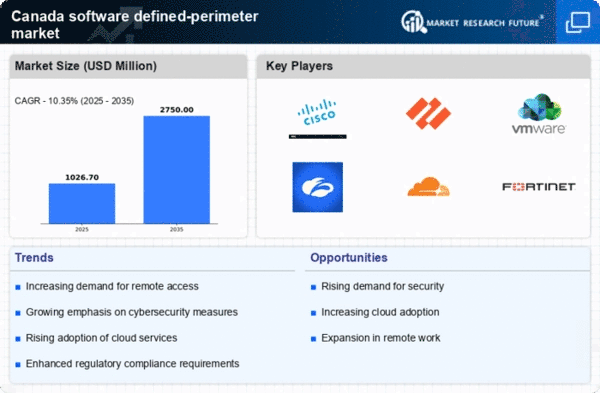
Key Market Dynamics Rising demand for secure remote access drives innovation in the software defined-perimeter market.

Countries Covered Canada
Leave a Comment

FAQs

What is the expected market size of the Canada Software Defined Perimeter Market in 2024?

The Canada Software Defined Perimeter Market is expected to be valued at 787.2 million USD in 2024.

What will be the market size of the Canada Software Defined Perimeter Market by 2035?

By 2035, the market is projected to reach a value of 2071.0 million USD.

What is the anticipated Compound Annual Growth Rate (CAGR) for the Canada Software Defined Perimeter Market from 2025 to 2035?

The expected CAGR for the market during this period is 9.192%.

Which segment will dominate the market by deployment in 2024?

In 2024, the Cloud deployment segment is projected to be valued at 394.0 million USD.

What will be the value of the On-Premise deployment segment in 2035?

The On-Premise deployment segment is expected to be valued at 1036.0 million USD in 2035.

Who are the key players in the Canada Software Defined Perimeter Market?

Major players include Dell Technologies, Zscaler, VMware, Cato Networks, and Cisco Systems, among others.

What challenges may affect the growth of the Canada Software Defined Perimeter Market?

Challenges may include emerging security threats and the need for integration with existing systems.

What are the growth prospects for the Cloud deployment segment through 2035?

The Cloud segment is anticipated to grow significantly, reaching an estimated 1035.0 million USD by 2035.

What opportunities exist in the Canada Software Defined Perimeter Market?

Opportunities lie in increasing demand for enhanced cybersecurity technologies among enterprises.

How is the competitive landscape of the Canada Software Defined Perimeter Market evolving?

The competitive landscape is evolving with companies focusing on innovative solutions and partnerships to enhance market presence.

Download Free Sample

Kindly complete the form below to receive a free sample of this Report

Compare Licence

×
Features License Type
Single User Multiuser License Enterprise User
Price $4,950 $5,950 $7,250
Maximum User Access Limit 1 User Upto 10 Users Unrestricted Access Throughout the Organization
Free Customization
Direct Access to Analyst
Deliverable Format
Platform Access
Discount on Next Purchase 10% 15% 15%
Printable Versions