×
Request Free Sample ×

Kindly complete the form below to receive a free sample of this Report

* Please use a valid business email

Leading companies partner with us for data-driven Insights

clients tt-cursor
Hero Background

Canada Pressure Vessel Market

ID: MRFR/EnP/53696-HCR
200 Pages
Chitranshi Jaiswal
February 2026

Canada Pressure Vessel Market Research Report By Material (Steel Alloys, Other alloys, Composites), By Product (Boilers, Nuclear reactors, Separators, Others) and By Application (Oil & Gas, Chemicals, Power generation, Others)- Forecast to 2035

Share:
Download PDF ×

We do not share your information with anyone. However, we may send you emails based on your report interest from time to time. You may contact us at any time to opt-out.

Canada Pressure Vessel Market Infographic
Purchase Options

Canada Pressure Vessel Market Summary

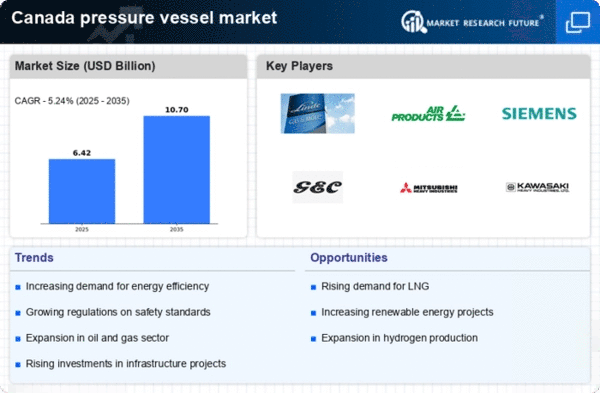
As per Market Research Future analysis, the Canada pressure vessel market Size was estimated at 6.1 USD Billion in 2024. The Canada pressure vessel market is projected to grow from 6.42 USD Billion in 2025 to 10.7 USD Billion by 2035, exhibiting a compound annual growth rate (CAGR) of 5.2% during the forecast period 2025 - 2035

Key Market Trends & Highlights

The Canada pressure vessel market is poised for growth driven by regulatory compliance and technological advancements.

  • The market is experiencing a notable shift towards enhanced regulatory compliance and safety standards.
  • Technological advancements in manufacturing processes are significantly influencing market dynamics.
  • Sustainability and energy efficiency are becoming increasingly critical in pressure vessel design and production.
  • The growing demand in the oil and gas sector and infrastructure development initiatives are key drivers of market expansion.

Market Size & Forecast

2024 Market Size 6.1 (USD Billion)
2035 Market Size 10.7 (USD Billion)
CAGR (2025 - 2035) 5.24%

Major Players

Linde AG (DE), Air Products and Chemicals Inc (US), Siemens AG (DE), General Electric Company (US), Mitsubishi Heavy Industries Ltd (JP), Kawasaki Heavy Industries Ltd (JP), Emerson Electric Co (US), Atlas Copco AB (SE), Schlumberger Limited (US)

Our Impact
Enabled $4.3B Revenue Impact for Fortune 500 and Leading Multinationals
Partnering with 2000+ Global Organizations Each Year
30K+ Citations by Top-Tier Firms in the Industry

Canada Pressure Vessel Market Trends

The pressure vessel market is currently experiencing a dynamic phase characterized by evolving regulations and technological advancements. In Canada, the demand for pressure vessels is driven by various sectors, including oil and gas, chemical processing, and power generation. Regulatory bodies are increasingly emphasizing safety standards, which necessitates the adoption of advanced materials and manufacturing techniques. This shift not only enhances the durability and efficiency of pressure vessels but also aligns with environmental sustainability goals. As industries strive to meet stringent compliance requirements, the market is likely to witness a surge in innovation and investment. Moreover, the trend towards automation and digitalization in manufacturing processes is reshaping the landscape of the pressure vessel market. Companies are integrating smart technologies to monitor performance and optimize operations, which could lead to reduced operational costs and improved safety. The emphasis on energy efficiency and reduced emissions is also influencing design and production methods. As a result, the pressure vessel market is poised for growth, driven by both regulatory pressures and technological advancements that promise to enhance operational efficiency and safety across various applications.

Regulatory Compliance and Safety Standards

The pressure vessel market is increasingly influenced by stringent regulatory frameworks aimed at ensuring safety and environmental protection. Canadian authorities are enforcing rigorous standards that manufacturers must adhere to, prompting investments in advanced materials and technologies. This trend not only enhances the safety of pressure vessels but also encourages innovation in design and manufacturing processes.

Technological Advancements in Manufacturing

Innovations in manufacturing techniques are significantly impacting the pressure vessel market. The adoption of advanced fabrication methods, such as additive manufacturing and automated welding, is improving production efficiency and product quality. These technological advancements enable manufacturers to create more complex designs while reducing waste and operational costs.

Sustainability and Energy Efficiency

There is a growing emphasis on sustainability within the pressure vessel market, driven by both regulatory requirements and consumer demand. Manufacturers are increasingly focusing on energy-efficient designs and materials that minimize environmental impact. This trend is likely to shape future developments, as companies seek to align with global sustainability goals.

Canada Pressure Vessel Market Drivers

Growing Demand in Oil and Gas Sector

The oil and gas sector in Canada is experiencing a notable surge in demand for pressure vessels, driven by the need for efficient storage and transportation of hydrocarbons. As exploration and production activities expand, the pressure vessel market is poised to benefit significantly. In 2025, the sector is projected to contribute approximately 30% of the total market revenue, reflecting a robust growth trajectory. This demand is further fueled by the increasing investments in infrastructure and the development of new extraction technologies. Consequently, manufacturers are likely to focus on producing high-quality, durable pressure vessels that meet the stringent requirements of the oil and gas industry, thereby enhancing their market position.

Infrastructure Development Initiatives

Canada's ongoing infrastructure development initiatives are playing a crucial role in bolstering the pressure vessel market. With substantial investments allocated for upgrading and expanding facilities, particularly in the energy and water sectors, the demand for pressure vessels is expected to rise. The Canadian government has earmarked over $10 billion for infrastructure projects in 2025, which includes the construction of new pipelines and storage facilities. This influx of capital is likely to stimulate the market, as companies seek to procure advanced pressure vessels that comply with safety and efficiency standards. As a result, the pressure vessel market is anticipated to witness a significant uptick in activity and innovation.

Increased Focus on Environmental Regulations

The pressure vessel market in Canada is increasingly influenced by stringent environmental regulations aimed at reducing emissions and enhancing safety. Regulatory bodies are enforcing compliance measures that necessitate the use of advanced pressure vessels designed to minimize leaks and ensure safe operation. In 2025, it is estimated that compliance-related expenditures will account for approximately 15% of the total market value. This regulatory landscape compels manufacturers to innovate and invest in technologies that not only meet but exceed these standards. Consequently, the pressure vessel market is likely to see a shift towards more sustainable practices, which may include the adoption of eco-friendly materials and designs.

Technological Innovations in Design and Materials

Technological advancements in design and materials are reshaping the pressure vessel market in Canada. Innovations such as the use of composite materials and advanced manufacturing techniques are enhancing the performance and durability of pressure vessels. In 2025, it is projected that the market for composite pressure vessels will grow by approximately 20%, driven by their lightweight properties and resistance to corrosion. This shift towards advanced materials is likely to attract a broader range of applications, including renewable energy and chemical processing. As manufacturers embrace these innovations, the pressure vessel market is expected to evolve, offering more efficient and reliable solutions to meet diverse industrial needs.

Rising Demand from the Chemical Processing Industry

The chemical processing industry in Canada is a significant driver of growth for the pressure vessel market. As the sector expands, the need for specialized pressure vessels that can withstand high temperatures and pressures becomes increasingly critical. In 2025, the chemical processing sector is anticipated to account for nearly 25% of the total market share, reflecting a robust demand for customized solutions. This trend is likely to encourage manufacturers to develop innovative designs that cater to the specific requirements of chemical production processes. Consequently, the pressure vessel market is expected to experience sustained growth, driven by the evolving needs of the chemical sector.


Market Segment Insights

By Material: Steel Alloys (Largest) vs. Composites (Fastest-Growing)

In the Canada pressure vessel market, the distribution of materials is notably led by steel alloys, which command a significant share due to their robust properties and widespread usage across various industries. Other alloys and composites are also present, contributing to a diversified material landscape, but they hold a comparatively smaller share. Composites are gaining traction, appealing to specific applications that require lightweight and corrosion-resistant solutions, thereby enhancing the competitive dynamics of the market. The market is witnessing a shift towards composites, which are recognized for their growing advantages in efficiency and performance. Driven by technological advancements and increasing demand for innovative materials, the composites segment is expected to experience the fastest growth. This trend is bolstered by industries seeking to enhance performance while maintaining cost integrity, leading to intensified development and adoption of composite materials.

Steel Alloys (Dominant) vs. Composites (Emerging)

Steel alloys remain the dominant material in the Canada pressure vessel market, known for their strength, durability, and versatility. They are extensively used in heavy industries such as oil and gas and chemical processing, offering dependable solutions for high-pressure applications. In contrast, composites are an emerging alternative, valued for their lightweight nature and resistance to corrosion. While steel alloys are preferred for their reliability, composites are increasingly preferred for specialized applications where weight reduction is critical. The market is likely to see a gradual shift as composites become more prevalent, addressing specific needs in high-performance environments.

By Product: Boilers (Largest) vs. Nuclear reactors (Fastest-Growing)

In the Canada pressure vessel market, the market share distribution reveals that boilers represent the largest segment, driven by their essential role in industrial heating applications. Separators and other products are also present but have smaller shares in comparison. The presence of robust manufacturing industries significantly contributes to the dominance of boilers. Meanwhile, nuclear reactors are emerging as the fastest-growing segment, reflecting the increasing interest in clean energy solutions and government support for nuclear energy initiatives. The growth trends indicate a favorable outlook for both segments, but the impetus lies in the transition towards sustainable energy. As environmental concerns escalate, the nuclear reactor segment is witnessing heightened investments and advancements in technology. Factors such as regulatory support, safety enhancements, and a growing awareness surrounding energy efficiency are driving the demand for nuclear reactors, positioning them prominently for future growth within the Canada pressure vessel market.

Boilers: Dominant vs. Nuclear reactors: Emerging

Boilers have long been the dominant force in the Canada pressure vessel market, recognized for their reliability and efficiency in various industrial processes. They play a critical role across sectors like manufacturing, food processing, and oil and gas, making them indispensable for operational continuity. On the other hand, nuclear reactors are emerging as a viable alternative due to the increasing shift towards low-carbon energy sources. With advancements in technology and renewed interest from governmental bodies, nuclear reactors promise not only efficiency but also sustainability. This juxtaposition highlights the ongoing transformation of energy production methods, where traditional boiler systems are dynamically complemented by the innovative potential of nuclear technology, positioning both as pivotal to future energy strategies.

By Application: Oil & Gas (Largest) vs. Chemicals (Fastest-Growing)

In the Canada pressure vessel market, the application segment showcases a diverse distribution of market share among 'Oil & Gas', 'Chemicals', 'Power Generation', and 'Others'. The 'Oil & Gas' sector holds the largest share, driven by the region's robust energy sector and ongoing projects in fossil fuel extraction. Meanwhile, the 'Chemicals' sector emerges as the fastest-growing segment, propelled by rising demand for chemical processing and production. Growth trends in the Canada pressure vessel market are influenced by a surge in energy independence and environmental regulations. The 'Oil & Gas' sector's stability facilitates investment in advanced pressure vessel technologies, while the 'Chemicals' sector responds to evolving industrial processes. Future innovations and sustainability initiatives are expected to redefine market dynamics across these segments.

Oil & Gas (Dominant) vs. Chemicals (Emerging)

The 'Oil & Gas' application segment is characterized by its extensive use of pressure vessels in exploration, extraction, and refining activities. This sector benefits from a well-established infrastructure and significant capital investment, making it a dominant player in the Canada pressure vessel market. Conversely, the 'Chemicals' sector, though emerging, is rapidly gaining traction as new applications and technologies develop. The demand for specialized pressure vessels in chemical processes reflects shifting industrial practices, emphasizing efficiency and safety. As regulations tighten and environmental concerns rise, both segments must adapt, with 'Chemicals' poised for accelerated growth.

Get more detailed insights about Canada Pressure Vessel Market

Key Players and Competitive Insights

The pressure vessel market in Canada is characterized by a competitive landscape that is increasingly shaped by innovation, sustainability, and strategic partnerships. Key players such as Linde AG (DE), Air Products and Chemicals Inc (US), and Siemens AG (DE) are actively pursuing strategies that emphasize technological advancement and regional expansion. Linde AG (DE) has focused on enhancing its product offerings through the integration of advanced materials and manufacturing techniques, which positions the company favorably in a market that demands high efficiency and safety standards. Meanwhile, Air Products and Chemicals Inc (US) has been investing in digital transformation initiatives, aiming to optimize its operations and improve customer engagement, thereby reinforcing its competitive edge. Siemens AG (DE) is also making strides in the market by leveraging its expertise in automation and digitalization, which collectively shapes a dynamic competitive environment where innovation is paramount.
The business tactics employed by these companies reflect a concerted effort to localize manufacturing and optimize supply chains, which are critical in a moderately fragmented market. This competitive structure allows for a diverse range of offerings, yet the influence of major players remains substantial. The collective strategies of these key companies not only enhance their market positions but also contribute to a more resilient supply chain, which is essential in meeting the evolving demands of the industry.
In October 2025, Linde AG (DE) announced a strategic partnership with a Canadian energy firm to develop low-carbon hydrogen production technologies. This collaboration is significant as it aligns with global sustainability goals and positions Linde at the forefront of the transition to cleaner energy solutions. The partnership is expected to enhance Linde's capabilities in producing pressure vessels that meet the stringent requirements of hydrogen storage and transportation, thereby expanding its market share in the renewable energy sector.
In September 2025, Air Products and Chemicals Inc (US) launched a new line of pressure vessels designed specifically for the storage of liquefied natural gas (LNG). This product introduction is noteworthy as it addresses the growing demand for LNG infrastructure in Canada, particularly in light of the country's commitment to reducing greenhouse gas emissions. By diversifying its product portfolio, Air Products aims to capture a larger segment of the market while reinforcing its commitment to sustainability.
In August 2025, Siemens AG (DE) unveiled a new digital platform aimed at enhancing the operational efficiency of pressure vessel manufacturing processes. This initiative is indicative of the broader trend towards digitalization within the industry, as it allows for real-time monitoring and predictive maintenance of equipment. By adopting such advanced technologies, Siemens not only improves its operational capabilities but also sets a benchmark for competitors in the market.
As of November 2025, the competitive trends within the pressure vessel market are increasingly defined by digitalization, sustainability, and the integration of artificial intelligence. Strategic alliances are becoming more prevalent, as companies recognize the need to collaborate in order to innovate and meet regulatory demands. The shift from price-based competition to a focus on technological advancement and supply chain reliability is evident, suggesting that future competitive differentiation will hinge on the ability to innovate and adapt to changing market conditions.

Key Companies in the Canada Pressure Vessel Market include

Industry Developments

Recent developments in the Canada Pressure Vessel Market highlight significant activities among key players such as Babcock and Wilcox, Bechtel, and Aker Solutions. Growth in market valuation has been noted, with demand stimulated by the energy sector's expansion and stringent regulatory requirements for safety and efficiency. In early 2023, a notable merger took place when National Oilwell Varco acquired specific assets of CB&I to enhance their product offerings in Canada. Additionally, developments in the nuclear energy sector have prompted increased investments from companies like Fluor Corporation and Alstom, particularly in reactor and auxiliary systems utilizing pressure vessels. 

Over the past three years, the market has seen consistent growth, attributed to rising demands in oil and gas projects, with companies such as Welded Tube of Canada investing in advanced technologies to improve product quality. Furthermore, as of September 2023, efforts to enhance sustainability in manufacturing processes are being prioritized by firms including Kvaerner and Worley, reflecting a broader trend towards environmental responsibility. The Canadian government continues to support these initiatives through grants and programs aimed at boosting local manufacturing capabilities in this critical sector.


Future Outlook

Canada Pressure Vessel Market Future Outlook

The Pressure Vessel Market in Canada is projected to grow at a 5.24% CAGR from 2025 to 2035, driven by increasing industrial applications and regulatory standards.

New opportunities lie in:

  • Development of advanced composite pressure vessels for lightweight applications.
  • Expansion into renewable energy sectors, focusing on hydrogen storage solutions.
  • Implementation of predictive maintenance technologies to enhance operational efficiency.

By 2035, the pressure vessel market is expected to achieve robust growth and innovation.

Market Segmentation

Canada Pressure Vessel Market Product Outlook

  • Boilers
  • Nuclear reactors
  • Separators
  • Others

Canada Pressure Vessel Market Material Outlook

  • Steel alloys
  • Other alloys
  • Composites

Canada Pressure Vessel Market Application Outlook

  • Oil & Gas
  • Chemicals
  • Power generation
  • Others

Report Scope

MARKET SIZE 2024 6.1(USD Billion)
MARKET SIZE 2025 6.42(USD Billion)
MARKET SIZE 2035 10.7(USD Billion)
COMPOUND ANNUAL GROWTH RATE (CAGR) 5.24% (2025 - 2035)
REPORT COVERAGE Revenue Forecast, Competitive Landscape, Growth Factors, and Trends
BASE YEAR 2024
Market Forecast Period 2025 - 2035
Historical Data 2019 - 2024
Market Forecast Units USD Billion
Key Companies Profiled Linde AG (DE), Air Products and Chemicals Inc (US), Siemens AG (DE), General Electric Company (US), Mitsubishi Heavy Industries Ltd (JP), Kawasaki Heavy Industries Ltd (JP), Emerson Electric Co (US), Atlas Copco AB (SE), Schlumberger Limited (US)
Segments Covered Material, Product, Application
Key Market Opportunities Adoption of advanced materials enhances efficiency and safety in the pressure vessel market.
Key Market Dynamics Regulatory changes drive innovation and competition in the pressure vessel market, enhancing safety and efficiency standards.
Countries Covered Canada
Leave a Comment

FAQs

What is the projected market size of the Canada Pressure Vessel Market in 2024?

The Canada Pressure Vessel Market is expected to be valued at 6.5 billion USD in 2024.

What will be the market value of the Canada Pressure Vessel Market by 2035?

By 2035, the Canada Pressure Vessel Market is projected to reach a value of 11.5 billion USD.

What is the expected CAGR for the Canada Pressure Vessel Market from 2025 to 2035?

The expected CAGR for the Canada Pressure Vessel Market from 2025 to 2035 is 5.324%.

Which material segment holds the largest market value in 2024?

In 2024, the Steel Alloys segment holds the largest market value at 3.0 billion USD.

What is the projected market size for the Other Alloys segment by 2035?

The Other Alloys segment is projected to reach 3.0 billion USD by 2035.

Which key competitors are prominent in the Canada Pressure Vessel Market?

Major players in the Canada Pressure Vessel Market include Babcock & Wilcox, Bechtel, and National Oilwell Varco.

What is the anticipated market size for Composites in 2024?

The Composites segment of the Canada Pressure Vessel Market is anticipated to be valued at 1.5 billion USD in 2024.

How does the growth rate for the Steel Alloys segment compare to other materials through 2035?

The Steel Alloys segment is expected to grow significantly, reaching 5.0 billion USD by 2035, showing robust demand.

What are the emerging trends driving growth in the Canada Pressure Vessel Market?

Key trends include increasing industrial applications and advancements in material technology driving market growth.

Is there any impact of regional factors on the Canada Pressure Vessel Market?

Regional factors like industrial growth in provinces significantly influence the dynamics of the Canada Pressure Vessel Market.

Download Free Sample

Kindly complete the form below to receive a free sample of this Report

Compare Licence

×
Features License Type
Single User Multiuser License Enterprise User
Price $4,950 $5,950 $7,250
Maximum User Access Limit 1 User Upto 10 Users Unrestricted Access Throughout the Organization
Free Customization
Direct Access to Analyst
Deliverable Format
Platform Access
Discount on Next Purchase 10% 15% 15%
Printable Versions