×
Request Free Sample ×

Kindly complete the form below to receive a free sample of this Report

* Please use a valid business email

Leading companies partner with us for data-driven Insights

clients tt-cursor
Hero Background

Canada Linux Operating System Market

ID: MRFR/ICT/63334-HCR
200 Pages
Aarti Dhapte
February 2026

Canada Linux Operating System Market Size, Share and Research Report: By Distribution Channel (Direct Sales, Online Sales, Retail Sales), By Deployment Type (On-Premises, Cloud-Based), By End User (Individual Users, Small and Medium Enterprises, Large Enterprises, Government) and By Application (Server Operating System, Desktop Operating System, Embedded Operating System)- Industry Forecast to 2035

Share:
Download PDF ×

We do not share your information with anyone. However, we may send you emails based on your report interest from time to time. You may contact us at any time to opt-out.

Canada Linux Operating System Market Infographic
Purchase Options

Canada Linux Operating System Market Summary

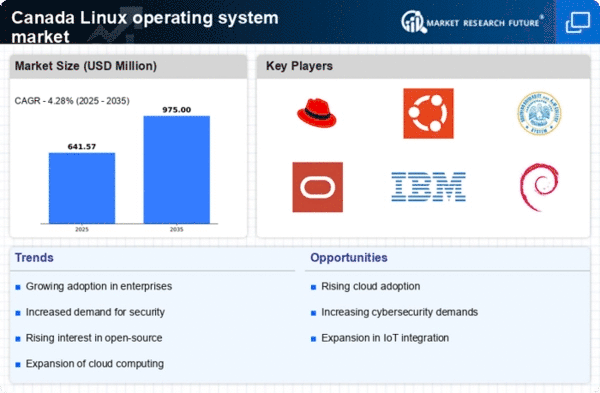
As per Market Research Future analysis, the Canada Linux Operating System Market size was estimated at 615.24 USD Million in 2024. The Linux Operating-system market is projected to grow from 641.57 USD Million in 2025 to 975.0 USD Million by 2035, exhibiting a compound annual growth rate (CAGR) of 4.2% during the forecast period 2025 - 2035

Key Market Trends & Highlights

The Canada Linux operating-system market is experiencing notable growth driven by diverse sector adoption and evolving technological needs.

  • The public sector emerges as the largest segment, showcasing a rising adoption of Linux for enhanced operational efficiency.
  • Educational institutions represent the fastest-growing segment, increasingly embracing open-source solutions for cost-effective learning environments.
  • A heightened focus on cybersecurity and data privacy is shaping the market, as organizations prioritize secure operating systems.
  • Key market drivers include the growing demand for customization and cost efficiency, reflecting budget constraints across various sectors.

Market Size & Forecast

2024 Market Size 615.24 (USD Million)
2035 Market Size 975.0 (USD Million)
CAGR (2025 - 2035) 4.28%

Major Players

Red Hat (US), Canonical (GB), SUSE (DE), Oracle (US), IBM (US), Debian (FR), Alpine Linux (US), Arch Linux (US)

Our Impact
Enabled $4.3B Revenue Impact for Fortune 500 and Leading Multinationals
Partnering with 2000+ Global Organizations Each Year
30K+ Citations by Top-Tier Firms in the Industry

Canada Linux Operating System Market Trends

the Canada Linux Operating System Market in Canada is currently experiencing significant growth., driven by various factors including technological advancements and increasing demand for open-source solutions. Organizations across multiple sectors are increasingly adopting linux operating systems due to their flexibility, security features, and cost-effectiveness. This trend is particularly evident in the public sector, where government agencies are exploring linux-based systems to enhance operational efficiency and reduce reliance on proprietary software. Furthermore, the growing emphasis on data privacy and cybersecurity is prompting businesses to consider linux as a viable alternative to traditional operating systems. In addition, the educational sector is witnessing a surge in the adoption of linux operating systems, as institutions aim to equip students with relevant skills for the modern workforce. This shift is supported by various initiatives aimed at promoting open-source software in educational curricula. As the linux operating-system market continues to expand, it appears poised to play a crucial role in shaping the future of technology in Canada, fostering innovation and collaboration among users and developers alike. The increasing community support and resources available for linux users further contribute to its growing popularity, suggesting a promising outlook for the market in the coming years.

Rising Adoption in Public Sector

Government agencies are increasingly turning to linux operating systems to improve efficiency and reduce costs. This trend reflects a broader movement towards open-source solutions, which offer enhanced security and flexibility compared to proprietary software.

Educational Institutions Embrace Open Source

Schools and universities are integrating linux operating systems into their curricula, aiming to prepare students for careers in technology. This initiative not only promotes technical skills but also encourages a culture of collaboration and innovation.

Focus on Cybersecurity and Data Privacy

With growing concerns over data breaches, organizations are prioritizing security in their IT infrastructure. Linux operating systems are perceived as a robust option, providing advanced security features that align with the needs of businesses and government entities.

Canada Linux Operating System Market Drivers

Community-Driven Development

The linux operating-system market in Canada benefits from a robust community-driven development model. This collaborative approach fosters innovation and rapid problem-solving, as developers from diverse backgrounds contribute to the improvement of linux distributions. The active participation of Canadian developers in open-source projects enhances the quality and security of linux systems. Furthermore, this community engagement often leads to faster updates and a more responsive development cycle. As organizations increasingly recognize the advantages of community support, the linux operating-system market is likely to expand, attracting more users who value the collaborative nature of open-source software.

Growing Demand for Customization

The linux operating-system market in Canada experiences a notable increase in demand for customization options. Organizations are increasingly seeking tailored solutions that align with their specific operational needs. This trend is particularly evident in sectors such as finance and healthcare, where unique software requirements necessitate flexible operating systems. According to recent data, approximately 35% of Canadian businesses report a preference for open-source solutions due to their adaptability. This customization capability not only enhances operational efficiency but also fosters innovation, as companies can modify the software to suit their evolving requirements. As a result, the Linux operating system market is likely to experience sustained growth driven by the demand for customized solutions.

Increased Focus on Sustainability

the Linux operating system market in Canada is witnessing an increasing focus on sustainability and environmental responsibility. Organizations are increasingly aware of their ecological footprint and are seeking solutions that align with their sustainability goals. Linux systems, known for their efficiency and lower resource consumption, are becoming a preferred choice for environmentally conscious businesses. Recent surveys indicate that around 40% of Canadian companies prioritize sustainable IT practices, which include adopting linux operating systems. This trend not only reflects a commitment to environmental stewardship but also positions the linux operating-system market as a leader in promoting sustainable technology solutions.

Support for Emerging Technologies

The linux operating-system market in Canada is poised for growth due to its strong support for emerging technologies. As industries increasingly adopt cloud computing, artificial intelligence, and the Internet of Things (IoT), the flexibility and scalability of linux systems become paramount. Many Canadian tech companies are leveraging linux to develop innovative applications that integrate seamlessly with these technologies. This trend is reflected in the rising number of startups and established firms that choose linux as their preferred platform for development. The ability of linux to adapt to new technological advancements positions it as a vital player in the evolving landscape of the Canadian tech industry.

Cost Efficiency and Budget Constraints

In the current economic climate, the linux operating-system market in Canada is significantly influenced by cost efficiency and budget constraints. Many organizations are facing financial pressures, prompting them to seek more affordable alternatives to proprietary software. Linux-based systems often present a lower total cost of ownership, as they typically do not require expensive licensing fees. Recent statistics indicate that businesses can save up to 50% on software costs by transitioning to linux operating systems. This financial incentive is compelling for small to medium-sized enterprises, which are increasingly adopting linux solutions to optimize their budgets while maintaining robust operational capabilities.


Market Segment Insights

By Distribution Channel: Online Sales (Largest) vs. Direct Sales (Fastest-Growing)

In the Canada linux operating-system market, the distribution channels are primarily dominated by online sales, which hold a significant share of the total market. The convenience and accessibility offered by online platforms have led to an increase in customers choosing this method for their linux operating-system needs. Meanwhile, direct sales are not far behind, capturing a considerable segment due to the personalized service and support they offer, which appeals to various enterprise clients. Looking at growth trends, online sales are projected to continue their dominance as more consumers shift to digital purchasing methods. The rising acceptance of online platforms for software distribution further drives this growth. Conversely, direct sales are witnessing a surge as companies invest more in direct customer engagement strategies. Retail sales occupy a smaller niche, primarily driven by consumers seeking immediate availability and personal interaction, even as they face stiff competition from online sales.

Online Sales (Dominant) vs. Direct Sales (Emerging)

Online sales represent the dominant distribution channel within the Canada linux operating-system market, characterized by their extensive reach and ability to provide a seamless purchasing experience. This channel's strength lies in its vast assortment and the convenience it offers to consumers. In contrast, direct sales are emerging as a significant player, focusing on building relationships and providing tailored solutions for clients. While online sales benefit from scale, direct sales capitalize on the personal touch, making them appealing for organizations that require more customized support. Retail sales, although smaller, retain relevance for customers who prefer physical interactions and immediate access to software solutions, highlighting different consumer preferences within the market.

By Deployment Type: Cloud-Based (Largest) vs. On-Premises (Fastest-Growing)

In the Canada linux operating-system market, Cloud-Based solutions have established themselves as the largest segment, dominating the overall deployment preferences among users. This shift towards Cloud-Based solutions is driven by their scalability, flexibility, and lower maintenance costs, which appeal to a range of organizations from startups to established enterprises. Conversely, the On-Premises segment, while smaller in market share, is identified as the fastest-growing area, as businesses increasingly seek robust, localized control over their operating environments. The growth trend for On-Premises solutions is underpinned by heightened concerns over data security and compliance regulations. Organizations that prioritize data sovereignty and prefer to manage their infrastructure internally are turning more towards On-Premises deployments. The evolving landscape, marked by innovations in deployment strategies and increasing investment in IT security, is anticipated to accelerate the adoption of On-Premises systems in the coming years, solidifying their market position despite the existing dominance of Cloud-Based offerings.

Cloud-Based (Dominant) vs. On-Premises (Emerging)

Cloud-Based deployment in the Canada linux operating-system market is characterized by its vast scalability and convenience, allowing businesses to access resources and applications over the internet without the need for physical hardware on site. This model facilitates easier updates and lower upfront costs, making it an appealing choice for many organizations. In contrast, On-Premises solutions are gaining traction among entities that demand greater control over their IT environments, driven by concerns regarding data privacy and regulatory compliance. Although currently emerging, On-Premises systems are witnessing accelerated adoption as organizations invest in self-hosted architectures. As both segments evolve, a dual approach that leverages the strengths of each deployment type may become increasingly common.

By End User: Individual Users (Largest) vs. Small and Medium Enterprises (Fastest-Growing)

In the Canada linux operating-system market, the distribution of market share among end users reveals Individual Users as the largest segment, driven by their preference for open-source solutions. Meanwhile, Small and Medium Enterprises (SMEs) are gaining traction, representing the fastest-growing segment due to their need for cost-effective and flexible operating systems that can enhance productivity. Growth trends in this segment are largely influenced by the increasing adoption of digital tools amongst individual users and SMEs. Individual Users are drawn towards the customization options offered by linux, allowing for personalized experiences. Coupled with this, SMEs are leveraging linux to reduce operational costs while ensuring robust security, making them a preferred choice in the evolving tech landscape.

Individual Users: Dominant vs. Small and Medium Enterprises: Emerging

Individual Users dominate the Canada linux operating-system market, characterized by a diverse group ranging from hobbyists to tech-savvy individuals. Their growing inclination toward linux is attributed to its versatility and cost-effectiveness. Conversely, Small and Medium Enterprises are an emerging segment, recognizing linux for its ability to deliver reliable performance and scalability. As these enterprises face budget constraints, they find linux to be an ideal solution, fostering innovation and allowing for seamless integration with other technologies. The ability to customize software further enhances its appeal among SMEs, as they seek tailored solutions to meet their specific operational needs.

By Application: Server Operating System (Largest) vs. Desktop Operating System (Fastest-Growing)

In the Canada linux operating-system market, the Server Operating System segment currently commands a significant market share, leveraging its status as the preferred choice for cloud and server environments. Meanwhile, the Desktop Operating System segment, while smaller in comparison, has quickly garnered attention due to the rising demand for robust and flexible personal computing solutions, indicating a shift in user preferences toward open-source alternatives. Growth trends in the Canada linux operating-system market highlight a robust momentum in the Desktop Operating System segment, driven by increasing adoption among educational institutions and small to medium-sized enterprises. This is complemented by the Server Operating System segment, which continues to thrive on the back of expanding data center infrastructure and a growing emphasis on reliable, secure server environments. Both segments reflect a strong commitment to innovation and adaptability in meeting consumer and business needs.

Server Operating System (Dominant) vs. Desktop Operating System (Emerging)

The Server Operating System segment stands as the dominant force within the Canada linux operating-system market, primarily due to its deep-rooted integration in enterprise-level solutions where stability and security are paramount. This segment caters to businesses seeking effective solutions to manage their IT infrastructure, thus reflecting a matured market dynamic. In contrast, the Desktop Operating System segment is emerging, adapting rapidly to new trends in personal computing. Its growing recognition stems from enhanced user experiences and the appeal of open-source platforms, driving an increase in both popularity and usage, particularly among younger users and tech-savvy individuals. Collectively, these segments highlight significant opportunities for growth and innovation.

Get more detailed insights about Canada Linux Operating System Market

Key Players and Competitive Insights

The linux operating-system market in Canada is characterized by a dynamic competitive landscape, driven by innovation, strategic partnerships, and a growing demand for open-source solutions. Key players such as Red Hat (US), Canonical (GB), and SUSE (DE) are at the forefront, each adopting distinct strategies to enhance their market presence. Red Hat (US) focuses on enterprise solutions and cloud services, leveraging its strong brand reputation to attract large organizations. Canonical (GB), known for its Ubuntu distribution, emphasizes user-friendly interfaces and community engagement, appealing to both individual users and businesses. Meanwhile, SUSE (DE) positions itself as a leader in enterprise-grade solutions, particularly in hybrid cloud environments, which is increasingly relevant in today's digital transformation landscape.The business tactics employed by these companies reflect a moderately fragmented market structure, where collaboration and competition coexist. Localizing operations and optimizing supply chains are common strategies, allowing companies to respond swiftly to regional demands. The collective influence of these key players shapes the market, as they continuously innovate and adapt to changing consumer preferences and technological advancements.

In October Red Hat (US) announced a strategic partnership with a leading cloud provider to enhance its hybrid cloud offerings. This move is significant as it aligns with the growing trend of businesses seeking integrated solutions that combine on-premises and cloud environments. By strengthening its cloud capabilities, Red Hat (US) aims to capture a larger share of the enterprise market, which is increasingly migrating to hybrid models.

In September Canonical (GB) launched a new version of Ubuntu, focusing on improved security features and enhanced performance for IoT devices. This initiative is crucial as it addresses the rising concerns around cybersecurity in connected devices, positioning Canonical (GB) as a proactive player in the IoT space. The emphasis on security not only attracts new users but also reinforces the brand's commitment to providing reliable solutions in an evolving technological landscape.

In August SUSE (DE) expanded its presence in Canada by opening a new regional office aimed at supporting local businesses in their digital transformation journeys. This strategic expansion indicates SUSE's commitment to understanding and addressing the unique needs of the Canadian market. By establishing a local presence, SUSE (DE) enhances its customer engagement and support capabilities, which could lead to increased market share in the region.

As of November the competitive trends in the linux operating-system market are increasingly defined by digitalization, sustainability, and the integration of AI technologies. Strategic alliances are becoming more prevalent, as companies recognize the value of collaboration in driving innovation. The competitive differentiation is likely to evolve from traditional price-based competition to a focus on technological advancements, reliability in supply chains, and the ability to deliver tailored solutions that meet the specific needs of diverse customer segments.

Key Companies in the Canada Linux Operating System Market include

Industry Developments

The Canada Linux Operating System Market has seen various recent developments and current affairs. In October 2023, Red Hat unveiled new innovations in Fedora alongside significant partnerships aimed at enhancing cloud-native technologies, benefiting local enterprises. 

Similarly, Canonical has expanded its presence, focusing on enhanced services for Canadian customers, emphasizing security and scalability in cloud computing. Merger and acquisition activities have been notable, such as Oracle’s acquisition of a smaller tech firm in September 2023 aimed at bolstering its capabilities in the cloud and Linux systems market, enhancing its competitive edge. 

Additionally, VMware has been expanding its alliances with Canadian tech startups to promote VMware Cloud solutions, which is attracting more businesses to adopt Linux-based environments. The growth of Linux usage in government sectors and telecommunications is being fueled by increasing demands for open-source solutions, supporting Canada’s digital transformation efforts. Over the past two to three years, significant attention has also been directed towards the environmental sustainability of Linux systems in Canadian industries, with many corporations adopting green IT initiatives and aiming to lower their carbon footprint through efficient open-source solutions.

Future Outlook

Canada Linux Operating System Market Future Outlook

The Linux Operating System Market in Canada is projected to grow at a 4.28% CAGR from 2025 to 2035, driven by cloud adoption, IoT integration, and enterprise demand.

New opportunities lie in:

  • Development of tailored Linux solutions for IoT devices
  • Expansion of Linux-based cloud services for businesses
  • Creation of training programs for Linux system administrators

By 2035, the Linux operating-system market is expected to be robust and diversified.

Market Segmentation

Canada Linux Operating System Market End User Outlook

  • Individual Users
  • Small and Medium Enterprises
  • Large Enterprises
  • Government

Canada Linux Operating System Market Application Outlook

  • Server Operating System
  • Desktop Operating System
  • Embedded Operating System

Canada Linux Operating System Market Deployment Type Outlook

  • On-Premises
  • Cloud-Based

Canada Linux Operating System Market Distribution Channel Outlook

  • Direct Sales
  • Online Sales
  • Retail Sales

Report Scope

MARKET SIZE 2024 615.24(USD Million)
MARKET SIZE 2025 641.57(USD Million)
MARKET SIZE 2035 975.0(USD Million)
COMPOUND ANNUAL GROWTH RATE (CAGR) 4.28% (2025 - 2035)
REPORT COVERAGE Revenue Forecast, Competitive Landscape, Growth Factors, and Trends
BASE YEAR 2024
Market Forecast Period 2025 - 2035
Historical Data 2019 - 2024
Market Forecast Units USD Million
Key Companies Profiled Red Hat (US), Canonical (GB), SUSE (DE), Oracle (US), IBM (US), Debian (FR), Alpine Linux (US), Arch Linux (US)
Segments Covered Distribution Channel, Deployment Type, End User, Application
Key Market Opportunities Growing demand for cloud computing solutions enhances opportunities in the linux operating-system market.
Key Market Dynamics Growing demand for open-source solutions drives innovation and competition in the Linux operating-system market.
Countries Covered Canada
Leave a Comment

FAQs

What is the expected market size of the Canada Linux Operating System Market in 2024?

The Canada Linux Operating System Market is expected to be valued at 620.0 USD Million in 2024.

What is the projected market size for the Canada Linux Operating System Market by 2035?

By 2035, the Canada Linux Operating System Market is anticipated to reach a value of 2500.0 USD Million.

What is the expected CAGR for the Canada Linux Operating System Market from 2025 to 2035?

The expected CAGR for the Canada Linux Operating System Market during the period from 2025 to 2035 is 13.514%.

Which distribution channel is expected to hold the largest market share in 2035?

The Direct Sales channel is projected to have the largest market share, valued at 1000.0 USD Million in 2035.

What market value is attributed to the Online Sales channel in 2024?

In 2024, the Online Sales channel is expected to be valued at 200.0 USD Million.

Who are the key players in the Canada Linux Operating System Market?

Major players in the market include Oracle, VMware, NVIDIA, Google, Red Hat, and Amazon, among others.

What is the expected market value for the Retail Sales channel in 2035?

The Retail Sales channel is projected to be valued at 600.0 USD Million in 2035.

How does the market size of Online Sales compare between 2024 and 2035?

The Online Sales channel is expected to grow from 200.0 USD Million in 2024 to 900.0 USD Million in 2035.

What are the key growth drivers for the Canada Linux Operating System Market?

Factors such as increased adoption of open-source software and growing demand for cloud-based services are key growth drivers.

What challenges does the Canada Linux Operating System Market face?

The market faces challenges including competition from proprietary operating systems and security concerns.

Download Free Sample

Kindly complete the form below to receive a free sample of this Report

Compare Licence

×
Features License Type
Single User Multiuser License Enterprise User
Price $4,950 $5,950 $7,250
Maximum User Access Limit 1 User Upto 10 Users Unrestricted Access Throughout the Organization
Free Customization
Direct Access to Analyst
Deliverable Format
Platform Access
Discount on Next Purchase 10% 15% 15%
Printable Versions