×
Request Free Sample ×

Kindly complete the form below to receive a free sample of this Report

* Please use a valid business email

Leading companies partner with us for data-driven Insights

clients tt-cursor
Hero Background

Canada Li Ion Battery Recycling Market

ID: MRFR/EnP/52535-HCR
200 Pages
Snehal Singh
February 2026

Canada Li-Ion Battery Recycling Market Research Report By Application (Consumer Electronics, Electric Vehicles, Energy Storage Systems, Power Tools), By Technology (Hydrometallurgical, Pyrometallurgical, Direct Recycling), By Battery Type (Lithium Nickel Manganese Cobalt Oxide, Lithium Iron Phosphate, Lithium Cobalt Oxide, Lithium Manganese Oxide) and By End Use (Automotive, Industrial, Residential, Commercial) - Forecast to 2035

Share:
Download PDF ×

We do not share your information with anyone. However, we may send you emails based on your report interest from time to time. You may contact us at any time to opt-out.

Canada Li Ion Battery Recycling Market Infographic
Purchase Options

Canada Li Ion Battery Recycling Market Summary

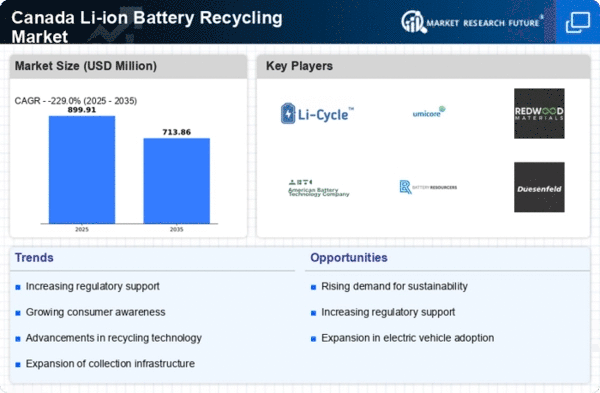
As per Market Research Future analysis, the Canada Li Ion Battery Recycling Market size was estimated at 921.0 USD Million in 2024. The Li Ion-battery-recycling market is projected to grow from 899.91 USD Million in 2025 to 713.86 USD Million by 2035, exhibiting a compound annual growth rate (CAGR) of 2.29% during the forecast period 2025 - 2035

Key Market Trends & Highlights

The Canada li ion-battery-recycling market is poised for growth driven by regulatory enhancements and technological advancements.

  • Regulatory frameworks are evolving to support sustainable recycling practices in the li ion-battery sector.
  • Technological innovations are enhancing the efficiency and effectiveness of recycling processes.
  • Consumer awareness regarding environmental impacts is increasing, influencing market dynamics.
  • The rising demand for electric vehicles and government incentives are key drivers propelling market expansion.

Market Size & Forecast

2024 Market Size 921.0 (USD Million)
2035 Market Size 713.86 (USD Million)
CAGR (2025 - 2035) -2.29%

Major Players

Li-Cycle (CA), Umicore (BE), Redwood Materials (US), American Battery Technology Company (US), Battery Resourcers (US), Duesenfeld (DE), Aqua Metals (US), Fortum (FI)

Our Impact
Enabled $4.3B Revenue Impact for Fortune 500 and Leading Multinationals
Partnering with 2000+ Global Organizations Each Year
30K+ Citations by Top-Tier Firms in the Industry

Canada Li Ion Battery Recycling Market Trends

The Canada Li Ion Battery Recycling Market is experiencing notable growth, driven by increasing environmental awareness and regulatory pressures. As the demand for electric vehicles and portable electronics rises, the need for effective recycling solutions becomes more pressing. In Canada, government initiatives are promoting sustainable practices, encouraging manufacturers to adopt circular economy principles. This shift not only addresses waste management challenges but also enhances resource recovery, thereby reducing reliance on virgin materials. Furthermore, advancements in recycling technologies are improving efficiency and recovery rates, making the process more economically viable. In addition, public and private sector collaborations are emerging to foster innovation in recycling methods. Educational campaigns are raising awareness about the importance of recycling lithium-ion batteries, which is crucial for minimizing environmental impact. The li ion-battery-recycling market is poised for further expansion as stakeholders recognize the long-term benefits of sustainable practices. As regulations tighten and consumer preferences shift towards greener alternatives, the market is likely to evolve, presenting new opportunities for growth and development.

Regulatory Framework Enhancements

Recent developments in legislation are shaping the li ion-battery-recycling market. Canadian authorities are implementing stricter regulations aimed at improving recycling rates and ensuring responsible disposal of batteries. These regulations are likely to compel manufacturers to adopt more sustainable practices, thereby fostering a more robust recycling ecosystem.

Technological Innovations

Advancements in recycling technologies are transforming the li ion-battery-recycling market. New methods are emerging that enhance the efficiency of material recovery, reducing costs and environmental impact. These innovations may lead to higher recovery rates of valuable materials, making recycling more attractive to businesses.

Increased Consumer Awareness

There is a growing awareness among consumers regarding the environmental implications of battery disposal. Educational initiatives are encouraging responsible recycling behaviors, which could drive demand for recycling services. This trend suggests a shift in consumer attitudes, potentially influencing market dynamics.

Canada Li Ion Battery Recycling Market Drivers

Growing Environmental Concerns

Environmental concerns are increasingly driving the li ion-battery-recycling market in Canada. With the rising awareness of the ecological impact of battery waste, there is a growing push for sustainable practices. The Canadian public is becoming more conscious of the need to recycle batteries to prevent hazardous materials from contaminating landfills. Reports indicate that improper disposal of lithium-ion batteries can lead to significant environmental damage, prompting calls for better recycling solutions. This heightened awareness is likely to result in increased participation in recycling programs, thereby expanding the li ion-battery-recycling market as consumers seek responsible disposal options.

Government Incentives and Policies

Government initiatives play a crucial role in shaping the li ion-battery-recycling market in Canada. Various federal and provincial programs are being implemented to promote recycling and reduce environmental impact. For instance, the Canadian government has introduced financial incentives for companies that engage in battery recycling, which could potentially increase recycling rates by up to 30% by 2027. Additionally, policies aimed at reducing landfill waste and promoting circular economy practices are likely to bolster the market. These incentives not only encourage recycling but also stimulate innovation in recycling technologies, thereby enhancing the overall efficiency of the li ion-battery-recycling market.

Rising Demand for Electric Vehicles

The increasing adoption of electric vehicles (EVs) in Canada is a pivotal driver for the li ion-battery-recycling market. As the Canadian government aims to have 100% of new light-duty vehicle sales be zero-emission by 2035, the demand for lithium-ion batteries is expected to surge. This transition is projected to create a substantial volume of used batteries that require recycling. In 2023, it was estimated that the number of EVs on Canadian roads would exceed 1 million, leading to a significant increase in battery waste. Consequently, the li ion-battery-recycling market is likely to expand to accommodate the growing need for sustainable disposal and recovery of valuable materials from these batteries.

Collaboration Between Industry Stakeholders

Collaboration among various stakeholders in the li ion-battery-recycling market is emerging as a key driver. Partnerships between manufacturers, recyclers, and government agencies are fostering a more integrated approach to battery recycling. These collaborations can lead to the development of standardized recycling protocols and shared resources, which may enhance the efficiency of recycling operations. For instance, joint ventures between automotive manufacturers and recycling firms are likely to streamline the collection and processing of used batteries. This cooperative effort could potentially increase the overall recycling rate in Canada, thereby strengthening the li ion-battery-recycling market.

Technological Advancements in Recycling Processes

Technological advancements are significantly influencing the li ion-battery-recycling market. Innovations in recycling processes, such as hydrometallurgical and pyrometallurgical methods, are enhancing the efficiency of material recovery from spent batteries. These technologies can potentially recover up to 95% of valuable materials like lithium, cobalt, and nickel, which are essential for new battery production. As these processes become more refined and cost-effective, they are likely to attract investment and increase the capacity of recycling facilities across Canada. This trend suggests a promising future for the li ion-battery-recycling market, as improved technologies may lead to higher recovery rates and lower environmental impact.

Market Segment Insights

By Application: Electric Vehicles (Largest) vs. Consumer Electronics (Fastest-Growing)

In the Canada li ion-battery-recycling market, the market share distribution across the application segment reflects significant diversification. The Electric Vehicles segment holds the largest share, driven by the increasing adoption of electric vehicles and the need for sustainable battery disposal. On the other hand, Consumer Electronics has emerged as the fastest-growing segment, fueled by the proliferation of portable devices and the corresponding rise in battery usage. Growth trends in this segment are notably influenced by technological advancements and regulatory pressures. The government is pushing for environmentally-friendly recycling initiatives, creating a favorable landscape for all applications. The Energy Storage Systems segment is also gaining traction as renewable energy sources become prevalent, further enhancing the demand for effective battery recycling solutions.

Electric Vehicles: Dominant vs. Consumer Electronics: Emerging

The Electric Vehicles segment stands out as the dominant force in the Canada li ion-battery-recycling market, representing a robust demand for recycling solutions to support the growing fleet of electric cars. This segment benefits from widespread automotive industry investments in electric technology and enhanced awareness of sustainability. Conversely, the Consumer Electronics segment is rapidly emerging, driven by the surge in smartphones, laptops, and other portable devices requiring lithium-ion batteries. This growth is complemented by consumer consciousness surrounding electronic waste and battery recycling. As more manufacturers adopt eco-friendly practices, both segments are poised for continued evolution under shifting regulatory frameworks and consumer preferences.

By Technology: Hydrometallurgical (Largest) vs. Pyrometallurgical (Fastest-Growing)

The Canada li ion-battery-recycling market exhibits a diverse distribution of technologies used in recycling processes. Currently, the hydrometallurgical method holds the largest market share due to its efficiency in extracting valuable metals from battery components. In contrast, the pyrometallurgical approach, although smaller in market share, is gaining attention for its rapid growth, fueled by advancements in technology and increasing demand for sustainable practices. Growth trends in this segment reveal that the hydrometallurgical process is being increasingly adopted, driven by its lower environmental impact and higher recovery rates of metals. The pyrometallurgical method is emerging as a competitive option, particularly as regulatory pressures intensify and battery manufacturers seek to enhance recycling efficiency. As innovations persist, both segments are expected to experience dynamic shifts in market positioning, with a strong focus on sustainable recycling solutions.

Technology: Hydrometallurgical (Dominant) vs. Pyrometallurgical (Emerging)

Hydrometallurgical recycling technology stands out as the dominant force in the Canada li ion-battery-recycling market. This method is characterized by its ability to recover a wide array of metals, including lithium, cobalt, and nickel, through chemical processes that are less energy-intensive compared to traditional approaches. It leverages environmentally friendly practices, appealing to a market increasingly concerned about sustainability. On the other hand, pyrometallurgical technology, while currently classified as emerging, is rapidly evolving. It is recognized for its efficiency in processing battery materials, although it faces challenges regarding emissions and environmental concerns. As regulatory frameworks continue to evolve, both technologies are expected to push the boundaries of recycling efficiency and sustainability.

By Battery Type: Lithium Nickel Manganese Cobalt Oxide (Largest) vs. Lithium Iron Phosphate (Fastest-Growing)

The market for battery types in the Canada li ion-battery-recycling market is primarily driven by Lithium Nickel Manganese Cobalt Oxide, which has emerged as the largest segment due to its high energy density and efficiency in various applications. Following closely is Lithium Iron Phosphate, which is gaining traction in the recycling space as a reliable and safer alternative, significantly enhancing its market share in recent years. Growth trends in this segment indicate a shift towards sustainable and efficient battery technologies. Factors driving this growth include rising demand for clean energy solutions, advancements in recycling technologies, and increasing regulatory support for recycling practices. These trends position both Lithium Nickel Manganese Cobalt Oxide and Lithium Iron Phosphate for sustained growth in the coming years, with the latter being recognized for its rapid adoption across various sectors.

Lithium Nickel Manganese Cobalt Oxide (Dominant) vs. Lithium Iron Phosphate (Emerging)

Lithium Nickel Manganese Cobalt Oxide is recognized as the dominant player in the battery type segment due to its favorable characteristics, such as high capacity and longer lifecycle, making it a preferred choice for electric vehicles and portable electronics. On the other hand, Lithium Iron Phosphate is emerging as a strong competitor, appealing due to its thermal stability and environmental benefits, contributing to its rapid acceptance in various applications. These two battery types represent distinct preferences within the Canada li ion-battery-recycling market, highlighting a transition towards more sustainable and efficient technologies, with Lithium Iron Phosphate poised for a notable rise in adoption.

By End Use: Automotive (Largest) vs. Industrial (Fastest-Growing)

In the Canada li ion-battery-recycling market, the automotive segment holds the largest market share, driven by the increasing adoption of electric vehicles and stringent regulations regarding battery disposal. This trend reflects consumers and manufacturers' growing awareness of environmental sustainability and the importance of recycling in reducing waste. The industrial segment, while smaller in overall share, is the fastest-growing due to rising demand for batteries in various applications, such as backup power systems and renewable energy storage, leading to increased recycling efforts to reclaim valuable materials. The growth in the automotive sector is primarily attributed to advancements in battery technology and the expansion of electric vehicle manufacturing. Government initiatives aimed at promoting recycling also play a vital role in bolstering this sector. Meanwhile, the industrial sector is witnessing a surge in demand as more companies are incorporating energy storage solutions in their operations, thereby amplifying the need for effective recycling strategies to ensure sustainability and efficiency in battery usage.

Automotive (Dominant) vs. Industrial (Emerging)

The automotive segment is dominant in the Canada li ion-battery-recycling market, characterized by its substantial volume of batteries requiring recycling due to the rapid rise of electric vehicle production. This segment benefits from robust infrastructure and established relationships among manufacturers, recyclers, and regulators, ensuring a streamlined recycling process. In contrast, the industrial segment is emerging, representing untapped potential as businesses increasingly adopt advanced energy storage technologies. Industrial applications are expanding, which leads to a higher volume of batteries entering the recycling lifecycle. Both segments showcase distinct market characteristics, with automotive focusing on sustained volume and regulations, while industrial emphasizes innovation and adaptability to growing energy demands.

Get more detailed insights about Canada Li Ion Battery Recycling Market

Key Players and Competitive Insights

The li ion-battery-recycling market is currently characterized by a dynamic competitive landscape, driven by increasing demand for sustainable battery solutions and stringent regulatory frameworks. Key players such as Li-Cycle (CA), Umicore (BE), and Redwood Materials (US) are at the forefront, each adopting distinct strategies to enhance their market positioning. Li-Cycle (CA) focuses on innovative recycling technologies that maximize resource recovery, while Umicore (BE) emphasizes its commitment to sustainability through advanced material processing techniques. Redwood Materials (US) is leveraging partnerships with major automotive manufacturers to secure a steady supply of used batteries, thereby reinforcing its operational focus on circular economy principles. Collectively, these strategies contribute to a competitive environment that is increasingly oriented towards sustainability and technological advancement.In terms of business tactics, companies are localizing manufacturing and optimizing supply chains to enhance efficiency and reduce costs. The market structure appears moderately fragmented, with several players vying for market share, yet the influence of key players is substantial. This competitive structure fosters innovation and encourages collaboration among companies, as they seek to address the challenges associated with battery waste and resource scarcity.

In October Li-Cycle (CA) announced the opening of a new recycling facility in Ontario, which is expected to significantly increase its processing capacity. This strategic move not only enhances Li-Cycle's operational footprint but also aligns with Canada's growing emphasis on local recycling solutions, potentially positioning the company as a leader in the region. The facility is anticipated to create numerous jobs and contribute to the local economy, further solidifying Li-Cycle's commitment to sustainable practices.

In September Umicore (BE) entered into a strategic partnership with a leading automotive manufacturer to develop a closed-loop battery recycling system. This collaboration is poised to enhance Umicore's capabilities in recovering valuable materials from end-of-life batteries, thereby reinforcing its position as a key player in the sustainable materials sector. The partnership underscores the importance of collaboration in achieving circular economy goals and may lead to significant advancements in recycling technologies.

In November Redwood Materials (US) secured a $100 million investment to expand its recycling operations in North America. This funding is likely to accelerate the company's growth trajectory and enhance its ability to meet the increasing demand for recycled battery materials. The investment reflects a broader trend of increasing financial support for sustainable technologies, indicating a shift towards prioritizing innovation and resource recovery in the industry.

As of November current competitive trends are heavily influenced by digitalization, sustainability, and the integration of advanced technologies such as AI in recycling processes. Strategic alliances are becoming increasingly vital, as companies recognize the need for collaboration to navigate the complexities of the market. Looking ahead, competitive differentiation is expected to evolve, with a pronounced shift from price-based competition to a focus on innovation, technological advancements, and supply chain reliability. This transition may redefine the competitive landscape, fostering a more sustainable and efficient li ion-battery-recycling market.

Key Companies in the Canada Li Ion Battery Recycling Market include

Industry Developments

Recent developments in the Canada Li-Ion Battery Recycling Market have seen significant advancements and strategic movements among key players. Companies like LiCycle Corp and American Battery Technology Company have made strides in scaling their recycling operations, enhancing the domestic capacity for battery recycling in Canada. In June 2023, Aqua Metals announced its plans to expand its lithium-ion battery recycling facility in Canada, aiming to increase the recovery efficiency of valuable materials.

Additionally, in July 2023, Cirba Solutions launched a new initiative focusing on end-of-life battery management, reflecting a growing emphasis on sustainable practices in the sector.In terms of market valuation, the Canadian Li-Ion Battery Recycling Market is witnessing a growth trajectory fueled by heightened demand for electric vehicles and sustainable battery solutions. The Canadian government's support for clean technology initiatives is further bolstering investment opportunities for companies like Redwood Materials and Umicore. Notably, the recent focus on sustainability is encouraging collaborations and partnerships, yet no significant mergers or acquisitions have been reported in this sector during the year 2023.

Overall, the industry is poised for growth amid evolving regulatory frameworks and environmental considerations.

Future Outlook

Canada Li Ion Battery Recycling Market Future Outlook

The li ion-battery-recycling market in Canada is projected to experience a decline of -2.29% CAGR from 2025 to 2035, driven by regulatory changes and technological advancements.

New opportunities lie in:

  • Development of automated sorting technologies for efficient recycling processes.
  • Partnerships with electric vehicle manufacturers for battery take-back programs.
  • Investment in research for advanced recycling methods to recover rare materials.

By 2035, the market is expected to stabilize, adapting to emerging challenges and opportunities.

Market Segmentation

Canada Li Ion Battery Recycling Market End Use Outlook

  • Automotive
  • Industrial
  • Residential
  • Commercial

Canada Li Ion Battery Recycling Market Technology Outlook

  • Hydrometallurgical
  • Pyrometallurgical
  • Direct Recycling

Canada Li Ion Battery Recycling Market Application Outlook

  • Consumer Electronics
  • Electric Vehicles
  • Energy Storage Systems
  • Power Tools

Canada Li Ion Battery Recycling Market Battery Type Outlook

  • Lithium Nickel Manganese Cobalt Oxide
  • Lithium Iron Phosphate
  • Lithium Cobalt Oxide
  • Lithium Manganese Oxide

Report Scope

MARKET SIZE 2024 921.0(USD Million)
MARKET SIZE 2025 899.91(USD Million)
MARKET SIZE 2035 713.86(USD Million)
COMPOUND ANNUAL GROWTH RATE (CAGR) -2.29% (2025 - 2035)
REPORT COVERAGE Revenue Forecast, Competitive Landscape, Growth Factors, and Trends
BASE YEAR 2024
Market Forecast Period 2025 - 2035
Historical Data 2019 - 2024
Market Forecast Units USD Million
Key Companies Profiled Li-Cycle (CA), Umicore (BE), Redwood Materials (US), American Battery Technology Company (US), Battery Resourcers (US), Duesenfeld (DE), Aqua Metals (US), Fortum (FI)
Segments Covered Application, Technology, Battery Type, End Use
Key Market Opportunities Growing demand for sustainable practices drives innovation in the li ion-battery-recycling market.
Key Market Dynamics Growing regulatory pressures and technological advancements drive innovation in the lithium-ion battery recycling market.
Countries Covered Canada
Leave a Comment

FAQs

What is the expected market size of the Canada Li-Ion Battery Recycling Market by 2035?

The Canada Li-Ion Battery Recycling Market is expected to be valued at 1150.0 million USD by the year 2035.

What was the market value of the Canada Li-Ion Battery Recycling Market in 2024?

In 2024, the overall market is expected to be valued at 513.0 million USD.

What is the expected CAGR of the Canada Li-Ion Battery Recycling Market from 2025 to 2035?

The expected CAGR for the Canada Li-Ion Battery Recycling Market from 2025 to 2035 is 7.615%.

Which application segment is projected to have the highest market value by 2035?

The Electric Vehicles application segment is projected to have a market value of 490.0 million USD by 2035.

What was the market size for the Consumer Electronics application in 2024?

The market size for the Consumer Electronics application in 2024 was valued at 150.0 million USD.

Who are some of the key players in the Canada Li-Ion Battery Recycling Market?

Key players in the market include Redwood Materials, Aqua Metals, and LiCycle Corp among others.

What is the expected market value for Energy Storage Systems by 2035?

The expected market value for Energy Storage Systems by 2035 is 210.0 million USD.

How much is the Power Tools application segment expected to grow by 2035?

The Power Tools application segment is expected to grow to 110.0 million USD by 2035.

What challenges might the Canada Li-Ion Battery Recycling Market face in the coming years?

The market may face challenges including regulatory changes and technological advancements impacting recycling methods.

What opportunities exist for growth in the Canada Li-Ion Battery Recycling Market?

Opportunities for growth include increasing demand for recycled materials in electric vehicles and consumer electronics.

Download Free Sample

Kindly complete the form below to receive a free sample of this Report

Compare Licence

×
Features License Type
Single User Multiuser License Enterprise User
Price $4,950 $5,950 $7,250
Maximum User Access Limit 1 User Upto 10 Users Unrestricted Access Throughout the Organization
Free Customization
Direct Access to Analyst
Deliverable Format
Platform Access
Discount on Next Purchase 10% 15% 15%
Printable Versions