×
Request Free Sample ×

Kindly complete the form below to receive a free sample of this Report

* Please use a valid business email

Leading companies partner with us for data-driven Insights

clients tt-cursor
Hero Background

Canada Laser Technology Market

ID: MRFR/ICT/56258-HCR
200 Pages
Aarti Dhapte
February 2026

Canada Laser Technology Market Size, Share and Research Report: By Technology (Fiber Laser, Solid-State Laser, Gas Laser, Semiconductor Laser), By Application (Material Processing, Medical, Communication, Defense, Aerospace), By End Use Industry (Manufacturing, Healthcare, Telecommunications, Automotive, Defense) and By Laser Type (Continuous Wave Laser, Pulsed Laser, Ultrafast Laser)- Industry Forecast to 2035

Share:
Download PDF ×

We do not share your information with anyone. However, we may send you emails based on your report interest from time to time. You may contact us at any time to opt-out.

Canada Laser Technology Market Infographic
Purchase Options

Canada Laser Technology Market Summary

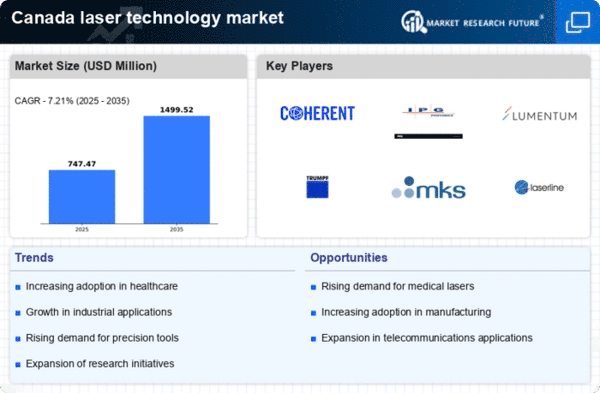
As per Market Research Future analysis, the Canada laser technology market Size was estimated at 697.2 USD Million in 2024. The Canada laser technology market is projected to grow from 747.47 USD Million in 2025 to 1499.52 USD Million by 2035, exhibiting a compound annual growth rate (CAGR) of 7.2% during the forecast period 2025 - 2035

Key Market Trends & Highlights

The Canada laser technology market is poised for substantial growth driven by innovations across various sectors.

  • The healthcare segment remains the largest, fueled by rising demand for advanced medical applications.
  • Industrial applications are witnessing rapid growth, particularly in manufacturing processes and automation.
  • Telecommunications advancements are emerging as a key area, with lasers playing a crucial role in data transmission.
  • Market drivers include technological advancements in manufacturing and increased adoption in defense and security sectors.

Market Size & Forecast

2024 Market Size 697.2 (USD Million)
2035 Market Size 1499.52 (USD Million)
CAGR (2025 - 2035) 7.21%

Major Players

Coherent Inc (US), IPG Photonics Corporation (US), Lumentum Holdings Inc (US), TRUMPF GmbH + Co. KG (DE), MKS Instruments Inc (US), Laserline GmbH (DE), NKT Photonics A/S (DK), Rofin-Sinar Technologies Inc (US)

Our Impact
Enabled $4.3B Revenue Impact for Fortune 500 and Leading Multinationals
Partnering with 2000+ Global Organizations Each Year
30K+ Citations by Top-Tier Firms in the Industry

Canada Laser Technology Market Trends

The laser technology market is experiencing notable growth, driven by advancements in various sectors such as healthcare, manufacturing, and telecommunications. In Canada, the increasing adoption of laser systems for medical applications, including surgical procedures and cosmetic treatments, highlights a shift towards minimally invasive techniques. Furthermore, the integration of laser technology in industrial processes, such as cutting and welding, enhances precision and efficiency, thereby attracting investments and fostering innovation. The emphasis on research and development within Canadian institutions also contributes to the evolution of laser applications, suggesting a promising future for this market. Moreover, the rising demand for laser-based solutions in telecommunications, particularly in fiber optic communications, indicates a significant trend towards improved data transmission capabilities. As industries continue to seek advanced technologies to meet growing consumer expectations, the laser technology market appears well-positioned to capitalize on these opportunities. The collaboration between public and private sectors in Canada further supports the development of laser technologies, potentially leading to breakthroughs that could redefine various applications. Overall, the landscape of the laser technology market is dynamic, with various factors influencing its trajectory and growth potential.

Healthcare Innovations

The integration of laser technology in healthcare is transforming treatment methodologies. Canadian medical facilities increasingly utilize lasers for surgical procedures, dermatological treatments, and dental applications. This trend reflects a broader movement towards non-invasive techniques, enhancing patient outcomes and recovery times.

Industrial Applications

In the industrial sector, laser technology is becoming essential for manufacturing processes. Canadian companies are adopting laser systems for cutting, engraving, and welding, which improves precision and reduces waste. This trend indicates a shift towards automation and efficiency in production lines.

Telecommunications Advancements

The telecommunications sector is witnessing a surge in laser technology applications, particularly in fiber optic networks. Canadian firms are investing in laser-based solutions to enhance data transmission speeds and reliability. This trend underscores the importance of lasers in meeting the demands of modern communication systems.

Canada Laser Technology Market Drivers

Rising Demand in Medical Applications

The laser technology market in Canada experiences a notable surge in demand due to advancements in medical applications. Lasers are increasingly utilized in surgical procedures, diagnostics, and therapeutic treatments, enhancing precision and reducing recovery times. The Canadian healthcare sector is projected to invest approximately $2 billion in laser technologies by 2026, reflecting a growing recognition of their efficacy. This trend is driven by the need for minimally invasive procedures, which are becoming the standard in various medical fields. Furthermore, the integration of laser technology in cosmetic procedures is also contributing to market growth, as consumers seek non-invasive options for aesthetic enhancements. The laser technology market is thus positioned to benefit from these evolving healthcare needs, indicating a robust future for laser applications in medical settings.

Increased Adoption in Defense and Security

The laser technology market in Canada is experiencing growth due to increased adoption in defense and security applications. The Canadian government is investing in advanced laser systems for various military and law enforcement purposes, including target designation, range finding, and non-lethal deterrence. The defense budget for laser technologies is projected to reach $500 million by 2027, reflecting a strategic focus on enhancing national security capabilities. This trend is driven by the need for precision and effectiveness in defense operations, as well as the growing importance of cybersecurity measures. The laser technology market is likely to benefit from these investments, as advancements in laser systems contribute to improved operational efficiency and effectiveness in defense scenarios. The integration of laser technology into security protocols suggests a promising future for its applications in safeguarding national interests.

Emerging Applications in Telecommunications

The laser technology market in Canada is poised for growth due to emerging applications in telecommunications. As the demand for high-speed data transmission increases, lasers are becoming essential components in fiber optic communication systems. The market for optical communication lasers is expected to expand significantly, with projections indicating a growth rate of 10% annually over the next five years. Canadian telecommunications companies are investing in laser technology to enhance network capacity and reliability, addressing the needs of a digitally connected society. The laser technology market is thus likely to thrive as innovations in optical networks and data transmission continue to evolve. This trend underscores the critical role of laser technology in supporting the infrastructure necessary for modern communication systems.

Technological Advancements in Manufacturing

In Canada, the laser technology market is significantly influenced by technological advancements in manufacturing processes. Industries are increasingly adopting laser cutting, welding, and engraving techniques to enhance production efficiency and product quality. The market for industrial lasers is expected to grow at a CAGR of 8% over the next five years, driven by the demand for precision and automation in manufacturing. Canadian manufacturers are leveraging laser technology to reduce waste and improve energy efficiency, aligning with sustainability goals. This shift towards advanced manufacturing practices is likely to propel the laser technology market forward, as companies seek to remain competitive in a rapidly evolving landscape. The integration of smart technologies with laser systems further enhances their capabilities, suggesting a promising trajectory for the market.

Growth in Research and Development Activities

The laser technology market in Canada is bolstered by an increase in research and development (R&D) activities across various sectors. Academic institutions and private enterprises are investing heavily in laser research, exploring new applications and improving existing technologies. Government funding for R&D initiatives in photonics and laser technologies has seen a rise, with allocations reaching approximately $150 million in recent years. This investment fosters innovation and collaboration between academia and industry, leading to the development of cutting-edge laser solutions. The laser technology market stands to gain from these advancements, as new discoveries and applications emerge, potentially transforming sectors such as telecommunications, defense, and environmental monitoring. The emphasis on R&D indicates a commitment to maintaining Canada’s competitive edge in the global laser technology landscape.


Market Segment Insights

By Technology: Fiber Laser (Largest) vs. Gas Laser (Fastest-Growing)

The Canada laser technology market exhibits a diverse distribution among its segments, with fiber laser technology holding the largest share. This segment's robust performance is driven by its efficiency and versatility across various applications, making it a preferred choice for industries such as manufacturing and medical. Meanwhile, gas lasers are witnessing rapid growth, attracting attention due to their effectiveness in cutting and welding applications. This growth is further fueled by advancements in technology that enhance their performance and reduce costs. As industries in Canada continue to adopt laser technologies for precision and automation, the growth trends indicate a shift towards more innovative laser solutions. The increasing demand for high-quality and cost-effective laser systems drives the fiber laser segment, while gas lasers benefit from their adaptability in high-demand sectors. Furthermore, investments in research and development are accelerating the evolution of both technologies, ensuring they meet the changing needs of the market.

Technology: Fiber Laser (Dominant) vs. Gas Laser (Emerging)

Fiber lasers are recognized as the dominant technology in the Canada laser technology market owing to their superior efficiency and low maintenance costs. These lasers provide high beam quality and flexibility, which enhance their applicability in various industries including automotive, aerospace, and medical sectors. On the other hand, gas lasers are emerging as a significant alternative, particularly in applications requiring high power and precision. Their ability to operate at lower costs and their effectiveness in specialized procedures make them attractive for growth. With ongoing advancements in both technologies, the competition is set to intensify, shaping the future landscape of the Canada laser technology market.

By Application: Material Processing (Largest) vs. Medical (Fastest-Growing)

In the Canada laser technology market, the material processing segment holds the largest market share, driven by its extensive applications in manufacturing and industrial processes. This segment includes laser cutting, welding, and engraving, which are critical for various industries, including automotive and electronics. Following closely, the medical segment is rapidly expanding due to advancements in laser surgical equipment and its increasing adoption in medical therapies for precise applications. The growth trends indicate a robust trajectory for both segments. Material processing is propelled by the continuous demand for efficient and precise manufacturing technologies. Conversely, the medical segment is experiencing a surge, fueled by innovations in minimally invasive surgeries and the rising prevalence of chronic diseases. This dynamic interplay between industrial and medical applications showcases the versatility of laser technologies within the market.

Material Processing (Dominant) vs. Medical (Emerging)

Material processing is a dominant segment in the Canada laser technology market, characterized by its vital role in enhancing productivity and accuracy in manufacturing processes. It encompasses a wide array of applications such as cutting, engraving, and welding, catering predominantly to sectors like automotive, aerospace, and consumer goods. The efficiency and precision offered by laser technology make it indispensable in modern manufacturing. On the other hand, the medical segment is emerging rapidly, driven by the growing emphasis on non-invasive surgical procedures and innovative treatment methodologies. This segment leverages laser applications for various medical procedures, such as vision correction and tissue ablation, reflecting an increasing integration of technology in healthcare practices.

By End-use Industry: Manufacturing (Largest) vs. Healthcare (Fastest-Growing)

The Canada laser technology market exhibits a diverse distribution across various end-use industries. Manufacturing leads in market share, driven by the increasing demand for precise and efficient production processes. Following closely, healthcare is expanding rapidly due to advancements in medical technologies and procedures relying on laser solutions. Telecommunications and automotive sectors are also significant contributors, although they hold relatively smaller shares compared to the dominant manufacturing and the burgeoning healthcare segment. Growth trends in the Canada laser technology market are notably influenced by technological advancements and increased investment in research and development. The rise in demand for non-invasive medical procedures boosts the healthcare segment, while manufacturing capitalizes on streamlining processes and reducing waste. Additionally, the automotive and defense industries are integrating more laser applications, reflecting an overall trend towards automation and precision in various sectors.

Manufacturing: Traditional (Dominant) vs. Healthcare: Medical Applications (Emerging)

Manufacturing stands out as a dominant force in the Canada laser technology market, characterized by its reliance on laser cutting, welding, and engraving technologies that enhance efficiency and precision. This traditional segment benefits from established practices and widespread industrial adoption. On the other hand, healthcare, as an emerging segment, is witnessing rapid growth through innovative medical applications such as laser surgery and diagnostics. The healthcare industry's shift towards minimally invasive procedures positions it as a key growth area, driving advancements and investment in laser technologies. Both segments showcase distinct characteristics: manufacturing focuses on production efficiency while healthcare emphasizes patient outcomes and safety.

By Laser Type: Continuous Wave Laser (Largest) vs. Ultrafast Laser (Fastest-Growing)

In the Canada laser technology market, the Continuous Wave Laser dominates the segment, holding a significant share due to its widespread applications in industries like manufacturing and telecommunications. Its reliability and efficiency make it a preferred choice among users, while the Pulsed Laser also maintains a robust market position, offering versatility in materials processing and medical applications. On the other hand, the Ultrafast Laser segment is recognized as the fastest-growing area within the market, driven by increasing demand in advanced manufacturing and research sectors. The capability of ultrafast lasers to deliver high precision and minimal thermal impact on materials is enhancing adoption rates across various cutting-edge technologies, positioning it for rapid growth over the coming years.

Continuous Wave Laser (Dominant) vs. Ultrafast Laser (Emerging)

The Continuous Wave Laser is characterized by its ability to produce a continuous output of laser light, making it highly efficient for long-duration applications in sectors such as telecommunications and manufacturing. This segment benefits from established technological foundations and a broad range of uses, offering consistent performance that meets diverse industrial standards. In contrast, the Ultrafast Laser is recognized as an emerging technology, generating extremely short pulses of light that enable high-precision material processing, including micro-machining and medical procedures. Its ability to minimize thermal damage makes it particularly appealing for advanced applications, driving its rapid market growth as industries increasingly seek high-performance laser solutions.

Get more detailed insights about Canada Laser Technology Market

Key Players and Competitive Insights

The laser technology market in Canada is characterized by a dynamic competitive landscape, driven by innovation, technological advancements, and increasing applications across various sectors. Key players such as Coherent Inc (US), IPG Photonics Corporation (US), and Lumentum Holdings Inc (US) are at the forefront, each adopting distinct strategies to enhance their market presence. Coherent Inc (US) focuses on expanding its product portfolio through continuous innovation, particularly in the fields of industrial and medical lasers. Meanwhile, IPG Photonics Corporation (US) emphasizes operational efficiency and cost leadership, leveraging its advanced manufacturing capabilities to maintain a competitive edge. Lumentum Holdings Inc (US) appears to be concentrating on strategic partnerships and collaborations to enhance its technological offerings, particularly in the telecommunications sector, thereby shaping a competitive environment that is increasingly collaborative and innovation-driven.
The business tactics employed by these companies reflect a broader trend towards localizing manufacturing and optimizing supply chains to enhance responsiveness to market demands. The competitive structure of the market is moderately fragmented, with several players vying for market share, yet the influence of major companies remains substantial. This collective presence of key players fosters a competitive atmosphere where innovation and operational excellence are paramount.
In October 2025, Coherent Inc (US) announced the launch of a new line of high-power laser systems designed for advanced manufacturing applications. This strategic move is likely to bolster its position in the industrial sector, catering to the growing demand for precision and efficiency in manufacturing processes. The introduction of these systems not only enhances Coherent's product offerings but also aligns with the industry's shift towards automation and smart manufacturing solutions.
In September 2025, IPG Photonics Corporation (US) revealed its plans to invest $50 million in expanding its manufacturing facility in Ontario. This investment is indicative of the company's commitment to local production and supply chain optimization, which may enhance its ability to meet the increasing demand for high-performance laser systems in North America. Such a strategic expansion could potentially lead to improved operational efficiencies and reduced lead times for customers.
In August 2025, Lumentum Holdings Inc (US) entered into a strategic partnership with a leading telecommunications provider to develop next-generation optical networking solutions. This collaboration is expected to leverage Lumentum's expertise in laser technology and the partner's extensive market reach, thereby positioning both companies to capitalize on the growing demand for high-speed data transmission. The partnership underscores the importance of strategic alliances in driving innovation and expanding market reach in the laser technology sector.
As of November 2025, current competitive trends in the laser technology market are increasingly defined by digitalization, sustainability, and the integration of artificial intelligence (AI). Companies are actively pursuing strategic alliances to enhance their technological capabilities and market positioning. The competitive differentiation is likely to evolve from traditional price-based competition towards a focus on innovation, advanced technology, and supply chain reliability. This shift suggests that companies that prioritize R&D and strategic collaborations will be better positioned to thrive in an increasingly complex and competitive landscape.

Key Companies in the Canada Laser Technology Market include

Industry Developments

The Canada Laser Technology Market has recently experienced significant advancements and changes. Notably, advancements in fiber laser technologies have been spearheaded by companies such as IPG Photonics and TRUMPF, which have contributed to enhanced efficiency and cost-effectiveness in diverse applications. In July 2023, MKS Instruments announced the expansion of their Canadian operations, indicating a strong growth trajectory in the region. 

Notably, in June 2023, Coherent acquired a prominent Canadian laser manufacturing firm, showcasing a trend of consolidation in the industry. The focus on innovation and Research and Development is evident as Han's Laser and Lumentum Holdings continue to collaborate with Canadian universities to spearhead new applications within the medical and manufacturing sectors. 

Additionally, the Canadian government has been actively supporting the laser technology sector through grants and initiatives aimed at promoting high-tech manufacturing, thereby influencing market growth. The intersection of these developments reflects a dynamic landscape in the Canada Laser Technology Market, characterized by strategic expansions, innovative partnerships, and a commitment to maintaining competitive advantage in a rapidly evolving global market.


Future Outlook

Canada Laser Technology Market Future Outlook

The laser technology market is projected to grow at a 7.21% CAGR from 2025 to 2035, driven by advancements in manufacturing, healthcare applications, and telecommunications.

New opportunities lie in:

  • Development of high-precision laser cutting systems for aerospace manufacturing.
  • Expansion of laser-based medical devices for minimally invasive surgeries.
  • Integration of laser technology in telecommunications for enhanced data transmission.

By 2035, the laser technology market is expected to achieve substantial growth and innovation.

Market Segmentation

Canada Laser Technology Market Laser Type Outlook

  • Continuous Wave Laser
  • Pulsed Laser
  • Ultrafast Laser

Canada Laser Technology Market Technology Outlook

  • Fiber Laser
  • Solid-State Laser
  • Gas Laser
  • Semiconductor Laser

Canada Laser Technology Market Application Outlook

  • Material Processing
  • Medical
  • Communication
  • Defense
  • Aerospace

Canada Laser Technology Market End-use Industry Outlook

  • Manufacturing
  • Healthcare
  • Telecommunications
  • Automotive
  • Defense

Report Scope

MARKET SIZE 2024 697.2(USD Million)
MARKET SIZE 2025 747.47(USD Million)
MARKET SIZE 2035 1499.52(USD Million)
COMPOUND ANNUAL GROWTH RATE (CAGR) 7.21% (2025 - 2035)
REPORT COVERAGE Revenue Forecast, Competitive Landscape, Growth Factors, and Trends
BASE YEAR 2024
Market Forecast Period 2025 - 2035
Historical Data 2019 - 2024
Market Forecast Units USD Million
Key Companies Profiled Coherent Inc (US), IPG Photonics Corporation (US), Lumentum Holdings Inc (US), TRUMPF GmbH + Co. KG (DE), MKS Instruments Inc (US), Laserline GmbH (DE), NKT Photonics A/S (DK), Rofin-Sinar Technologies Inc (US)
Segments Covered Technology, Application, End-use Industry, Laser Type
Key Market Opportunities Advancements in laser applications for healthcare and manufacturing drive growth in the laser technology market.
Key Market Dynamics Growing demand for laser applications in manufacturing drives innovation and competition in the Canadian laser technology market.
Countries Covered Canada
Leave a Comment

FAQs

What is the projected market size of the Canada Laser Technology Market by 2035?

By 2035, the Canada Laser Technology Market is expected to be valued at 1700.0 million USD.

What is the expected CAGR for the Canada Laser Technology Market from 2025 to 2035?

The expected CAGR for the Canada Laser Technology Market from 2025 to 2035 is 7.723%.

Which technology segment is expected to dominate the Canada Laser Technology Market?

The Fiber Laser segment is projected to have significant dominance, growing from 200.0 million USD in 2024 to 460.0 million USD by 2035.

What is the estimated value of the Semiconductor Laser segment in 2035?

The Semiconductor Laser segment is estimated to reach 680.0 million USD by 2035.

Who are the key players in the Canada Laser Technology Market?

Major players in the market include IPG Photonics, MKS Instruments, Coherent, and TRUMPF, among others.

What is the market size for Solid-State Lasers in 2024?

The Solid-State Laser segment is valued at 150.0 million USD in 2024.

How much is the Gas Laser market expected to grow by 2035?

The Gas Laser segment is anticipated to grow to 230.0 million USD by 2035.

What are the emerging trends driving the Canada Laser Technology Market?

Emerging trends include increased automation, advancements in laser technology, and a growing demand for precision manufacturing.

What key applications are fueling growth in the Canada Laser Technology Market?

Key applications include material processing, medical technology, and telecommunications, which are significantly driving the market growth.

How does the market size of the Canada Laser Technology Market in 2024 compare across different technologies?

In 2024, the market sizes are valued at 200.0 million USD for Fiber Lasers, 150.0 million USD for Solid-State Lasers, 100.0 million USD for Gas Lasers, and 300.0 million USD for Semiconductor Lasers.

Download Free Sample

Kindly complete the form below to receive a free sample of this Report

Compare Licence

×
Features License Type
Single User Multiuser License Enterprise User
Price $4,950 $5,950 $7,250
Maximum User Access Limit 1 User Upto 10 Users Unrestricted Access Throughout the Organization
Free Customization
Direct Access to Analyst
Deliverable Format
Platform Access
Discount on Next Purchase 10% 15% 15%
Printable Versions