×
Request Free Sample ×

Kindly complete the form below to receive a free sample of this Report

* Please use a valid business email

Leading companies partner with us for data-driven Insights

clients tt-cursor
Hero Background

Canada Intelligent Document Processing Market

ID: MRFR/ICT/44268-HCR
200 Pages
Aarti Dhapte
February 2026

Canada Intelligent Document Processing Market Size, Share and Research Report: By Component (Solutions, Services), By Deployment Type (On premises, Cloud), By Organization Size (SME’s, Large Enterprises), By Technology (Natural Language Processing (NLP), Optical Character Recognition (OCR), Robotic Process Automation (RPA), Computer Vision, Deep Learning (DL), Machine Learning (ML)) and By Vertical (BFSI, Government defence, Retail and E-commerce, Manufacturing, Healthcare and Life Sciences, Transportation Logistics, Others)- Industry Forecast to 2035

Share:
Download PDF ×

We do not share your information with anyone. However, we may send you emails based on your report interest from time to time. You may contact us at any time to opt-out.

Canada Intelligent Document Processing Market Infographic
Purchase Options

Canada Intelligent Document Processing Market Summary

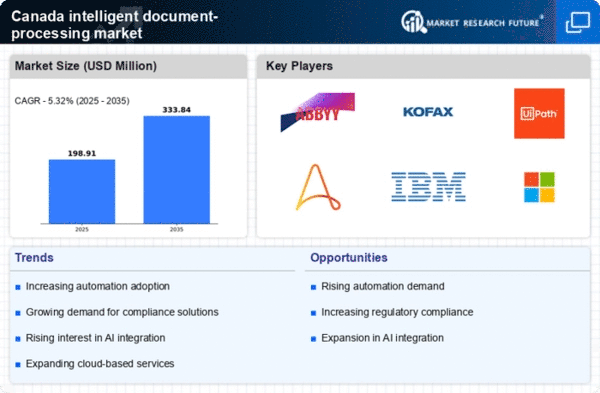
As per Market Research Future analysis, the Canada Intelligent Document Processing Market size was estimated at 188.86 USD Million in 2024. The Canada intelligent document-processing market is projected to grow from 198.91 USD Million in 2025 to 333.84 USD Million by 2035, exhibiting a compound annual growth rate (CAGR) of 5.3% during the forecast period 2025 - 2035

Key Market Trends & Highlights

The Canada intelligent document-processing market is experiencing robust growth driven by technological advancements and evolving business needs.

  • The market is witnessing increased adoption of AI technologies, enhancing efficiency and accuracy in document processing.
  • Cloud-based solutions are gaining traction, reflecting a shift towards more flexible and scalable operational models.
  • The largest segment in this market is the financial services sector, while the healthcare sector is emerging as the fastest-growing segment.
  • Key market drivers include the growing demand for automation and regulatory compliance pressures, which are shaping industry dynamics.

Market Size & Forecast

2024 Market Size 188.86 (USD Million)
2035 Market Size 333.84 (USD Million)
CAGR (2025 - 2035) 5.32%

Major Players

ABBYY (RU), Kofax (US), UiPath (US), Automation Anywhere (US), IBM (US), Microsoft (US), DocuWare (DE), OpenText (CA), Nintex (AU)

Our Impact
Enabled $4.3B Revenue Impact for Fortune 500 and Leading Multinationals
Partnering with 2000+ Global Organizations Each Year
30K+ Citations by Top-Tier Firms in the Industry

Canada Intelligent Document Processing Market Trends

The Canada Intelligent Document Processing Market is currently experiencing a notable transformation, driven by advancements in artificial intelligence and machine learning technologies. Organizations are increasingly recognizing the value of automating document handling processes, which enhances efficiency and reduces operational costs. This shift is particularly evident in sectors such as finance, healthcare, and legal, where the volume of paperwork is substantial. As businesses seek to streamline workflows, the demand for intelligent solutions that can accurately extract, classify, and process information from various document types is on the rise. Furthermore, the integration of cloud-based services is facilitating easier access to these technologies, allowing organizations to scale their operations more effectively. In addition, regulatory compliance and data security concerns are prompting organizations to adopt intelligent document-processing solutions. The ability to manage sensitive information securely while adhering to legal requirements is becoming increasingly critical. As a result, vendors are focusing on developing solutions that not only enhance productivity but also ensure compliance with industry standards. This trend indicates a growing awareness among businesses of the importance of safeguarding data while optimizing document workflows. Overall, the intelligent document-processing market is poised for continued growth, driven by technological advancements and the evolving needs of organizations across various sectors.

Increased Adoption of AI Technologies

Organizations are increasingly integrating artificial intelligence into their document-processing workflows. This trend enhances the accuracy and speed of data extraction, allowing for more efficient handling of large volumes of documents.

Focus on Compliance and Security

With rising concerns over data privacy and regulatory compliance, businesses are prioritizing solutions that ensure secure document handling. This focus on compliance is shaping the development of intelligent document-processing technologies.

Shift Towards Cloud-Based Solutions

The movement towards cloud computing is influencing the intelligent document-processing market. Cloud-based solutions offer flexibility and scalability, enabling organizations to adapt their document management processes to changing needs.

Canada Intelligent Document Processing Market Drivers

Growing Demand for Automation

The intelligent document-processing market in Canada is experiencing a notable surge in demand for automation solutions. Organizations are increasingly recognizing the potential of automating document workflows to enhance efficiency and reduce operational costs. According to recent data, the automation of document processing can lead to a reduction in processing time by up to 70%. This trend is particularly evident in sectors such as finance and healthcare, where the volume of documents is substantial. As businesses strive to streamline operations, the intelligent document-processing market is likely to benefit from this growing demand for automation, enabling companies to allocate resources more effectively and improve overall productivity.

Rising Need for Data Analytics

The intelligent document-processing market in Canada is increasingly driven by the rising need for data analytics capabilities. Organizations are recognizing the value of extracting insights from unstructured data contained within documents. By leveraging intelligent document-processing technologies, businesses can transform raw data into actionable insights, enhancing decision-making processes. This trend is particularly relevant in sectors such as retail and logistics, where data-driven strategies are essential for competitive advantage. The market is expected to expand as companies invest in solutions that not only automate document processing but also provide advanced analytics features, thereby unlocking the full potential of their data.

Regulatory Compliance Pressures

In Canada, the intelligent document-processing market is significantly influenced by the pressures of regulatory compliance. Organizations are required to adhere to various regulations, such as the Personal Information Protection and Electronic Documents Act (PIPEDA), which mandates strict data handling and privacy protocols. This regulatory landscape compels businesses to adopt intelligent document-processing solutions that ensure compliance while managing sensitive information. The market is projected to grow as companies seek to mitigate risks associated with non-compliance, which can result in hefty fines and reputational damage. Consequently, the intelligent document-processing market is positioned to thrive as organizations prioritize compliance-driven solutions.

Focus on Enhanced User Experience

In the Canadian intelligent document-processing market, there is a growing emphasis on enhancing user experience. Organizations are recognizing that user-friendly interfaces and intuitive workflows are essential for maximizing the adoption of document-processing solutions. As employees become more accustomed to digital tools, the demand for solutions that prioritize usability is likely to increase. This focus on user experience not only improves employee satisfaction but also drives productivity by reducing the learning curve associated with new technologies. Consequently, the intelligent document-processing market is expected to evolve, with vendors prioritizing user-centric design in their offerings to meet the needs of Canadian businesses.

Integration with Existing Systems

The intelligent document-processing market in Canada is witnessing a trend towards seamless integration with existing enterprise systems. Organizations are increasingly seeking solutions that can easily connect with their current software infrastructure, such as Customer Relationship Management (CRM) and Enterprise Resource Planning (ERP) systems. This integration is crucial for ensuring a smooth flow of information and enhancing overall operational efficiency. As businesses aim to create a more cohesive digital ecosystem, the demand for intelligent document-processing solutions that offer robust integration capabilities is likely to rise. This trend may lead to increased adoption of such technologies across various industries, further propelling the market forward.


Market Segment Insights

By Component: Solution (Largest) vs. Services (Fastest-Growing)

In the Canada intelligent document-processing market, the Solution segment holds the largest share, characterized by a diverse array of offerings designed to optimize document handling and processing strategies. This segment's robust market presence is driven by increasing demand for automation and efficiency in managing business documents, allowing companies to streamline their operations effectively. Conversely, the Services segment is the fastest-growing area within the market, indicating a shift towards personalized and managed service solutions. This growth is fueled by businesses seeking to enhance their document workflows through consultancy, support, and integration services, which are essential for adapting to the rapidly evolving technological landscape.

Solutions (Dominant) vs. Services (Emerging)

The Solutions segment dominates the Canada intelligent document-processing market with its comprehensive range of products aimed at automating document-related tasks. This includes software that integrates AI and machine learning capabilities, helping businesses improve accuracy and save time. On the other hand, the Services segment is emerging as a significant player, reflecting a growing preference for tailored services that assist organizations in deploying document-processing solutions effectively. Service offerings often encompass implementation, training, and ongoing support, creating a holistic approach that is attractive to businesses looking to enhance operational efficiencies while minimizing disruptions.

By Deployment Mode: Cloud (Largest) vs. On-premises (Fastest-Growing)

In the segment of deployment modes within the Canada intelligent document-processing market, cloud-based solutions dominate with a significant share due to their scalability and flexibility. Organizations are increasingly opting for cloud services as they offer a more efficient approach to data management, allowing for easy access and collaboration across distant teams. Conversely, on-premises solutions, while currently smaller in market share, are gaining traction among businesses with strict compliance and security requirements. Growth trends indicate a robust surge for on-premises deployment as organizations seek to enhance their data security and control. The increasing adoption of hybrid models also reflects a shift in preference, where companies utilize both deployment modes to leverage the benefits of each. The rapid digitization of processes is driving demand, with on-premises solutions emerging as a viable option in regulated industries that prioritize data sovereignty.

Cloud (Dominant) vs. On-premises (Emerging)

The cloud deployment mode is characterized by its ease of use, lower upfront costs, and the ability to quickly scale resources as needed. This mode is particularly appealing to small and medium-sized enterprises (SMEs) looking to minimize IT overhead and streamline operations. Additionally, the cloud offers advanced features like AI integration and automated workflows, enhancing productivity and efficiency. On the other hand, the on-premises approach caters to organizations requiring stringent data control and compliance. Although it presents higher initial costs, it ensures complete ownership of the infrastructure and data, appealing to sectors such as finance and healthcare that prioritize security and regulatory adherence. As such, while cloud solutions lead in market presence, on-premises deployments are emerging as essential in sectors that demand robust data governance.

By Organization Size: SMEs (Largest) vs. Large Enterprises (Fastest-Growing)

The Canada intelligent document-processing market is characterized by a significant distribution of market share between SMEs and Large Enterprises. SMEs hold a substantial portion of the market, leveraging cost-effective solutions to drive efficiency and streamline operations. However, the rapid digital transformation and increasing reliance on automated processes are enabling Large Enterprises to capture growth rapidly as they implement more sophisticated intelligent automation solutions. Growth trends in this segment reveal that while SMEs focus on integrating intelligent document-processing technologies to enhance operational workflows, Large Enterprises have been quick to adopt innovative solutions at scale. This rapid adoption is fueled by the need for enhanced data processing capabilities and improved customer experiences. The competitive landscape suggests that Large Enterprises are well-positioned to lead the market, driven by their resources and investment in advanced technologies.

SMEs: Dominant vs. Large Enterprises: Emerging

In the Canada intelligent document-processing market, SMEs are regarded as the dominant segment due to their widespread adoption of accessible and user-friendly solutions. These smaller organizations prioritize cost efficiency, which resonates with their need to optimize workflows on a budget. On the other hand, Large Enterprises represent an emerging segment, characterized by their capability to invest heavily in cutting-edge technologies. Their focus on advanced integrations allows for more complex document processing tasks, positioning them as fast adopters of innovation. As these enterprises expand their operations, their demand for intelligent document-processing solutions is projected to accelerate, creating a dynamic interplay between the two segments.

By Technology: Natural Language Processing (NLP) (Largest) vs. Robotic Process Automation (RPA) (Fastest-Growing)

In the Canada intelligent document-processing market, Natural Language Processing (NLP) commands the largest market share due to its advanced capabilities in understanding and interpreting human language. Following closely in popularity is Robotic Process Automation (RPA), which is gaining traction among organizations seeking to automate workflows and improve operational efficiency. The other segments, including Optical Character Recognition (OCR) and Machine Learning (ML), also contribute significantly, but NLP and RPA dominate the landscape. The growth trends in this segment are primarily driven by the increasing need for efficient document handling and data processing among businesses. The rise of artificial intelligence (AI) technologies is propelling NLP to new heights, while RPA's adoption is being stimulated by the demand for cost-effective solutions that enhance productivity. As businesses continue to digitize operations, the integration of these technologies is expected to accelerate, making them essential in the Canada intelligent document-processing market.

Technology: NLP (Dominant) vs. RPA (Emerging)

Natural Language Processing (NLP) stands out as the dominant force in the technology segment of the Canada intelligent document-processing market, primarily due to its ability to analyze and process large volumes of unstructured data. It enables organizations to derive insights from text data efficiently, enhancing decision-making processes. Conversely, Robotic Process Automation (RPA) is emerging rapidly, aimed at automating repetitive tasks traditionally performed by humans. This segment's growth is characterized by its ease of implementation and scalability, allowing businesses to streamline operations and reduce costs effectively. While NLP focuses on language comprehension and generation, RPA focuses on automating rule-based tasks, making them complementary technologies that together enhance overall operational efficiency.

By Vertical: BFSI (Largest) vs. Healthcare and Life Sciences (Fastest-Growing)

In the Canada intelligent document-processing market, The BFSI sector holds the largest market share. This is driven by the increasing demand for automation and efficiency in financial transactions and document management. This segment's prominence can be attributed to its reliance on technology to streamline operations and enhance customer experience, making it a key player in the overall market dynamics. Conversely, the Healthcare and Life Sciences segment is recognized as the fastest-growing area within the market, fueled by the necessity for enhanced patient data management and regulatory compliance. Factors such as digital transformation in healthcare, increased focus on patient-centric solutions, and the need for real-time data accessibility are propelling this segment’s rapid growth and adoption of intelligent document-processing solutions.

BFSI: Dominant vs. Healthcare and Life Sciences: Emerging

The BFSI sector serves as the dominant force in the Canada intelligent document-processing market, characterized by its extensive use of automated solutions for handling vast amounts of documentation related to transactions, compliance, and customer service. Its established infrastructure and investment in advanced technologies position it favorably against other segments. On the other hand, the Healthcare and Life Sciences segment is emerging rapidly, with a growing emphasis on innovative document processing to manage patient information, enhance operational efficacy, and comply with stringent regulations. This segment is leveraging advancements in AI and machine learning to improve workflows, reduce errors, and ultimately deliver better patient outcomes, establishing a strong foothold in the evolving market landscape.

Get more detailed insights about Canada Intelligent Document Processing Market

Key Players and Competitive Insights

The intelligent document-processing market in Canada is characterized by a dynamic competitive landscape, driven by the increasing demand for automation and efficiency in document management. Key players such as ABBYY (RU), Kofax (US), and OpenText (CA) are strategically positioned to leverage technological advancements and enhance their operational capabilities. ABBYY (RU) focuses on innovation through AI-driven solutions, while Kofax (US) emphasizes partnerships to expand its market reach. OpenText (CA), as a local player, capitalizes on its regional expertise to tailor solutions that meet specific Canadian business needs. Collectively, these strategies contribute to a competitive environment that is increasingly focused on technological integration and customer-centric solutions.
In terms of business tactics, companies are localizing their operations to better serve the Canadian market, optimizing supply chains to enhance efficiency. The market structure appears moderately fragmented, with several players vying for market share. However, the influence of major companies is significant, as they set benchmarks for innovation and service delivery, thereby shaping the overall competitive dynamics.
In October 2025, Kofax (US) announced a strategic partnership with a leading Canadian financial institution to enhance its document automation capabilities. This collaboration is expected to streamline processes and improve customer service, indicating Kofax's commitment to leveraging local partnerships for growth. Such moves not only strengthen Kofax's market position but also reflect a broader trend of companies seeking to integrate more deeply with local businesses to enhance service delivery.
In September 2025, OpenText (CA) launched a new AI-powered document processing solution aimed at small to medium-sized enterprises (SMEs). This initiative is particularly significant as it addresses the unique challenges faced by SMEs in managing documents efficiently. By focusing on this segment, OpenText is likely to capture a growing market niche, thereby reinforcing its competitive edge in the region.
In November 2025, ABBYY (RU) unveiled a new feature in its document processing software that utilizes machine learning to improve data extraction accuracy. This enhancement is crucial as it aligns with the increasing demand for precision in document management. By continuously innovating its offerings, ABBYY positions itself as a leader in the market, potentially attracting clients who prioritize accuracy and efficiency in their operations.
As of November 2025, the competitive trends in the intelligent document-processing market are increasingly defined by digitalization, sustainability, and the integration of AI technologies. Strategic alliances are becoming more prevalent, as companies recognize the value of collaboration in enhancing their service offerings. Looking ahead, it is anticipated that competitive differentiation will evolve, shifting from price-based competition to a focus on innovation, technological advancements, and supply chain reliability. This transition underscores the importance of adaptability and forward-thinking strategies in maintaining a competitive edge.

Key Companies in the Canada Intelligent Document Processing Market include

Industry Developments

Recent developments in the Canada Intelligent Document Processing Market reflect an increasing adoption of automation technologies among businesses looking to enhance operational efficiencies. Companies such as OpenText and Kofax are expanding their offerings to leverage AI and machine learning in processing documents, effectively streamlining workflows. Notably, in October 2023, Automation Anywhere unveiled new features specifically catering to Canadian enterprises, further reinforcing the country's position as a tech hub.

Furthermore, IBM and UiPath have reported significant growth in service demand, driven by the rise of remote work and digital transformation initiatives.In recent mergers and acquisitions, Blue Prism announced its acquisition by SSC Technologies in September 2023, which could influence market dynamics within the Canadian sector due to SSC's robust presence in financial services. Additionally, Adobe and Hyland are focusing on partnerships to integrate document management capabilities further. Over the past few years, there has been a marked emphasis on compliance and data security within Canadian regulations, enhancing the demand for intelligent document processing solutions.

As a result, companies are investing heavily in technologies designed to mitigate risks associated with data handling and processing efficiencies.


Future Outlook

Canada Intelligent Document Processing Market Future Outlook

The intelligent document-processing market in Canada is projected to grow at a 5.32% CAGR from 2025 to 2035, driven by automation, AI advancements, and increasing data volume.

New opportunities lie in:

  • Develop AI-driven document classification tools for niche industries.
  • Create subscription-based models for document processing software.
  • Implement cloud-based solutions for scalable document management systems.

By 2035, the market is expected to achieve robust growth, reflecting evolving business needs.

Market Segmentation

Canada Intelligent Document Processing Market Vertical Outlook

  • BFSI
  • Government & Defense
  • Retail and E-commerce
  • Manufacturing
  • Healthcare and Life Sciences
  • Transportation & Logistics
  • Others

Canada Intelligent Document Processing Market Component Outlook

  • Solution
  • Services

Canada Intelligent Document Processing Market Technology Outlook

  • Natural Language Processing (NLP)
  • Optical Character Recognition (OCR)
  • Robotic Process Automation (RPA)
  • Computer Vision
  • Deep Learning (DL)
  • Machine Learning (ML)

Canada Intelligent Document Processing Market Deployment Mode Outlook

  • On-premises
  • Cloud

Canada Intelligent Document Processing Market Organization Size Outlook

  • SMEs
  • Large Enterprises

Report Scope

MARKET SIZE 2024 188.86(USD Million)
MARKET SIZE 2025 198.91(USD Million)
MARKET SIZE 2035 333.84(USD Million)
COMPOUND ANNUAL GROWTH RATE (CAGR) 5.32% (2025 - 2035)
REPORT COVERAGE Revenue Forecast, Competitive Landscape, Growth Factors, and Trends
BASE YEAR 2024
Market Forecast Period 2025 - 2035
Historical Data 2019 - 2024
Market Forecast Units USD Million
Key Companies Profiled ABBYY (RU), Kofax (US), UiPath (US), Automation Anywhere (US), IBM (US), Microsoft (US), DocuWare (DE), OpenText (CA), Nintex (AU)
Segments Covered Component, Deployment Mode, Organization Size, Technology, Vertical
Key Market Opportunities Integration of artificial intelligence enhances efficiency in the intelligent document-processing market.
Key Market Dynamics Growing demand for automation in document processing drives innovation and competition among local technology providers.
Countries Covered Canada
Leave a Comment

FAQs

What is the projected market size of the Canada Intelligent Document Processing Market in 2024?

The Canada Intelligent Document Processing Market is projected to be valued at 81.02 million USD in 2024.

What is the expected market size of the Canada Intelligent Document Processing Market by 2035?

By 2035, the expected market size of the Canada Intelligent Document Processing Market is 325.07 million USD.

What is the compound annual growth rate (CAGR) for the Canada Intelligent Document Processing Market from 2025 to 2035?

The expected CAGR for the Canada Intelligent Document Processing Market from 2025 to 2035 is 13.463%.

Which component of the Canada Intelligent Document Processing Market holds major market value in 2024?

In 2024, the Solutions component of the Canada Intelligent Document Processing Market is valued at 40.51 million USD.

What is the market value of the Services component in the Canada Intelligent Document Processing Market in 2024?

The Services component is also valued at 40.51 million USD in the Canada Intelligent Document Processing Market for the year 2024.

How significant is the growth of the Solutions segment by 2035?

The Solutions segment is expected to grow significantly to 162.03 million USD by 2035.

What is the anticipated market value for the Services segment by 2035?

The Services segment is projected to reach a value of 163.04 million USD by 2035.

Who are the key players in the Canada Intelligent Document Processing Market?

Key players in the market include OpenText, DocuWare, Automation Anywhere, UiPath, Kofax, Adobe, and SAP among others.

What opportunities exist in the Canada Intelligent Document Processing Market?

Emerging trends in automation and increased demand for digital transformation present significant opportunities in the market.

What are the current challenges faced by the Canada Intelligent Document Processing Market?

Challenges include integration complexities and the need for skilled workforce to manage advanced processing technologies.

Download Free Sample

Kindly complete the form below to receive a free sample of this Report

Compare Licence

×
Features License Type
Single User Multiuser License Enterprise User
Price $4,950 $5,950 $7,250
Maximum User Access Limit 1 User Upto 10 Users Unrestricted Access Throughout the Organization
Free Customization
Direct Access to Analyst
Deliverable Format
Platform Access
Discount on Next Purchase 10% 15% 15%
Printable Versions