×
Request Free Sample ×

Kindly complete the form below to receive a free sample of this Report

* Please use a valid business email

Leading companies partner with us for data-driven Insights

clients tt-cursor
Hero Background

Canada Government Education Market

ID: MRFR/ICT/60476-HCR
200 Pages
Aarti Dhapte
February 2026

Canada Government Education Market Size, Share and Trends Analysis Report By Sector (Preschool, K-12, Higher Education, Others) and By Delivery Mode (Online, Offline)- Forecast to 2035

Share:
Download PDF ×

We do not share your information with anyone. However, we may send you emails based on your report interest from time to time. You may contact us at any time to opt-out.

Canada Government Education Market Infographic
Purchase Options

Canada Government Education Market Summary

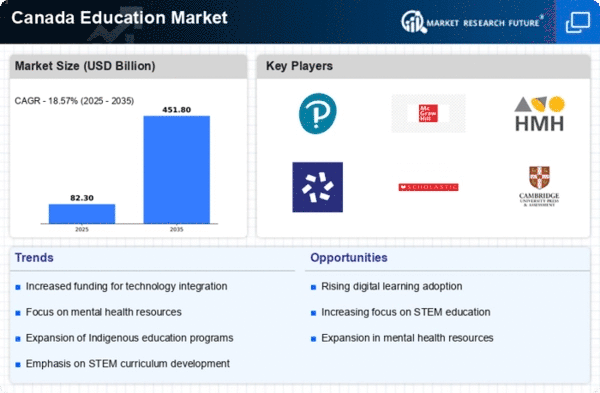
As per Market Research Future analysis, the Canada's Government Education Market Size was estimated at 69.41 USD Billion in 2024. The Canada government education market is projected to grow from 82.3 USD Billion in 2025 to 451.8 USD Billion by 2035, exhibiting a compound annual growth rate (CAGR) of 18.5% during the forecast period 2025 - 2035

Key Market Trends & Highlights

The Canada The education market in Canada is experiencing a transformative shift towards digitalization and inclusivity.

  • The largest segment in the Canada government education market is K-12 education, while the fastest-growing segment is post-secondary education.
  • Digital transformation is reshaping educational delivery, enhancing accessibility and engagement for diverse learners.
  • Collaboration with industry stakeholders is becoming increasingly vital to align educational outcomes with labor market needs.
  • Increased government funding and a strong emphasis on STEM education are driving significant advancements in the education sector.

Market Size & Forecast

2024 Market Size 69.41 (USD Billion)
2035 Market Size 451.8 (USD Billion)
CAGR (2025 - 2035) 18.57%

Major Players

Pearson (GB), McGraw-Hill Education (US), Houghton Mifflin Harcourt (US), Cengage Learning (US), Scholastic Corporation (US), Cambridge University Press (GB), Wiley (US), Oxford University Press (GB)

Our Impact
Enabled $4.3B Revenue Impact for Fortune 500 and Leading Multinationals
Partnering with 2000+ Global Organizations Each Year
30K+ Citations by Top-Tier Firms in the Industry

Canada Government Education Market Trends

The The education market in Canada in Canada is currently experiencing a transformative phase, driven by various factors including technological advancements and evolving educational policies. The integration of digital tools into classrooms is reshaping traditional teaching methods, allowing for more personalized learning experiences. This shift appears to be fostering greater engagement among students, as educators increasingly utilize online resources and interactive platforms. Furthermore, the emphasis on inclusivity and accessibility in education is gaining traction, with initiatives aimed at supporting diverse learning needs. This focus on equity suggests a commitment to ensuring that all students have the opportunity to succeed, regardless of their background or abilities. In addition, the government education market is witnessing a growing trend towards collaboration between educational institutions and industry stakeholders. Partnerships are being formed to enhance curriculum relevance and better prepare students for the workforce. This alignment between education and employment needs indicates a proactive approach to addressing skills gaps in the labor market. As these trends continue to evolve, the government education market is likely to adapt, reflecting the changing demands of society and the economy.

Digital Transformation in Education

The integration of technology into the classroom is reshaping the educational landscape. Digital tools are being utilized to enhance learning experiences, making education more interactive and engaging for students. This trend indicates a shift towards personalized learning, where students can progress at their own pace.

Focus on Inclusivity and Accessibility

There is a growing emphasis on creating inclusive educational environments that cater to diverse learning needs. Initiatives aimed at supporting students with disabilities and those from various backgrounds are becoming more prevalent, suggesting a commitment to equity in education.

Collaboration with Industry Stakeholders

Educational institutions are increasingly partnering with industry to align curricula with workforce demands. This collaboration aims to equip students with relevant skills, indicating a proactive approach to bridging the gap between education and employment.

Canada Government Education Market Drivers

Emphasis on STEM Education

The government education market in Canada is witnessing a pronounced emphasis on Science, Technology, Engineering, and Mathematics (STEM) education. This focus is driven by the recognition of the critical role that STEM skills play in the modern economy. In 2023, approximately 30% of high school graduates pursued STEM-related fields in post-secondary education, indicating a growing interest among students. The government has initiated various programs aimed at promoting STEM education, including funding for specialized training and resources for teachers. This strategic emphasis is likely to enhance the skill set of future generations, aligning educational outcomes with labor market demands. Consequently, the government education market is adapting to these trends, potentially leading to a more skilled workforce that can contribute to Canada's economic growth.

Increased Government Funding

The government education market in Canada is experiencing a notable increase in funding allocations. In recent years, provincial and federal governments have recognized the necessity of investing in education to enhance learning outcomes. For instance, the total expenditure on public elementary and secondary education reached approximately $50 billion in 2023, reflecting a growth of around 5% from the previous year. This influx of financial resources is likely to facilitate the implementation of innovative teaching methods and the integration of technology in classrooms. Furthermore, increased funding may also support the development of infrastructure, ensuring that educational institutions are equipped to meet modern standards. As a result, the government education market is poised for growth, driven by enhanced financial support aimed at improving educational quality and accessibility.

Focus on Indigenous Education

The government education market in Canada is placing a heightened focus on Indigenous education, reflecting a commitment to reconciliation and inclusivity. Educational authorities are increasingly recognizing the importance of incorporating Indigenous perspectives and knowledge into curricula. In 2023, approximately 15% of schools reported offering specialized programs aimed at Indigenous students, which may include culturally relevant teaching methods and resources. This focus is likely to enhance educational experiences for Indigenous learners, fostering a sense of belonging and identity. Furthermore, the government education market is expected to continue evolving in this area, as initiatives aimed at improving educational outcomes for Indigenous populations gain momentum. This shift may contribute to a more equitable education system that respects and values diverse cultural backgrounds.

Adoption of Hybrid Learning Models

The government education market in Canada is increasingly adopting hybrid learning models, which combine traditional classroom instruction with online learning components. This approach appears to be gaining traction as educational institutions seek to enhance flexibility and accessibility for students. In 2023, approximately 25% of schools reported implementing hybrid learning strategies, allowing students to benefit from both in-person and remote education. This model not only accommodates diverse learning styles but also addresses geographical barriers, enabling students in remote areas to access quality education. The government education market is likely to continue evolving in this direction, as stakeholders recognize the potential of hybrid models to improve educational outcomes and cater to a broader range of student needs.

Integration of Mental Health Initiatives

The government education market in Canada is increasingly integrating mental health initiatives into educational frameworks. Recognizing the importance of mental well-being for academic success, educational authorities are implementing programs aimed at supporting students' mental health. In 2023, approximately 40% of schools reported having mental health resources available for students, reflecting a growing awareness of this issue. These initiatives may include counseling services, workshops, and training for educators to identify and address mental health concerns. By prioritizing mental health, the government education market is likely to foster a more supportive learning environment, which could lead to improved student engagement and academic performance. This shift indicates a broader understanding of the holistic needs of students within the educational system.


Market Segment Insights

By Sector: K-12 (Largest) vs. Higher Education (Fastest-Growing)

In the Canada government education market, the K-12 segment represents the largest share, reflecting the foundational emphasis on early education and basic schooling. With a significant number of students enrolled in primary and secondary schools, K-12 is critical to the overall market. The preschool segment contributes to this by preparing children for K-12, though it holds a smaller share in comparison. Higher education is a growing part of the market as more individuals seek advanced degrees to improve career prospects, leading to an increasing share as the focus on lifelong learning rises. Growth trends indicate that the K-12 segment is stable, driven by governmental policies and consistent enrollment figures. Meanwhile, the higher education segment is the fastest-growing, spurred by technology integration, online course offerings, and a growing demand for skilled labor in the economy. Overall, both segments face unique challenges and opportunities as educational needs evolve. Emerging trends in digital learning and educational technology foster innovation, particularly in the higher education space.

K-12 (Dominant) vs. Higher Education (Emerging)

The K-12 segment stands as the dominant force in the Canada government education market, focusing on delivering quality education to children aged 5 to 18 years. It encompasses a wide range of institutions, from public schools to private establishments, all adhering to government standards to ensure quality learning experiences. This segment is characterized by substantial investments in educational resources, teacher training, and infrastructural development, ultimately enhancing student outcomes. Conversely, the higher education sector is emerging rapidly, with increasing participation rates and a shift towards flexible learning options such as online courses. This growth is supported by partnerships between academic institutions and industries, enabling a curriculum that meets market demands, thus attracting a diverse student population looking for career-oriented education.

By Delivery Mode: Online (Largest) vs. Offline (Fastest-Growing)

In the Canada government education market, the delivery mode segment is predominantly driven by online education, which has emerged as the largest segment. Online learning solutions offer flexibility and accessibility, attracting a significant number of students, educators, and institutions eager to adapt to the digital landscape. As educational institutions increasingly embrace technology, the online segment has solidified its position with a major portion of the market share. Conversely, the offline delivery mode, while currently smaller in size, is experiencing rapid growth and is recognized as the fastest-growing segment in the market. With a resurgence in-person learning following shifts back to traditional classroom settings, offline education is gaining traction. This growth is propelled by a demand for hands-on learning experiences that online modes cannot fully replicate, indicating a complementary relationship between both delivery modes in future educational strategies.

Online (Dominant) vs. Offline (Emerging)

The online delivery mode stands as the dominant force in the Canada government education market, characterized by its ability to provide an extensive range of courses and learning materials through digital platforms. Its advantages include cost-effectiveness, convenience, and the ability to reach a wider audience. Conversely, the offline delivery mode, labeled as emerging, is experiencing a notable resurgence driven by the increasing preference for face-to-face learning experiences, especially in certain subjects that require direct interaction. As educational institutions navigate the duality of these modes, they are focusing on integrating the strengths of both online and offline methodologies to meet diverse learner needs and preferences, creating a more comprehensive educational landscape.

Get more detailed insights about Canada Government Education Market

Key Players and Competitive Insights

The The education market in Canada in Canada is characterized by a dynamic competitive landscape, driven by the increasing demand for innovative educational solutions and digital learning platforms. Key players such as Pearson (GB), McGraw-Hill Education (US), and Scholastic Corporation (US) are actively shaping the market through strategic initiatives focused on digital transformation and partnerships. These companies are leveraging technology to enhance learning experiences, indicating a collective shift towards more interactive and personalized educational resources, which is likely to redefine traditional educational methodologies.In terms of business tactics, companies are increasingly localizing their operations to better cater to regional educational needs. This approach not only optimizes supply chains but also enhances responsiveness to local market demands. The competitive structure of the market appears moderately fragmented, with several players vying for market share. However, the influence of major companies remains substantial, as they set trends and standards that smaller entities often follow.

In October Pearson (GB) announced a partnership with a leading Canadian technology firm to develop a new suite of digital learning tools aimed at enhancing STEM education in primary schools. This strategic move underscores Pearson's commitment to innovation and its focus on addressing the specific needs of the Canadian education system. By collaborating with local experts, Pearson is likely to strengthen its market position and improve educational outcomes.

In September McGraw-Hill Education (US) launched a comprehensive online platform designed to support teachers and students in remote learning environments. This initiative reflects the company's strategic emphasis on digital solutions, which are increasingly vital in today’s educational landscape. The platform's features, including real-time analytics and personalized learning pathways, suggest a forward-thinking approach that could enhance user engagement and learning effectiveness.

In August Scholastic Corporation (US) expanded its offerings by introducing a new line of culturally relevant literature aimed at diverse student populations in Canada. This initiative not only aligns with current educational trends emphasizing inclusivity but also positions Scholastic as a leader in providing resources that reflect the multicultural fabric of Canadian society. Such strategic actions may enhance brand loyalty and market penetration.

As of November the competitive trends in the government education market are increasingly defined by digitalization, sustainability, and the integration of artificial intelligence (AI) into educational tools. Strategic alliances among key players are shaping the landscape, fostering innovation and collaboration. The shift from price-based competition to a focus on technological advancement and supply chain reliability is evident, suggesting that future competitive differentiation will hinge on the ability to innovate and adapt to evolving educational needs.

Key Companies in the Canada Government Education Market include

Industry Developments

The Canada Government Education Market has seen significant developments recently, particularly in partnerships and funding initiatives aimed at enhancing educational outcomes. In September 2023, the University of British Columbia launched a new research initiative focused on climate change and sustainability, aligning with government priorities on environmental education. The University of Alberta secured a grant to improve technology access for underserved communities, reflecting ongoing efforts to bridge the digital divide in education. Additionally, in August 2023, the University of Toronto announced a collaboration with Canadian tech firms to incorporate artificial intelligence in curriculum development, enhancing the educational landscape. 

Merger activity has remained minimal within the specified universities, with no major acquisitions reported recently. Growth in market valuation is evident, driven by increased public funding and investment in innovation, positioning institutions like McGill University and Concordia University as leaders in research and development. Throughout the last few years, significant government initiatives, such as the Canada Student Financial Assistance Program updates in March 2021, have also played a crucial role in shaping the educational landscape, ensuring greater accessibility and affordability for students across Canada.

Future Outlook

Canada Government Education Market Future Outlook

The Government Education Market in Canada is projected to grow at an 18.57% CAGR from 2025 to 2035, driven by technological advancements, increased funding, and evolving educational needs.

New opportunities lie in:

  • Development of AI-driven personalized learning platforms
  • Expansion of online vocational training programs
  • Implementation of smart classroom technologies for enhanced engagement

By 2035, the market is expected to be robust, reflecting substantial growth and innovation.

Market Segmentation

Canada Government Education Market Sector Outlook

  • Preschool
  • K-12
  • Higher Education
  • Others

Canada Government Education Market Delivery Mode Outlook

  • Online
  • Offline

Report Scope

MARKET SIZE 2024 69.41(USD Billion)
MARKET SIZE 2025 82.3(USD Billion)
MARKET SIZE 2035 451.8(USD Billion)
COMPOUND ANNUAL GROWTH RATE (CAGR) 18.57% (2025 - 2035)
REPORT COVERAGE Revenue Forecast, Competitive Landscape, Growth Factors, and Trends
BASE YEAR 2024
Market Forecast Period 2025 - 2035
Historical Data 2019 - 2024
Market Forecast Units USD Billion
Key Companies Profiled Pearson (GB), McGraw-Hill Education (US), Houghton Mifflin Harcourt (US), Cengage Learning (US), Scholastic Corporation (US), Cambridge University Press (GB), Wiley (US), Oxford University Press (GB)
Segments Covered Sector, Delivery Mode
Key Market Opportunities Integration of digital learning platforms enhances accessibility and engagement in the government education market.
Key Market Dynamics Growing emphasis on digital learning tools reshapes government education delivery and accessibility in Canada.
Countries Covered Canada
Leave a Comment

FAQs

What is the expected market size of the Canada Government Education Market in 2024?

The Canada Government Education Market is expected to be valued at 69.41 USD Billion in 2024.

What is the projected market size for the Canada Government Education Market by 2035?

By 2035, the Canada Government Education Market is projected to grow to 103.57 USD Billion.

What is the compound annual growth rate (CAGR) for the Canada Government Education Market from 2025 to 2035?

The expected CAGR for the Canada Government Education Market from 2025 to 2035 is 3.705%.

Which sector holds the largest market share within the Canada Government Education Market in 2024?

The K-12 sector holds the largest market share, valued at 30.0 USD Billion in 2024.

What will be the K-12 market size in the Canada Government Education Market by 2035?

The K-12 sector is projected to grow to 44.0 USD Billion by 2035.

What is the anticipated market size for the Higher Education segment in 2024?

The Higher Education segment is anticipated to be valued at 20.0 USD Billion in 2024.

Which are the key players in the Canada Government Education Market?

Key players in the market include the University of British Columbia, McGill University, and the University of Toronto among others.

What is the projected value of the Preschool segment in the Canada Government Education Market in 2035?

The Preschool segment is projected to be valued at 15.0 USD Billion by 2035.

What factors are driving the growth of the Canada Government Education Market?

Factors driving growth include increased funding, technological advancements, and a focus on educational outcomes.

What are the expected trends shaping the Canada Government Education Market up to 2035?

Expected trends include digital transformation in education, personalized learning solutions, and increased investment in infrastructure.

Download Free Sample

Kindly complete the form below to receive a free sample of this Report

Compare Licence

×
Features License Type
Single User Multiuser License Enterprise User
Price $4,950 $5,950 $7,250
Maximum User Access Limit 1 User Upto 10 Users Unrestricted Access Throughout the Organization
Free Customization
Direct Access to Analyst
Deliverable Format
Platform Access
Discount on Next Purchase 10% 15% 15%
Printable Versions