×
Request Free Sample ×

Kindly complete the form below to receive a free sample of this Report

* Please use a valid business email

Leading companies partner with us for data-driven Insights

clients tt-cursor
Hero Background

Canada Digital Railway Market

ID: MRFR/ICT/58558-HCR
200 Pages
Aarti Dhapte
February 2026

Canada Digital Railway Market Research Report By Offering (Solution, Services) and By Application (Railway Operation Management, Asset Management, Passenger Experience, Others) - Forecast to 2035

Share:
Download PDF ×

We do not share your information with anyone. However, we may send you emails based on your report interest from time to time. You may contact us at any time to opt-out.

Canada Digital Railway Market Infographic
Purchase Options

Canada Digital Railway Market Summary

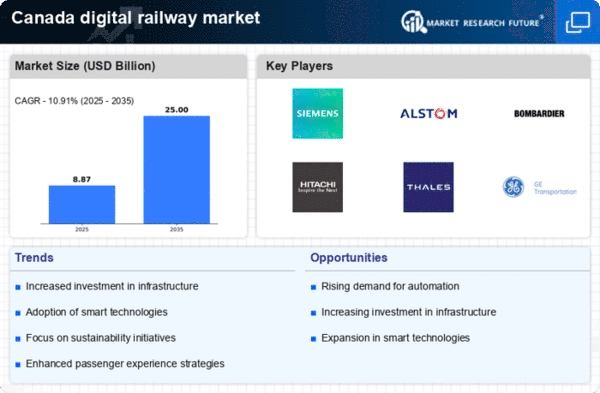
As per Market Research Future analysis, the Canada Digital Railway Market size was estimated at 8.0 USD Billion in 2024. The Digital Railway market is projected to grow from 8.87 USD Billion in 2025 to 25.0 USD Billion by 2035, exhibiting a compound annual growth rate (CAGR) of 10.9% during the forecast period 2025 - 2035

Key Market Trends & Highlights

The Canada digital railway market is poised for substantial growth driven by technological advancements and sustainability initiatives.

  • The integration of smart technologies is transforming operational efficiency in the digital railway sector.
  • Sustainability remains a focal point, with increasing emphasis on reducing carbon footprints and enhancing energy efficiency.
  • Government initiatives and investments are propelling modernization efforts, particularly in urban areas.
  • Advancements in communication technologies and the growing demand for passenger safety are key drivers of market expansion.

Market Size & Forecast

2024 Market Size 8.0 (USD Billion)
2035 Market Size 25.0 (USD Billion)
CAGR (2025 - 2035) 10.91%

Major Players

Siemens (DE), Alstom (FR), Bombardier (CA), Hitachi (JP), Thales (FR), GE Transportation (US), Knorr-Bremse (DE), Mitsubishi Electric (JP), ABB (CH)

Our Impact
Enabled $4.3B Revenue Impact for Fortune 500 and Leading Multinationals
Partnering with 2000+ Global Organizations Each Year
30K+ Citations by Top-Tier Firms in the Industry

Canada Digital Railway Market Trends

The Canada Digital Railway Market is currently experiencing a transformative phase. This transformation is driven by advancements in technology and a growing emphasis on sustainability. In Canada, the integration of digital solutions into railway operations is enhancing efficiency, safety, and customer experience. The adoption of smart technologies, such as IoT and AI, is enabling real-time monitoring and predictive maintenance, which are crucial for optimizing performance and reducing operational costs. Furthermore, the Canadian government is actively promoting initiatives aimed at modernizing rail infrastructure, which is likely to bolster the digital railway market's growth. Moreover, the increasing demand for eco-friendly transportation options is pushing stakeholders to invest in digital solutions that minimize environmental impact. The shift towards electrification and automation in rail systems aligns with national goals for reducing greenhouse gas emissions. As a result, the digital railway market is poised for significant expansion, with various players collaborating to develop innovative solutions that cater to the evolving needs of the industry. This trend indicates a promising future for rail transport in Canada, as it embraces digitalization to enhance service delivery and operational efficiency.

Integration of Smart Technologies

The digital railway market is witnessing a surge in the integration of smart technologies. Innovations such as IoT devices and AI applications are being utilized to enhance operational efficiency and safety. These technologies facilitate real-time data collection and analysis, allowing for improved decision-making and predictive maintenance.

Focus on Sustainability

There is a growing emphasis on sustainability within the digital railway market. Stakeholders are increasingly prioritizing eco-friendly solutions, such as electrification and energy-efficient systems. This focus aligns with national environmental goals and reflects a commitment to reducing the carbon footprint of rail transport.

Government Initiatives and Investments

Government initiatives play a crucial role in shaping the digital railway market. Investments in modernizing rail infrastructure and promoting digital solutions are being prioritized. These efforts aim to enhance service quality, improve safety standards, and support the transition towards a more efficient and sustainable rail system.

Canada Digital Railway Market Drivers

Increased Demand for Passenger Safety

Passenger safety remains a paramount concern within the digital railway market in Canada. The implementation of advanced safety systems, such as automated train control and collision avoidance technologies, is becoming increasingly prevalent. These systems utilize real-time data analytics to enhance situational awareness and reduce the likelihood of accidents. According to recent statistics, the adoption of these safety measures has the potential to decrease incident rates by up to 30%. As public awareness of safety issues grows, the demand for safer railway systems is likely to drive investments in digital technologies. Consequently, the digital railway market is expected to expand as stakeholders prioritize safety enhancements to meet regulatory requirements and public expectations.

Environmental Regulations and Compliance

Stringent environmental regulations are increasingly influencing the digital railway market in Canada. Government policies aimed at reducing carbon emissions are prompting railway operators to adopt greener technologies. Digital solutions, such as energy-efficient train systems and automated energy management, are being implemented to comply with these regulations. The Canadian government has set ambitious targets to reduce greenhouse gas emissions by 30% by 2030, which is likely to drive the adoption of sustainable practices within the railway sector. As a result, the digital railway market is expected to see a rise in investments focused on eco-friendly technologies, aligning with both regulatory requirements and public demand for sustainable transportation options.

Advancements in Communication Technologies

The digital railway market in Canada is growing rapidly, driven by advancements in communication technologies. Enhanced connectivity solutions, such as 5G networks, are facilitating real-time data exchange between trains and control centers. This improvement in communication is crucial for operational efficiency and safety. The integration of Internet of Things (IoT) devices allows for continuous monitoring of train conditions, which can lead to predictive maintenance and reduced downtime. As a result, the digital railway market is projected to grow at a CAGR of approximately 8% over the next five years, driven by these technological advancements. Furthermore, the ability to transmit large volumes of data quickly enhances decision-making processes, thereby optimizing overall railway operations.

Investment in Infrastructure Modernization

Infrastructure modernization is a critical driver for the digital railway market in Canada. Aging railway systems require significant upgrades to meet contemporary operational standards and passenger expectations. Investments in digital technologies, such as automated signaling systems and advanced maintenance solutions, are essential for enhancing the efficiency and reliability of railway services. The Canadian government has allocated approximately $10 billion for infrastructure improvements over the next five years, which is likely to stimulate growth in the digital railway market. This funding will support the integration of innovative technologies that improve service delivery and operational performance, ultimately benefiting both operators and passengers.

Growing Urbanization and Population Density

Urbanization trends in Canada are significantly influencing the digital railway market. As cities expand and populations increase, the demand for efficient public transportation systems intensifies. Digital railway solutions, such as smart ticketing and real-time passenger information systems, are essential for accommodating the needs of urban commuters. The Canadian urban population is projected to reach approximately 38 million by 2030, necessitating improvements in railway infrastructure. This demographic shift is likely to drive investments in digital technologies that enhance the passenger experience and operational efficiency. The digital railway market is thus positioned to benefit from urbanization, as stakeholders seek to modernize and expand railway services to meet growing demand.


Market Segment Insights

By Component: Software (Largest) vs. Hardware (Fastest-Growing)

In the Canada digital railway market, the component segment is primarily driven by software, which holds the largest market share due to its critical role in system integration and data analytics. Hardware follows as a significant contributor, while services also play a vital role by supporting operational efficiency and maintenance. As technology advances, software's dominance ensures it remains a key focus area for innovations and updates that enhance overall functionality. Growth trends in the component segment indicate a substantial rise in hardware adoption as the fastest-growing area, propelled by advancements in IoT and automation technologies. This growth is driven by the need for more reliable and efficient physical components that facilitate real-time data processing. Software continues to expand due to increasing demand for robust cybersecurity measures and data management solutions, while services are adapting to new operational challenges posed by emerging technologies.

Software (Dominant) vs. Hardware (Emerging)

Software in the Canada digital railway market is characterized by its extensive applications in optimizing railway operations through innovative algorithms and data-driven insights. The dominant nature of software stems from its ability to integrate various functionalities, such as scheduling, tracking, and predictive maintenance, leading to safer and more efficient railway systems. In contrast, hardware, while currently emerging, focuses on integrating advanced sensors, communication tools, and automated systems that support the digital transformation of railway operations. The rapid evolution of hardware technologies directly complements software solutions, creating a synergistic effect that enhances overall system performance.

By Solution: Passenger Information System (Largest) vs. Advanced Security Monitoring System (Fastest-Growing)

In the Canada digital railway market, the distribution of shares among the various solution segments indicates that the Passenger Information System holds the largest share, significantly contributing to the operational efficiency and passenger satisfaction. On the other hand, the Advanced Security Monitoring System is witnessing rapid adoption, driven by increasing safety concerns and technological advancements that enhance passenger safety and security across railway networks. The growth trends in the solution segment are primarily influenced by the need for increased operational efficiency and safety within the railway infrastructure. With advancements in technology, solutions such as Smart Ticketing and Rail Analytics are also gaining traction, allowing operators to leverage data for optimizing services. The demand for modernized systems driven by passenger expectations and regulatory requirements will continue to propel this segment forward in the coming years.

Passenger Information System (Dominant) vs. Advanced Security Monitoring System (Emerging)

The Passenger Information System serves as a crucial component in enhancing the travel experience for passengers, providing real-time updates on train schedules, delays, and other essential information. This segment commands a dominant position due to its importance in increasing customer satisfaction and operational efficiency for rail operators. In contrast, the Advanced Security Monitoring System is emerging as a key player, benefiting from heightened security needs in the transportation sector. Its ability to incorporate state-of-the-art surveillance and analytics technologies to monitor and ensure safe travel is attracting attention from operators looking to bolster their security measures. Both segments showcase unique strengths, with the Passenger Information System focusing on user experience and the Advanced Security Monitoring System aimed at safeguarding passengers.

By Deployment: Cloud (Largest) vs. On-Premises (Fastest-Growing)

In the Canada digital railway market, the deployment segment is primarily dominated by Cloud solutions, which hold a significant share of the overall market. Companies favor Cloud deployment for its scalability, flexibility, and lower upfront costs, enabling rapid adoption and enhancing operational efficiency. Meanwhile, On-Premises solutions are witnessing a gradual but notable growth, appealing particularly to organizations that prioritize security and control over their data. The trends in this segment reveal a notable shift towards Cloud deployment, driven by advancements in technology and increasing digitalization in the railway industry. The need for real-time data accessibility and improved connectivity has propelled Cloud adoption, making it the preferred choice for many companies. In contrast, On-Premises solutions are gaining traction due to rising concerns over cybersecurity, leading organizations to invest more in robust on-premises systems as they seek to maintain data privacy while still benefiting from digital innovations.

Deployment: Cloud (Dominant) vs. On-Premises (Emerging)

Cloud deployment in the Canada digital railway market stands out as the dominant model, offering unparalleled scalability and ease of access for operators and stakeholders. This model allows for real-time data sharing and operational flexibility, which are critical for modern railway management. On the other hand, On-Premises deployment is emerging as a viable choice for organizations that prioritize data security and control. Despite its slower growth rate, it is appealing for companies apprehensive about Cloud vulnerabilities, thus attracting a niche market segment focused on stringent regulatory compliance and customized solutions.

Get more detailed insights about Canada Digital Railway Market

Key Players and Competitive Insights

The digital railway market in Canada is characterized by a dynamic competitive landscape, driven by technological advancements and a growing emphasis on sustainability. Key players such as Siemens (DE), Alstom (FR), and Bombardier (CA) are actively engaged in innovation and strategic partnerships to enhance their market positions. Siemens (DE) focuses on digital transformation and smart rail solutions, while Alstom (FR) emphasizes sustainable mobility and green technologies. Bombardier (CA), leveraging its strong local presence, aims to optimize its operations through strategic collaborations and regional expansions. Collectively, these strategies contribute to a competitive environment that prioritizes technological innovation and sustainability.
In terms of business tactics, companies are increasingly localizing manufacturing and optimizing supply chains to enhance operational efficiency. The market appears moderately fragmented, with several key players exerting influence over various segments. This structure allows for a diverse range of offerings, enabling companies to cater to specific regional needs while maintaining competitive pressure on pricing and service delivery.
In October 2025, Siemens (DE) announced a partnership with a Canadian technology firm to develop advanced predictive maintenance solutions for rail systems. This strategic move is likely to enhance operational efficiency and reduce downtime, aligning with the growing trend towards digitalization in the railway sector. By integrating AI and IoT technologies, Siemens (DE) aims to provide more reliable and efficient services, thereby strengthening its competitive edge.
In September 2025, Alstom (FR) unveiled its new hydrogen-powered train prototype in Canada, marking a significant step towards sustainable rail transport. This initiative not only showcases Alstom's commitment to green technologies but also positions the company as a leader in the transition to low-emission rail solutions. The introduction of hydrogen trains could potentially reshape the market dynamics, as it addresses environmental concerns while meeting the increasing demand for sustainable transport options.
In August 2025, Bombardier (CA) secured a major contract to supply digital signaling systems for a new urban transit project in Toronto. This contract underscores Bombardier's strategic focus on enhancing urban mobility through innovative solutions. By investing in digital signaling technology, Bombardier (CA) is likely to improve safety and efficiency in urban rail networks, further solidifying its market presence.
As of November 2025, the competitive trends in the digital railway market are increasingly defined by digitalization, sustainability, and the integration of AI technologies. Strategic alliances among key players are shaping the landscape, fostering innovation and collaboration. Moving forward, competitive differentiation is expected to evolve, with a shift from price-based competition to a focus on technological advancements, innovation, and supply chain reliability. Companies that prioritize these aspects are likely to gain a competitive advantage in the rapidly changing market.

Key Companies in the Canada Digital Railway Market include

Industry Developments

In recent months, the Canada Digital Railway Market has witnessed significant developments, particularly aimed at enhancing operational efficiency and embracing digital transformation. Key players such as Bombardier and Siemens are engaging in innovative projects that integrate advanced technologies into their rail systems, fostering smarter transportation solutions. Notably, in August 2023, Canadian Pacific Railway announced initiatives focused on digital infrastructure upgrades, which are expected to enhance communication and monitoring systems across their network. Additionally, in September 2023, Alstom disclosed intentions to expand its digital solutions portfolio in Canada, emphasizing the importance of sustainability and efficiency in rail transport. 

Meanwhile, Canadian National Railway is also prioritizing investments in Internet of Things technologies to optimize logistics and freight operations. Mergers and acquisitions remain relevant, with Kawasaki Heavy Industries completing its acquisition of a Canadian transport technology firm in July 2023 to strengthen its foothold in the market. As the sector continues to evolve, companies like GE Transportation and Rockwell Automation are focusing on Research and Development to tailor solutions that meet the specific demands of Canadian railroading, contributing to a robust digital railway ecosystem.

Future Outlook

Canada Digital Railway Market Future Outlook

The digital railway market in Canada is poised for growth at a 10.91% CAGR from 2025 to 2035, driven by technological advancements and increased investment in infrastructure.

New opportunities lie in:

  • Development of AI-driven predictive maintenance solutions
  • Integration of IoT for real-time asset tracking
  • Expansion of digital ticketing platforms for enhanced customer experience

By 2035, the digital railway market is expected to achieve substantial growth and innovation.

Market Segmentation

Canada Digital Railway Market Solution Outlook

  • Smart Ticketing System
  • Rail Communication Networking System
  • Advanced Security Monitoring System
  • Passenger Information System
  • Rail Analytics System
  • Freight Information System
  • Track Monitoring and Maintenance
  • Signalling Control System
  • Infrastructure Maintenance Services
  • Train Control Management System
  • Safety Security Solutions

Canada Digital Railway Market Component Outlook

  • Hardware
  • Software
  • Services

Canada Digital Railway Market Deployment Outlook

  • On-Premises
  • Cloud

Report Scope

MARKET SIZE 2024 8.0(USD Billion)
MARKET SIZE 2025 8.87(USD Billion)
MARKET SIZE 2035 25.0(USD Billion)
COMPOUND ANNUAL GROWTH RATE (CAGR) 10.91% (2025 - 2035)
REPORT COVERAGE Revenue Forecast, Competitive Landscape, Growth Factors, and Trends
BASE YEAR 2024
Market Forecast Period 2025 - 2035
Historical Data 2019 - 2024
Market Forecast Units USD Billion
Key Companies Profiled Siemens (DE), Alstom (FR), Bombardier (CA), Hitachi (JP), Thales (FR), GE Transportation (US), Knorr-Bremse (DE), Mitsubishi Electric (JP), ABB (CH)
Segments Covered Component, Solution, Deployment
Key Market Opportunities Integration of advanced analytics and IoT for enhanced operational efficiency in the digital railway market.
Key Market Dynamics Technological advancements drive efficiency and safety improvements in Canada's digital railway market.
Countries Covered Canada
Leave a Comment

FAQs

What is the projected market size of the Canada Digital Railway Market in 2024?

The projected market size of the Canada Digital Railway Market in 2024 is expected to be valued at 8.0 billion USD.

What is the anticipated market growth rate from 2025 to 2035 for the Canada Digital Railway Market?

The anticipated compound annual growth rate for the Canada Digital Railway Market from 2025 to 2035 is 10.914%.

How much will the Solution segment of the Canada Digital Railway Market be valued in 2035?

The Solution segment of the Canada Digital Railway Market is expected to be valued at 14.5 billion USD in 2035.

What is the expected market size for the Services segment of the Canada Digital Railway Market in 2024?

The Services segment of the Canada Digital Railway Market is expected to be valued at 3.5 billion USD in 2024.

Who are the key players in the Canada Digital Railway Market?

Key players in the Canada Digital Railway Market include Bombardier, Siemens, ABB, and Canadian Pacific Railway among others.

What will the overall market size of the Canada Digital Railway Market be by 2035?

The overall market size of the Canada Digital Railway Market is expected to reach 25.0 billion USD by 2035.

What are the growth drivers for the Canada Digital Railway Market?

Growth drivers for the Canada Digital Railway Market include technological advancements and increasing demand for efficient rail operations.

What challenges does the Canada Digital Railway Market face?

Challenges in the Canada Digital Railway Market include the need for significant investments and integration of new technologies.

How is the Canada Digital Railway Market expected to evolve by 2035?

The Canada Digital Railway Market is expected to evolve significantly with improved solutions and services driving increased investments.

What impact do current global scenarios have on the Canada Digital Railway Market?

Current global scenarios may influence operational dynamics and investment strategies within the Canada Digital Railway Market.

Download Free Sample

Kindly complete the form below to receive a free sample of this Report

Compare Licence

×
Features License Type
Single User Multiuser License Enterprise User
Price $4,950 $5,950 $7,250
Maximum User Access Limit 1 User Upto 10 Users Unrestricted Access Throughout the Organization
Free Customization
Direct Access to Analyst
Deliverable Format
Platform Access
Discount on Next Purchase 10% 15% 15%
Printable Versions