×
Request Free Sample ×

Kindly complete the form below to receive a free sample of this Report

* Please use a valid business email

Leading companies partner with us for data-driven Insights

clients tt-cursor
Hero Background

Canada Digital Identity in Airports Market

ID: MRFR/ICT/58314-HCR
200 Pages
Aarti Dhapte
February 2026

Canada Digital Identity in Airports Market Size, Share and Trends Analysis Report By Offering (Solutions, Services), By Solution Type (Identity Verification, Authentication, Identity Lifecycle Management, Other Solution Types), By Identity Type (Biometric, Non-biometric) and By Organization Size (Large Organization, SMEs)- Forecast to 2035

Share:
Download PDF ×

We do not share your information with anyone. However, we may send you emails based on your report interest from time to time. You may contact us at any time to opt-out.

Canada Digital Identity in Airports Market Infographic
Purchase Options

Canada Digital Identity in Airports Market Summary

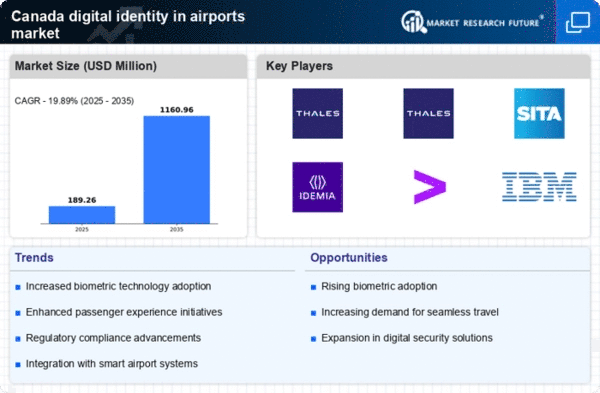
As per Market Research Future analysis, the Canada Digital Identity in Airports Market size was estimated at 157.86 USD Million in 2024. The Digital Identity-in-airports market is projected to grow from 189.26 USD Million in 2025 to 1160.96 USD Million by 2035, exhibiting a compound annual growth rate (CAGR) of 19.8% during the forecast period 2025 - 2035

Key Market Trends & Highlights

The Canada digital identity-in-airports market is experiencing robust growth driven by technological advancements and increasing passenger expectations.

  • Biometric technology adoption is rapidly transforming airport security processes, enhancing efficiency and passenger flow.
  • Data privacy and security concerns are prompting airports to implement more stringent measures to protect personal information.
  • Collaborative partnerships among technology providers and airports are fostering innovation and improving service delivery.
  • Technological advancements in biometrics and a focus on enhanced customer experience are key drivers propelling market growth.

Market Size & Forecast

2024 Market Size 157.86 (USD Million)
2035 Market Size 1160.96 (USD Million)
CAGR (2025 - 2035) 19.89%

Major Players

Gemalto (FR), Thales Group (FR), SITA (CH), IDEMIA (FR), Accenture (IE), IBM (US), NEC Corporation (JP), Cognitec Systems (DE)

Our Impact
Enabled $4.3B Revenue Impact for Fortune 500 and Leading Multinationals
Partnering with 2000+ Global Organizations Each Year
30K+ Citations by Top-Tier Firms in the Industry

Canada Digital Identity in Airports Market Trends

The Canada Digital Identity in Airports Market is evolving rapidly, driven by advancements in technology and increasing demand for streamlined passenger experiences. Airports are increasingly adopting biometric solutions, such as facial recognition and fingerprint scanning, to enhance security and efficiency. These innovations not only expedite the check-in and boarding processes but also improve overall passenger satisfaction. As travelers seek more convenient and secure ways to navigate through airports, the integration of digital identity solutions appears to be a key focus for airport authorities and stakeholders. Furthermore, the emphasis on data privacy and compliance with regulations is shaping the development of these technologies, ensuring that passenger information is handled securely and responsibly. In addition, the digital identity-in-airports market is likely to witness further growth as partnerships between technology providers and airport operators become more prevalent. Collaborative efforts may lead to the creation of comprehensive identity management systems that facilitate seamless travel experiences. The ongoing investment in infrastructure and technology upgrades suggests a commitment to enhancing operational efficiency and passenger safety. As the landscape continues to evolve, the digital identity-in-airports market is poised to play a crucial role in the future of air travel, reflecting broader trends in digital transformation and customer-centric services.

Biometric Technology Adoption

The adoption of biometric technologies is becoming increasingly prevalent in the digital identity-in-airports market. Airports are implementing systems that utilize facial recognition and fingerprint scanning to streamline passenger processing. This trend not only enhances security but also significantly reduces wait times, thereby improving the overall travel experience.

Data Privacy and Security

Concerns regarding data privacy and security are paramount in the digital identity-in-airports market. As airports implement advanced identity solutions, there is a growing emphasis on ensuring compliance with regulations and protecting passenger information. This focus on safeguarding data is likely to influence technology development and operational practices.

Collaborative Partnerships

Collaborative partnerships between technology providers and airport operators are emerging as a key trend in the digital identity-in-airports market. These alliances aim to create integrated identity management systems that enhance operational efficiency and passenger convenience. Such collaborations may lead to innovative solutions that redefine the travel experience.

Canada Digital Identity in Airports Market Drivers

Increased Passenger Volume

The digital identity-in-airports market is poised for growth as passenger volumes continue to rise in Canada. With an increase in both domestic and international travel, airports are under pressure to enhance their operational capabilities. The Canadian Transportation Agency reported a 15% increase in air travel demand in recent years, necessitating the implementation of efficient identity verification systems. Digital identity solutions, particularly biometric technologies, are being adopted to manage this influx effectively. By streamlining processes and reducing bottlenecks, these solutions are essential for accommodating growing passenger numbers, thus driving the digital identity-in-airports market.

Regulatory Support and Compliance

The digital identity-in-airports market is significantly influenced by regulatory frameworks that promote the use of digital identity solutions. In Canada, government initiatives aimed at enhancing airport security and passenger safety are driving the adoption of digital identity technologies. The Canadian government has implemented regulations that encourage airports to adopt biometric systems, ensuring compliance with international security standards. This regulatory support is expected to bolster market growth, with an estimated increase in investment in digital identity solutions by 25% over the next few years. Such compliance not only enhances security but also fosters trust among passengers, further propelling the digital identity-in-airports market.

Focus on Enhanced Customer Experience

The digital identity-in-airports market is increasingly driven by the need to enhance customer experience. Canadian airports are recognizing that efficient identity verification processes can significantly improve passenger satisfaction. By implementing digital identity solutions, airports can offer faster check-in and boarding experiences, which are crucial in today’s competitive travel environment. Surveys indicate that 70% of travelers prefer airports that utilize biometric technology for seamless processing. This focus on customer experience is likely to propel investments in digital identity solutions, as airports strive to meet evolving passenger expectations and improve overall service quality.

Integration of Advanced Data Analytics

The digital identity-in-airports market is benefiting from the integration of advanced data analytics into identity verification processes. Canadian airports are increasingly leveraging data analytics to enhance security measures and optimize operational efficiency. By analyzing passenger data, airports can identify patterns and potential security threats, thereby improving the effectiveness of their identity verification systems. This integration is expected to grow, with forecasts suggesting a 20% increase in the use of data analytics in airport operations over the next few years. Such advancements not only bolster security but also streamline processes, making them vital for the digital identity-in-airports market.

Technological Advancements in Biometrics

The digital identity-in-airports market is experiencing a surge due to rapid advancements in biometric technologies. Innovations such as facial recognition, fingerprint scanning, and iris recognition are becoming increasingly sophisticated, enhancing the efficiency of passenger processing. In Canada, airports are integrating these technologies to streamline check-in and boarding processes, thereby reducing wait times. According to recent data, the adoption of biometric systems in Canadian airports is projected to increase by 30% over the next five years. This trend not only improves operational efficiency but also elevates the overall passenger experience, making it a crucial driver for the digital identity-in-airports market.


Market Segment Insights

By Offering: Solutions (Largest) vs. Services (Fastest-Growing)

In the Canada digital identity-in-airports market, the Solutions segment holds a significant share, dominating the landscape with its comprehensive offerings that cater to various operational needs within airports. This segment's stability and established presence allow it to capitalize on existing infrastructure, maintaining a strong foothold against emerging alternatives. On the other hand, the Services segment, while smaller in market share, is rapidly gaining traction, reflecting the industry's shift towards more agile and customer-centric approaches that enhance traveler experience. The growth of the Services segment can be attributed to several key factors, including the increasing demand for personalized travel experiences and the adoption of advanced technologies. As airports look to enhance operational efficiency and streamline identity verification processes, the emphasis on innovative service delivery has intensified. This trend is expected to drive substantial growth, positioning Services as the fastest-growing component within the Canada digital identity-in-airports market, supported by partnerships with technology providers and evolving customer expectations.

Solutions: Dominant vs. Services: Emerging

The Solutions segment remains the dominant force within the market, providing robust technologies designed to enhance operational workflows, improve security, and ensure compliance with regulations. Characterized by advanced biometric systems, identity management software, and integrated platforms, this segment appeals to airport authorities seeking reliable and effective solutions to address complex identity verification challenges. Conversely, the Services segment is on the rise, focusing on value-added offerings such as consulting, system integration, and ongoing support. This emerging segment is marked by its adaptability and alignment with shifting customer expectations, prioritizing personalized services that improve the travel experience. As airports invest in enhancing passenger interactions and journey management, the Services segment is expected to experience accelerated growth.

By Solution Type: Identity Verification (Largest) vs. Authentication (Fastest-Growing)

In the Canada digital identity-in-airports market, the segment of Identity Verification holds the largest market share, driven by its critical role in ensuring security and compliance within airport operations. This segment's dominance reflects the increasing demand for sophisticated identity validation measures as aviation security continues to tighten globally. Authentication follows closely as the fastest-growing segment, as more airports adopt advanced biometric technology to enhance passenger experience and streamline boarding processes. The growth trends within these segments are influenced by several factors, including technological advancements and a rising focus on seamless travel experiences. The integration of AI and machine learning into identity management systems facilitates quicker verifications, which are becoming essential in busy airport environments. The increasing incidence of identity fraud further propels the need for robust identity verification solutions, while investments in user-friendly authentication methods are expected to accelerate the adoption of these solutions across the sector.

Identity Verification (Dominant) vs. Authentication (Emerging)

Identity Verification emerges as the dominant solution type in the Canada digital identity-in-airports market due to its foundational role in securing passenger identities and ensuring compliance with international safety standards. This segment leverages technologies like biometrics, facial recognition, and document verification to authenticate travelers efficiently. On the other hand, Authentication is marked as an emerging solution that complements Identity Verification by enhancing the overall travel experience. It focuses on quick and secure access to airport services, adapting rapidly to technological advancements and user expectations. As airports seek integrated solutions that balance security with convenience, both segments play crucial but distinctive roles in shaping the future of digital identity within the sector.

By Identity Type: Biometric (Largest) vs. Non-biometric (Fastest-Growing)

In the Canada digital identity-in-airports market, the distribution of market share between biometric and non-biometric identity types reveals a clear dominance of biometric solutions, which are characterized by their accuracy and efficiency in passenger verification processes. Non-biometric identity types, while holding a smaller share, are rapidly gaining traction due to their cost-effectiveness and ease of implementation, catering to a different segment of the airport population that seeks simplified processes. Growth trends within this segment indicate a significant shift towards biometric technologies, driven by the heightened emphasis on security and operational efficiency in airports. As passengers increasingly demand faster and more reliable identification processes, airports are investing in advanced biometric systems. Meanwhile, non-biometric solutions are emerging as appealing alternatives for airports looking to modernize their systems without extensive financial commitments, thus positioning them as a viable growth segment in the market.

Identity Type: Biometric (Dominant) vs. Non-biometric (Emerging)

Biometric identity types leverage advanced technologies such as facial recognition, fingerprint scanning, and iris detection, making them dominant in the Canada digital identity-in-airports market. These solutions enhance security while streamlining the passenger experience by reducing wait times. Their robustness and accuracy appeal to airport authorities aiming for seamless operations. Conversely, non-biometric identity types, which include traditional document checks and manual verification, are emerging as cost-effective alternatives. As airports look to balance security needs with budget constraints, non-biometric solutions offer simpler implementations, catering to budget-sensitive airports and enhancing user convenience without the complexities associated with advanced technologies.
By Organization Size: Large Organization (Largest) vs. SMEs (Fastest-Growing)

The Canada digital identity-in-airports market exhibits a notable distribution in the 'Organization Size' segment, with large organizations commanding a significant share due to their extensive operational capacity and advanced technological infrastructure. These entities possess the resources to invest in sophisticated digital identity solutions, making them predominant players in the market. In contrast, SMEs represent a growing force, adapting quickly to changing consumer needs and embracing innovative technologies, although their overall market share remains lower than that of large organizations. Growth trends indicate that while large organizations provide stability to the sector, SMEs are emerging as fast adopters of digital identity solutions in airports. The increasing need for efficient passenger processing and secure identification drives SMEs to enhance their service offerings, thereby positioning themselves for rapid growth. Furthermore, government initiatives aimed at fostering innovation among smaller businesses contribute to the accelerated adoption of digital identity technologies in this segment.

Large Organization: Dominant vs. SMEs: Emerging

Large organizations in the Canada digital identity-in-airports market are characterized by their robust financial resources, extensive experience, and ability to implement cutting-edge technologies. They often lead the way in developing comprehensive systems that enhance security and streamline passenger processing. On the other hand, SMEs, while smaller in market share, are increasingly recognized as emerging players due to their agility and innovative approaches. These organizations are focused on delivering niche solutions tailored to specific airport needs, leveraging cloud technologies and partnerships to create competitive advantages. Their rapid responsiveness to market demands positions them as key drivers of change, steadily gaining traction in an evolving digital landscape.

Get more detailed insights about Canada Digital Identity in Airports Market

Key Players and Competitive Insights

The digital identity-in-airports market is characterized by a rapidly evolving competitive landscape, driven by technological advancements and increasing demand for seamless passenger experiences. Key players such as Gemalto (France), Thales Group (France), and SITA (Switzerland) are at the forefront, each adopting distinct strategies to enhance their market positioning. Gemalto (France) focuses on innovation in biometric solutions, while Thales Group (France) emphasizes partnerships with airport authorities to implement integrated identity management systems. SITA (Switzerland) leverages its extensive experience in airport operations to provide tailored solutions that enhance operational efficiency and passenger flow. Collectively, these strategies contribute to a dynamic competitive environment, where innovation and collaboration are paramount.In terms of business tactics, companies are increasingly localizing manufacturing and optimizing supply chains to enhance responsiveness to market demands. The market structure appears moderately fragmented, with several players vying for market share, yet the influence of major companies remains substantial. This competitive structure fosters an environment where collaboration and strategic partnerships are essential for growth and sustainability.

In October IDEMIA (France) announced a strategic partnership with a leading Canadian airport to deploy advanced biometric screening technologies. This move is significant as it not only enhances the airport's security measures but also streamlines the passenger experience, aligning with the growing trend towards digital identity solutions. The partnership is expected to set a benchmark for future collaborations in the region.

In September Accenture (Ireland) launched a new initiative aimed at integrating AI-driven identity verification systems within airport operations. This initiative is crucial as it positions Accenture (Ireland) as a leader in the digital transformation of airport services, potentially reshaping how identity verification is conducted in real-time. The integration of AI technologies is likely to enhance operational efficiency and reduce wait times for passengers.

In August IBM (United States) unveiled a comprehensive digital identity framework designed specifically for airports, focusing on data privacy and security. This framework is particularly relevant in the current climate, where data protection is paramount. By prioritizing security, IBM (United States) not only addresses regulatory concerns but also builds trust with passengers, which is essential for the adoption of digital identity solutions.

As of November current trends in the digital identity-in-airports market include a strong emphasis on digitalization, sustainability, and the integration of AI technologies. Strategic alliances are increasingly shaping the competitive landscape, enabling companies to pool resources and expertise. Looking ahead, it appears that competitive differentiation will evolve from traditional price-based competition to a focus on innovation, technological advancements, and supply chain reliability. This shift suggests that companies that prioritize these areas will likely gain a competitive edge in the market.

Key Companies in the Canada Digital Identity in Airports Market include

Industry Developments

In recent months, the Canada Digital Identity in Airports Market has seen notable developments, particularly in the context of enhancing security and passenger experience. Companies like SITA and IDEMIA are at the forefront, implementing biometric authentication systems that streamline passenger processing at various Canadian airports. Accenture partnered with the Government of Canada to explore innovative solutions for digital identity verification, reflecting a push towards more efficient airport operations. Additionally, in March 2023, Thales Group acquired a minority stake in a Canadian fintech firm aimed at revolutionizing digital identity management, fueling growth in this sector. 

Furthermore, IBM's cloud services are increasingly integral to the data management needs of airport operators, enhancing operational efficiency amid rising air travel post-pandemic. Growth in the market valuation of firms such as Verizon and Microsoft indicates a robust demand for secure and efficient digital identity solutions. In the last couple of years, major airports in Toronto and Vancouver have begun pilot programs focused on integrating cutting-edge technology to facilitate smoother travel experiences. Enhanced digital identity protocols have become critical in ensuring the security of passenger data while also improving public trust in digital identity applications in air travel.

Future Outlook

Canada Digital Identity in Airports Market Future Outlook

The digital identity-in-airports market is projected to grow at a 19.89% CAGR from 2025 to 2035, driven by technological advancements, increased security demands, and enhanced passenger experiences.

New opportunities lie in:

  • Integration of biometric verification systems for seamless passenger flow.
  • Development of mobile identity applications for real-time updates.
  • Partnerships with airlines for personalized travel experiences using data analytics.

By 2035, the market is expected to achieve substantial growth, driven by innovation and strategic partnerships.

Market Segmentation

Canada Digital Identity in Airports Market Offering Outlook

  • Solutions
  • Services

Canada Digital Identity in Airports Market Identity Type Outlook

  • Biometric
  • Non-biometric

Canada Digital Identity in Airports Market Solution Type Outlook

  • Identity Verification
  • Authentication
  • Identity Lifecycle Management
  • Other Solution Types

Canada Digital Identity in Airports Market Organization Size Outlook

  • Large Organization
  • SMEs

Report Scope

MARKET SIZE 2024 157.86(USD Million)
MARKET SIZE 2025 189.26(USD Million)
MARKET SIZE 2035 1160.96(USD Million)
COMPOUND ANNUAL GROWTH RATE (CAGR) 19.89% (2025 - 2035)
REPORT COVERAGE Revenue Forecast, Competitive Landscape, Growth Factors, and Trends
BASE YEAR 2024
Market Forecast Period 2025 - 2035
Historical Data 2019 - 2024
Market Forecast Units USD Million
Key Companies Profiled Gemalto (FR), Thales Group (FR), SITA (CH), IDEMIA (FR), Accenture (IE), IBM (US), NEC Corporation (JP), Cognitec Systems (DE)
Segments Covered Offering, Solution Type, Identity Type, Organization Size
Key Market Opportunities Integration of biometric technologies enhances security and efficiency in the digital identity-in-airports market.
Key Market Dynamics Growing emphasis on biometric solutions enhances security and efficiency in airport passenger processing.
Countries Covered Canada
Leave a Comment

FAQs

What is the expected market size for the Canada Digital Identity in Airports Market in 2024?

The Canada Digital Identity in Airports Market is expected to be valued at 157.5 million USD in 2024.

How much is the Canada Digital Identity in Airports Market expected to grow by 2035?

By 2035, the Canada Digital Identity in Airports Market is expected to reach a value of 614.0 million USD.

What is the projected compound annual growth rate (CAGR) for the Canada Digital Identity in Airports Market from 2025 to 2035?

The market is projected to have a CAGR of 13.166% from 2025 to 2035.

What is the expected market value for solutions in the Canada Digital Identity in Airports Market by 2035?

The solutions segment of the market is expected to be valued at 303.0 million USD by 2035.

What are some major players in the Canada Digital Identity in Airports Market?

Key players in the market include Verizon, Accenture, SITA, and Microsoft among others.

How much is the services segment of the Canada Digital Identity in Airports Market expected to be worth in 2035?

The services segment is anticipated to reach a value of 311.0 million USD by 2035.

What trends are driving the growth of the Canada Digital Identity in Airports Market?

Key growth drivers include the increasing focus on security and efficiency at airports through digital identity solutions.

What challenges does the Canada Digital Identity in Airports Market face?

The market faces challenges such as regulatory compliance and the integration of new technologies.

How does the current global scenario impact the Canada Digital Identity in Airports Market?

The global emphasis on enhanced security and streamlined travel processes is positively influencing the market.

What is the expected market size for the Canada Digital Identity in Airports Market's services segment in 2024?

In 2024, the services segment is expected to be valued at 79.5 million USD.

Download Free Sample

Kindly complete the form below to receive a free sample of this Report

Compare Licence

×
Features License Type
Single User Multiuser License Enterprise User
Price $4,950 $5,950 $7,250
Maximum User Access Limit 1 User Upto 10 Users Unrestricted Access Throughout the Organization
Free Customization
Direct Access to Analyst
Deliverable Format
Platform Access
Discount on Next Purchase 10% 15% 15%
Printable Versions







