×
Request Free Sample ×

Kindly complete the form below to receive a free sample of this Report

* Please use a valid business email

Leading companies partner with us for data-driven Insights

clients tt-cursor
Hero Background

Canada Centralised Workstations Market

ID: MRFR/ICT/57499-HCR
200 Pages
Aarti Dhapte
February 2026

Canada Centralized Workstations Market Size, Share and Trends Analysis Report By Type (1-to-1 Workstations, 1-to-Many Workstations), By Operating System (Windows Centralized Workstations, Linux Centralized Workstations, Unix Centralized Workstations), By Enterprise Size (Large Enterprise, Small and Medium-Sized Enterprise) and By Application (Healthcare, Education, Banking and Finance, Manufacturing, Media & Entertainment, Engineering & Design)-Forecast to 2035

Share:
Download PDF ×

We do not share your information with anyone. However, we may send you emails based on your report interest from time to time. You may contact us at any time to opt-out.

Canada Centralised Workstations Market Infographic
Purchase Options

Canada Centralised Workstations Market Summary

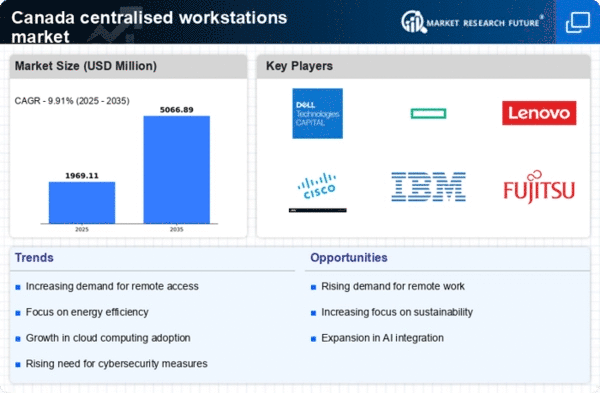
As per Market Research Future analysis, the Canada Centralised Workstations Market size was estimated at 1791.56 USD Million in 2024. The Centralised Workstations market is projected to grow from 1969.11 USD Million in 2025 to 5066.89 USD Million by 2035, exhibiting a compound annual growth rate (CAGR) of 9.9% during the forecast period 2025 - 2035

Key Market Trends & Highlights

The Canada centralised workstations market is experiencing a transformative shift towards remote work solutions and enhanced data security.

  • The demand for remote work solutions is surging, reflecting a broader trend in workplace flexibility.
  • Data security and management are becoming paramount as organizations prioritize safeguarding sensitive information.
  • Sustainability initiatives are gaining traction, influencing workstation design and operational practices.
  • Technological advancements and the shift towards hybrid work models are driving the market, alongside a growing need for collaborative work environments.

Market Size & Forecast

2024 Market Size 1791.56 (USD Million)
2035 Market Size 5066.89 (USD Million)
CAGR (2025 - 2035) 9.91%

Major Players

Dell Technologies (US), Hewlett Packard Enterprise (US), Lenovo (CN), Cisco Systems (US), IBM (US), Fujitsu (JP), Oracle (US), Supermicro (US)

Our Impact
Enabled $4.3B Revenue Impact for Fortune 500 and Leading Multinationals
Partnering with 2000+ Global Organizations Each Year
30K+ Citations by Top-Tier Firms in the Industry

Canada Centralised Workstations Market Trends

The is experiencing a notable transformation, driven by advancements in technology and evolving workplace dynamics. Organizations are increasingly adopting centralized systems to enhance efficiency and streamline operations. This shift appears to be influenced by the growing demand for remote work solutions, which necessitate robust infrastructure to support a distributed workforce. As businesses seek to optimize their resources, the integration of centralized workstations is becoming a strategic priority. Furthermore, the emphasis on data security and management is prompting companies to invest in centralized solutions that offer better control over sensitive information. In addition, the trend towards sustainability is shaping the centralised workstations market. Companies are recognizing the importance of reducing their carbon footprint and are exploring energy-efficient technologies. This focus on sustainability not only aligns with corporate social responsibility goals but also appeals to environmentally conscious consumers. As a result, the market is likely to see an increase in the adoption of eco-friendly workstations that minimize energy consumption and waste. Overall, the centralised workstations market is poised for growth, driven by technological advancements, security concerns, and a commitment to sustainability.

Increased Demand for Remote Work Solutions

The Canada Centralised Workstations Market is experiencing a surge in demand for solutions that facilitate remote work. Organizations are investing in centralized systems to ensure seamless connectivity and collaboration among employees, regardless of their location. This trend reflects a broader shift in workplace culture, where flexibility and adaptability are becoming essential.

Focus on Data Security and Management

As businesses increasingly rely on centralized workstations, the emphasis on data security is intensifying. Companies are prioritizing solutions that provide enhanced control over sensitive information, thereby mitigating risks associated with data breaches. This trend underscores the importance of robust security measures in the centralised workstations market.

Sustainability Initiatives

the centralised workstations market is influenced by a growing commitment to sustainability. Organizations are exploring energy-efficient technologies and eco-friendly workstations to reduce their environmental impact. This trend not only aligns with corporate responsibility goals but also resonates with consumers who prioritize sustainability.

Canada Centralised Workstations Market Drivers

Rising Focus on Cost Efficiency

Cost efficiency is becoming a pivotal driver for the centralised workstations market in Canada. Organizations are increasingly seeking ways to optimize their operational expenses, and centralised workstations offer a viable solution. By consolidating resources and minimizing hardware costs, businesses can achieve significant savings. For example, companies can reduce their IT maintenance costs by up to 30% through the implementation of centralised workstations. This financial incentive is compelling many Canadian firms to transition from traditional setups to more centralized solutions. Additionally, the potential for reduced energy consumption and lower overhead costs further enhances the appeal of centralised workstations. As a result, the market is likely to witness sustained growth as organizations prioritize cost-effective solutions.

Shift Towards Hybrid Work Models

The shift towards hybrid work models is a notable driver for the centralised workstations market in Canada. As organizations adapt to flexible work arrangements, the demand for centralized solutions that support both remote and in-office employees is increasing. Centralised workstations enable seamless access to resources, regardless of location, fostering a cohesive work environment. This trend is particularly relevant in sectors that require a blend of in-person collaboration and remote work capabilities. Market data suggests that companies implementing hybrid models are likely to see a 25% improvement in employee satisfaction and productivity. Consequently, the centralised workstations market is poised for growth as businesses seek to implement solutions that accommodate the evolving nature of work.

Increased Regulatory Compliance Requirements

the centralised workstations market is shaped by increased regulatory compliance requirements in Canada. As industries face stricter regulations regarding data protection and privacy, organizations are compelled to adopt solutions that ensure compliance. Centralised workstations provide enhanced security features and centralized data management, making it easier for businesses to adhere to these regulations. For instance, sectors such as finance and healthcare are particularly affected by compliance mandates, driving the demand for secure workstation solutions. Market analysis indicates that companies investing in compliant technologies are likely to experience a 15% reduction in compliance-related penalties. Thus, the need for regulatory compliance is a significant driver for the centralised workstations market, as organizations seek to mitigate risks associated with non-compliance.

Growing Need for Collaborative Work Environments

the centralised workstations market is significantly influenced by the growing need for collaborative work environments. As businesses in Canada prioritize teamwork and communication, the demand for workstations that facilitate collaboration is increasing. Centralised workstations provide a unified platform where teams can access shared resources and tools, enhancing productivity and innovation. This trend is particularly evident in sectors such as technology and design, where collaborative efforts are crucial for project success. Market data suggests that organizations investing in collaborative technologies are likely to see a 20% increase in project efficiency. Consequently, the centralised workstations market is expected to benefit from this shift towards collaborative workspaces, as companies seek solutions that foster teamwork and creativity.

Technological Advancements in Workstation Solutions

The centralised workstations market in Canada is experiencing a surge due to rapid technological advancements. Innovations in hardware and software are enhancing the performance and efficiency of workstations. For instance, the integration of artificial intelligence and machine learning into workstation systems is streamlining workflows and improving productivity. As organizations increasingly adopt these advanced technologies, the demand for centralised workstations is likely to rise. According to recent data, the market is projected to grow at a CAGR of 8.5% over the next five years, indicating a robust expansion driven by these technological improvements. Furthermore, the ability to support high-performance computing tasks is becoming essential for various industries, further propelling the growth of the centralised workstations market in Canada.


Market Segment Insights

By Type: 1-to-1 Workstations (Largest) vs. 1-to-Many Workstations (Fastest-Growing)

In the Canada centralised workstations market, 1-to-1 workstations dominate the segment, showcasing higher adoption rates among businesses that prioritize personalized workspace solutions. This preference is attributed to the increasing demand for privacy and tailored environments that enhance productivity. In contrast, 1-to-Many workstations represent the fastest-growing segment, fueled by the rise of collaborative work environments where flexibility and shared resources are becoming essential for organizational efficiency. The growth of 1-to-Many workstations can be attributed to changing workplace dynamics, where companies are opting for more adaptable setups to accommodate hybrid work models. The emphasis on cost-effectiveness and space optimization drives organizations to invest in these workstations. Moreover, advancements in technology that facilitate seamless collaboration among teams are further propelling this segment's growth in the market, signaling a shift towards shared workspace solutions.

Workstation Type: 1-to-1 (Dominant) vs. 1-to-Many (Emerging)

1-to-1 workstations are characterized by their dedicated setups, offering individual employees personalized spaces that enhance focus and productivity. They cater to industries that require confidentiality and concentrated work, such as finance and legal sectors. On the other hand, 1-to-Many workstations are emerging as a flexible solution for organizations embracing collaborative work styles. These setups enable multiple users to share common spaces, promoting creativity and teamwork. The versatility in design and functionality of 1-to-Many workstations appeals to tech-savvy companies looking to enhance employee interaction while optimizing real estate costs. As workplaces evolve, both types are likely to coexist, meeting diverse organizational needs.

By Operating System: Windows Centralized Workstations (Largest) vs. Linux Centralized Workstations (Fastest-Growing)

In the Canada centralised workstations market, Windows Centralized Workstations hold a significant share, serving as the backbone of many business operations. Linux Centralized Workstations follow, carving out a niche, particularly in sectors that prioritize open-source solutions. Unix Centralized Workstations, while having a smaller market slice, still cater to specialized applications, and others contribute to diverse operational needs. This segmentation indicates robust operating system preferences based on business needs and technical environments. The growth trends within this segment are largely driven by the evolving needs for efficiency and security in corporate environments. Windows continues to thrive due to its widespread acceptance and compatibility, while Linux shows rapid adoption, especially among startups and tech firms that value flexibility. The increasing demand for cloud solutions also propels the Linux segment, while Unix maintains a loyal user base in enterprise settings that require reliability and performance.

Windows Centralized Workstations (Dominant) vs. Linux Centralized Workstations (Emerging)

Windows Centralized Workstations dominate the Canada centralised workstations market, primarily due to their extensive support, user-friendly interfaces, and integration capabilities with various software applications. Organizations often prefer them for large-scale deployments owing to their robust security features and widespread familiarity among users. In contrast, Linux Centralized Workstations are emerging strongly, primarily appealing to tech-savvy businesses and developers who favor customization and cost-effective solutions. The rise of open-source methodologies and a growing interest in sustainable IT practices enhance Linux's reputation. With these dynamics, companies are finding value in a hybrid environment that capitalizes on the strengths of both operating systems, adapting to rapidly changing technological landscapes.

By Enterprise Size: Large Enterprises (Largest) vs. Small and Medium-Sized Enterprises (SME) (Fastest-Growing)

In the Canada centralised workstations market, the distribution of market share between large enterprises and SMEs is distinct. Large enterprises dominate the segment due to their significant investments in advanced technology and infrastructure, which facilitate enhanced productivity and efficiency. These organizations represent the largest portion of the market, leveraging economies of scale to optimize their operations and reduce costs. In contrast, the small and medium-sized enterprises are recognized as the fastest-growing segment within the market. This growth is driven by a surge in digital transformation initiatives and the increased need for collaborative working environments. SMEs are adopting centralized workstation solutions to improve their operational capabilities, enhance employee satisfaction, and adapt to evolving market demands, thereby establishing a stronger foothold in the market.

Large Enterprises (Dominant) vs. Small and Medium-Sized Enterprises (Emerging)

Large enterprises in the Canada centralised workstations market are characterized by their substantial resources and advanced technology adoption. They prioritize robust workstation solutions to facilitate complex operations and support a large workforce. Their dominance stems from the ability to invest heavily in infrastructure, ensuring scalability and efficiency. Conversely, small and medium-sized enterprises represent an emerging segment that is increasingly recognizing the importance of centralized workstations. These SMEs are adapting quickly to technological advancements, implementing flexible and cost-effective workstation solutions that cater to their specific needs. This agility allows them to innovate and compete effectively, demonstrating substantial growth potential as they transition towards more integrated workplace environments.

By Application: Healthcare (Largest) vs. Education (Fastest-Growing)

In the Canada centralised workstations market, the application segment is primarily dominated by the healthcare sector, which accounts for a significant share due to its robust demand for high-performance computing solutions. Following closely is the education sector, which, while not as large, is increasingly leveraging workstation technologies to enhance learning and administrative efficiency across institutions. Other notable applications include banking and finance, manufacturing, media and entertainment, and engineering & design, each contributing diverse needs that are catered to by advanced workstation capabilities. Growth trends indicate an upward trajectory for the education sector, attributed to the rising adoption of digital tools and remote learning solutions, particularly in the wake of recent global shifts toward hybrid learning models. The healthcare industry is continuously expanding its infrastructure, driven by the need for efficient data management and advanced imaging technologies. Additionally, both sectors heavily rely on customized solutions to meet their unique operational requirements, driving the demand for centralized workstations.

Healthcare: Dominant vs. Education: Emerging

The healthcare sector stands out as the dominant application within the Canada centralised workstations market, characterized by its commitment to innovation and technology in patient care and administrative processes. This sector benefits from significant investments in IT infrastructure aimed at improving service delivery and operational efficiency. On the other hand, education represents an emerging segment, rapidly adopting workstations for enhanced educational delivery and administrative functions. This shift is fueled by increased funding for digital education initiatives and the necessity for collaborative tools for both students and educators. As these sectors evolve, the distinct needs for performance, security, and user experience will continue to shape workstation offerings tailored to these critical applications.

Get more detailed insights about Canada Centralised Workstations Market

Key Players and Competitive Insights

The centralised workstations market in Canada is characterized by a dynamic competitive landscape, driven by technological advancements and increasing demand for efficient computing solutions. Key players such as Dell Technologies (US), Hewlett Packard Enterprise (US), and Lenovo (CN) are strategically positioned to leverage innovation and digital transformation. Dell Technologies (US) focuses on enhancing its product offerings through continuous innovation, while Hewlett Packard Enterprise (US) emphasizes partnerships to expand its market reach. Lenovo (CN) appears to be concentrating on regional expansion and localizing its manufacturing processes to better serve Canadian customers. Collectively, these strategies contribute to a competitive environment that is increasingly focused on technological differentiation and customer-centric solutions.
In terms of business tactics, companies are localizing manufacturing and optimizing supply chains to enhance operational efficiency. The market structure is moderately fragmented, with several key players exerting influence over various segments. This fragmentation allows for a diverse range of offerings, catering to different customer needs while fostering competition among established and emerging players.
In October 2025, Dell Technologies (US) announced a significant investment in a new research and development facility in Toronto, aimed at accelerating innovation in centralised workstations. This move is strategically important as it not only enhances Dell's local presence but also positions the company to better respond to the specific needs of Canadian enterprises, potentially increasing its market share in the region.
In September 2025, Hewlett Packard Enterprise (US) launched a new line of energy-efficient workstations designed to meet the growing demand for sustainable computing solutions. This initiative reflects HPE's commitment to sustainability and aligns with global trends towards environmentally friendly technology, which may resonate well with Canadian businesses increasingly focused on corporate social responsibility.
In August 2025, Lenovo (CN) entered into a strategic partnership with a Canadian cloud service provider to integrate its centralised workstations with cloud-based solutions. This collaboration is likely to enhance Lenovo's competitive edge by offering customers seamless access to advanced computing resources, thereby addressing the rising demand for hybrid work environments.
As of November 2025, the competitive trends in the centralised workstations market are heavily influenced by digitalization, sustainability, and AI integration. Strategic alliances are becoming increasingly vital, as companies seek to enhance their technological capabilities and market reach. The shift from price-based competition to a focus on innovation, technology, and supply chain reliability is evident, suggesting that future competitive differentiation will hinge on the ability to deliver cutting-edge solutions that meet evolving customer demands.

Key Companies in the Canada Centralised Workstations Market include

Industry Developments

The Canada Centralized Workstations Market has recently witnessed significant developments, with growth in market valuation fueled by increased demand for remote work solutions and cloud computing services.

Notably, in September 2023, Nutanix announced a strategic partnership to enhance its deployment of hybrid cloud ecosystems tailored for Canadian enterprises, responding to the evolving needs in the post-pandemic work environment. In terms of mergers and acquisitions, in August 2023, Hewlett-Packard Enterprise finalized its acquisition of a local data analytics firm, augmenting its service offerings in Canada.

Furthermore, in July 2023, Dell Technologies announced a new product line to boost productivity, which has significantly impacted the market as Canadian businesses adapt to a hybrid work model. Over the last two to three years, the emphasis on sustainability has also driven technological investments, as evidenced by IBM's increased focus on energy-efficient technologies.

The surge in digital transformation projects across various sectors has enhanced the overall landscape of Centralized Workstations in Canada, where companies like Cisco Systems and VMware are actively participating in the innovation drive. The competitive environment remains robust, with major players consistently evolving their strategic initiatives.


Future Outlook

Canada Centralised Workstations Market Future Outlook

The centralised workstations market in Canada is projected to grow at a 9.91% CAGR from 2025 to 2035, driven by technological advancements and increasing demand for efficient computing solutions.

New opportunities lie in:

  • Development of AI-integrated workstation solutions for enhanced productivity.
  • Expansion of remote workstation services to cater to hybrid work models.
  • Investment in energy-efficient workstation technologies to reduce operational costs.

By 2035, the market is expected to achieve substantial growth, reflecting evolving business needs.

Market Segmentation

Canada Centralised Workstations Market Type Outlook

  • 1-to-1 Workstations
  • 1-to-Many Workstations

Canada Centralised Workstations Market Application Outlook

  • Healthcare
  • Education
  • Banking and Finance
  • Manufacturing
  • Media & Entertainment
  • Engineering & Design
  • Others

Canada Centralised Workstations Market Enterprise Size Outlook

  • Large Enterprises
  • Small and Medium-Sized Enterprise (SME)

Canada Centralised Workstations Market Operating System Outlook

  • Windows Centralized Workstations
  • Linux Centralized Workstations
  • Unix Centralized Workstations
  • Others

Report Scope

MARKET SIZE 2024 1791.56(USD Million)
MARKET SIZE 2025 1969.11(USD Million)
MARKET SIZE 2035 5066.89(USD Million)
COMPOUND ANNUAL GROWTH RATE (CAGR) 9.91% (2025 - 2035)
REPORT COVERAGE Revenue Forecast, Competitive Landscape, Growth Factors, and Trends
BASE YEAR 2024
Market Forecast Period 2025 - 2035
Historical Data 2019 - 2024
Market Forecast Units USD Million
Key Companies Profiled Dell Technologies (US), Hewlett Packard Enterprise (US), Lenovo (CN), Cisco Systems (US), IBM (US), Fujitsu (JP), Oracle (US), Supermicro (US)
Segments Covered Type, Operating System, Enterprise Size, Application
Key Market Opportunities Integration of advanced virtualization technologies enhances efficiency in the centralised workstations market.
Key Market Dynamics Growing demand for centralized workstations driven by technological advancements and evolving consumer preferences in Canada.
Countries Covered Canada
Leave a Comment

FAQs

What is the current market size of the Canada Centralized Workstations Market in 2024?

In 2024, the Canada Centralized Workstations Market is expected to be valued at 1.82 USD Billion.

What is the projected market size for the Canada Centralized Workstations Market by 2035?

By 2035, the market is anticipated to grow to 8.32 USD Billion.

What is the expected compound annual growth rate (CAGR) for the Canadian Centralized Workstations Market from 2025 to 2035?

The expected CAGR for the market during this period is 14.844%.

What are the market values for the '1-to-1 Workstations' segment in 2024 and 2035?

The '1-to-1 Workstations' segment is valued at 0.73 USD Billion in 2024 and projected to reach 3.31 USD Billion by 2035.

What is the market value for the '1-to-Many Workstations' segment in 2024 and what is its forecast for 2035?

The market value for '1-to-Many Workstations' in 2024 is estimated at 1.09 USD Billion, with a forecast of 5.01 USD Billion by 2035.

Who are the key players in the Canada Centralized Workstations Market?

Major players include Hewlett Packard Enterprise, Unisys, Fujitsu, Nutanix, and Dell Technologies among others.

Are there any key opportunities driving growth in the Canada Centralized Workstations Market?

Key opportunities are driven by advancements in technology and increasing demand for efficient centralized computing solutions.

What challenges might affect the Canada Centralized Workstations Market growth?

Challenges include competition from decentralized computing solutions and fluctuating technology trends.

How does the Canadian Centralized Workstations Market grow compared to other regions?

The market's growth is robust, with expectations of significant expansion in contrast to other regions due to increased adoption of centralized work solutions.

What is the impact of technological trends on the Canada Centralized Workstations Market?

Technological trends are expected to enhance the market, enabling better performance and cost efficiency for organizations.

Download Free Sample

Kindly complete the form below to receive a free sample of this Report

Compare Licence

×
Features License Type
Single User Multiuser License Enterprise User
Price $4,950 $5,950 $7,250
Maximum User Access Limit 1 User Upto 10 Users Unrestricted Access Throughout the Organization
Free Customization
Direct Access to Analyst
Deliverable Format
Platform Access
Discount on Next Purchase 10% 15% 15%
Printable Versions