×
Request Free Sample ×

Kindly complete the form below to receive a free sample of this Report

* Please use a valid business email

Leading companies partner with us for data-driven Insights

clients tt-cursor
Hero Background

Canada Blockchain Fintech Market

ID: MRFR/BS/57366-HCR
200 Pages
Aarti Dhapte
February 2026

Canada Blockchain Fintech Market Size, Share and Research Report By Application (Payments, Clearing, Settlement, Exchange, Remittance, Smart Contracts, Identity Management, Compliance Management, Know Your Customer, Content Storage Management), By Provider (Application and Solution Providers, Middleware Providers, Infrastructure and Protocols Providers), By Organization Size (Small-Medium Size Enterprises, Large Enterprises) and By Industry Vertical (Banking, Non-banking, Financial Services, Insurance)-Forecast to 2035

Share:
Download PDF ×

We do not share your information with anyone. However, we may send you emails based on your report interest from time to time. You may contact us at any time to opt-out.

Canada Blockchain Fintech Market Infographic
Purchase Options

Canada Blockchain Fintech Market Summary

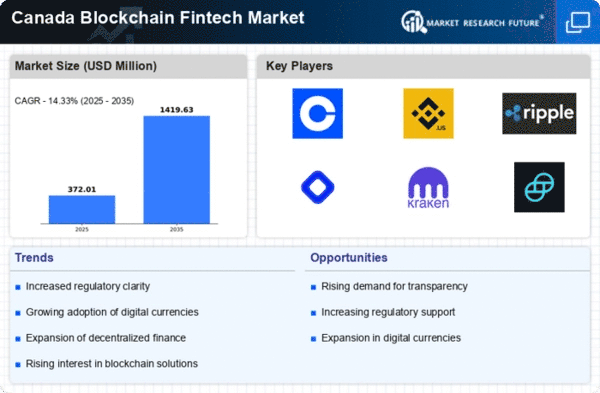
As per Market Research Future analysis, the Canada Blockchain Fintech Market Size was estimated at 325.38 USD Million in 2024. The Canada blockchain fintech market is projected to grow from 372.01 USD Million in 2025 to 1419.63 USD Million by 2035, exhibiting a compound annual growth rate (CAGR) of 14.3% during the forecast period 2025 - 2035

Key Market Trends & Highlights

The Canada Blockchain Fintech Market is experiencing robust growth driven by regulatory clarity and technological advancements.

  • The largest segment in the Canada blockchain fintech market is decentralized finance, which is rapidly gaining traction.
  • The fastest-growing segment is the integration of blockchain with traditional financial systems, reflecting a shift towards hybrid models.
  • Increased regulatory clarity is fostering a more stable environment for blockchain initiatives, encouraging investment and innovation.
  • Technological advancements in blockchain and growing investment in startups are key drivers propelling market expansion.

Market Size & Forecast

2024 Market Size 325.38 (USD Million)
2035 Market Size 1419.63 (USD Million)
CAGR (2025 - 2035) 14.33%

Major Players

Coinbase (US), Binance (MT), Ripple (US), BlockFi (US), Kraken (US), Gemini (US), Bitfinex (HK), Bitstamp (LU), eToro (IL)

Our Impact
Enabled $4.3B Revenue Impact for Fortune 500 and Leading Multinationals
Partnering with 2000+ Global Organizations Each Year
30K+ Citations by Top-Tier Firms in the Industry

Canada Blockchain Fintech Market Trends

The blockchain fintech market is currently experiencing a transformative phase, characterized by rapid technological advancements and increasing adoption across various sectors. In Canada, the integration of blockchain technology into financial services is reshaping traditional banking, payment systems, and investment strategies. Regulatory frameworks are evolving to accommodate these innovations, fostering a conducive environment for startups and established firms alike. This shift not only enhances operational efficiency but also promotes transparency and security in transactions, which are critical in building consumer trust. Furthermore, the collaboration between financial institutions and technology providers is likely to drive the development of new products and services, catering to the diverse needs of consumers and businesses. In addition, the growing interest in decentralized finance (DeFi) solutions is noteworthy. Canadian consumers and businesses are increasingly exploring alternatives to conventional financial systems, seeking greater control over their assets and transactions. This trend suggests a potential shift in how financial services are delivered, with an emphasis on user empowerment and reduced reliance on intermediaries. As the blockchain fintech market continues to evolve, it appears poised to play a pivotal role in the future of finance, offering innovative solutions that align with the changing landscape of consumer expectations and regulatory requirements.

Increased Regulatory Clarity

The blockchain fintech market is witnessing a trend towards enhanced regulatory clarity in Canada. Government bodies are actively working to establish frameworks that support innovation while ensuring consumer protection. This development is likely to encourage more businesses to enter the market, fostering competition and driving technological advancements.

Rise of Decentralized Finance

Decentralized finance is gaining traction within the blockchain fintech market. Canadian users are increasingly attracted to platforms that offer peer-to-peer transactions and financial services without traditional intermediaries. This shift may lead to a redefinition of financial services, emphasizing autonomy and direct control over assets.

Integration with Traditional Financial Systems

There is a notable trend of integration between blockchain solutions and traditional financial systems. Canadian financial institutions are exploring partnerships with blockchain startups to enhance their service offerings. This collaboration could result in improved efficiency, reduced costs, and enhanced security for consumers.

Canada Blockchain Fintech Market Drivers

Consumer Demand for Financial Inclusion

There is a growing consumer demand for financial inclusion, which is significantly influencing the Blockchain Fintech Market. Many Canadians, particularly those in underserved communities, are seeking alternative financial solutions that blockchain technology can provide. The ability to access financial services without traditional banking barriers is appealing, as it promotes economic empowerment. According to recent studies, approximately 20% of Canadians are unbanked or underbanked, highlighting a substantial market opportunity. Blockchain solutions can offer lower transaction costs and increased accessibility, making them attractive to this demographic. As awareness of these benefits spreads, the blockchain fintech market is likely to see increased adoption among consumers seeking inclusive financial services.

Technological Advancements in Blockchain

The Blockchain Fintech Market is experiencing rapid technological advancements that enhance transaction speed, security, and scalability. Innovations such as smart contracts and decentralized applications (dApps) are becoming increasingly prevalent. In Canada, the adoption of these technologies is projected to grow, with an estimated market size reaching $2 billion by 2026. This growth is driven by the need for more efficient financial services and the demand for transparency in transactions. As Canadian businesses and consumers become more aware of the benefits of blockchain technology, the market is likely to expand further. The integration of artificial intelligence and machine learning with blockchain solutions may also provide additional opportunities for innovation within the blockchain fintech market.

Growing Investment in Blockchain Startups

Investment in blockchain startups is surging, significantly impacting the Blockchain Fintech Market. In Canada, venture capital funding for blockchain-related companies has increased by over 50% in the past year, indicating a strong interest from investors. This influx of capital is likely to foster innovation and accelerate the development of new financial products and services. As more startups emerge, they contribute to a competitive landscape that drives advancements in technology and service offerings. The Canadian government has also shown support for blockchain initiatives, which may further encourage investment. This trend suggests that the blockchain fintech market will continue to evolve, attracting both domestic and international investors.

Regulatory Support for Blockchain Initiatives

Regulatory support for blockchain initiatives is emerging as a crucial driver for the Blockchain Fintech Market. In Canada, government agencies are actively exploring frameworks that promote the safe and responsible use of blockchain technology. This regulatory clarity is essential for fostering innovation and attracting investment. Recent initiatives, such as the Canadian Securities Administrators' guidelines on cryptocurrency offerings, indicate a willingness to embrace blockchain solutions while ensuring consumer protection. As regulations evolve, they may provide a more stable environment for businesses operating in the blockchain fintech market. This supportive regulatory landscape could encourage more companies to enter the market, further driving growth and development.

Collaboration Between Financial Institutions and Blockchain Firms

Collaboration between traditional financial institutions and blockchain firms is becoming increasingly prevalent, significantly impacting the Blockchain Fintech Market. In Canada, major banks are exploring partnerships with blockchain startups to enhance their service offerings and improve operational efficiency. These collaborations often focus on areas such as cross-border payments, identity verification, and fraud prevention. By leveraging blockchain technology, financial institutions can streamline processes and reduce costs. This trend suggests a shift towards a more integrated financial ecosystem, where traditional and innovative solutions coexist. As these partnerships grow, they are likely to drive further adoption of blockchain technology within the Canadian financial sector.


Market Segment Insights

By Application: Payments (Largest) vs. Compliance Management (Fastest-Growing)

In the Canada blockchain fintech market, the application segment is predominantly led by Payments, showcasing a significant market share. This category proves to be pivotal, driven by the increasing demand for efficient and secure transaction methods. Close contenders such as Clearing and Settlement and Exchanges and Remittances also play essential roles, reflecting the market's transition towards digital solutions, but Payments remains at the forefront, driving the majority of market activities. Looking forward, Compliance Management, particularly Know Your Customer (KYC) solutions, is emerging as the fastest-growing segment. This growth is fueled by stringent regulatory requirements and a strong focus on privacy and security. Moreover, as businesses increasingly adopt blockchain technology to streamline processes, segments like Smart Contracts and Identity Management are also expected to witness substantial growth, driven by their adaptability and efficiency in modern financial ecosystems.

Payments (Dominant) vs. Compliance Management (Emerging)

Payments is currently the dominant player in the Canada blockchain fintech market, characterized by its widespread acceptance and growing technological integration into daily transactions. This segment benefits from robust consumer demand for faster, cheaper, and more secure payment methods, leading to significant innovation and investment. On the other hand, Compliance Management, particularly in relation to KYC, represents an emerging trend as businesses strive to navigate regulatory landscapes effectively. The importance of safeguarding user identities while adhering to compliance standards is propelling this segment's growth. As organizations look for solutions that can seamlessly integrate compliance protocols with blockchain capabilities, Compliance Management is increasingly seen as essential for future-proofing financial transactions.

By Provider: Application and Solution Providers (Largest) vs. Middleware Providers (Fastest-Growing)

In the Canada blockchain fintech market, the distribution of market share among different provider segments reveals important insights. Application and Solution Providers hold the largest share, driven by the increasing adoption of blockchain technology across various industries. Middleware Providers are witnessing rapid growth due to the rising demand for seamless integration of blockchain with existing infrastructures, highlighting their pivotal role in the ecosystem. Growth trends in this segment are largely influenced by evolving technological advancements and regulatory support for blockchain solutions. The surge in digital payments and the need for enhanced security solutions are key drivers for Application and Solution Providers, while Middleware Providers benefit from companies seeking to enhance operational efficiency and data management capabilities. As more enterprises adopt blockchain, these segments are poised for sustained growth.

Application and Solution Providers (Dominant) vs. Middleware Providers (Emerging)

Application and Solution Providers are a dominant force in the Canada blockchain fintech market, offering robust solutions that cater to various industry needs, including financial services and supply chain management. Their extensive expertise in developing applications facilitates wider blockchain adoption. In contrast, Middleware Providers are emerging as essential components, enabling smoother interaction between legacy systems and blockchain technology. Their ability to offer integration solutions is critical for companies aiming to harness blockchain's potential without overhauling existing infrastructures. This developing landscape reflects a significant shift toward digital transformation, where both segments play crucial roles in advancing the overall ecosystem.

By Organization Size: Small and Medium-Sized Enterprises (Largest) vs. Large Enterprises (Fastest-Growing)

In the Canada blockchain fintech market, the organization size segment is primarily dominated by Small and Medium-Sized Enterprises (SMEs), which hold a significant share due to their growing adoption of innovative financial solutions. These SMEs leverage blockchain technology to enhance operational efficiency and reduce costs, thus gaining a competitive edge in their respective sectors. Conversely, Large Enterprises, while presenting a smaller share, have rapidly increased their involvement in blockchain solutions, driven by their need for secure and transparent transactions at scale. The growth trends within this segment indicate a shift towards digital transformation among both SMEs and Large Enterprises. SMEs are increasingly prioritizing blockchain applications to improve customer engagement and streamline transactions. Meanwhile, Large Enterprises are investing heavily in blockchain to enhance their supply chain management and data security. This dual focus creates a dynamic interplay, with SMEs appearing as a stable force while Large Enterprises emerge as the fastest-growing players, reshaping the landscape of the Canada blockchain fintech market.

Small and Medium-Sized Enterprises (Dominant) vs. Large Enterprises (Emerging)

Small and Medium-Sized Enterprises (SMEs) in the Canada blockchain fintech market are characterized by their agility and innovative approaches, enabling them to harness blockchain technology effectively. They often adopt niche solutions that cater to specific needs, making them highly adaptable to market changes. Their widespread integration of blockchain solutions leads to enhanced efficiencies and lower operational costs. In contrast, Large Enterprises, classified as emerging in this segment, are focusing on leveraging blockchain for extensive applications across various sectors, such as financial services and supply chain management. This shift underscores their strategic investments in technology to ensure a competitive advantage and secure data handling, although they often implement changes at a slower pace than SMEs due to their size and existing structures.

By Industry Vertical: Banking (Largest) vs. Non-Banking (Fastest-Growing)

In the Canada blockchain fintech market, the industry verticals showcase a diverse market share distribution. Banking remains the largest segment, driven by traditional financial institutions adopting blockchain technology for enhanced security and efficiency. Meanwhile, the Non-Banking sector is gaining momentum, buoyed by innovative startups and tech-driven solutions that cater to the evolving demands of consumers, thereby expanding its share rapidly. Growth trends indicate that the banking vertical is leveraging blockchain to streamline operations and improve customer trust, while the Non-Banking segment capitalizes on disruptive technologies and decentralized finance (DeFi) to attract a younger, more tech-savvy audience. This dual growth is fueled by increasing regulatory acceptance and the quest for improved transaction transparency across all financial services.

Banking (Dominant) vs. Non-Banking (Emerging)

The Banking segment in the Canada blockchain fintech market is characterized by its conservative approach, focused on regulatory compliance and security features, which fortify trust among customers. Major banks are incorporating blockchain to optimize payment processes and enhance transaction security, thus maintaining their dominant market position. In contrast, the Non-Banking segment is emerging rapidly as a hub for innovation and flexibility, attracting investments in decentralized applications and blockchain-based financial solutions. This sector thrives on agility and digital transformation, appealing to younger demographics seeking alternative financial services that offer lower fees and enhanced accessibility. The contrasting strategies of these segments highlight the ongoing evolution within the market, balancing traditional banking values with disruptive technological advancements.

Get more detailed insights about Canada Blockchain Fintech Market

Key Players and Competitive Insights

The blockchain fintech market in Canada is characterized by a dynamic competitive landscape, driven by rapid technological advancements and increasing consumer demand for decentralized financial solutions. Major players such as Coinbase (US), Binance (MT), and Ripple (US) are at the forefront, each adopting distinct strategies to enhance their market presence. Coinbase (US) focuses on innovation through continuous product development, aiming to simplify user experiences and expand its service offerings. Meanwhile, Binance (MT) emphasizes regional expansion, actively seeking partnerships with local financial institutions to bolster its operational footprint. Ripple (US) is strategically positioned around facilitating cross-border payments, leveraging its blockchain technology to enhance transaction efficiency and reduce costs, thereby shaping a competitive environment that prioritizes technological prowess and customer-centric solutions.
The business tactics employed by these companies reflect a nuanced understanding of the market's structure, which appears moderately fragmented yet increasingly competitive. Localizing services and optimizing supply chains are pivotal strategies that these firms utilize to cater to diverse consumer needs across Canada. The collective influence of these key players fosters a competitive atmosphere where innovation and strategic partnerships are paramount, allowing them to navigate regulatory challenges and market fluctuations effectively.
In October 2025, Coinbase (US) announced the launch of a new educational initiative aimed at enhancing user knowledge about blockchain technology and cryptocurrency trading. This move is significant as it not only positions Coinbase (US) as a thought leader in the space but also addresses the growing need for consumer education in a rapidly evolving market. By empowering users with knowledge, Coinbase (US) seeks to build trust and foster a more informed customer base, which could lead to increased adoption of its services.
In September 2025, Binance (MT) entered into a strategic partnership with a prominent Canadian bank to facilitate seamless fiat-to-crypto transactions. This collaboration is indicative of Binance's (MT) commitment to integrating its services within the traditional financial ecosystem, thereby enhancing accessibility for users. Such partnerships are likely to strengthen Binance's (MT) market position by providing a more robust infrastructure for transactions, ultimately driving user engagement and retention.
In August 2025, Ripple (US) secured a significant deal with a major financial institution in Canada to implement its blockchain-based payment solutions. This strategic action underscores Ripple's (US) focus on expanding its influence in the cross-border payments sector. By aligning with established financial entities, Ripple (US) not only enhances its credibility but also positions itself as a key player in transforming traditional payment systems, which may lead to increased market share and customer loyalty.
As of November 2025, the competitive trends within the blockchain fintech market are increasingly defined by digitalization, sustainability, and the integration of artificial intelligence (AI). Strategic alliances are becoming more prevalent, as companies recognize the value of collaboration in navigating complex regulatory landscapes and enhancing service offerings. Looking ahead, competitive differentiation is likely to evolve, shifting from price-based competition to a focus on innovation, technological advancements, and supply chain reliability. This transition suggests that companies will need to invest in cutting-edge technologies and sustainable practices to maintain a competitive edge in an ever-evolving market.

Key Companies in the Canada Blockchain Fintech Market include

Industry Developments

Recent developments in the Canada Blockchain Fintech Market have highlighted the increasing adoption of crypto services by established financial institutions. Wealthsimple, a prominent investment platform, announced enhancements to its cryptocurrency trading features in October 2023 to cater to the rising interest among investors.

In October 2023, Shopify launched new tools aimed at streamlining cryptocurrency payment integrations for merchants, bolstering the platform's appeal to e-commerce businesses. Additionally, Coinberry secured a partnership with a notable financial institution to offer crypto custody services, reflecting the growing acceptance of blockchain solutions in traditional finance.

Moreover, Blockchain Canada has been actively lobbying for favorable regulatory frameworks to advance blockchain innovation, signaling a more cooperative environment for fintech startups. The market is projected to grow substantially, driven by continuous technological advancements and increasing institutional interest in cryptocurrencies.

Future Outlook

Canada Blockchain Fintech Market Future Outlook

The blockchain fintech market is projected to grow at a 14.33% CAGR from 2025 to 2035, driven by technological advancements, regulatory support, and increasing demand for secure transactions.

New opportunities lie in:

  • Development of decentralized finance (DeFi) platforms for small businesses
  • Integration of blockchain in supply chain finance solutions
  • Creation of blockchain-based identity verification systems for financial services

By 2035, the blockchain fintech market is expected to achieve substantial growth and innovation.

Market Segmentation

Canada Blockchain Fintech Market Provider Outlook

  • Application and Solution Providers
  • Middleware Providers
  • Infrastructure and Protocols Providers

Canada Blockchain Fintech Market Application Outlook

  • Payments
  • Clearing and Settlement
  • Exchanges and Remittances
  • Smart Contracts
  • Identity Management
  • Compliance Management/Know Your Customer (KYC)
  • Content Storage Management

Canada Blockchain Fintech Market Industry Vertical Outlook

  • Banking
  • Non-Banking
  • Financial Services
  • Insurance

Canada Blockchain Fintech Market Organization Size Outlook

  • Small and Medium-Sized Enterprises
  • Large Enterprises

Report Scope

MARKET SIZE 2024 325.38(USD Million)
MARKET SIZE 2025 372.01(USD Million)
MARKET SIZE 2035 1419.63(USD Million)
COMPOUND ANNUAL GROWTH RATE (CAGR) 14.33% (2025 - 2035)
REPORT COVERAGE Revenue Forecast, Competitive Landscape, Growth Factors, and Trends
BASE YEAR 2024
Market Forecast Period 2025 - 2035
Historical Data 2019 - 2024
Market Forecast Units USD Million
Key Companies Profiled Coinbase (US), Binance (MT), Ripple (US), BlockFi (US), Kraken (US), Gemini (US), Bitfinex (HK), Bitstamp (LU), eToro (IL)
Segments Covered Application, Provider, Organization Size, Industry Vertical
Key Market Opportunities Integration of decentralized finance solutions into traditional banking systems presents a transformative opportunity.
Key Market Dynamics Regulatory advancements and technological innovations drive growth in the blockchain fintech market, enhancing competitive dynamics.
Countries Covered Canada
Leave a Comment

FAQs

What is the expected market size of the Canada Blockchain Fintech Market by 2024?

The Canada Blockchain Fintech Market is expected to be valued at 284.71 million USD in 2024.

How much is the Canada Blockchain Fintech Market projected to grow by 2035?

By 2035, the market is projected to reach a valuation of 1650.56 million USD.

What is the expected CAGR for the Canada Blockchain Fintech Market from 2025 to 2035?

The market is expected to grow at a CAGR of 17.323% during the period from 2025 to 2035.

What are the projected values for the Payments application segment by 2035?

The Payments application segment is projected to be valued at 580.56 million USD by 2035.

What is the expected market size for the Clearing application segment in 2024?

The Clearing application segment is expected to be valued at 60.45 million USD in 2024.

Who are some of the major players in the Canada Blockchain Fintech Market?

Major players include Wealthsimple, Crypto.com, Mavennet, Shopify, and Gemini among others.

What is the projected market size for the Settlement application by 2035?

The Settlement application segment is projected to reach a value of 315.12 million USD by 2035.

What is the anticipated market value for the Exchange application in 2024?

The Exchange application segment is expected to be valued at 43.87 million USD in 2024.

What is the expected market value for the Remittance application segment by 2035?

The Remittance application segment is projected to be valued at 146.97 million USD by 2035.

How is the competitive landscape characterized in the Canada Blockchain Fintech Market?

The market is characterized by a competitive landscape with multiple players contributing to its growth and innovation opportunities.

Download Free Sample

Kindly complete the form below to receive a free sample of this Report

Compare Licence

×
Features License Type
Single User Multiuser License Enterprise User
Price $4,950 $5,950 $7,250
Maximum User Access Limit 1 User Upto 10 Users Unrestricted Access Throughout the Organization
Free Customization
Direct Access to Analyst
Deliverable Format
Platform Access
Discount on Next Purchase 10% 15% 15%
Printable Versions