×
Request Free Sample ×

Kindly complete the form below to receive a free sample of this Report

* Please use a valid business email

Leading companies partner with us for data-driven Insights

clients tt-cursor
Hero Background

Canada Biogas Market

ID: MRFR/EnP/53481-HCR
200 Pages
Chitranshi Jaiswal
February 2026

Canada Biogas Market Research Report By Application (Electricity Generation, Transportation Fuel, Heating Applications, Fertilizer Production), By Feedstock (Agricultural Waste, Municipal Solid Waste, Animal Manure, Industrial Waste), By Technology (Anaerobic Digestion, Landfill Gas Recovery, Gasification) and By End Use (Residential, Commercial, Industrial)-Forecast to 2035

Share:
Download PDF ×

We do not share your information with anyone. However, we may send you emails based on your report interest from time to time. You may contact us at any time to opt-out.

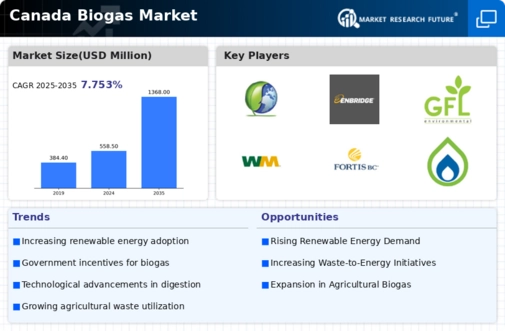
Canada Biogas Market Infographic
Purchase Options

Canada Biogas Market Summary

As per analysis, the Canada Biogas Market is projected to grow from USD 0.648 Billion in 2025 to USD 1.27 Billion by 2035, exhibiting a compound annual growth rate (CAGR) of 7.02% during the forecast period (2025 - 2035).

Key Market Trends & Highlights

The Canada biogas market is poised for growth driven by technological advancements and increasing demand for renewable energy.

  • The Electricity Generation segment remains the largest contributor to the biogas market in Canada.
  • The Combined Heat and Power segment is currently the fastest-growing area within the biogas sector.
  • Agricultural Residues represent the largest source of feedstock, while Food Waste is emerging as the fastest-growing feedstock segment.
  • Government support and rising environmental awareness are key drivers propelling the biogas market forward.

Market Size & Forecast

2024 Market Size 0.602 (USD Billion)
2035 Market Size 1.27 (USD Billion)
CAGR (2025 - 2035) 7.02%

Major Players

Enbridge Inc (CA), FortisBC Energy Inc (CA), Biogas Energy Ltd (CA), Greenlane Renewables Inc (CA), Anaergia Inc (CA), GFL Environmental Inc (CA), Sustainable Bioproducts (CA), Waste Management Inc (US), Veolia North America (US)

Our Impact
Enabled $4.3B Revenue Impact for Fortune 500 and Leading Multinationals
Partnering with 2000+ Global Organizations Each Year
30K+ Citations by Top-Tier Firms in the Industry

Canada Biogas Market Trends

The Canada Biogas Market is currently experiencing a notable transformation, driven by a combination of environmental policies and technological advancements. The Canadian government has been actively promoting renewable energy sources, including biogas, as part of its commitment to reducing greenhouse gas emissions. This shift is evident in the increasing number of biogas facilities across the country, which are converting organic waste into valuable energy. Furthermore, the integration of biogas into the energy grid is becoming more prevalent, suggesting a growing acceptance of this renewable resource within the energy landscape. In addition to government support, the canada biogas market is witnessing heightened interest from private investors and businesses seeking sustainable energy solutions. The agricultural sector, in particular, is leveraging biogas technology to manage waste and generate energy, thereby enhancing operational efficiency. As the market evolves, it appears that collaboration between various stakeholders, including government entities, private companies, and research institutions, will be crucial in driving innovation and expanding the biogas sector. This collaborative approach may lead to the development of new technologies and practices that further enhance the viability of biogas as a key player in Canada's energy future.

Government Incentives and Policies

The Canadian Government has implemented various incentives and policies aimed at promoting the development of the biogas sector. These initiatives include financial support for biogas projects, regulatory frameworks that facilitate the integration of biogas into the energy market, and programs that encourage research and development in renewable energy technologies. Such measures are likely to stimulate growth and attract investment in the canada biogas market.

Technological Advancements

Innovations in biogas technology are playing a pivotal role in enhancing the efficiency and effectiveness of biogas production. Developments in anaerobic digestion processes, for instance, are improving the conversion rates of organic materials into biogas. This trend suggests that as technology continues to advance, the potential for increased biogas output and reduced operational costs will likely attract more stakeholders to the market.

Growing Demand for Renewable Energy

There is a rising demand for renewable energy sources in Canada, driven by both consumer preferences and corporate sustainability goals. This trend indicates that businesses and individuals are increasingly seeking cleaner energy alternatives, which positions the canada biogas market favorably. As awareness of environmental issues grows, the appeal of biogas as a sustainable energy source is expected to strengthen.

Canada Biogas Market Drivers

Technological Innovations

Technological advancements play a pivotal role in shaping the Canada biogas market. Innovations in anaerobic digestion technology, such as improved microbial strains and enhanced process control systems, have led to increased efficiency and higher biogas yields. Moreover, the integration of digital technologies, including IoT and data analytics, allows for better monitoring and optimization of biogas production processes. According to recent data, the efficiency of biogas plants has improved by approximately 20% over the past decade due to these advancements. This not only makes biogas production more economically viable but also positions the industry as a competitive player in the renewable energy sector. As technology continues to evolve, the potential for further growth in the Canada biogas market appears promising.

Agricultural Waste Utilization

The Canada biogas market is significantly driven by the utilization of agricultural waste as a feedstock for biogas production. Canada has a robust agricultural sector, generating substantial amounts of organic waste, including manure and crop residues. By converting this waste into biogas, farmers can not only manage waste effectively but also generate renewable energy and reduce their operational costs. According to estimates, approximately 60% of biogas production in Canada comes from agricultural sources. This dual benefit of waste management and energy production is likely to attract more farmers to adopt biogas technologies. Furthermore, the integration of biogas systems into agricultural practices aligns with sustainable farming initiatives, enhancing the overall appeal of the industry.

Rising Environmental Awareness

The growing environmental awareness among Canadian consumers and businesses is a significant driver for the Canada biogas market. As concerns about climate change and greenhouse gas emissions intensify, there is an increasing demand for sustainable energy solutions. Biogas, produced from organic waste, offers a renewable alternative that helps reduce landfill waste and lower carbon footprints. Recent surveys indicate that over 70% of Canadians support the transition to renewable energy sources, which bodes well for the biogas sector. This shift in public perception is likely to encourage more municipalities and companies to invest in biogas projects, thereby expanding the market. The alignment of biogas production with environmental goals positions the industry favorably in the context of Canada's commitment to achieving net-zero emissions by 2050.

Government Support and Incentives

The Canada biogas market benefits significantly from government support and incentives aimed at promoting renewable energy sources. Federal and provincial governments have implemented various programs to encourage the development of biogas projects. For instance, the Clean Growth Program provides funding for innovative clean technology projects, including biogas production. Additionally, the Renewable Energy Standard Offer Program in Ontario has facilitated the growth of biogas facilities by offering fixed payments for energy produced. This supportive regulatory framework is crucial, as it not only reduces the financial burden on project developers but also enhances the attractiveness of biogas as a viable energy source. As a result, the industry is likely to see increased investment and expansion in the coming years.

Energy Security and Diversification

Energy security and diversification are critical factors driving the Canada biogas market. As Canada seeks to reduce its reliance on fossil fuels, biogas presents a viable alternative that can contribute to a more resilient energy system. The country has abundant organic resources, which can be harnessed to produce biogas, thereby diversifying the energy mix. Recent government reports indicate that increasing biogas production could potentially displace a significant portion of natural gas consumption in the residential and industrial sectors. This shift not only enhances energy security but also supports local economies by creating jobs in biogas production and related sectors. As the demand for energy continues to grow, the Canada biogas market is well-positioned to play a crucial role in meeting these needs.


Market Segment Insights

By Application: Electricity Generation (Largest) vs. Combined Heat and Power (Fastest-Growing)

In the Canada biogas market, the application segments show a varied distribution, with Electricity Generation holding the largest market share. This sector benefits from the increasing demand for renewable energy, as more operators focus on reducing their carbon footprint. Combined Heat and Power (CHP) follows closely, capitalizing on its efficient energy recovery methods. Meanwhile, Transportation Fuel and Agricultural Use make up smaller portions of the market but are essential in advocating for sustainable practices in their respective areas. Growth trends indicate that while Electricity Generation remains a cornerstone of biogas applications, CHP is emerging as the fastest-growing segment. This growth is driven by technological advancements and government incentives that encourage energy savings. Furthermore, the biogas market is witnessing rising interest in Transportation Fuel applications, particularly for its potential in reducing emissions in the transportation sector, which might experience growth in the coming years.

Electricity Generation (Dominant) vs. Transportation Fuel (Emerging)

Electricity Generation is a dominant application in the Canada biogas market, leveraging biogas to produce clean, renewable electricity. This segment is well-established, with operators increasingly integrating biogas facilities into the energy mix, supported by regulatory frameworks that favor renewable sources. In contrast, Transportation Fuel is an emerging segment that shows great promise, largely due to growing consumer awareness and demand for cleaner transportation options. The advancement in biogas upgrading technologies has improved the viability of biogas as a transportation fuel, making it a competitive alternative to fossil fuels. As infrastructure for biogas vehicles progresses, the Transportation Fuel segment is expected to grow rapidly, reflecting a shift towards sustainable transportation solutions.

By Feedstock Type: Agricultural Residues (Largest) vs. Food Waste (Fastest-Growing)

In the Canada biogas market, the feedstock type segment showcases distinct contributions from various sources. Agricultural residues hold the largest share, benefiting from the extensive agricultural practices in Canada. In contrast, food waste is emerging rapidly, reflecting the increasing awareness of waste-to-energy technology and the need for sustainable waste management solutions. Additionally, animal manure and energy crops contribute to the market, but their shares are comparatively smaller, making them important yet supplementary feedstocks in the overall biogas production landscape.

Agricultural Residues (Dominant) vs. Food Waste (Emerging)

Agricultural residues represent the dominant feedstock in the Canada biogas market, largely due to the country's strong agricultural sector that produces significant amounts of leftover materials. These residues are readily available and provide an effective means of generating biogas while promoting sustainable farming practices. On the other hand, food waste is the emerging feedstock gaining traction for its potential to address environmental concerns related to organic waste. Its rapid growth is driven by urbanization, increasing food consumption, and waste generation, backed by governmental and private initiatives aiming to divert waste from landfills and enhance energy recovery.

By Technology: Anaerobic Digestion (Largest) vs. Upgrading Technologies (Fastest-Growing)

Anaerobic digestion currently leads the Canadian biogas market, dominating the technological landscape with a significant share. This process converts organic materials into biogas through microbial activity in the absence of oxygen, making it a preferred choice for both agricultural and waste management applications. In contrast, upgrading technologies, which refine biogas into biomethane suitable for grid injection or vehicle fuel, are experiencing rapid adoption as the demand for cleaner energy alternatives grows. The growth trends in the Canadian biogas market are largely driven by an increasing focus on renewable energy and sustainability initiatives. Governments are introducing supportive policies, and technological advancements are making both anaerobic digestion and upgrading technologies more efficient and cost-effective. The rising awareness regarding greenhouse gas emissions and a shift toward circular economy practices are contributing significantly to the expansion of these segments.

Anaerobic Digestion (Dominant) vs. Upgrading Technologies (Emerging)

Anaerobic digestion remains the dominant technology in the Canadian biogas market due to its efficiency in processing a wide range of organic materials, including agricultural waste, food waste, and municipal solid waste. This method not only produces biogas but also generates digestate, which can be utilized as a nutrient-rich fertilizer. On the other hand, upgrading technologies are emerging rapidly as they play a critical role in enhancing the quality of biogas. These technologies remove impurities to produce high-purity biomethane, making it suitable for a variety of applications such as transportation fuels and energy grid integration. As these technologies evolve, they are likely to interface well with existing anaerobic digestion systems, driving further innovation and market growth.

By End Use: Residential (Largest) vs. Commercial (Fastest-Growing)

In the Canada biogas market, the end use segments are distinctly diverse, with residential applications currently holding the largest market share. The residential sector is increasingly adopting biogas solutions, driven by a growing awareness of sustainable practices and eco-friendly energy sources. Other segments, such as commercial and industrial, are significant but not as predominant, contributing to the overall dynamics of biogas utilization across the country.

Residential (Dominant) vs. Commercial (Emerging)

The residential segment of the Canada biogas market stands as a dominant force, largely due to its appeal to environmentally conscious consumers looking for sustainable energy solutions. This segment typically benefits from government incentives and initiatives promoting renewable energy adoption. On the other hand, the commercial segment is emerging rapidly, fueled by a surge in corporate sustainability efforts and regulatory support. Companies are increasingly looking to integrate biogas energy into their operations as a cost-effective solution to meet their energy needs while reducing carbon footprints.

Get more detailed insights about Canada Biogas Market

Key Players and Competitive Insights

The competitive dynamics within the biogas market in Canada are characterized by a blend of innovation, strategic partnerships, and a growing emphasis on sustainability. Key players such as Enbridge Inc (CA), Greenlane Renewables Inc (CA), and Anaergia Inc (CA) are at the forefront, each adopting distinct strategies that collectively shape the market landscape. Enbridge Inc (CA) has focused on expanding its renewable energy portfolio, particularly through investments in biogas infrastructure, which positions the company as a leader in the transition towards cleaner energy sources. Meanwhile, Greenlane Renewables Inc (CA) emphasizes technological innovation, particularly in biogas upgrading systems, which enhances its competitive edge in providing efficient solutions for biogas production. Anaergia Inc (CA) has adopted a strategy centered on integrated waste management and renewable energy generation, which not only diversifies its offerings but also aligns with the increasing demand for sustainable waste solutions.

The business tactics employed by these companies reflect a concerted effort to optimize operations and enhance market presence. Localizing manufacturing and optimizing supply chains are prevalent strategies that allow these firms to respond swiftly to market demands. The competitive structure of the market appears moderately fragmented, with several players vying for market share, yet the influence of major companies is substantial, often dictating trends and setting benchmarks for operational excellence.

In November 2025, Enbridge Inc (CA) announced a partnership with a local municipality to develop a new biogas facility aimed at converting organic waste into renewable natural gas. This strategic move not only enhances Enbridge's operational capacity but also reinforces its commitment to sustainability and community engagement. The facility is expected to process approximately 50,000 tons of organic waste annually, significantly contributing to local renewable energy production.

In December 2025, Greenlane Renewables Inc (CA) secured a contract to supply its biogas upgrading technology to a large-scale agricultural operation in Ontario. This contract is pivotal as it underscores the growing recognition of biogas as a viable energy source within the agricultural sector. By leveraging its advanced technology, Greenlane aims to enhance the efficiency of biogas production, thereby solidifying its market position and expanding its customer base.

In January 2026, Anaergia Inc (CA) launched a new initiative focused on integrating artificial intelligence (AI) into its biogas production processes. This initiative is expected to optimize operational efficiency and reduce costs, reflecting a broader trend towards digitalization in the industry. By harnessing AI, Anaergia aims to enhance its competitive advantage and respond more effectively to the evolving market landscape.

As of January 2026, the biogas market is witnessing a shift towards digitalization, sustainability, and technological integration. Strategic alliances among key players are increasingly shaping the competitive landscape, fostering innovation and collaboration. The focus appears to be shifting from price-based competition to differentiation through technology and supply chain reliability. This evolution suggests that companies that prioritize innovation and sustainable practices are likely to thrive in the future, as they align with the growing consumer and regulatory demand for cleaner energy solutions.

Key Companies in the Canada Biogas Market include

Industry Developments

Recent developments in the Canada Biogas Market have illustrated a growing emphasis on renewable energy solutions, with increasing government support and investments in biogas infrastructure across the country. Companies such as Greenlane Renewables and Enbridge are advancing projects that convert organic waste into biogas and biomethane, facilitating the transition toward cleaner energy alternatives.

Notably, in October 2023, Enbridge announced an initiative to boost biomethane production which is expected to enhance its capacity for renewable energy generation. Ecosystem Energy Services and GFL Environmental are also making strides by expanding their waste-to-energy facilities, contributing significantly to waste management and energy recovery goals.

In the context of mergers and acquisitions, Urban Impact recently acquired Biogas Solutions, strengthening its market position in June 2023, while FortisBC is collaborating with various stakeholders to enhance biogas utilization. Over the last few years, investments and innovations in biogas processing technology have surged, with notable contributions from companies like Anaergia and Lystek International, pushing the market valuation higher and promising a robust energy future for Canada.


Future Outlook

Canada Biogas Market Future Outlook

The Canada biogas market is projected to grow at a 7.02% CAGR from 2025 to 2035, driven by renewable energy policies, waste management innovations, and increasing energy demands.

New opportunities lie in:

  • Development of biogas upgrading technologies for grid injection
  • Expansion of agricultural waste-to-energy projects
  • Partnerships with municipalities for organic waste collection systems

By 2035, the Canada biogas market is expected to be robust, driven by sustainable energy initiatives.

Market Segmentation

Canada Biogas Market End Use Outlook

  • Residential
  • Commercial
  • Industrial
  • Agricultural

Canada Biogas Market Technology Outlook

  • Anaerobic Digestion
  • Landfill Gas Recovery
  • Gasification
  • Upgrading Technologies

Canada Biogas Market Application Outlook

  • Electricity Generation
  • Combined Heat and Power
  • Transportation Fuel
  • Agricultural Use

Canada Biogas Market Feedstock Type Outlook

  • Agricultural Residues
  • Animal Manure
  • Food Waste
  • Energy Crops

Report Scope

MARKET SIZE 20240.602(USD Billion)
MARKET SIZE 20250.648(USD Billion)
MARKET SIZE 20351.27(USD Billion)
COMPOUND ANNUAL GROWTH RATE (CAGR)7.02% (2024 - 2035)
REPORT COVERAGERevenue Forecast, Competitive Landscape, Growth Factors, and Trends
BASE YEAR2024
Market Forecast Period2025 - 2035
Historical Data2019 - 2024
Market Forecast UnitsUSD Billion
Key Companies ProfiledEnbridge Inc (CA), FortisBC Energy Inc (CA), Biogas Energy Ltd (CA), Greenlane Renewables Inc (CA), Anaergia Inc (CA), GFL Environmental Inc (CA), Sustainable Bioproducts (CA), Waste Management Inc (US), Veolia North America (US)
Segments CoveredApplication, Feedstock Type, Technology, End Use
Key Market OpportunitiesExpansion of agricultural biogas projects driven by supportive government policies and increasing renewable energy demand.
Key Market DynamicsGrowing regulatory support and technological advancements drive expansion in Canada's biogas market.
Countries CoveredCanada
Leave a Comment

FAQs

What is the current valuation of the Canada biogas market?

The Canada biogas market was valued at 0.602 USD Billion in 2024.

What is the projected market size for the Canada biogas market by 2035?

The projected valuation for the Canada biogas market is 1.27 USD Billion by 2035.

What is the expected CAGR for the Canada biogas market during the forecast period?

The expected CAGR for the Canada biogas market from 2025 to 2035 is 7.02%.

Which companies are considered key players in the Canada biogas market?

Key players in the Canada biogas market include Enbridge Inc, FortisBC Energy Inc, and Greenlane Renewables Inc.

What are the main applications of biogas in Canada?

The main applications of biogas in Canada include electricity generation, combined heat and power, transportation fuel, and agricultural use.

How does the feedstock type impact the Canada biogas market?

Feedstock types such as agricultural residues, animal manure, food waste, and energy crops contribute significantly to the market, with food waste valued between 0.2 and 0.4 USD Billion.

What technologies are utilized in the Canada biogas market?

Technologies such as anaerobic digestion, landfill gas recovery, gasification, and upgrading technologies are utilized, with anaerobic digestion valued between 0.25 and 0.55 USD Billion.

What are the end-use segments for biogas in Canada?

End-use segments for biogas in Canada include residential, commercial, industrial, and agricultural applications.

What is the valuation range for electricity generation in the Canada biogas market?

The valuation range for electricity generation in the Canada biogas market is between 0.25 and 0.55 USD Billion.

How does the biogas market in Canada compare to other renewable energy sectors?

While specific comparisons to other renewable energy sectors are not provided, the growth trajectory of the biogas market suggests a robust potential for expansion in the coming years.

Download Free Sample

Kindly complete the form below to receive a free sample of this Report

Compare Licence

×
Features License Type
Single User Multiuser License Enterprise User
Price $4,950 $5,950 $7,250
Maximum User Access Limit 1 User Upto 10 Users Unrestricted Access Throughout the Organization
Free Customization
Direct Access to Analyst
Deliverable Format
Platform Access
Discount on Next Purchase 10% 15% 15%
Printable Versions