×
Request Free Sample ×

Kindly complete the form below to receive a free sample of this Report

* Please use a valid business email

Leading companies partner with us for data-driven Insights

clients tt-cursor
Hero Background

Canada Artificial Intelligence Based Personalization Market

ID: MRFR/ICT/57266-HCR
200 Pages
Aarti Dhapte
February 2026

Canada Artificial Intelligence Based Personalization Market Research Report By Type (Website Personalization, Display Ads Personalization, Social Media Personalization, E-Mail Personalization, Others), By Technology (Machine Learning, Deep Learning, Natural Language Processing), and By Application (Travel, Retail, Media & Entertainment, Others)- Forecast to 2035

Share:
Download PDF ×

We do not share your information with anyone. However, we may send you emails based on your report interest from time to time. You may contact us at any time to opt-out.

Canada Artificial Intelligence Based Personalization Market Infographic
Purchase Options

Canada Artificial Intelligence Based Personalization Market Summary

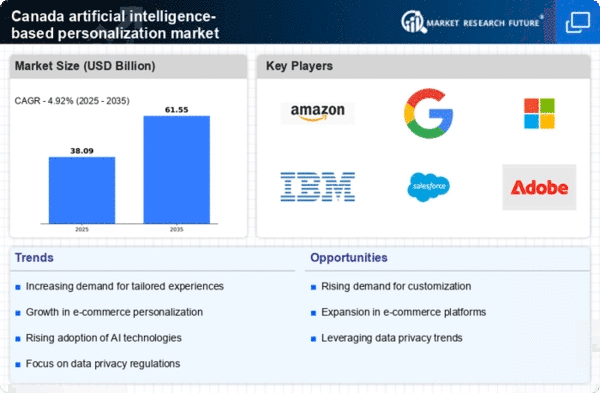
As per Market Research Future analysis, the Canada artificial intelligence-based-personalization market Size was estimated at 36.31 USD Billion in 2024. The Canada artificial intelligence-based-personalization market is projected to grow from 38.09 USD Billion in 2025 to 61.55 USD Billion by 2035, exhibiting a compound annual growth rate (CAGR) of 4.9% during the forecast period 2025 - 2035

Key Market Trends & Highlights

The Canada artificial intelligence-based-personalization market is experiencing robust growth driven by technological advancements and evolving consumer expectations.

  • The market is witnessing increased adoption of AI technologies across various sectors, enhancing personalization capabilities.
  • Data privacy and ethical considerations are becoming central to the development and deployment of AI-driven personalization solutions.
  • Collaboration between industries is fostering innovation and expanding the reach of AI personalization applications.
  • The rising demand for personalized experiences and advancements in machine learning algorithms are key drivers propelling market growth.

Market Size & Forecast

2024 Market Size 36.31 (USD Billion)
2035 Market Size 61.55 (USD Billion)
CAGR (2025 - 2035) 4.92%

Major Players

Amazon (US), Google (US), Microsoft (US), IBM (US), Salesforce (US), Adobe (US), SAP (DE), Oracle (US), Alibaba (CN)

Our Impact
Enabled $4.3B Revenue Impact for Fortune 500 and Leading Multinationals
Partnering with 2000+ Global Organizations Each Year
30K+ Citations by Top-Tier Firms in the Industry

Canada Artificial Intelligence Based Personalization Market Trends

The artificial intelligence-based-personalization market is currently experiencing notable growth, driven by advancements in technology and increasing consumer expectations. Businesses are increasingly adopting AI-driven solutions to enhance customer experiences, tailoring offerings to individual preferences. This trend is evident across various sectors, including retail, finance, and healthcare, where personalized services are becoming essential for maintaining competitive advantage. As organizations recognize the value of data-driven insights, investments in AI technologies are likely to rise, fostering innovation and improving customer engagement. Moreover, the regulatory landscape in Canada is evolving to address privacy concerns associated with data usage in the artificial intelligence-based-personalization market. The government is implementing frameworks that promote ethical AI practices while ensuring consumer protection. This balance between innovation and regulation may influence how companies approach personalization strategies. As the market matures, collaboration between technology providers and businesses will be crucial in developing solutions that meet both consumer needs and regulatory requirements. The future appears promising, with potential for further advancements in AI capabilities and their application in creating personalized experiences.

Increased Adoption of AI Technologies

Organizations are increasingly integrating AI technologies into their operations to enhance personalization. This trend is driven by the need to meet evolving consumer expectations and improve customer satisfaction. Businesses are leveraging AI to analyze consumer behavior, enabling them to deliver tailored experiences that resonate with individual preferences.

Focus on Data Privacy and Ethics

As the artificial intelligence-based-personalization market expands, there is a growing emphasis on data privacy and ethical considerations. Companies are prioritizing transparency in data usage and implementing measures to protect consumer information. This focus on ethical practices is likely to shape the development of AI solutions in the market.

Collaboration Between Sectors

Collaboration among various sectors is becoming increasingly important in the artificial intelligence-based-personalization market. Partnerships between technology providers, businesses, and regulatory bodies are fostering innovation and ensuring that solutions align with consumer needs and regulatory standards. This collaborative approach may enhance the effectiveness of personalized offerings.

Canada Artificial Intelligence Based Personalization Market Drivers

Growing E-commerce Sector

The expansion of the e-commerce sector in Canada serves as a significant driver for the artificial intelligence-based-personalization market. With online shopping becoming increasingly prevalent, businesses are seeking ways to enhance the customer experience through personalized recommendations and targeted marketing. In 2025, e-commerce sales in Canada are projected to reach $50 billion, highlighting the need for effective personalization strategies. AI technologies enable retailers to analyze consumer data and deliver tailored product suggestions, which can lead to higher conversion rates. As e-commerce continues to grow, the demand for AI-driven personalization solutions is likely to increase, further propelling the artificial intelligence-based-personalization market in Canada.

Increased Investment in AI Startups

Investment in AI startups is a crucial driver for the artificial intelligence-based-personalization market in Canada. Venture capital funding for AI-related ventures has surged, with Canadian startups attracting over $1 billion in 2025 alone. This influx of capital enables these startups to innovate and develop cutting-edge personalization technologies. As these companies create new solutions, they contribute to the overall growth of the market by providing businesses with advanced tools for customer engagement. Furthermore, established companies are increasingly collaborating with these startups to integrate AI-driven personalization into their existing systems. This trend not only accelerates technological advancements but also enhances the competitive landscape of the artificial intelligence-based-personalization market in Canada.

Regulatory Support for AI Innovations

Regulatory support for AI innovations is emerging as a vital driver for the artificial intelligence-based-personalization market in Canada. The Canadian government has implemented policies aimed at fostering AI research and development, which encourages businesses to invest in AI technologies. Initiatives such as funding programs and tax incentives for AI projects are designed to stimulate innovation within the sector. This supportive regulatory environment not only facilitates the growth of AI startups but also encourages established companies to adopt AI-driven personalization strategies. As a result, the artificial intelligence-based-personalization market is likely to benefit from increased investment and innovation, positioning Canada as a leader in AI technology.

Rising Demand for Personalized Experiences

The artificial intelligence-based-personalization market in Canada is experiencing a notable surge in demand for tailored customer experiences. As consumers increasingly seek products and services that resonate with their individual preferences, businesses are compelled to adopt AI-driven solutions. This trend is reflected in a 2025 report indicating that 70% of Canadian consumers prefer personalized offerings. Companies leveraging AI technologies can analyze vast amounts of data to create unique customer profiles, thereby enhancing engagement and satisfaction. The ability to deliver customized experiences not only fosters customer loyalty but also drives revenue growth, as personalized marketing strategies have been shown to increase conversion rates by up to 30%. Consequently, the rising demand for personalized experiences is a significant driver for the artificial intelligence-based-personalization market in Canada.

Advancements in Machine Learning Algorithms

The artificial intelligence-based-personalization market is significantly influenced by advancements in machine learning algorithms. In Canada, the development of sophisticated algorithms enables businesses to analyze consumer behavior more effectively. These algorithms can process large datasets, identifying patterns and trends that inform personalized marketing strategies. For instance, a recent study revealed that companies utilizing advanced machine learning techniques saw a 25% increase in customer engagement. As these technologies evolve, they provide businesses with the tools necessary to enhance their personalization efforts, leading to improved customer experiences. The continuous innovation in machine learning is likely to propel the growth of the artificial intelligence-based-personalization market, as organizations strive to stay competitive in an increasingly data-driven landscape.


Market Segment Insights

By Type: Website Personalization (Largest) vs. E-mail Personalization (Fastest-Growing)

The Canada artificial intelligence-based-personalization market exhibits diverse distributions among its segment values, with website personalization holding the largest share. This segment plays a pivotal role in enhancing user experience by tailoring content to individual preferences. Following closely are display ads and social media personalization, which have gained substantial traction due to their interactive nature and ability to engage customers effectively. E-mail personalization, while currently smaller, is rapidly gaining attention for its targeted outreach capabilities. Growth trends in this segment are significantly driven by increasing consumer demand for personalized experiences and advancements in AI technologies. Companies are leveraging data analytics and machine learning algorithms to refine their personalization strategies, thus boosting customer engagement. E-mail personalization is observed to be the fastest-growing segment, primarily propelled by businesses recognizing its effectiveness in reaching and retaining customers through customized content. As brands continue to prioritize personalized communication, this segment is poised for remarkable growth.

Website Personalization (Dominant) vs. E-mail Personalization (Emerging)

Website personalization stands as the dominant force in the Canada artificial intelligence-based-personalization market, characterized by its ability to deliver tailored online experiences. This segment utilizes extensive user data to optimize website content, ensuring visitors encounter relevant products and services. Its effectiveness is reflected in improved customer satisfaction and increased conversion rates. On the other hand, e-mail personalization is emerging as a crucial segment, focusing on crafting personalized e-mail campaigns that resonate with target audiences. This emerging trend capitalizes on the power of direct communication, making it an attractive strategy for brands looking to enhance customer loyalty and engagement. As both segments evolve, their respective strategies will likely adapt to shifting consumer preferences and technological advancements.

By Technology: Machine Learning (Largest) vs. Deep Learning (Fastest-Growing)

In the Canada artificial intelligence-based-personalization market, Machine Learning currently holds a significant share, driven by its robust applications in various industries. This segment's popularity stems from its ability to analyze large datasets and optimize personalization efforts efficiently. Meanwhile, Deep Learning is rapidly gaining traction, showcasing remarkable advancements in processing complex and unstructured data, further enriching user experiences. The growth trends in this sector indicate a surge in the adoption of Artificial Intelligence technologies, particularly in industries like e-commerce and digital marketing. Organizations are increasingly leveraging these technologies to provide tailored experiences for consumers. The demand for Natural Language Processing is also on the rise, fueled by applications in chatbots and voice recognition software, making it a crucial player in enhancing customer interactions.

Technology: Machine Learning (Dominant) vs. Deep Learning (Emerging)

Machine Learning remains the dominant force in the technology segment of the Canada artificial intelligence-based-personalization market due to its versatility and established frameworks. It enables businesses to refine their strategies through data-driven insights, creating personalized user experiences. On the other hand, Deep Learning is emerging as a powerful alternative, particularly in areas requiring high-level data interpretation, like image recognition and natural language processing. This evolving technology harnesses neural networks to process vast amounts of data, making it instrumental in developing advanced personalization capabilities. As businesses prioritize customer satisfaction, both Machine Learning and Deep Learning are positioning themselves to meet these needs effectively.

By Application: Retail (Largest) vs. Travel (Fastest-Growing)

In the Canada artificial intelligence-based-personalization market, the application segment presents a diverse landscape with retail taking the lion's share. This sector leverages AI-driven personalization to tailor shopping experiences, thus enhancing customer engagement and loyalty. It accounts for a significant portion of the market, influenced by the growing demand for customized solutions across consumer touchpoints. Meanwhile, travel has emerged as the fastest-growing segment due to a burgeoning interest in personalized travel experiences. Travelers increasingly seek tailored recommendations and services that cater to their specific preferences, driving rapid growth in AI adoption in this sector. The growth trends in the Canada artificial intelligence-based-personalization market are shaped by several factors. Retailers are investing heavily in AI technologies to stay competitive, utilizing data analytics to refine marketing strategies and improve customer service. On the other hand, the travel sector capitalizes on innovations such as real-time data processing and predictive analytics, allowing for highly customized travel itineraries. This convergence of technology and customer expectation is propelling both segments, with retail maintaining dominance while travel showcases remarkable growth potential.

Retail: Dominant vs. Travel: Emerging

The retail segment remains the dominant force within the application landscape of the Canada artificial intelligence-based-personalization market, driven by significant investments in technology and consumer demand for customized shopping experiences. Retailers employ AI to analyze consumer behavior, optimize inventory management, and enhance customer engagement through personalized marketing strategies. The integration of these solutions not only boosts sales but also builds long-term customer relationships. Conversely, the travel sector is categorized as an emerging segment, rapidly evolving as consumers seek tailored vacation experiences. AI-driven recommendations and dynamic pricing models are becoming increasingly prevalent, allowing travel companies to provide unique itineraries and offerings that cater to individual traveler preferences. This shift is indicative of the industry's ability to adapt and innovate, positioning travel as a compelling growth area in the market.

Get more detailed insights about Canada Artificial Intelligence Based Personalization Market

Key Players and Competitive Insights

The artificial intelligence-based-personalization market is currently characterized by intense competition and rapid innovation, driven by the increasing demand for tailored customer experiences across various sectors. Major players such as Amazon (US), Google (US), and Microsoft (US) are at the forefront, leveraging their technological prowess to enhance personalization capabilities. Amazon (US) focuses on integrating AI into its e-commerce platform, aiming to refine product recommendations and improve customer engagement. Google (US) emphasizes its data analytics and machine learning capabilities to provide personalized advertising solutions, while Microsoft (US) is enhancing its Azure cloud services to support businesses in deploying AI-driven personalization strategies. Collectively, these strategies contribute to a dynamic competitive environment, where innovation and customer-centric approaches are paramount.
In terms of business tactics, companies are increasingly localizing their operations to better cater to regional markets, optimizing supply chains to enhance efficiency. The market structure appears moderately fragmented, with a mix of established giants and emerging players. This fragmentation allows for diverse approaches to personalization, as companies strive to differentiate themselves through unique offerings and localized strategies. The influence of key players is substantial, as their investments in technology and partnerships shape the overall market landscape.
In October 2025, Amazon (US) announced the launch of a new AI-driven recommendation engine designed to enhance user experience on its platform. This strategic move is significant as it not only reinforces Amazon's commitment to personalization but also positions the company to capture a larger share of the e-commerce market by improving conversion rates through tailored suggestions. The emphasis on AI integration suggests a shift towards more sophisticated algorithms that can analyze user behavior in real-time.
In September 2025, Google (US) unveiled a partnership with a leading retail chain to implement AI-based personalization in their customer engagement strategies. This collaboration is noteworthy as it highlights Google's strategy to expand its influence in the retail sector, leveraging its AI capabilities to drive sales and enhance customer loyalty. The partnership indicates a growing trend of tech companies aligning with traditional businesses to create more personalized shopping experiences.
In August 2025, Microsoft (US) launched a new suite of AI tools aimed at small and medium-sized enterprises (SMEs) to facilitate the adoption of personalized marketing strategies. This initiative is crucial as it democratizes access to advanced AI technologies, enabling smaller players to compete effectively in the personalization space. By empowering SMEs, Microsoft is likely to foster innovation and increase competition within the market.
As of November 2025, current trends in the artificial intelligence-based-personalization market include a strong focus on digitalization, sustainability, and the integration of AI technologies. Strategic alliances are becoming increasingly important, as companies recognize the value of collaboration in enhancing their capabilities. Looking ahead, competitive differentiation is expected to evolve, with a shift from price-based competition to a greater emphasis on innovation, technological advancement, and supply chain reliability. This transition may redefine how companies approach personalization, ultimately leading to more sophisticated and effective solutions.

Key Companies in the Canada Artificial Intelligence Based Personalization Market include

Industry Developments

Tim Hortons enhanced its mobile app in April 2024 by adding AI-driven personalisation, which allows users to receive customised menu recommendations and specials according to their location, past purchases, and personal preferences.

Lululemon implemented AI-powered predictive analytics in May 2024 to optimise inventory and suggest customised training wear, lowering stock problems and raising customer satisfaction. An AI-based financial advising system was introduced by Royal Bank of Canada (RBC) in January 2025. It uses transactional data to provide individualised banking advise and product recommendations.

In order to provide proactive and individualised service resolutions, Telus deployed AI-enabled support systems by June 2025 that examine customer interaction trends.Last but not least, AI Digital entered the Canadian market in March 2025 by establishing an office in Montréal to provide AI-powered programmatic advertising, which enables companies to run highly transparent and customised ad campaigns across a variety of platforms.

Together, these advancements demonstrate a clear trend towards highly customised experiences in telecom, advertising, retail, and banking, propelled by AI's prowess in data analytics, recommender systems, and real-time contextual insights.

Future Outlook

Canada Artificial Intelligence Based Personalization Market Future Outlook

The artificial intelligence-based-personalization market is projected to grow at 4.92% CAGR from 2025 to 2035, driven by advancements in machine learning, data analytics, and consumer demand for tailored experiences.

New opportunities lie in:

  • Development of AI-driven customer segmentation tools for targeted marketing campaigns.
  • Integration of personalization algorithms in e-commerce platforms to enhance user experience.
  • Creation of subscription-based models for personalized content delivery services.

By 2035, the market is expected to achieve substantial growth, reflecting evolving consumer preferences and technological advancements.

Market Segmentation

Canada Artificial Intelligence Based Personalization Market Type Outlook

  • Website Personalization
  • Display Ads Personalization
  • Social Media Personalization
  • E-mail Personalization
  • Others

Canada Artificial Intelligence Based Personalization Market Technology Outlook

  • Machine Learning
  • Deep Learning
  • Natural Language Processing

Canada Artificial Intelligence Based Personalization Market Application Outlook

  • Travel
  • Retail
  • Media & Entertainment
  • Others

Report Scope

MARKET SIZE 2024 36.31(USD Billion)
MARKET SIZE 2025 38.09(USD Billion)
MARKET SIZE 2035 61.55(USD Billion)
COMPOUND ANNUAL GROWTH RATE (CAGR) 4.92% (2025 - 2035)
REPORT COVERAGE Revenue Forecast, Competitive Landscape, Growth Factors, and Trends
BASE YEAR 2024
Market Forecast Period 2025 - 2035
Historical Data 2019 - 2024
Market Forecast Units USD Billion
Key Companies Profiled Amazon (US), Google (US), Microsoft (US), IBM (US), Salesforce (US), Adobe (US), SAP (DE), Oracle (US), Alibaba (CN)
Segments Covered Type, Technology, Application
Key Market Opportunities Integration of advanced machine learning algorithms enhances user engagement in the artificial intelligence-based-personalization market.
Key Market Dynamics Rising demand for tailored consumer experiences drives innovation in artificial intelligence-based personalization solutions.
Countries Covered Canada
Leave a Comment

FAQs

What is the expected market size of the Canada Artificial Intelligence Based Personalization Market in 2024?

The expected market size of the Canada Artificial Intelligence Based Personalization Market in 2024 is valued at 20.8 USD Billion.

What will be the projected market size in 2035?

By 2035, the projected size of the Canada Artificial Intelligence Based Personalization Market is expected to reach 30.0 USD Billion.

What is the expected compound annual growth rate (CAGR) for the market from 2025 to 2035?

The expected CAGR for the Canada Artificial Intelligence Based Personalization Market from 2025 to 2035 is 3.384%.

Which segment of the market generated the highest revenue in 2024?

In 2024, the Website Personalization segment generated the highest revenue, valued at 5.6 USD Billion.

What is the revenue expectation for Display Ads Personalization in 2035?

The expected revenue for Display Ads Personalization in 2035 is projected to be 6.5 USD Billion.

Who are the key players in the Canada Artificial Intelligence Based Personalization Market?

Key players in the market include Adobe, Shopify, Amazon, Salesforce, and IBM, among others.

What is the market size for Social Media Personalization in 2024?

The market size for Social Media Personalization in 2024 is valued at 3.7 USD Billion.

What growth rate can be expected for E-Mail Personalization from 2024 to 2035?

E-Mail Personalization is expected to grow from 3.0 USD Billion in 2024 to 4.2 USD Billion in 2035.

What are the future opportunities for the Artificial Intelligence Based Personalization Market?

Future opportunities in the market include advancements in personalization technologies and increasing demand for tailored experiences.

What is the expected market value for 'Others' segment in 2035?

The expected market value for the 'Others' segment in 2035 is projected to be 6.0 USD Billion.

Download Free Sample

Kindly complete the form below to receive a free sample of this Report

Compare Licence

×
Features License Type
Single User Multiuser License Enterprise User
Price $4,950 $5,950 $7,250
Maximum User Access Limit 1 User Upto 10 Users Unrestricted Access Throughout the Organization
Free Customization
Direct Access to Analyst
Deliverable Format
Platform Access
Discount on Next Purchase 10% 15% 15%
Printable Versions