×
Request Free Sample ×

Kindly complete the form below to receive a free sample of this Report

* Please use a valid business email

Leading companies partner with us for data-driven Insights

clients tt-cursor
Hero Background

Canada Adaptive Optics Market

ID: MRFR/ICT/61638-HCR
200 Pages
Aarti Dhapte
February 2026

Canada Adaptive Optics Market Size, Share and Research Report: By Application (Astronomy, Biomedical, Defense and Security, Industrial, Consumer Electronics), By Component (Wavefront Sensors, Deformable Mirrors, Control Systems, Software, Other Components), By End User (Research Institutions, Healthcare Providers, Military Organizations, Manufacturing Companies, Educational Institutions), and By Technology (Closed-Loop Adaptive Optics, Open-Loop Adaptive Optics, Hybrid Adaptive Optics)- Industry Forecast to 2035

Share:
Download PDF ×

We do not share your information with anyone. However, we may send you emails based on your report interest from time to time. You may contact us at any time to opt-out.

Canada Adaptive Optics Market Infographic
Purchase Options

Canada Adaptive Optics Market Summary

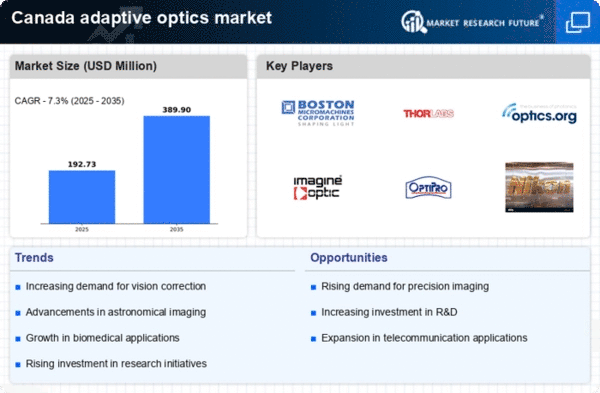
As per Market Research Future analysis, the Canada adaptive optics market Size was estimated at 179.62 USD Million in 2024. The Canada adaptive optics market is projected to grow from 192.73 USD Million in 2025 to 389.9 USD Million by 2035, exhibiting a compound annual growth rate (CAGR) of 7% during the forecast period 2025 - 2035

Key Market Trends & Highlights

The Canada adaptive optics market is poised for growth driven by technological advancements and increasing applications across various sectors.

  • Technological advancements are enhancing the capabilities of adaptive optics systems, particularly in healthcare and defense.
  • The healthcare segment is the largest, driven by the demand for improved imaging techniques and diagnostics.
  • The defense segment is the fastest-growing, reflecting rising investments in security and surveillance technologies.
  • Key market drivers include rising investment in research and development and growing applications in environmental monitoring.

Market Size & Forecast

2024 Market Size 179.62 (USD Million)
2035 Market Size 389.9 (USD Million)
CAGR (2025 - 2035) 7.3%

Major Players

Boston Micromachines Corporation (US), Thorlabs, Inc. (US), Adaptive Optics Associates, LLC (US), Imagine Optic (FR), OptiPro Systems, LLC (US), Nikon Corporation (JP), Rayleigh Instruments (UK), Zygo Corporation (US)

Our Impact
Enabled $4.3B Revenue Impact for Fortune 500 and Leading Multinationals
Partnering with 2000+ Global Organizations Each Year
30K+ Citations by Top-Tier Firms in the Industry

Canada Adaptive Optics Market Trends

The adaptive optics market is currently experiencing notable growth, driven by advancements in technology and increasing applications across various sectors. In Canada, the demand for adaptive optics is particularly pronounced in fields such as astronomy, telecommunications, and biomedical imaging. The integration of adaptive optics systems enhances image quality and precision, which is crucial for research and development in these areas. Furthermore, the Canadian government has been supportive of initiatives that promote innovation in optical technologies, fostering an environment conducive to market expansion. As a result, companies are increasingly investing in research and development to create more sophisticated adaptive optics solutions that meet the evolving needs of consumers and industries alike. In addition to technological advancements, the adaptive optics market is influenced by the growing emphasis on high-resolution imaging and real-time data processing. This trend is evident in the healthcare sector, where adaptive optics is utilized for improved diagnostics and treatment planning. Moreover, the collaboration between academic institutions and industry players in Canada is likely to spur further innovation, leading to the development of new applications and products. Overall, the adaptive optics market appears poised for continued growth, with a focus on enhancing performance and expanding its reach across various sectors.

Technological Advancements

Recent innovations in adaptive optics technology are driving the market forward. Enhanced algorithms and improved hardware are enabling more precise control of optical systems, which is essential for applications in fields such as astronomy and medical imaging.

Increased Demand in Healthcare

The healthcare sector is witnessing a surge in the adoption of adaptive optics for applications like retinal imaging and diagnostics. This trend reflects a broader movement towards personalized medicine and the need for high-resolution imaging techniques.

Government Support and Funding

Canadian government initiatives aimed at promoting research and development in optical technologies are likely to bolster the adaptive optics market. Funding programs and partnerships with academic institutions are fostering innovation and encouraging new market entrants.

Canada Adaptive Optics Market Drivers

Emergence of Startups and Innovation Hubs

The adaptive optics market in Canada is benefiting from the emergence of numerous startups and innovation hubs dedicated to optical technologies. These entities are fostering a culture of innovation, leading to the development of novel adaptive optics solutions tailored to various applications. In 2025, it is estimated that the number of startups in this sector will increase by 25%, contributing to a more dynamic market landscape. This influx of new players is likely to stimulate competition, driving advancements in technology and reducing costs. Consequently, the adaptive optics market is expected to experience accelerated growth as these startups introduce disruptive technologies and solutions that cater to diverse industry needs.

Collaboration Between Academia and Industry

The adaptive optics market in Canada is witnessing a significant trend of collaboration between academic institutions and industry players. This partnership is crucial for advancing research and translating theoretical knowledge into practical applications. In 2025, it is anticipated that joint ventures between universities and optical technology companies will increase by 30%, facilitating the development of cutting-edge adaptive optics systems. These collaborations are likely to enhance the skill set of the workforce and promote knowledge transfer, ultimately benefiting the adaptive optics market. As a result, the industry is expected to see a rise in innovative products and solutions that address real-world challenges, further propelling market growth.

Increased Focus on Environmental Monitoring

The adaptive optics market is increasingly being driven by the need for enhanced environmental monitoring capabilities. In Canada, there is a growing emphasis on utilizing advanced optical technologies to monitor atmospheric conditions, pollution levels, and climate change effects. The market for adaptive optics in environmental applications is projected to grow by 20% annually, reflecting the rising demand for precise data collection and analysis. This trend is further supported by government initiatives aimed at improving environmental sustainability. As a result, the adaptive optics market is likely to see an influx of projects focused on environmental monitoring, thereby expanding its application scope and driving overall market growth.

Growing Applications in Defense and Security

The adaptive optics market in Canada is witnessing a notable expansion due to its growing applications in defense and security. The Canadian government has recognized the strategic importance of advanced optical technologies for national security, leading to increased funding for defense-related projects. In 2025, it is estimated that the defense sector will account for approximately 30% of the total market share in adaptive optics. This growth is attributed to the demand for high-resolution imaging systems that can operate effectively in challenging environments. Consequently, the adaptive optics market is likely to see a rise in collaborations between defense contractors and optical technology firms, further enhancing the industry's prospects.

Rising Investment in Research and Development

The adaptive optics market in Canada is experiencing a surge in investment directed towards research and development (R&D). This trend is primarily driven by the increasing recognition of the potential applications of adaptive optics in various fields, including astronomy, telecommunications, and biomedical imaging. In 2025, R&D expenditures in the optics sector are projected to reach approximately $500 million, reflecting a growth of 15% from the previous year. This influx of funding is likely to foster innovation, leading to the development of advanced adaptive optics systems that enhance imaging capabilities. As a result, the adaptive optics market is poised to benefit from improved product offerings and increased competitiveness, ultimately driving market growth in Canada.


Market Segment Insights

By Application: Astronomy (Largest) vs. Biomedical (Fastest-Growing)

In the Canada adaptive optics market, the application segment showcases a diverse distribution among its key verticals. Astronomy currently holds the largest share, benefiting from ongoing innovations and increased government investments in space exploration. Following closely is the biomedical sector, which is gaining traction due to the rising demand for enhanced imaging techniques and minimally invasive surgical procedures, highlighting the competitive landscape of adaptive optics applications. The growth trends in this segment are promising, especially for biomedical, which is projected to grow rapidly as healthcare providers adopt advanced technologies for diagnostics and treatment. Meanwhile, the defense and security application also presents significant potential, driven by increasing investments in national security and surveillance systems, supporting further technological advancements in adaptive optics.

Astronomy (Dominant) vs. Biomedical (Emerging)

Astronomy has maintained its position as a dominant application in the Canada adaptive optics market, leveraging sophisticated technologies to improve astronomical observations and telescope capabilities. The investments in this sector have led to substantial advancements, enabling clearer images of celestial bodies. On the other hand, biomedical is emerging rapidly within the adaptive optics landscape, with innovations tailored for health applications. This sector is characterized by a growing focus on precision medicine and enhanced imaging techniques, which are critical for diagnostics and surgical methodologies. The collaboration between tech firms and healthcare institutions is further propelling this segment, making it a hotspot for future growth.

By Component: Wavefront Sensors (Largest) vs. Deformable Mirrors (Fastest-Growing)

In the Canada adaptive optics market, the distribution of market share among component segments is diverse. Wavefront Sensors dominate the landscape, capturing the largest share due to their essential role in correcting wavefront errors in optical systems. Deformable Mirrors, while slightly behind in overall share, are recognized as rapidly gaining traction as demand for high-precision applications increases. The growth trends in this segment are driven by advancements in technology and increasing applications across industries such as astronomy, ophthalmology, and telecommunications. The rise of adaptive optics in these fields is spurred by the need for enhanced imaging quality and performance. Furthermore, innovations in control systems and software are contributing to the overall expansion of the market, making it an exciting area for investment and development.

Wavefront Sensors (Dominant) vs. Control Systems (Emerging)

Wavefront Sensors are the dominant component in the market due to their critical function in measuring the wavefront distortions, which is essential for the performance of adaptive optical systems. These sensors are widely utilized in various advanced applications, ensuring they maintain a significant presence in the market. On the other hand, Control Systems are emerging as a vital segment, providing the necessary frameworks for real-time adjustment and management of wavefront corrections. Their integration with other components is pivotal for enhancing overall system efficacy, making them increasingly attractive to consumers looking for advanced adaptive optics solutions. As technologies evolve, both wavefront sensors and control systems will play crucial roles in shaping the future of adaptive optics.

By End User: Research Institutions (Largest) vs. Healthcare Providers (Fastest-Growing)

The Canada adaptive optics market exhibits a diverse array of end users, with Research Institutions holding the largest share due to their extensive applications in scientific studies and developments. This segment is crucial, as it drives technological advancements and innovations. In contrast, Healthcare Providers are rapidly expanding in this market, leveraging adaptive optics for enhanced imaging techniques in medical diagnostics and treatment, making it a highly sought-after segment. Growth trends indicate that the demand for adaptive optics is primarily propelled by advancements in technology and an increasing focus on precision in research and healthcare applications. Research Institutions are focusing on developing cutting-edge solutions, while Healthcare Providers are adopting these technologies to improve patient outcomes. This dynamic is expected to continue, with a significant impact on the overall market growth.

Research Institutions: Dominant vs. Healthcare Providers: Emerging

Research Institutions dominate the Canada adaptive optics market, driven by their need for high-resolution imaging and accurate data collection in various research fields such as astronomy, biology, and materials science. They invest heavily in advanced technologies to enhance their research capabilities, leading to a robust demand for adaptive optics. On the other hand, Healthcare Providers are emerging rapidly, utilizing adaptive optics systems for applications such as ophthalmology and microsurgery. This segment's growth is fueled by the increasing prevalence of eye diseases and the need for improved imaging techniques, positioning them as a key player with immense potential for future advancement in the market.

By Technology: Closed-Loop Adaptive Optics (Largest) vs. Open-Loop Adaptive Optics (Fastest-Growing)

In the Canada adaptive optics market, Closed-Loop Adaptive Optics holds the largest share, showcasing its stronghold in various applications such as astronomy and telecommunications. This segment is highly favored due to its ability to correct distortions in real-time, ensuring optimal performance in critical optical systems. Conversely, Open-Loop Adaptive Optics, while currently smaller in market share, is emerging rapidly as technological advancements enable its wider application in fields such as biomedical imaging and remote sensing. The growth trends within the technology segment are largely driven by the increasing demand for high-precision instruments and the ongoing innovations in adaptive optics technologies. Advances in computational techniques and MEMS (Micro-Electro-Mechanical Systems) are propelling the efficiency of both Closed-Loop and Open-Loop systems. As industries recognize the benefits of adaptive optics in enhancing image quality and performance, investments in research and development are expected to foster substantial growth across this segment.

Technology: Closed-Loop Adaptive Optics (Dominant) vs. Open-Loop Adaptive Optics (Emerging)

Closed-Loop Adaptive Optics remains the dominant technology in the Canada adaptive optics market, characterized by its precise feedback mechanisms that correct optical aberrations in real-time. This technology's robustness in high-stakes environments like telescopic imaging and satellite communications makes it indispensable, with systems being integrated into advanced optical networks. In contrast, Open-Loop Adaptive Optics represents an emerging segment, tailored for applications requiring rapid response times but less stringent error correction. Its development is fueled by innovations in lidar systems and optical sensors, which enhance its utility in fields such as environmental monitoring and autonomous vehicles, positioning it for substantial growth in the coming years.

Get more detailed insights about Canada Adaptive Optics Market

Key Players and Competitive Insights

The adaptive optics market in Canada is characterized by a dynamic competitive landscape, driven by technological advancements and increasing demand across various sectors, including astronomy, biomedical imaging, and telecommunications. Key players such as Boston Micromachines Corporation (US), Thorlabs, Inc. (US), and Nikon Corporation (Japan) are strategically positioned to leverage innovation and partnerships to enhance their market presence. Boston Micromachines Corporation (US) focuses on developing high-performance wavefront sensors and deformable mirrors, which are critical for applications in both research and commercial sectors. Thorlabs, Inc. (US) emphasizes a broad product portfolio that caters to diverse optical applications, while Nikon Corporation (Japan) integrates adaptive optics into its imaging systems, thereby enhancing the capabilities of its existing product lines. Collectively, these strategies contribute to a competitive environment that is increasingly focused on technological differentiation and customer-centric solutions.In terms of business tactics, companies are increasingly localizing manufacturing and optimizing supply chains to enhance operational efficiency and reduce costs. The market structure appears moderately fragmented, with several players competing on innovation and technological capabilities rather than solely on price. This fragmentation allows for niche players to thrive, while larger corporations consolidate their market share through strategic acquisitions and partnerships.

In October Thorlabs, Inc. (US) announced the launch of a new line of adaptive optics products aimed at the biomedical sector, which is expected to enhance imaging capabilities in live-cell microscopy. This strategic move not only diversifies Thorlabs' product offerings but also positions the company to capitalize on the growing demand for advanced imaging solutions in healthcare. The introduction of these products may significantly impact market dynamics by attracting new customers and increasing Thorlabs' competitive edge.

In September Nikon Corporation (Japan) revealed a collaboration with a leading Canadian research institution to develop next-generation adaptive optics systems for astronomical applications. This partnership is indicative of Nikon's commitment to innovation and its strategy to strengthen its foothold in the Canadian market. By aligning with academic research, Nikon is likely to enhance its technological capabilities and foster the development of cutting-edge solutions that meet the evolving needs of the astronomy sector.

In August Boston Micromachines Corporation (US) secured a contract with a Canadian government agency to supply advanced adaptive optics systems for satellite imaging applications. This contract underscores the growing importance of adaptive optics in defense and surveillance, suggesting a shift in focus towards governmental and military applications. Such strategic contracts may not only bolster Boston Micromachines' revenue but also enhance its reputation as a leader in the adaptive optics domain.

As of November current trends in the adaptive optics market indicate a strong emphasis on digitalization, sustainability, and the integration of artificial intelligence (AI) into optical systems. Strategic alliances are increasingly shaping the competitive landscape, as companies seek to combine expertise and resources to drive innovation. The competitive differentiation appears to be shifting from price-based competition to a focus on technological advancements, reliability in supply chains, and the ability to deliver customized solutions. This evolution suggests that companies that prioritize innovation and strategic partnerships will likely emerge as leaders in the adaptive optics market.

Key Companies in the Canada Adaptive Optics Market include

Industry Developments

Thorlabs Canada ULC celebrated its tenth year of business in Montreal in April 2023. The company is still providing optical components, namely fiber-based systems and optomechanical gear, that are essential for adaptive optics research in Canadian labs and universities.

In the meantime, Teledyne DALSA, a division of Teledyne Technologies with its headquarters in Canada, introduced its high-resolution Linea2 4K multispectral camera in August 2024. It is intended to assist with imaging projects related to astronomy and adaptive optics.

To improve wavefront accuracy across AO installations, Canadian observatories expanded their purchases of Zygo interferometric equipment in January 2025. These devices are used to calibrate deformable mirror surfaces.

Precision components for AO testbeds are now more widely available thanks to the nationally focused fabrication and innovation made possible by Thorlabs' Montreal R&D center, which collaborates with École Polytechnique and Université de Montréal.Furthermore, Teledyne DALSA imaging solutions keep enabling Canadian labs working on turbulence correction and wavefront sensor development.

When taken as a whole, these 2023–2025 advancements show how Canada's adaptive optics landscape is changing thanks to strengthened domestic production, cutting-edge imaging technologies, and industry–academia partnerships, strengthening the groundwork for upcoming AO projects in biomedical optics, astronomy, and defense.

Future Outlook

Canada Adaptive Optics Market Future Outlook

The Adaptive Optics Market is projected to grow at a 7.3% CAGR from 2025 to 2035, driven by advancements in imaging technologies and increased demand in healthcare and astronomy.

New opportunities lie in:

  • Development of customized adaptive optics solutions for telecommunication networks.
  • Expansion of adaptive optics applications in autonomous vehicle navigation systems.
  • Investment in R&D for next-generation adaptive optics components and systems.

By 2035, the adaptive optics market is expected to achieve substantial growth, driven by innovation and diverse applications.

Market Segmentation

Canada Adaptive Optics Market End User Outlook

  • Research Institutions
  • Healthcare Providers
  • Military Organizations
  • Manufacturing Companies
  • Educational Institutions

Canada Adaptive Optics Market Component Outlook

  • Wavefront Sensors
  • Deformable Mirrors
  • Control Systems
  • Software
  • Other Components

Canada Adaptive Optics Market Technology Outlook

  • Closed-Loop Adaptive Optics
  • Open-Loop Adaptive Optics
  • Hybrid Adaptive Optics

Canada Adaptive Optics Market Application Outlook

  • Astronomy
  • Biomedical
  • Defense and Security
  • Industrial
  • Consumer Electronics

Report Scope

MARKET SIZE 2024 179.62(USD Million)
MARKET SIZE 2025 192.73(USD Million)
MARKET SIZE 2035 389.9(USD Million)
COMPOUND ANNUAL GROWTH RATE (CAGR) 7.3% (2025 - 2035)
REPORT COVERAGE Revenue Forecast, Competitive Landscape, Growth Factors, and Trends
BASE YEAR 2024
Market Forecast Period 2025 - 2035
Historical Data 2019 - 2024
Market Forecast Units USD Million
Key Companies Profiled Boston Micromachines Corporation (US), Thorlabs, Inc. (US), Adaptive Optics Associates, LLC (US), Imagine Optic (FR), OptiPro Systems, LLC (US), Nikon Corporation (JP), Rayleigh Instruments (UK), Zygo Corporation (US)
Segments Covered Application, Component, End User, Technology
Key Market Opportunities Advancements in adaptive optics technology enhance imaging systems for medical and astronomical applications.
Key Market Dynamics Technological advancements drive growth in adaptive optics, enhancing imaging systems across various Canadian industries.
Countries Covered Canada
Leave a Comment

FAQs

What is the anticipated market size of the Canada Adaptive Optics Market in 2024?

The Canada Adaptive Optics Market is expected to be valued at 89.55 million USD in 2024.

What will the Canada Adaptive Optics Market be worth by 2035?

By 2035, the market is projected to reach a value of 194.57 million USD.

What is the expected CAGR for the Canada Adaptive Optics Market from 2025 to 2035?

The market is expected to grow at a CAGR of 7.309% during the period from 2025 to 2035.

Which application segment is expected to dominate the Canada Adaptive Optics Market?

Astronomy is expected to be the dominant application segment, valued at 30 million USD in 2024.

What is the projected market value for the Biomedical application in 2035?

The Biomedical application segment is projected to reach a value of 50 million USD by 2035.

Who are the major players in the Canada Adaptive Optics Market?

Key players include Rigaku Corporation, ASML, Nikon Corporation, and Canon Inc.

What was the market size for Consumer Electronics in 2024?

The Consumer Electronics application segment was valued at 10.55 million USD in 2024.

What is the projected market value for Defense and Security in 2035?

The Defense and Security segment is expected to reach 30 million USD by 2035.

What is the expected growth rate for the Industrial application segment?

The Industrial application segment is anticipated to grow from 10 million USD in 2024 to 25 million USD by 2035.

What challenges do the players in the Canada Adaptive Optics Market face?

Players in this market face challenges related to technological advancements and competition among key competitors.

Download Free Sample

Kindly complete the form below to receive a free sample of this Report

Compare Licence

×
Features License Type
Single User Multiuser License Enterprise User
Price $4,950 $5,950 $7,250
Maximum User Access Limit 1 User Upto 10 Users Unrestricted Access Throughout the Organization
Free Customization
Direct Access to Analyst
Deliverable Format
Platform Access
Discount on Next Purchase 10% 15% 15%
Printable Versions