×
Request Free Sample ×

Kindly complete the form below to receive a free sample of this Report

* Please use a valid business email

Leading companies partner with us for data-driven Insights

clients tt-cursor
Hero Background

Building Thermal Insulation Market

ID: MRFR/PCM/1014-HCR
111 Pages
Snehal Singh
February 2026

Building Thermal Insulation Market Research Report By Material Type (Fiberglass, Foam Board, Mineral Wool, Cellulose, Reflective Insulation), By Application (Exterior Insulation, Interior Insulation, Roof Insulation, Floor Insulation, Cavity Wall Insulation), By End Use (Residential, Commercial, Industrial), By Form (Batts and Rolls, Foam Boards, Spray Foam, Rigid Boards) and By Regional (North America, Europe, South America, Asia Pacific, Middle East and Africa) - Forecast to 2035

Share:
Download PDF ×

We do not share your information with anyone. However, we may send you emails based on your report interest from time to time. You may contact us at any time to opt-out.

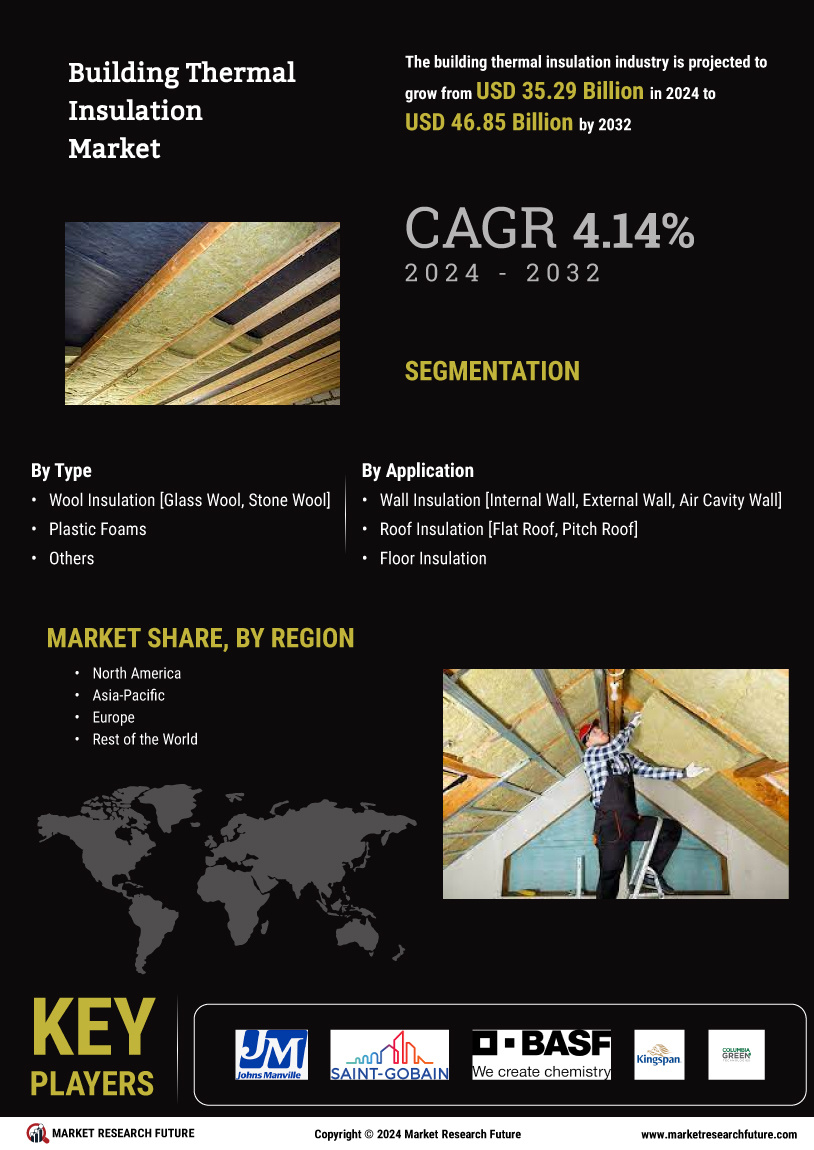
Building Thermal Insulation Market Infographic
Purchase Options

Building Thermal Insulation Market Summary

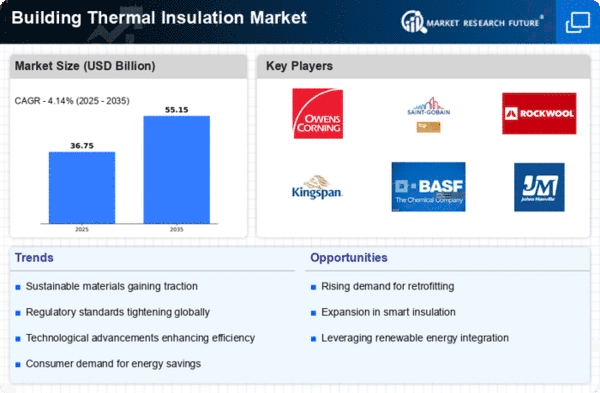
As per MRFR analysis, the Building Thermal Insulation Market Size was estimated at 26.9 USD Billion in 2024. The Building Thermal Insulation industry is projected to grow from 28.5 USD Billion in 2025 to 50.5 USD Billion by 2035, exhibiting a compound annual growth rate (CAGR) of 5.9% during the forecast period 2025 - 2035.

Key Market Trends & Highlights

The Building Thermal Insulation Market is experiencing a dynamic shift towards sustainability and technological integration.

  • North America remains the largest market for building thermal insulation, driven by stringent energy efficiency regulations.
  • The Asia-Pacific region is recognized as the fastest-growing market, fueled by rapid urbanization and infrastructure development.
  • The residential segment continues to dominate the market, while the commercial segment is witnessing the fastest growth due to increasing demand for energy-efficient buildings.
  • Rising energy costs and a heightened focus on sustainability are key drivers propelling the adoption of advanced insulation materials.

Market Size & Forecast

2024 Market Size 26.9 (USD Billion)
2035 Market Size 50.5 (USD Billion)
CAGR (2025 - 2035) 5.9%

Major Players

Owens Corning (US), Saint-Gobain (FR), Rockwool International (DK), Kingspan Group (IE), BASF SE (DE), Johns Manville (US), Knauf Insulation (DE), Armacell International (DE), GAF Materials Corporation (US), Dow Inc. (US)

Our Impact
Enabled $4.3B Revenue Impact for Fortune 500 and Leading Multinationals
Partnering with 2000+ Global Organizations Each Year
30K+ Citations by Top-Tier Firms in the Industry

Building Thermal Insulation Market Trends

The Building Thermal Insulation Market is currently experiencing a notable transformation driven by various factors, including increasing energy efficiency regulations and a growing awareness of environmental sustainability. As governments worldwide implement stricter building codes, the demand for effective thermal insulation solutions is on the rise. This shift is not only aimed at reducing energy consumption but also at minimizing carbon footprints associated with construction and building operations. Consequently, manufacturers are innovating and developing advanced materials that offer superior thermal performance while being environmentally friendly. Moreover, the market is witnessing a surge in the adoption of smart building technologies, which integrate insulation materials with advanced monitoring systems. This integration allows for real-time energy management, enhancing the overall efficiency of buildings. As urbanization continues to escalate, the need for sustainable construction practices becomes increasingly critical. The building thermal insulation market appears poised for growth, driven by technological advancements and a collective push towards greener building solutions.

Sustainable Materials Adoption

There is a growing trend towards the use of sustainable and eco-friendly materials in the Building Thermal Insulation Market. Manufacturers are increasingly focusing on developing insulation products made from recycled or renewable resources, which not only meet performance standards but also align with environmental goals.

Integration of Smart Technologies

The incorporation of smart technologies into building designs is becoming more prevalent. This trend involves the use of insulation materials that can interact with smart systems, allowing for enhanced energy management and monitoring, ultimately leading to improved building efficiency.

Regulatory Compliance and Standards

As energy efficiency regulations become more stringent, compliance with building codes is driving demand for high-performance insulation solutions. The building thermal insulation market is adapting to these changes by offering products that meet or exceed regulatory requirements, ensuring that buildings are both energy-efficient and compliant.

Building Thermal Insulation Market Drivers

Market Growth Projections

The Global Building Thermal Insulation Market Industry is projected to experience steady growth over the next decade. With a compound annual growth rate (CAGR) of 3.0% anticipated from 2025 to 2035, the market is expected to reach a valuation of 38.2 USD Billion by 2035. This growth trajectory reflects the increasing adoption of thermal insulation solutions across various sectors, including residential, commercial, and industrial applications. The demand for energy-efficient building practices, coupled with technological advancements in insulation materials, is likely to sustain this upward trend, indicating a robust future for the market.

Rising Construction Activities

The resurgence of construction activities globally is significantly influencing the Global Building Thermal Insulation Market Industry. As urbanization accelerates, particularly in developing regions, there is a marked increase in residential and commercial building projects. For example, Asia-Pacific is witnessing rapid urban development, leading to heightened demand for thermal insulation materials. This trend is expected to contribute to the market's growth trajectory, with estimates suggesting a market value of 38.2 USD Billion by 2035. The construction sector's recovery and expansion are likely to create substantial opportunities for insulation manufacturers, thereby bolstering the overall market.

Government Incentives and Subsidies

Government incentives and subsidies aimed at promoting energy-efficient building practices are significantly impacting the Global Building Thermal Insulation Market Industry. Various countries are offering financial support for the adoption of insulation technologies that meet energy efficiency standards. For example, tax credits and rebates for energy-efficient renovations encourage homeowners to invest in thermal insulation solutions. These initiatives not only stimulate market demand but also contribute to the overall reduction of energy consumption in buildings. As governments continue to prioritize energy efficiency, the market is likely to experience sustained growth, driven by these supportive policies.

Growing Demand for Energy Efficiency

The increasing emphasis on energy efficiency in buildings is a primary driver for the Global Building Thermal Insulation Market Industry. Governments worldwide are implementing stringent regulations aimed at reducing energy consumption and greenhouse gas emissions. For instance, the European Union's Energy Performance of Buildings Directive mandates that all new buildings meet high energy performance standards. This regulatory push is expected to propel the market, with projections indicating that the market could reach 27.6 USD Billion by 2024. As energy costs rise, the demand for effective thermal insulation solutions that enhance energy efficiency is likely to grow, further driving market expansion.

Technological Advancements in Insulation Materials

Innovations in insulation technology are reshaping the Global Building Thermal Insulation Market Industry. The development of advanced materials, such as aerogels and vacuum insulation panels, offers superior thermal performance compared to traditional materials. These innovations not only enhance energy efficiency but also contribute to space-saving designs in modern architecture. As architects and builders increasingly seek high-performance solutions, the demand for these advanced insulation materials is likely to rise. The ongoing research and development efforts in this sector may lead to a more competitive market landscape, further driving growth in the coming years.

Increased Awareness of Environmental Sustainability

The growing awareness of environmental sustainability is a crucial driver for the Global Building Thermal Insulation Market Industry. Consumers and businesses alike are becoming more conscious of their environmental impact, leading to a preference for sustainable building practices. This shift is prompting manufacturers to develop eco-friendly insulation materials that minimize carbon footprints. For instance, natural insulation products made from recycled materials are gaining traction. As sustainability becomes a core value in construction, the demand for thermal insulation solutions that align with these principles is expected to rise, potentially enhancing market growth.

Market Segment Insights

By Application: Residential (Largest) vs. Commercial (Fastest-Growing)

In the Building Thermal Insulation Market, the Residential segment holds the largest share, driven by the increasing demand for energy-efficient homes. This segment benefits from rising consumer awareness regarding energy conservation and the implementation of strict building codes promoting thermal insulation solutions. Conversely, the Commercial segment is the fastest-growing, fueled by the ongoing trend of green buildings and energy efficiency in commercial properties. This growth is influenced by efforts from corporations to optimize energy use and meet regulatory standards.

Residential (Dominant) vs. Commercial (Emerging)

The Residential segment showcases robust demand for thermal insulation products as homeowners seek to enhance energy efficiency and comfort while minimizing energy costs. It includes a variety of applications such as single-family homes and multi-family units, focusing on products that provide superior thermal performance. On the other hand, the Commercial segment is emerging as a significant player, prioritizing sustainable construction practices. It encompasses a wide array of structures, including offices and retail spaces, where insulation materials are key to achieving energy certifications and reducing operational costs, ultimately leading to a stronger focus on innovative insulation solutions.

By Material Type: Fiberglass (Largest) vs. Foam Board (Fastest-Growing)

The Building Thermal Insulation Market is primarily dominated by four material types: fiberglass, Foam Board, Mineral Wool, and Cellulose. Fiberglass leads the market with the largest share due to its widespread use, affordability, and effective thermal performance. Foam Board, though historically smaller, is gaining traction rapidly, reflecting innovative applications and performance enhancements, contributing to its increasing market share.

Fiberglass (Dominant) vs. Cellulose (Emerging)

Fiberglass insulation remains the dominant choice for many builders and contractors due to its excellent thermal resistance, cost-effectiveness, and availability. It is widely utilized in residential and commercial buildings. In contrast, Cellulose insulation represents an emerging alternative that is often favored for retrofitting existing structures and being environmentally friendly. Often made from recycled paper, Cellulose is treated for fire resistance and pest control, and though it currently holds a smaller market share, its sustainable attributes are projected to boost its adoption in future insulation projects.

By End Use: New Construction (Largest) vs. Renovation (Fastest-Growing)

In the Building Thermal Insulation Market, the distribution of market share among the end-use segments shows that New Construction holds the largest portion, driven by ongoing infrastructural developments worldwide. This segment benefits from regulations favoring energy-efficient building practices, making it a focus for both investors and developers alike. Conversely, Renovation is emerging as the fastest-growing segment, influenced by the rising trend of refurbishing existing structures to meet modern energy standards, thus presenting significant opportunities for advanced insulation solutions.

New Construction (Dominant) vs. Retrofit (Emerging)

The New Construction segment remains dominant in the Building Thermal Insulation Market, largely due to the continuous investments in new residential and commercial projects. It is characterized by innovative building materials and techniques that prioritize energy efficiency and regulatory compliance. On the other hand, the Retrofit segment is gaining momentum as property owners increasingly seek to upgrade older buildings with modern thermal insulation to enhance energy performance and reduce maintenance costs. This segment appeals to environmentally-conscious consumers looking for sustainable solutions, making it a valuable area for growth in the market.

By Installation Method: Spray Foam (Largest) vs. Blanket Insulation (Fastest-Growing)

In the Building Thermal Insulation Market, the installation methods are segmented into Spray Foam, Board Insulation, and Blanket Insulation. Among these, Spray Foam holds the largest market share due to its superior thermal performance and versatility in application. Blanket Insulation, while smaller in market share, is witnessing rapid growth, driven by increasing demand for cost-effective insulation solutions, especially in residential buildings. Board Insulation maintains a significant presence but is growing at a more moderate pace compared to its counterparts.

Spray Foam (Dominant) vs. Blanket Insulation (Emerging)

Spray Foam insulation is recognized for its exceptional air sealing properties, which contribute to its dominance in the market. It is ideal for irregularly shaped spaces and provides excellent thermal resistance, making it a favored choice among builders and contractors. On the other hand, Blanket Insulation, which includes batts and rolls, is gaining popularity as an emerging choice due to its ease of installation and cost-effectiveness. While Spray Foam remains dominant, Blanket Insulation's growth is fueled by increased awareness of energy efficiency and sustainability, as well as building codes advocating for improved insulation practices.

By Thermal Resistance: High (Largest) vs. Low (Fastest-Growing)

The Building Thermal Insulation Market showcases a diverse distribution in thermal resistance segments, notably displaying a robust inclination towards high thermal resistance products, which currently occupy the largest market share. Conversely, low thermal resistance insulation materials are rapidly gaining traction among consumers seeking cost-effective solutions, thus hinting at their emerging market stance as the fastest-growing segment. This diverse landscape reflects varying consumer preferences based on energy efficiency and cost considerations, leading to significant market dynamics across these categories. In recent times, the preference for sustainability and energy-efficient building solutions has driven growth within the high thermal resistance segment, positioning it as the market leader. The demand for energy-efficient materials, coupled with stringent regulations on energy consumption, has propelled the adoption of high thermal resistance products. Meanwhile, the low thermal resistance segment, appealing to budget-conscious consumers, is increasingly perceived as a practical choice for less critical applications. As energy costs rise, the market is set to evolve further, with continual innovation and enhanced product offerings across all segments.

High (Dominant) vs. Low (Emerging)

In the Building Thermal Insulation Market, high thermal resistance materials are characterized by their superior ability to minimize heat transfer, leading them to dominate the market due to their effectiveness in energy conservation and thermal comfort. These materials, often comprised of advanced technologies, are highly sought after for new constructions and renovation projects where energy efficiency is paramount. Conversely, low thermal resistance products, while less effective in thermal management, are emerging as a cost-efficient choice for specific applications where thermal performance is not as crucial. This segment is gaining popularity among DIY enthusiasts and small-scale projects, and it is increasingly viewed as an appealing entry point into the insulation market. As consumer awareness about energy efficiency grows, both segments are likely to evolve, adapting to changing market dynamics.

Get more detailed insights about Building Thermal Insulation Market

Regional Insights

North America : Market Leader in Insulation

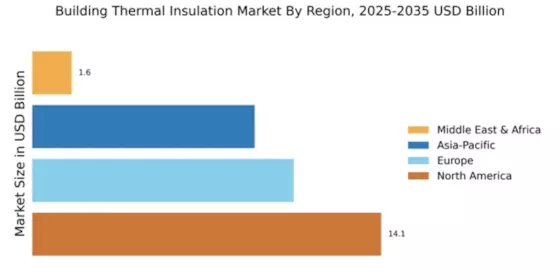
North America is poised to maintain its leadership in the Building Thermal Insulation market, holding a significant market share of 14.12 in 2024. The region's growth is driven by stringent energy efficiency regulations and a rising demand for sustainable building practices. Government initiatives aimed at reducing carbon footprints are further propelling the market, as builders and developers seek compliant insulation solutions to meet these standards. The competitive landscape is robust, with key players like Owens Corning, Johns Manville, and GAF Materials Corporation leading the charge. The U.S. and Canada are the primary markets, benefiting from advanced manufacturing capabilities and a strong focus on innovation. The presence of established companies ensures a steady supply of high-quality insulation products, catering to both residential and commercial sectors.

Europe : Sustainable Growth and Innovation

Europe's Building Thermal Insulation market is characterized by a market size of 10.58, reflecting a strong commitment to sustainability and energy efficiency. The region is witnessing a surge in demand for eco-friendly insulation materials, driven by EU regulations aimed at reducing greenhouse gas emissions. Initiatives like the European Green Deal are catalyzing investments in energy-efficient building technologies, further enhancing market growth. Leading countries such as Germany, France, and the UK are at the forefront of this transformation, with companies like Saint-Gobain and Knauf Insulation playing pivotal roles. The competitive landscape is marked by innovation, with a focus on developing advanced materials that meet stringent regulatory standards. The presence of established manufacturers ensures a diverse range of products, catering to various construction needs.

Asia-Pacific : Rapid Expansion and Urbanization

The Asia-Pacific region, with a market size of 9.0, is experiencing rapid growth in the Building Thermal Insulation sector, driven by urbanization and increasing construction activities. Countries like China and India are leading this expansion, fueled by government initiatives to improve energy efficiency in buildings. The rising awareness of sustainable construction practices is also contributing to the demand for high-performance insulation materials. The competitive landscape features key players such as Rockwool International and Kingspan Group, who are investing in local manufacturing to meet the growing demand. The region's diverse market dynamics are characterized by a mix of established companies and emerging players, ensuring a competitive environment that fosters innovation and product development.

Middle East and Africa : Emerging Market Potential

The Middle East and Africa (MEA) region, with a market size of 1.59, presents significant growth opportunities in the Building Thermal Insulation market. The increasing focus on energy efficiency and sustainable building practices is driving demand for insulation materials. Government initiatives aimed at enhancing building standards and reducing energy consumption are key catalysts for market growth in this region. Countries like the UAE and South Africa are leading the charge, with investments in infrastructure and construction projects. The competitive landscape is evolving, with both local and international players, including BASF SE and Armacell International, striving to capture market share. The region's unique challenges and opportunities create a dynamic environment for innovation and growth in the insulation sector.

Building Thermal Insulation Market Regional Image

Key Players and Competitive Insights

The Building Thermal Insulation Market is currently characterized by a dynamic competitive landscape, driven by increasing energy efficiency regulations and a growing emphasis on sustainable construction practices. Major players such as Owens Corning (US), Saint-Gobain (FR), and Rockwool International (DK) are strategically positioning themselves through innovation and regional expansion. For instance, Owens Corning (US) has focused on enhancing its product portfolio with advanced insulation solutions that cater to both residential and commercial sectors, thereby reinforcing its market presence. Similarly, Saint-Gobain (FR) has been actively pursuing mergers and acquisitions to bolster its technological capabilities and expand its geographical footprint, which collectively shapes a competitive environment that is increasingly focused on sustainability and performance. In terms of business tactics, companies are localizing manufacturing to reduce lead times and optimize supply chains, which is particularly crucial in a moderately fragmented market. The collective influence of key players is significant, as they not only drive innovation but also set industry standards that smaller competitors often follow. This competitive structure allows for a diverse range of products and solutions, catering to various customer needs while fostering a culture of continuous improvement. In November 2025, Rockwool International (DK) announced the launch of a new line of eco-friendly insulation products made from recycled materials. This strategic move not only aligns with the growing demand for sustainable building materials but also positions Rockwool as a leader in environmental responsibility within the market. The introduction of these products is expected to enhance their competitive edge, appealing to environmentally conscious consumers and businesses alike. In October 2025, Kingspan Group (IE) unveiled a significant investment in a new manufacturing facility in North America, aimed at increasing production capacity for its high-performance insulation products. This expansion is strategically important as it allows Kingspan to better serve the North American market, which is experiencing a surge in demand for energy-efficient building solutions. The facility is expected to create numerous jobs and contribute to local economies, further solidifying Kingspan's commitment to regional growth. In September 2025, BASF SE (DE) entered into a strategic partnership with a leading technology firm to develop smart insulation solutions that integrate AI for enhanced energy management. This collaboration signifies a shift towards digitalization in the insulation sector, where technology plays a crucial role in optimizing energy efficiency. The implications of such innovations could redefine competitive dynamics, as companies that leverage technology effectively may gain a substantial advantage. As of December 2025, current trends in the Building Thermal Insulation Market indicate a strong focus on digitalization, sustainability, and AI integration. Strategic alliances are increasingly shaping the competitive landscape, allowing companies to pool resources and expertise to innovate more rapidly. Looking ahead, competitive differentiation is likely to evolve from traditional price-based competition to a focus on innovation, technology, and supply chain reliability, as companies strive to meet the demands of a more environmentally conscious market.

Key Companies in the Building Thermal Insulation Market include

Industry Developments

  • Q2 2024: Saint-Gobain Acquires Building Insulation Manufacturer Building Products of Canada Corp. Saint-Gobain announced the acquisition of Building Products of Canada Corp., a leading manufacturer of residential roofing shingles and wood fiber insulation panels, expanding its presence in the North American building insulation market.
  • Q2 2024: Owens Corning Launches New FOAMULAR NGX XPS Insulation with Reduced Global Warming Potential Owens Corning introduced FOAMULAR NGX, a new extruded polystyrene (XPS) insulation product line designed to deliver lower global warming potential, aligning with evolving environmental regulations and green building standards.
  • Q3 2024: Kingspan Opens New Insulation Manufacturing Facility in Texas Kingspan Group officially opened a new state-of-the-art insulation manufacturing facility in Texas, aiming to meet growing demand for high-performance building thermal insulation products in the southern United States.
  • Q2 2024: Rockwool Announces $150 Million Investment in U.S. Stone Wool Insulation Plant Expansion Rockwool revealed a $150 million investment to expand its U.S. stone wool insulation plant, increasing production capacity to serve the North American construction market and support sustainable building initiatives.
  • Q1 2024: BASF Launches New Eco-Friendly Spray Foam Insulation for Commercial Buildings BASF introduced a new spray foam insulation product for commercial buildings, featuring a bio-based formulation and improved thermal performance to address stricter energy efficiency requirements.
  • Q2 2024: Knauf Insulation Partners with U.S. Homebuilder D.R. Horton for Nationwide Supply Agreement Knauf Insulation entered into a multi-year supply agreement with D.R. Horton, one of the largest U.S. homebuilders, to provide thermal insulation products for new residential construction projects nationwide.
  • Q3 2024: Kingspan Acquires U.S.-Based Homasote Company to Expand Sustainable Insulation Portfolio Kingspan completed the acquisition of Homasote Company, a U.S. manufacturer of recycled-content building insulation panels, strengthening its sustainable product offerings in North America.
  • Q2 2025: Saint-Gobain Announces New R&D Center for Advanced Insulation Materials in Germany Saint-Gobain inaugurated a new research and development center in Germany focused on developing next-generation building thermal insulation materials with enhanced energy efficiency and sustainability.
  • Q1 2025: Owens Corning Appoints New Vice President for Insulation Business Owens Corning announced the appointment of a new Vice President to lead its global insulation business, signaling a strategic focus on innovation and market expansion.
  • Q2 2025: Rockwool Signs Major Supply Contract with European Public Housing Consortium Rockwool secured a multi-year contract to supply stone wool insulation for a large-scale public housing retrofit program across several European countries, supporting energy efficiency upgrades.
  • Q3 2025: BASF and PPG Industries Announce Joint Venture for Advanced Insulation Coatings BASF and PPG Industries formed a joint venture to develop and commercialize advanced thermal insulation coatings for building applications, targeting improved energy performance and regulatory compliance.
  • Q1 2025: Knauf Insulation Launches New Plant in Poland to Meet Rising European Demand Knauf Insulation opened a new manufacturing plant in Poland, increasing its production capacity for mineral wool insulation products to address growing demand in the European construction sector.

Future Outlook

Building Thermal Insulation Market Future Outlook

The Building Thermal Insulation Market is projected to grow at a 5.9% CAGR from 2025 to 2035, driven by energy efficiency regulations, rising construction activities, and increasing consumer awareness.

New opportunities lie in:

  • Development of advanced eco-friendly insulation materials Integration of smart insulation technologies in buildings Expansion into emerging markets with tailored insulation solutions

By 2035, the market is expected to achieve robust growth, reflecting evolving industry standards and consumer preferences.

Market Segmentation

Building Thermal Insulation Market End Use Outlook

  • New Construction
  • Renovation
  • Retrofit

Building Thermal Insulation Market Application Outlook

  • Residential
  • Commercial
  • Industrial
  • Institutional

Building Thermal Insulation Market Material Type Outlook

  • Fiberglass
  • Foam Board
  • Mineral Wool
  • Cellulose

Building Thermal Insulation Market Thermal Resistance Outlook

  • Low
  • Medium
  • High

Building Thermal Insulation Market Installation Method Outlook

  • Spray Foam
  • Board Insulation
  • Blanket Insulation

Report Scope

MARKET SIZE 2024 26.9(USD Billion)
MARKET SIZE 2025 28.5(USD Billion)
MARKET SIZE 2035 50.5(USD Billion)
COMPOUND ANNUAL GROWTH RATE (CAGR) 5.9% (2025 - 2035)
REPORT COVERAGE Revenue Forecast, Competitive Landscape, Growth Factors, and Trends
BASE YEAR 2024
Market Forecast Period 2025 - 2035
Historical Data 2019 - 2024
Market Forecast Units USD Billion
Key Companies Profiled Owens Corning (US), Saint-Gobain (FR), Rockwool International (DK), Kingspan Group (IE), BASF SE (DE), Johns Manville (US), Knauf Insulation (DE), Armacell International (DE), GAF Materials Corporation (US), Dow Inc. (US)
Segments Covered Application, Material Type, End Use, Installation Method, Thermal Resistance
Key Market Opportunities Integration of advanced materials and smart technologies enhances energy efficiency in the Building Thermal Insulation Market.
Key Market Dynamics Rising demand for energy-efficient buildings drives innovation and competition in the building thermal insulation market.
Countries Covered North America, Europe, APAC, South America, MEA

Market Highlights

Author
Snehal Singh
Assistant Manager - Research

High acumen in analyzing complex macro & micro markets with more than 6 years of work experience in the field of market research. By implementing her analytical skills in forecasting and estimation into market research reports, she has expertise in Packaging, Construction, and Equipment domains. She handles a team size of 20-25 resources and ensures smooth running of the projects, associated marketing activities, and client servicing.

Leave a Comment

FAQs

What was the expected market size of the Building Thermal Insulation Market in 2024?

The Building Thermal Insulation Market was valued at 26.9 USD Billion in 2024.

What is the expected CAGR for the Building Thermal Insulation Market from 2025 to 2035?

Building Thermal Insulation Market is projected to register a CAGR of 5.9% from 2025-2035

Which region dominated the Building Thermal Insulation Market in 2024?

North America have the largest market share, valued at 9.0 USD Billion in 2024.

What will be the market size of the Building Thermal Insulation Market in Europe by 2035?

The market size for the Building Thermal Insulation Market in Europe is anticipated to reach 11.5 USD Billion by 2035.

Who are the key players in the Building Thermal Insulation Market?

Major players include SaintGobain, Knauf Insulation, Rockwool International, and Kingspan Group, among others.

What is the projected market value for Fiberglass insulation by 2035?

Fiberglass insulation is expected to be valued at 14.0 USD Billion by 2035.

What is the expected market growth rate for the Asia Pacific region in the coming years?

The Asia Pacific region is projected to grow, reaching a market size of 9.0 USD Billion by 2035.

What was the anticipated value of Foam Board insulation in 2024?

The Foam Board insulation market was valued at 7.5 USD Billion in 2024.

Download Free Sample

Kindly complete the form below to receive a free sample of this Report

Compare Licence

×
Features License Type
Single User Multiuser License Enterprise User
Price $4,950 $5,950 $7,250
Maximum User Access Limit 1 User Upto 10 Users Unrestricted Access Throughout the Organization
Free Customization
Direct Access to Analyst
Deliverable Format
Platform Access
Discount on Next Purchase 10% 15% 15%
Printable Versions