×
Request Free Sample ×

Kindly complete the form below to receive a free sample of this Report

* Please use a valid business email

Leading companies partner with us for data-driven Insights

clients tt-cursor
Hero Background
English
Chinese
French
Japanese
Korean
German
Spanish

Brown Fused Alumina Market Analysis

ID: MRFR/CnM/9469-CR
110 Pages
Priya Nagrale
October 2022

Brown Fused Alumina Market Research Report Information By Type ( Low Purity (<95%) High Purity (>95%) ) Application (Bonded & Coated Abrasives Blasting Refractory Grinding/Ball Mining Others) Region (North America Europe Asia-Pacific, South America Middle East Africa) Forecast 2030

Share:
Download PDF ×

We do not share your information with anyone. However, we may send you emails based on your report interest from time to time. You may contact us at any time to opt-out.

Brown Fused Alumina Market Infographic
Purchase Options

Market Analysis

In-depth Analysis of Brown Fused Alumina Market Industry Landscape

The brown fused alumina market operates within a dynamic framework influenced by various factors that shape its growth and evolution. Brown fused alumina, also known as brown aluminum oxide, is a versatile abrasive material widely used in grinding wheels, sandpaper, blasting media, and refractory applications. One of the primary drivers of market dynamics is the increasing demand from the abrasive industry. Brown fused alumina is prized for its hardness, toughness, and abrasive properties, making it ideal for cutting, grinding, and surface finishing applications across various industries such as metalworking, automotive, construction, and aerospace. As these industries continue to expand and innovate, the demand for brown fused alumina is expected to grow, driving market growth.

Technological advancements play a crucial role in shaping the competitive landscape of the brown fused alumina market. Innovations in manufacturing processes, product formulations, and abrasive technologies have led to improvements in product quality, performance, and efficiency. Advanced production techniques such as electric arc furnaces and rotary kilns allow manufacturers to produce high-quality brown fused alumina with precise chemical compositions and particle sizes. Moreover, the development of new bonding systems and abrasive coatings enhances the performance and versatility of brown fused alumina products, offering opportunities for market players to differentiate their offerings and cater to specific customer needs.

Market dynamics in the brown fused alumina industry are also influenced by economic factors such as industrial production, construction activity, and global manufacturing trends. Economic growth and industrial expansion drive demand for abrasive materials used in metal fabrication, surface preparation, and construction applications. Conversely, economic downturns or recessions may lead to reduced demand for brown fused alumina as industries scale back production and capital expenditures. Moreover, fluctuations in commodity prices, currency exchange rates, and trade policies can impact the cost of raw materials and affect the profitability of brown fused alumina manufacturers operating in the global market.

Environmental regulations and sustainability concerns are increasingly shaping the dynamics of the brown fused alumina market. Abrasive manufacturing processes can generate emissions, waste, and environmental pollutants if not properly managed. As a result, governments and regulatory bodies are implementing stricter environmental regulations to reduce emissions, improve waste management practices, and promote sustainable production in the abrasive industry. Brown fused alumina manufacturers are investing in technologies and practices to minimize environmental impact, such as adopting cleaner production processes, recycling abrasive waste, and reducing energy consumption. Additionally, there is a growing demand for eco-friendly abrasive materials and products that minimize dust emissions and environmental contamination, driving innovation and market growth in sustainable abrasive solutions.

Customer preferences and industry trends also influence market dynamics in the brown fused alumina sector. End-users are increasingly seeking abrasive materials that offer high performance, durability, and cost-effectiveness for their applications. Industry trends such as automation, digitization, and Industry 4.0 are driving the demand for advanced abrasive solutions that improve productivity, reduce processing times, and enhance product quality. Furthermore, the shift towards lightweight materials, composite materials, and advanced alloys in manufacturing and aerospace industries is creating new opportunities for brown fused alumina manufacturers to supply abrasive products tailored to these applications.

The competitive dynamics within the brown fused alumina market are characterized by intense rivalry among key players competing for market share and profitability. Market participants range from large multinational abrasive companies to smaller regional manufacturers and distributors. Strategies such as vertical integration, product differentiation, and geographic expansion are commonly employed by companies to strengthen their market position and differentiate themselves from competitors. Additionally, quality assurance, technical support, and customer service initiatives are essential for companies to maintain customer satisfaction and retain their competitive edge in a highly competitive market environment.

Author
Priya Nagrale
Senior Research Analyst

With an experience of over five years in market research industry (Chemicals & Materials domain), I gather and analyze market data from diverse sources to produce results, which are then presented back to a client. Also, provide recommendations based on the findings. As a Senior Research Analyst, I perform quality checks (QC) for market estimations, QC for reports, and handle queries and work extensively on client customizations. Also, handle the responsibilities of client proposals, report planning, report finalization, and execution

Leave a Comment

FAQs

What growth rate global Brown Fused Alumina market would register in the future?

The global Textile Fabric market would register a growth of 7.23 %.

Which industry will play a crucial role in taking the Brown Fused Alumina market ahead??

Steel Industries

What is the key restraining factor for the global Brown Fused Alumina market?

Stringent government regulations on mining activities

Who are the key players of brown fused alumina market?

The major players in the market include Imerys, Bosai Minerals Group Co., Ltd, LKAB Minerals, Kuhmichel Abrasiv GmbH, Saint-Gobain, Washington Mills, Shandong East Grinding Materials Co., Ltd, Elfusa Geral de Eletrofusão Ltda, and Yichuan Shengyu Abrasives Co., Limited.

What are the driver for brown fused alumina industry ?

High demand for abrasives from various end-use industries

Market Summary

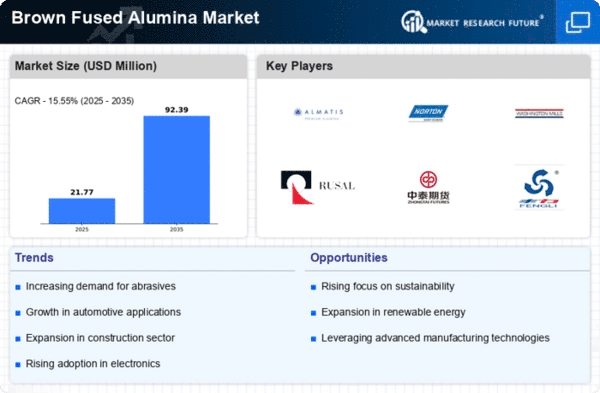
As per MRFR analysis, the Brown Fused Alumina Market Size was estimated at 18.84 USD Million in 2024. The Brown Fused Alumina industry is projected to grow from 21.77 USD Million in 2025 to 92.39 USD Million by 2035, exhibiting a compound annual growth rate (CAGR) of 15.55 during the forecast period 2025 - 2035.

Key Market Trends & Highlights

The Brown Fused Alumina Market is poised for growth driven by sustainability and technological advancements.

  • North America remains the largest market for brown fused alumina, driven by robust demand in abrasive applications. Asia-Pacific is the fastest-growing region, reflecting increasing investments in manufacturing and construction sectors. The abrasives segment continues to dominate the market, while the ceramics segment is experiencing rapid growth due to innovative applications. Key market drivers include rising demand in abrasive applications and a growing focus on sustainable practices.

Market Size & Forecast

2024 Market Size 18.84 (USD Million)
2035 Market Size 92.39 (USD Million)
CAGR (2025 - 2035) 15.55%
Largest Regional Market Share in 2024 Asia-Pacific

Major Players

<p>Almatis (DE), Norton Abrasives (US), Washington Mills (US), Rusal (RU), Henan Zhongtai (CN), Fujian Fengli (CN), Sibelco (BE), Kumthai Abrasives (CN), Zirconium (IN)</p>

Market Trends

The Brown Fused Alumina Market is currently experiencing a dynamic phase characterized by evolving demand patterns and technological advancements. This market, primarily driven by its applications in abrasives, refractories, and ceramics, appears to be adapting to the changing needs of various industries. The increasing focus on sustainability and eco-friendly materials is influencing production processes, prompting manufacturers to explore innovative methods that reduce environmental impact. Furthermore, the rise in construction and automotive sectors is likely to bolster the demand for brown fused alumina, as these industries require high-performance materials for their operations. In addition, the Brown Fused Alumina Market is witnessing a shift towards customization and specialized products. As industries seek tailored solutions to meet specific requirements, manufacturers are investing in research and development to create advanced formulations. This trend suggests a potential for growth in niche markets, where unique properties of brown fused alumina can be leveraged. Overall, the market landscape is evolving, with opportunities emerging for companies that can adapt to these trends and meet the diverse needs of their customers.

Sustainability Initiatives

The Brown Fused Alumina Market is increasingly influenced by sustainability initiatives. Manufacturers are exploring eco-friendly production methods and materials to align with global environmental standards. This shift not only addresses regulatory pressures but also caters to the growing consumer demand for sustainable products.

Customization and Specialization

There is a notable trend towards customization within the Brown Fused Alumina Market. Industries are seeking specialized products that meet specific performance criteria. This demand encourages manufacturers to innovate and develop tailored solutions, enhancing their competitive edge.

Technological Advancements

Technological advancements are reshaping the Brown Fused Alumina Market. Innovations in production techniques and material processing are improving product quality and efficiency. These advancements may lead to enhanced performance characteristics, making brown fused alumina more appealing across various applications.

Brown Fused Alumina Market Market Drivers

Market Growth Projections

The Global Brown Fused Alumina Market Industry is projected to experience substantial growth over the next decade. With a market value expected to reach 743.5 USD Million in 2024 and an impressive forecast of 1651.7 USD Million by 2035, the industry is poised for significant expansion. The anticipated CAGR of 7.53% from 2025 to 2035 indicates a robust growth trajectory, driven by increasing demand across various sectors such as abrasives, refractories, and ceramics. This growth reflects not only the material's versatility but also its critical role in supporting industrial processes and applications worldwide.

Growth in the Refractory Sector

The Global Brown Fused Alumina Market Industry is significantly influenced by the expanding refractory sector. Brown fused alumina is a critical raw material in the production of refractory products used in high-temperature applications, such as steel and cement manufacturing. As global infrastructure projects and industrial activities ramp up, the demand for refractories is expected to rise. This growth is particularly pronounced in regions with burgeoning industrial bases, where the need for durable and heat-resistant materials is paramount. The increasing focus on energy-efficient production processes further propels the demand for high-quality refractory materials, thereby supporting the market's expansion.

Rising Demand in Abrasive Applications

The Global Brown Fused Alumina Market Industry experiences a robust demand surge due to its extensive use in abrasive applications. Industries such as metalworking, automotive, and construction increasingly rely on brown fused alumina for grinding, cutting, and polishing. The material's hardness and durability make it ideal for producing high-quality abrasives. As the global economy expands, particularly in emerging markets, the demand for efficient and effective abrasive materials is likely to grow. This trend is reflected in the projected market value of 743.5 USD Million in 2024, with expectations to reach 1651.7 USD Million by 2035, indicating a strong growth trajectory fueled by industrial advancements.

Market Dynamics and Competitive Landscape

The Global Brown Fused Alumina Market Industry is characterized by dynamic market conditions and a competitive landscape. With numerous players operating in the market, competition drives innovation and price adjustments. Companies are increasingly focusing on product differentiation and quality enhancement to gain a competitive edge. The presence of both established manufacturers and new entrants creates a vibrant market environment. This competition may lead to strategic partnerships and collaborations aimed at expanding product offerings and market reach. As a result, the market is likely to witness continuous evolution, adapting to changing consumer preferences and technological advancements.

Technological Advancements in Manufacturing Processes

Technological innovations in the production of brown fused alumina significantly enhance the efficiency and quality of the material. The Global Brown Fused Alumina Market Industry benefits from advancements such as improved melting techniques and enhanced purification processes, which lead to higher purity levels and better performance characteristics. These innovations not only reduce production costs but also cater to the increasing quality standards demanded by various industries. As a result, manufacturers are likely to invest in these technologies, driving the market's growth. The anticipated CAGR of 7.53% from 2025 to 2035 further underscores the potential for technological improvements to shape the industry's future.

Environmental Regulations and Sustainability Initiatives

The Global Brown Fused Alumina Market Industry is increasingly shaped by stringent environmental regulations and sustainability initiatives. As industries strive to minimize their ecological footprint, the demand for eco-friendly materials is on the rise. Brown fused alumina, being a recyclable and sustainable product, aligns well with these initiatives. Manufacturers are likely to adopt greener production methods, which not only comply with regulations but also appeal to environmentally conscious consumers. This shift towards sustainability could enhance the market's reputation and broaden its customer base, thereby fostering growth in the coming years.

Market Segment Insights

By Application: Abrasives (Largest) vs. Ceramics (Fastest-Growing)

<p>The Brown Fused Alumina market showcases a diverse application landscape, with Abrasives holding the largest market share due to their widespread use in grinding and polishing applications. Following this, Refractories, Metallurgy, and Sandblasting have established their presence, though they command less share in comparison. Ceramics, while currently smaller, are gaining traction due to innovations in manufacturing processes that are enhancing product capabilities. As the market evolves, growth trends indicate significant expansion in the Ceramics segment, driven by rising demand in industries such as electronics and automotive. The Abrasives segment, while dominant, is also witnessing innovation aimed at improving efficiency and performance. Emerging technologies in Brown Fused Alumina production are expected to further enhance its application range, providing new growth avenues across all segments.</p>

<p>Abrasives (Dominant) vs. Ceramics (Emerging)</p>

<p>In the Brown Fused Alumina market, Abrasives are regarded as the dominant application due to their fundamental role in various industrial processes, particularly in manufacturing and construction sectors. They are known for their high hardness and durability, making them suitable for grinding, cutting, and polishing applications. Meanwhile, Ceramics are emerging as a vital segment, driven by their demand in high-tech applications such as electronics and medical devices. They offer unique characteristics such as lightweight, thermal stability, and design flexibility. The growth in Ceramics is attributed to advancements in technology and materials science that enable the development of enhanced products, positioning them for increased market share in the coming years.</p>

By End Use Industry: Automotive (Largest) vs. Construction (Fastest-Growing)

<p>In the Brown Fused Alumina Market, the automotive industry holds the largest share, driven by its significant demand for high-performance abrasives in manufacturing processes. The construction sector emerges as a crucial segment, contributing to the growing consumption of brown fused alumina, primarily for applications such as surface preparation and material blending. Overall, the market distribution reflects the diverse applications of brown fused alumina across various industries, with automotive leading in market presence.</p>

<p>Automotive: Dominant vs. Construction: Emerging</p>

<p>The automotive sector is a dominant player in the Brown Fused Alumina Market, leveraging its performance characteristics for grinding, polishing, and surface finishing applications in various automotive components. This sector is particularly influenced by ongoing advancements in vehicle manufacturing technologies, requiring high precision and durability from abrasives. In contrast, the construction sector is classified as emerging within this market, rapidly gaining traction due to increased infrastructural developments worldwide. Brown fused alumina is valued in this segment for its versatility, enabling effective application in materials like concrete and asphalt, thus driving its growth as a fundamental abrasive.</p>

By Product Form: Grains (Largest) vs. Powder (Fastest-Growing)

<p>The Brown Fused Alumina market is predominantly driven by the 'Grains' segment, which maintains a significant share due to its widespread application in refractory materials, abrasives, and various industrial processes. Following closely, the 'Powder' segment, known for its fine morphology and versatile uses, finds traction in high-end applications such as ceramics and electronic components, marking it as a key player within this product form category. Growth trends for this segment indicate increasing demand for both grains and powder forms, with grains benefiting from stable industrial applications while powders are gaining momentum. Technological advancements and a rising influx of specialized applications are propelling the powder segment towards rapid growth, making it an emerging powerhouse in the Brown Fused Alumina Market.</p>

<p>Grains (Dominant) vs. Powder (Emerging)</p>

<p>The 'Grains' segment of the Brown Fused Alumina market is characterized by its dominance in various industrial applications, primarily due to its excellent thermal and mechanical properties. This form is widely used in refractory products, abrasives, and coatings, making it an integral part of manufacturing processes that require durability and strength. On the other hand, the 'Powder' segment, labeled as emerging, is gaining popularity thanks to its fine particle size and superior performance in specialized applications, such as in the production of advanced ceramics and electronic components. As industries seek finer materials to improve product quality, the powder form is quickly evolving, showing promise for continued growth.</p>

By Purity Level: Standard Grade (Largest) vs. Ultra High Purity Grade (Fastest-Growing)

<p>In the Brown Fused Alumina market, the purity level segments portray a diverse distribution of market share. The Standard Grade is currently the largest segment, appealing to various industries due to its cost-effectiveness and sufficient purity levels for most applications. On the other hand, the High Purity and Ultra High Purity grades cater to specialized markets, with the latter experiencing increased demand due to advancements in high-end applications such as electronics and optics. Specialty grades are also carving out a niche but hold a smaller overall share in the market. The growth trends within this segment indicate a shift towards higher purity grades, driven by the rising need for high-performance materials in sectors like automotive, aerospace, and electronics. Innovations and technological advancements have propelled the Ultra High Purity Grade segment to become the fastest-growing, as industries seek materials that offer superior quality and reliability. The increasing emphasis on efficiency and precision in manufacturing processes is fostering this trend, presenting opportunities for producers to focus on higher-grade offerings.</p>

<p>Standard Grade (Dominant) vs. Specialty Grade (Emerging)</p>

<p>The Standard Grade Brown Fused Alumina dominates the market due to its versatility and affordability, frequently used in applications that require a balance between performance and cost. Its widespread adoption across various industries ensures a stable demand. Conversely, the Specialty Grade, while emerging, is gaining traction in niche applications that require tailored characteristics such as specific grain sizes, shapes, and performance properties. This segment appeals to specialized industries looking for innovative solutions, like advanced ceramics and precision abrasives. The growth of the Specialty Grade is fueled by increasing customization demands from end-users, although it currently represents a smaller portion of the market as it works towards establishing a more significant presence.</p>

By Distribution Channel: Direct Sales (Largest) vs. Online Sales (Fastest-Growing)

<p>In the Brown Fused Alumina Market, the distribution of sales across various channels showcases notable variances. Direct Sales remains the largest segment, leveraging established client relationships and providing tailored solutions that meet specific customer requirements. On the other hand, Distributors and Retail channels also contribute significantly but tend to have less visibility compared to Direct Sales. Online Sales, however, has begun to capture a larger share of the market, driven by the increasing trend of digital purchasing and online industrial supply platforms.</p>

<p>Distributors (Dominant) vs. Retail (Emerging)</p>

<p>Distributors play a dominant role in the Brown Fused Alumina Market, acting as vital intermediaries by ensuring a steady supply of products to various end-users. These distributors often have well-established networks, allowing them to reach a broader client base and respond swiftly to market needs. In contrast, the Retail segment is emerging, catering to specific niche markets and smaller buyers. While Retail faces hurdles such as limited market reach and higher operational costs, its growth is buoyed by an increasing demand for smaller <a href="https://www.marketresearchfuture.com/reports/packaging-market-10902">packaging</a> sizes and specialty products that serve specific applications.</p>

Get more detailed insights about Brown Fused Alumina Market Research Report—Global Forecast till 2035

Regional Insights

North America : Stable Market with Growth Potential

The North American brown fused alumina market is projected to reach $3.77 million by December 2025, driven by increasing demand in the automotive and aerospace sectors. Regulatory support for manufacturing standards and environmental compliance is expected to further boost market growth. The region's focus on innovation and quality assurance is also a significant growth driver, ensuring that products meet stringent industry requirements. Leading players in this region include Norton Abrasives and Washington Mills, which dominate the market with their extensive product portfolios and strong distribution networks. The U.S. remains the largest market, supported by a robust manufacturing base and technological advancements. Companies are increasingly investing in R&D to enhance product performance and sustainability, positioning themselves competitively in the global market.

Europe : Innovation and Sustainability Focus

Europe's brown fused alumina market is expected to reach €4.52 million by December 2025, driven by a strong emphasis on sustainability and innovation. The region is witnessing a shift towards eco-friendly production processes, supported by stringent regulations aimed at reducing carbon footprints. This regulatory environment is fostering growth in demand for high-quality abrasives across various industries, including metalworking and construction. Germany and the UK are leading countries in this market, with key players like Almatis and Sibelco enhancing their market presence through strategic partnerships and technological advancements. The competitive landscape is characterized by a mix of established companies and emerging players, all striving to meet the growing demand for specialized abrasives. The focus on R&D is crucial for maintaining a competitive edge in this evolving market.

Asia-Pacific : Dominant Market with High Demand

The Asia-Pacific region is the largest market for brown fused alumina, projected to reach $9.42 million by December 2025. This growth is fueled by rapid industrialization, particularly in countries like China and India, where demand for abrasives in manufacturing and construction is surging. Regulatory frameworks are increasingly supporting the adoption of advanced materials, further driving market expansion. The region's focus on infrastructure development is also a significant catalyst for growth. China is the dominant player in this market, with companies like Henan Zhongtai and Fujian Fengli leading the charge. The competitive landscape is marked by a mix of local and international players, all vying for market share. The presence of key manufacturers and a growing emphasis on quality and performance are shaping the future of the brown fused alumina market in this region.

Middle East and Africa : Emerging Market with Growth Opportunities

The Middle East and Africa brown fused alumina market is projected to reach $1.13 million by December 2025, driven by increasing industrial activities and infrastructure projects. The region is witnessing a gradual shift towards adopting advanced materials, supported by government initiatives aimed at boosting local manufacturing capabilities. This regulatory support is expected to enhance market growth and attract foreign investments in the sector. Countries like South Africa and the UAE are emerging as key players in this market, with local manufacturers beginning to establish a foothold. The competitive landscape is evolving, with both regional and international companies looking to capitalize on the growing demand for abrasives. The focus on quality and compliance with international standards is becoming increasingly important for market players in this region.

Key Players and Competitive Insights

The Brown Fused Alumina Market is characterized by a competitive landscape that is increasingly shaped by innovation, sustainability, and strategic partnerships. Key players such as Almatis (DE), Norton Abrasives (US), and Washington Mills (US) are actively pursuing strategies that enhance their market positioning. Almatis (DE) focuses on product innovation and sustainability, aiming to reduce its carbon footprint while expanding its product range. Norton Abrasives (US) emphasizes digital transformation and customer engagement, leveraging technology to optimize its supply chain and improve customer service. Washington Mills (US) is concentrating on regional expansion and operational efficiency, which allows it to respond swiftly to market demands and enhance its competitive edge.The market structure appears moderately fragmented, with several players vying for market share. Key business tactics include localizing manufacturing to reduce costs and optimize supply chains, which is crucial in maintaining competitiveness. The collective influence of these major players suggests a dynamic environment where collaboration and strategic alliances are becoming increasingly important for sustaining growth and innovation.


In November Almatis (DE) announced a partnership with a leading technology firm to develop advanced manufacturing processes aimed at reducing energy consumption by 20%. This strategic move is likely to enhance Almatis's sustainability credentials while positioning it as a leader in eco-friendly production methods. Such initiatives not only align with global sustainability trends but also cater to the growing demand for environmentally responsible products.


In October Norton Abrasives (US) launched a new digital platform designed to streamline customer interactions and improve order fulfillment efficiency. This initiative reflects a broader trend towards digitalization in the industry, enabling Norton to enhance customer experience and operational agility. By investing in technology, Norton is likely to strengthen its market position and respond more effectively to customer needs.


In September Washington Mills (US) expanded its production capacity by 15% through the acquisition of a new facility in North America. This strategic expansion is expected to bolster its supply chain capabilities and meet the increasing demand for brown fused alumina in various applications. Such growth initiatives indicate Washington Mills's commitment to maintaining a competitive edge in a rapidly evolving market.


As of December current competitive trends are heavily influenced by digitalization, sustainability, and the integration of AI technologies. Strategic alliances are reshaping the landscape, allowing companies to pool resources and expertise to drive innovation. The shift from price-based competition to a focus on technological advancement and supply chain reliability is evident. Moving forward, competitive differentiation will likely hinge on the ability to innovate and adapt to changing market dynamics, with a strong emphasis on sustainable practices and advanced manufacturing technologies.

Key Companies in the Brown Fused Alumina Market include

Industry Developments

Future Outlook

Brown Fused Alumina Market Future Outlook

<p>The Brown Fused Alumina Market is projected to grow at a 15.55% CAGR from 2025 to 2035, driven by increasing demand in abrasives, ceramics, and refractory applications.</p>

New opportunities lie in:

  • <p>Expansion into emerging markets with tailored product offerings. Development of eco-friendly brown fused alumina alternatives. Investment in advanced manufacturing technologies for enhanced efficiency.</p>

<p>By 2035, the market is expected to solidify its position as a leader in industrial materials.</p>

Market Segmentation

Brown Fused Alumina Market Application Outlook

  • Abrasives
  • Refractories
  • Ceramics
  • Metallurgy
  • Sandblasting

Brown Fused Alumina Market Product Form Outlook

  • Grains
  • Powder
  • Fused Blocks
  • Lumps
  • Micronized

Brown Fused Alumina Market Purity Level Outlook

  • Standard Grade
  • High Purity Grade
  • Ultra High Purity Grade
  • Specialty Grade

Brown Fused Alumina Market End Use Industry Outlook

  • Automotive
  • Construction
  • Electronics
  • Manufacturing
  • Aerospace

Brown Fused Alumina Market Distribution Channel Outlook

  • Direct Sales
  • Distributors
  • Online Sales
  • Retail

Report Scope

MARKET SIZE 2024 18.84(USD Million)
MARKET SIZE 2025 21.77(USD Million)
MARKET SIZE 2035 92.39(USD Million)
COMPOUND ANNUAL GROWTH RATE (CAGR) 15.55% (2025 - 2035)
REPORT COVERAGE Revenue Forecast, Competitive Landscape, Growth Factors, and Trends
BASE YEAR 2024
Market Forecast Period 2025 - 2035
Historical Data 2019 - 2024
Market Forecast Units USD Million
Key Companies Profiled Almatis (DE), Norton Abrasives (US), Washington Mills (US), Rusal (RU), Henan Zhongtai (CN), Fujian Fengli (CN), Sibelco (BE), Kumthai Abrasives (CN), Zirconium (IN)
Segments Covered Application, End Use Industry, Product Form, Purity Level, Distribution Channel
Key Market Opportunities Growing demand for high-performance abrasives in automotive and aerospace industries drives Brown Fused Alumina Market opportunities.
Key Market Dynamics Rising demand for high-performance abrasives drives innovation and competition in the Brown Fused Alumina market.
Countries Covered North America, Europe, APAC, South America, MEA

FAQs

What growth rate global Brown Fused Alumina market would register in the future?

The global Textile Fabric market would register a growth of 7.23 %.

Which industry will play a crucial role in taking the Brown Fused Alumina market ahead??

Steel Industries

What is the key restraining factor for the global Brown Fused Alumina market?

Stringent government regulations on mining activities

Who are the key players of brown fused alumina market?

The major players in the market include Imerys, Bosai Minerals Group Co., Ltd, LKAB Minerals, Kuhmichel Abrasiv GmbH, Saint-Gobain, Washington Mills, Shandong East Grinding Materials Co., Ltd, Elfusa Geral de Eletrofusão Ltda, and Yichuan Shengyu Abrasives Co., Limited.

What are the driver for brown fused alumina industry ?

High demand for abrasives from various end-use industries

  1. SECTION I: EXECUTIVE SUMMARY AND KEY HIGHLIGHTS |
    1. EXECUTIVE SUMMARY |
      1. Market Overview |
      2. Key Findings |
      3. Market Segmentation |
      4. Competitive Landscape |
      5. Challenges and Opportunities |
      6. Future Outlook 2
  2. SECTION II: SCOPING, METHODOLOGY AND MARKET STRUCTURE |
    1. MARKET INTRODUCTION |
      1. Definition |
      2. Scope of the study |--
    2. RESEARCH METHODOLOGY |
      1. Overview |
      2. Data Mining |
      3. Secondary Research |
      4. Primary Research |--
      5. Forecasting Model |
      6. Market Size Estimation |--
      7. Data Triangulation |
      8. Validation 3
  3. SECTION III: QUALITATIVE ANALYSIS |
    1. MARKET DYNAMICS |
      1. Overview |
      2. Drivers |
      3. Restraints |
      4. Opportunities |
    2. MARKET FACTOR ANALYSIS |
      1. Value chain Analysis |
      2. Porter's Five Forces Analysis |--
      3. COVID-19 Impact Analysis |--
  4. SECTION IV: QUANTITATIVE ANALYSIS |
    1. Chemicals and Materials, BY Application (USD Million) |
      1. Abrasives |
      2. Refractories |
      3. Ceramics |
      4. Metallurgy |
      5. Sandblasting |
    2. Chemicals and Materials, BY End Use Industry (USD Million) |
      1. Automotive |
      2. Construction |
      3. Electronics |
      4. Manufacturing |
      5. Aerospace |
    3. Chemicals and Materials, BY Product Form (USD Million) |
      1. Grains |
      2. Powder |
      3. Fused Blocks |
      4. Lumps |
      5. Micronized |
    4. Chemicals and Materials, BY Purity Level (USD Million) |
      1. Standard Grade |
      2. High Purity Grade |
      3. Ultra High Purity Grade |
      4. Specialty Grade |
    5. Chemicals and Materials, BY Distribution Channel (USD Million) |
      1. Direct Sales |
      2. Distributors |
      3. Online Sales |
      4. Retail |
    6. Chemicals and Materials, BY Region (USD Million) |
      1. North America |--
      2. Europe |--
      3. APAC |--
      4. South America |--
      5. MEA |--
  5. SECTION V: COMPETITIVE ANALYSIS |
    1. Competitive Landscape |
      1. Overview |
      2. Competitive Analysis |
      3. Market share Analysis |
      4. Major Growth Strategy in the Chemicals and Materials |
      5. Competitive Benchmarking |
      6. Leading Players in Terms of Number of Developments in the Chemicals and Materials |
      7. Key developments and growth strategies |--
      8. Major Players Financial Matrix |--
    2. Company Profiles |
      1. Almatis (DE) |--
      2. Norton Abrasives (US) |--
      3. Washington Mills (US) |--
      4. Rusal (RU) |--
      5. Henan Zhongtai (CN) |--
      6. Fujian Fengli (CN) |--
      7. Sibelco (BE) |--
      8. Kumthai Abrasives (CN) |--
      9. Zirconium (IN) |--
    3. Appendix |
      1. References |
      2. Related Reports

Chemicals and Materials Market Segmentation

Chemicals and Materials By Application (USD Million, 2025-2035)

  • Abrasives
  • Refractories
  • Ceramics
  • Metallurgy
  • Sandblasting

Chemicals and Materials By End Use Industry (USD Million, 2025-2035)

  • Automotive
  • Construction
  • Electronics
  • Manufacturing
  • Aerospace

Chemicals and Materials By Product Form (USD Million, 2025-2035)

  • Grains
  • Powder
  • Fused Blocks
  • Lumps
  • Micronized

Chemicals and Materials By Purity Level (USD Million, 2025-2035)

  • Standard Grade
  • High Purity Grade
  • Ultra High Purity Grade
  • Specialty Grade

Chemicals and Materials By Distribution Channel (USD Million, 2025-2035)

  • Direct Sales
  • Distributors
  • Online Sales
  • Retail
Infographic

Free Sample Request

Kindly complete the form below to receive a free sample of this Report

Get Free Sample

Customer Strories

Compare Licence

×
Features License Type
Single User Multiuser License Enterprise User
Price $4,950 $5,950 $7,250
Maximum User Access Limit 1 User Upto 10 Users Unrestricted Access Throughout the Organization
Free Customization
Direct Access to Analyst
Deliverable Format
Platform Access
Discount on Next Purchase 10% 15% 15%
Printable Versions