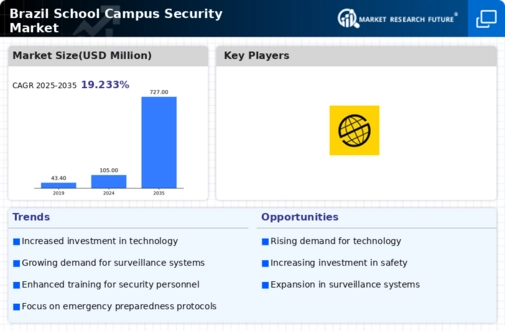
The Brazilian school campus security market is characterized by a competitive landscape that is increasingly shaped by technological advancements and a growing emphasis on safety. Key players such as G4S (BR), Prosegur (BR), and Grupo Protege (BR) are actively redefining their strategic positioning through innovation and partnerships. G4S (BR) has focused on enhancing its service offerings by integrating advanced surveillance technologies, which appears to be a response to the rising demand for comprehensive security solutions. Prosegur (BR), on the other hand, has been expanding its footprint through strategic acquisitions, thereby consolidating its market presence and enhancing its operational capabilities. Grupo Protege (BR) emphasizes regional expansion, particularly in urban areas, which suggests a targeted approach to meet the specific security needs of schools in densely populated regions. Collectively, these strategies indicate a competitive environment that is not only fragmented but also dynamic, with companies vying for market share through innovation and strategic growth initiatives.
In terms of business tactics, localizing manufacturing and optimizing supply chains are becoming increasingly critical. The market structure appears moderately fragmented, with several players competing for dominance. This fragmentation allows for a diverse range of services and solutions, catering to the unique security requirements of educational institutions. The collective influence of key players is significant, as they drive trends in technology adoption and service diversification, which are essential for maintaining competitive advantage in this sector.
In December 2025, G4S (BR) announced a partnership with a leading technology firm to develop an AI-driven surveillance system tailored for educational institutions. This strategic move is likely to enhance G4S's service offerings, positioning the company as a frontrunner in the integration of cutting-edge technology within the school security landscape. The emphasis on AI suggests a shift towards more proactive security measures, which could significantly improve incident response times and overall safety.
In November 2025, Prosegur (BR) completed the acquisition of a regional security firm specializing in educational facilities. This acquisition not only expands Prosegur's operational capabilities but also enhances its market share in the school security segment. The strategic importance of this move lies in Prosegur's ability to leverage local expertise and resources, thereby providing tailored security solutions that meet the specific needs of schools in various regions.
In October 2025, Grupo Protege (BR) launched a new training program for security personnel focused on crisis management and emergency response in schools. This initiative underscores the company's commitment to enhancing the skill set of its workforce, which is crucial for effective security management. By investing in personnel training, Grupo Protege (BR) is likely to improve its service quality and build stronger relationships with educational institutions.
As of January 2026, current trends in the Brazilian school campus security market are heavily influenced by digitalization, sustainability, and the integration of AI technologies. Strategic alliances among key players are shaping the competitive landscape, fostering innovation and collaboration. The shift from price-based competition to a focus on technological advancement and supply chain reliability is evident. Moving forward, competitive differentiation will likely hinge on the ability to innovate and adapt to emerging security challenges, ensuring that educational institutions are equipped with the most effective and reliable security solutions.